
Global Drug Screening Market Size, Share & Growth Report 2032

Drug Screening Market By Product & Service (Equipment, Rapid Testing Devices, and Laboratory Services and Consumables), By Sample Type (Breath Sample, Urine Sample, Hair Sample, Oral Fluid Sample, And Others), By End-User (Drug Testing Laboratories, Workplace & Schools, Hospitals, Criminal Justice System & Law Enforcement Agencies, Pain Management Centers, Drug Treatment Centers, and Personal Users), And By Region - Global Industry Perspective, Comprehensive Analysis, And Forecast 2024 - 2032
| Market Size in 2023 | Market Forecast in 2032 | CAGR (in %) | Base Year |
|---|---|---|---|
| USD 7.31 Billion | USD 29.52 Billion | 16.89% | 2023 |
What is the market size of the drug screening industry?
What will be the global Drug Screening market size during the forecast period?
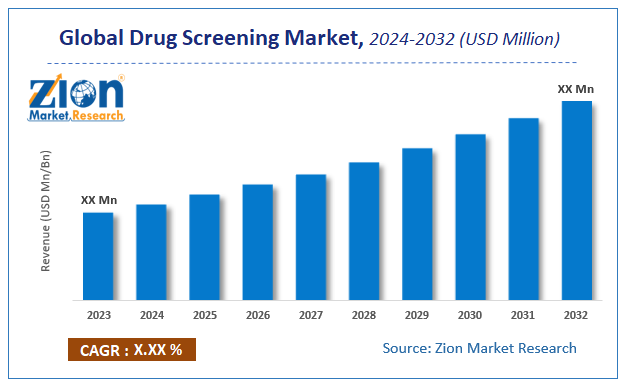
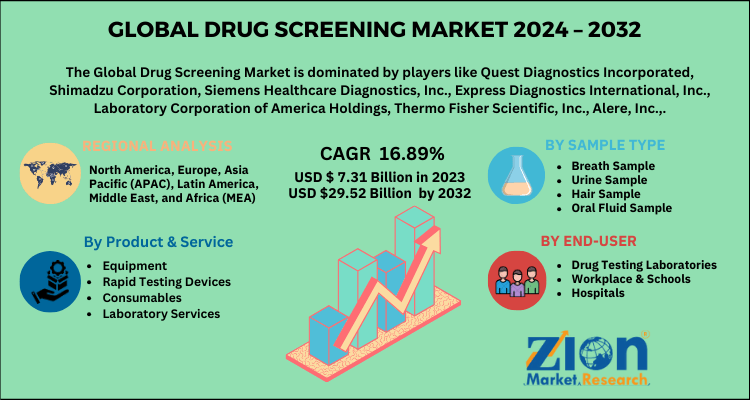
The global drug screening market size was worth around USD 7.31 billion in 2023 and is predicted to grow to around USD 29.52 billion by 2032 with a compound annual growth rate (CAGR) of roughly 16.89% between 2024 and 2032.
This report provides a comprehensive analysis of the growth drivers, restraints, and challenges shaping demand across the global drug screening market throughout the forecast period, while highlighting high-potential emerging opportunities within the industry.
Key Insights
- As per the analysis shared by our research analyst, the global Drug Screening market is estimated to grow annually at a CAGR of around 16.89% over the forecast period (2024-2032).
- In terms of revenue, the global Drug Screening market size was valued at around USD 7.31 billion in 2023 and is projected to reach USD 29.52 billion by 2032.
- The market is driven by rising alcohol and drug abuse, strict regulatory and workplace testing requirements, expanded use in transportation and sports, and technological advances that improve testing accuracy.
- Based on the product & service, the laboratory services and consumables segment is growing at a high rate and is projected to dominate the global market.
- Based on the sample type, the urine sample segment held the largest market share in 2023 and is expected to grow at a significant rate over the forecast period
- Based on the end-user, drug testing laboratories represented major demand centers due to high-volume testing programs and regulatory requirements
- Based on the region, North America is expected to establish market dominance, supported by high rates of substance abuse awareness, strict laws, and strong presence of key players
Drug Screening Market: Overview
Drug screening is the procedure by which potential medicines are recognized and optimized before selecting a drug candidate for further progression to clinical tests. Moreover, it involves screening huge libraries of chemicals for specific biological activities in high-throughput screening assays. Drug screening helps in analyzing & diagnosing biological samples like blood, urine, and hair, and identifies the presence of drugs in the patient's body. Screening of drugs is carried out to identify whether an individual has been under drug influence at a specific period or not. Additionally, technological breakthroughs in drug screening equipment have helped the end-users acquire accurate outcomes, and this has boosted the sales of drug screening devices.
Drug Screening Market: Dynamics
Growth Drivers
What factors are primarily accelerating demand for drug screening?
A surge in the intake of alcohol by young as well as older persons and an increase in the use of prescribed medicines will spur the growth of the drug screening industry over the estimated time span. Furthermore, the incessant use of narcotics as well as illegal drugs is likely to embellish the industry growth over the forecast period. Additionally, an increase in the competitiveness witnessed among the key players will open new horizons of growth for the market over the forecasting years.
Furthermore, the massive use of drug screening activities in railway, transport, and airline sectors is expected to boost the industry trends. Apart from this, drug screening is done at various sports events like the Olympics and World Athletics Meet to detect drugs like steroids consumed by athletes to boost their performance. In countries like the U.S., candidates have to undergo drug screening tests after clearing their aptitude tests and before getting an employment offer from the firms. All these aforementioned factors will drive the market growth over the estimated time span.
Restraints
What challenges could limit the expansion of the drug screening market?
Privacy concerns, legal challenges, and varying regulatory frameworks across jurisdictions can constrain testing programs in certain regions or settings. The cost of advanced laboratory equipment and the need for trained personnel may limit adoption among smaller organizations or in resource-constrained environments.
False positives or the need for confirmatory testing can increase operational complexity and costs, while evolving drug formulations may require continuous updates to testing panels and methods.
Drug Screening Market: Report Scope
| Report Attributes | Report Details |
|---|---|
| Report Name | Drug Screening Market |
| Market Size in 2023 | USD 7.31 Billion |
| Market Forecast in 2032 | USD 29.52 Billion |
| Growth Rate | CAGR of 16.89% |
| Number of Pages | 240 |
| Key Companies Covered | Quest Diagnostics Incorporated, Shimadzu Corporation, Siemens Healthcare Diagnostics, Inc., Express Diagnostics International, Inc., Laboratory Corporation of America Holdings, Thermo Fisher Scientific, Inc., Alere, Inc., Dragerwerk AG & Co. KGAA., and others. |
| Segments Covered | By Product & Service, By Sample Type, By End-User, and By Region |
| Regions Covered | North America, Europe, Asia Pacific (APAC), Latin America, The Middle East and Africa (MEA) |
| Base Year | 2023 |
| Historical Year | 2018 - 2022 |
| Forecast Year | 2024 - 2032 |
| Customization Scope | Avail customized purchase options to meet your exact research needs. Request For Customization |
Drug Screening Market: Segmentation
The Drug Screening market is segmented by product & service, sample type, end-user, and region.
Based on Product & Service Segment, the Drug Screening market is divided into Equipment, Rapid Testing Devices, and Consumables and Laboratory Services. Laboratory services and consumables represent leading segments due to the high volume of tests performed and the recurring nature of reagents, collection devices, assay kits, and professional analytical services. These components form the backbone of both routine and specialized screening programs, supporting consistent revenue and overall market growth.
Based on Sample Type Segment, the Drug Screening market is divided into Breath Sample, Urine Sample, Hair Sample, Oral Fluid Sample, and Others. Urine sample testing is the most dominant sub-segment because of its established reliability, relatively low cost, ability to detect a wide range of substances, and long-standing acceptance in workplace, clinical, and forensic settings. High testing volumes in this matrix continue to anchor significant market demand.
Based on End-user Segment, the Drug Screening market is divided into Drug Testing Laboratories, Workplace & Schools, Hospitals, Criminal Justice System & Law Enforcement Agencies, Pain Management Centers, Drug Treatment Centers, and Personal Users. Drug testing laboratories and workplace & schools constitute major end-user segments. Laboratories handle high volumes of confirmatory and specialized testing, while workplace and school programs drive large-scale routine screening driven by safety policies and regulatory requirements, generating substantial recurring demand.
Drug Screening Market: Regional Analysis
Why will North America continue to dominate the global market during the projection period?
North America is expected to establish market dominance during the forecast period. The region benefits from elevated awareness of drug and alcohol abuse, enforcement of strict laws and workplace policies, and the strong presence of leading diagnostic and laboratory companies. Substantial public and private funding directed toward substance-abuse prevention and screening programs further supports demand. High rates of driving-under-the-influence enforcement and pre-employment testing practices, particularly in the United States, reinforce consistent testing volumes and influence global standards and product development.
Drug Screening Market: Competitive Analysis
The global drug screening market is dominated by players like:
- Quest Diagnostics Incorporated
- Shimadzu Corporation
- Siemens Healthcare Diagnostics, Inc.
- Express Diagnostics International, Inc.
- Laboratory Corporation of America Holdings
- Thermo Fisher Scientific, Inc.
- Alere, Inc.
- Dragerwerk AG & Co. KGAA.
The global drug screening market is segmented as follows:
By Product & Service
- Equipment
- Chromatography Instruments
- Immunoassay Analyzers
- Breath Analyzers
- Semiconductor Breathalyzers
- Fuel Cell Breathalyzers
- Other Devices
- Rapid Testing Devices
- Urine Testing Devices
- Dip Cards
- Urine Testing Cups
- Cassettes
- Oral Fluid Testing Devices
- Urine Testing Devices
- Consumables
- Sample Collection Cups
- Assay Kits
- Calibrators & Controls
- Others
- Laboratory Services
By Sample Type
- Breath Sample
- Urine Sample
- Hair Sample
- Oral Fluid Sample
- Others (Sweat & Blood Samples)
By End-user
- Drug Testing Laboratories
- Workplace & Schools
- Hospitals
- Criminal Justice System & Law Enforcement Agencies
- Pain Management Centers
- Drug Treatment Centers
- Personal Users
By Region
- North America
- The U.S.
- Canada
- Mexico
- Europe
- France
- The UK
- Spain
- Germany
- Italy
- Rest of Europe
- Asia Pacific
- China
- Japan
- India
- Australia
- South Korea
- Rest of Asia Pacific
- The Middle East & Africa
- Saudi Arabia
- UAE
- Egypt
- Kuwait
- South Africa
- Rest of the Middle East & Africa
- Latin America
- Brazil
- Argentina
- Rest of Latin America
Table Of Content
Methodology
FrequentlyAsked Questions
Drug screening is a process that analyzes a biological sample (urine, blood, hair, saliva) to detect the presence of illegal drugs, prescription medications, or other unauthorized substances.
According to a study, the global drug screening market size was worth around USD 7.31 billion in 2023 and is expected to reach USD 29.52 billion by 2032.
The global drug screening market is expected to grow at a CAGR of 16.89% during the forecast period.
North America is expected to dominate the drug screening market over the forecast period.
Leading players in the global drug screening market include Quest Diagnostics Incorporated, Shimadzu Corporation, Siemens Healthcare Diagnostics, Inc., Express Diagnostics International, Inc., Laboratory Corporation of America Holdings, Thermo Fisher Scientific, Inc., Alere, Inc., and Dragerwerk AG & Co. KGAA., among others.
Key growth drivers include rising alcohol and drug abuse, increased misuse of prescription medicines, strict workplace and regulatory testing requirements, expanded use in transportation and sports, pre-employment screening practices, and technological advances that improve testing accuracy and accessibility.
The drug screening market report covers the geographical market along with a comprehensive competitive landscape analysis. It also includes cash flow analysis, profit ratio analysis, market basket analysis, market attractiveness analysis, sentiment analysis, PESTLE analysis, trend analysis, SWOT analysis, trade area analysis, demand & supply analysis, Porter’s five forces analysis, and value chain analysis.

HappyClients

