
Door Closer Market Size, Share, Trends, Growth and Forecast 2034

Door Closer Market By Type (Overhead Door Closers, Floor Spring Door Closers, Concealed Door Closers, Surface Mounted Door Closers), By Application (Commercial Buildings, Residential Buildings, Industrial Facilities, Institutional Buildings), By Material (Aluminum Body Door Closers, Steel Body Door Closers, Cast Iron Door Closers, Composite Body Door Closers), By End User (Building Contractors, Facility Management Companies, Architects and Designers, Homeowners), and By Region - Global and Regional Industry Overview, Market Intelligence, Comprehensive Analysis, Historical Data, and Forecasts 2026 - 2034
| Market Size in 2025 | Market Forecast in 2034 | CAGR (in %) | Base Year |
|---|---|---|---|
| USD 4.01 Billion | USD 5.83 Billion | 4.25% | 2025 |
Door Closer Industry Perspective:
What will be the size of the door closer market during the forecast period?
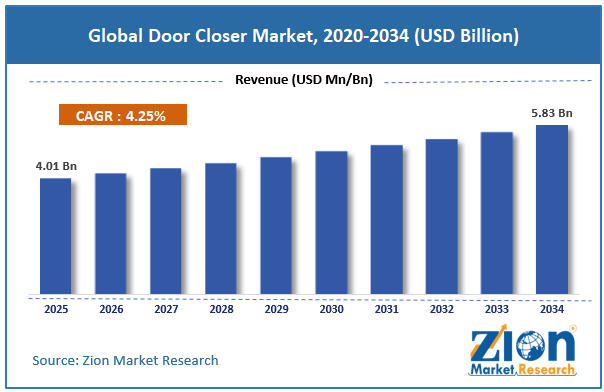
The global door closer market size was valued at approximately USD 4.01 billion in 2025 and is projected to reach around USD 5.83 billion by 2034, growing at a compound annual growth rate of approximately 4.25% between 2026 and 2034.
Key Insights
- As per the analysis shared by our research team, the global door closer market is estimated to grow at a compound annual growth rate of approximately 4.25% during the forecast period from 2026 to 2034.
- In terms of revenue, the global door closer market was valued at approximately USD 4.01 billion in 2025 and is projected to reach USD 5.83 billion by 2034.
- The door closer market is expected to grow strongly due to rising construction activity, stricter fire and building safety regulations, growing demand for accessible building designs, and expanding renovation projects across older buildings.
- Based on type, overhead door closers lead the market because of their widespread use and dependable performance in commercial settings, while concealed door closers are gaining strong momentum as one of the fastest-growing types for their neat appearance and hidden installation.
- Based on application, commercial buildings lead the market due to strict safety code requirements and heavy daily door usage. At the same time, industrial facilities are the fastest-growing segment as factories and warehouses prioritize durable door control systems.
- Based on material, aluminum body door closers lead the market because of their lightweight and corrosion-resistant qualities, while steel body door closers are seeing rapid adoption because of their strength and suitability for heavy-duty doors.
- Based on end user, building contractors lead the market due to their role in large-scale construction projects, while facility management companies are steadily growing as more property owners outsource building maintenance work.
- Based on region, North America leads the global door closer market, while Asia Pacific is the fastest-growing region due to rapid urbanization and rising construction spending.
Door Closer Market: Overview
A door closer is a mechanical device that automatically closes a door after it is opened, controlling speed and force for safe, smooth operation. It is commonly available in surface-mounted, concealed, hydraulic, and heavy-duty designs, with different types suited to various door sizes, weights, and building requirements. The door closer market is growing as demand rises for safer, more secure, and energy-efficient buildings across residential, commercial, and industrial sectors. Door closers are widely used in offices, hospitals, schools, apartments, shopping centers, hotels, and factories to prevent doors from slamming and reduce damage to doors and frames. They also support building safety by helping fire doors close automatically during emergencies, making them important for fire protection systems. Rising construction activity, stricter building safety codes, and growing awareness of energy efficiency are encouraging property owners and builders to install reliable door closers. These devices can also help maintain indoor temperatures by limiting how long doors stay open, supporting better energy management. Manufacturers are developing door closers with adjustable closing speeds, improved durability, smoother movement, and quieter operation for different building needs. Demand is also increasing for accessible door closers that make opening and closing easier for people with limited mobility. As modern buildings focus more on safety, convenience, accessibility, and energy savings, door closers are becoming an increasingly important part of building hardware.
The door closer industry continues to grow as builders, architects, and hardware manufacturers work together to create safer, smoother, and more dependable door control solutions worldwide.
Door Closer Market: Strategic Perspective
Where is the door closer market heading?
The door closer market is likely to shift toward smarter and more adjustable devices that suit modern building designs, including fire-rated systems, quieter operation, and easier installation methods. Future products may emphasize better adjustability, longer service life, corrosion-resistant coatings, and designs that blend smoothly with contemporary architecture.
Where should businesses invest in the door closer market?
Investment opportunities in the door closer market are likely to emerge in fire-rated closers, concealed and low-profile designs, accessible closing systems for people with limited mobility, and durable industrial-grade products. Manufacturers that combine strong safety performance with sleek design and offer dependable installation support can access a wider construction and facility management customer base.
What will reshape competition in the door closer market?
Competition in the door closer market will increasingly depend on closing smoothness, adjustability, durability, and compliance with safety standards rather than basic functionality alone. Companies offering reliable warranties, easier installation processes, responsive technical support, and products suited to different building types are likely to strengthen their market position.
Door Closer Market: Technology Roadmap 2026–2034
What is the projected development roadmap of the door closer market over the forecast period?
The door closer market is advancing through improved hydraulic mechanisms, more reliable fire safety compliance, expanded use of corrosion-resistant materials, and growing integration of adjustable closing controls, making door operation safer and smoother across different building environments. The market is expected to grow at a compound annual growth rate of approximately 4.25% over the forecast period, driven by accelerating construction investment, developing safety standards, and continuous refinement of door closer technology.
The following roadmap outlines key development phases expected through 2034.
2026–2028: Safety and Reliability Improvement Phase
- Better fire safety compliance: Manufacturers are expected to redesign closing mechanisms to meet stricter fire door regulations across commercial and institutional buildings.
- Improved closing smoothness: Building owners are likely to favor door closers with quieter operation and adjustable speed controls suited to high-traffic areas.
- Greater accessibility features: Product development is expected to focus on lighter opening resistance and delayed closing options for people with limited mobility.
2029–2031: Specialized Application and Construction Expansion Phase
- Concealed and low-profile solutions: Hidden door closers are expected to see wider use as architects seek cleaner, more modern building aesthetics.
- Industrial optimization: Heavy-duty door closers designed specifically for factories and warehouses are likely to become more important as industrial construction expands.
- Renovation project growth: Demand is expected to increase for easy-to-install replacement closers that building owners can fit during upgrade projects without major structural changes.
2032–2034: Smart Building Access Phase
- Sensor-supported operation: Future door closers may use sensors to detect door position, traffic flow, and closing speed automatically.
- Connected building integration: Smart models could connect with building management systems to share basic maintenance information and support better facility coordination.
- Greater automation features: Manufacturers are expected to explore motorized assistance technologies that help doors open and close with less physical effort.
Door Closer Market: Dynamics
Growth Drivers
Growing focus on building safety is strengthening the door closer market.
The door closer market is growing as stricter safety requirements encourage buildings to use controlled door movement. Door closers help fire doors shut automatically during emergencies, limiting the spread of smoke and flames and supporting safer evacuation. Offices, hospitals, schools, and residential buildings are also adopting them to reduce door slamming, noise, and accidental injuries. Rising construction of high-rise buildings, apartments, and shared spaces is creating steady demand for dependable door control products. Industrial facilities are increasingly using heavy-duty door closers that withstand frequent daily use and demanding conditions. Renovation and retrofit projects in older buildings are creating additional demand as property owners replace outdated door hardware. Growing awareness of accessible building design is also encouraging the installation of closers that make doors easier to operate for elderly people and individuals with limited mobility. These factors are expanding the use of door closers across commercial, residential, industrial, public buildings, and facilities worldwide.
How are product innovations opening new opportunities in the door closer market?
Product innovations are creating new opportunities in the door closer market by improving performance, durability, appearance, and installation flexibility. Fire-rated models are gaining demand as safety standards tighten, while concealed door closers offer a cleaner look for modern architectural projects. Adjustable closing speeds help reduce stress on doors and frames, particularly in buildings with heavy foot traffic. Manufacturers are adding corrosion-resistant coatings to extend product life in outdoor and coastal environments. Delayed-action mechanisms give people carrying items or using mobility aids more time to pass through doorways. New designs with lower opening resistance are also supporting accessibility in public and institutional buildings. Facility management companies are creating recurring demand by including door-closer maintenance in broader building service contracts. These innovations help the door closer market meet different customer needs across offices, homes, factories, shopping centers, hospitals, and other institutional buildings without repeating the safety-driven growth factors above.
Restraints
Installation costs and maintenance challenges limit growth in the door closer market.
The door closer market faces challenges related to cost, installation, maintenance, and building requirements. Property owners may delay upgrades when budgets are limited, especially if door hardware still works properly. Professional installation is often needed to ensure the closer is fitted correctly and adjusted for closing speed, increasing project costs. Choosing the right product can also be difficult because doors vary in size, weight, and usage, requiring different closer strengths. Regular maintenance keeps hydraulic systems running smoothly, while poor maintenance can cause doors to close too quickly or too slowly. In some regions, a shortage of skilled technicians and replacement parts can increase repair time and expenses. Small residential properties may consider door closers an unnecessary cost compared with commercial buildings. Manufacturers can overcome these barriers by offering easier installation, durable components, maintenance guidance, and technician training to support wider adoption across residential, commercial, and industrial spaces globally.
Opportunities
Rising construction and safety awareness are creating opportunities in the door closer market.
The door closer industry is growing as builders and property owners seek products that improve safety, comfort, and building performance. Commercial developers use dependable door closers to meet fire safety requirements while improving door control in offices, shopping centers, and other busy spaces. Hospitals and schools are also adopting them as safety standards tighten and controlled door movement becomes more important. Manufacturers are developing fire-rated models for high-risk areas, concealed designs for modern buildings, and heavy-duty versions for industrial facilities. Renovation projects offer another opportunity because replacing old door hardware is often part of building upgrades. Rising construction activity in emerging countries is encouraging developers to install modern door closers during new building projects. Improvements in hydraulic systems, arm strength, closing speed control, and corrosion resistance are making products more reliable across different climates and building types. Facility management companies are also creating demand by including door closer maintenance in wider building service contracts. Growing preference for attractive, low-profile designs is further supporting adoption. Easier adjustment and servicing are helping maintenance teams manage busy facilities. Overall, urban construction, stricter safety rules, and renovation activity are expected to create opportunities for the closer market across residential, commercial, industrial, and institutional buildings.
Challenges
What challenges does the door closer market face in sustaining growth and achieving adoption?
The door closer market faces challenges as many property owners delay upgrades when existing doors still work without dedicated closing systems. Selecting the right product can also be difficult because homes, offices, factories, and institutions have different door sizes, weights, usage levels, and safety needs. Installers require proper training to adjust closing speed, spring tension, and arm position correctly for each door. Frequent use can increase wear on hydraulic parts, especially in busy commercial and industrial buildings. Limited access to skilled technicians and replacement parts can also delay repairs, particularly in smaller cities and developing regions. Older buildings may create additional difficulties when modern door closers need to be installed on existing door frames. Manufacturers can reduce these barriers by offering products in different sizes and price ranges while making installation and adjustment simpler. Stronger components, clear maintenance guidance, technician training, and better service support can further improve adoption. These improvements can help the market reach more residential, commercial, industrial, and institutional buildings worldwide.
Door Closer Market: Report Scope
| Report Attributes | Report Details |
|---|---|
| Report Name | Door Closer Market |
| Market Size in 2025 | USD 4.01 Billion |
| Market Forecast in 2034 | USD 5.83 Billion |
| Growth Rate | CAGR of 4.25% |
| Number of Pages | 228 |
| Key Companies Covered | Assa Abloy, dormakaba Holding, Allegion plc, GEZE GmbH, Sargent Manufacturing, LCN by Allegion, Yale Security, Hafele Group, Dorma Group, Rockwood Manufacturing, and others. |
| Segments Covered | By Type, By Application, By Material, By End User, and By Region |
| Regions Covered | North America, Europe, Asia Pacific (APAC), Latin America, Middle East, and Africa (MEA) |
| Base Year | 2025 |
| Historical Year | 2020 - 2024 |
| Forecast Year | 2026 - 2034 |
| Customization Scope | Avail customized purchase options to meet your exact research needs. Request For Customization |
Door Closer Market: Segmentation
The global door closer market is segmented by type, application, material, end user, and region.
What makes overhead door closers the dominant type in the door closer market?
Based on type, the global door closer industry is categorized into overhead, floor spring, concealed, and surface-mounted door closers. Overhead door closers hold about 41% of the market share, leading because of their dependable performance, broad compatibility, and common use across standard commercial doorways. Concealed door closers hold around 23% market share. They are the fastest-growing segment because demand is increasing for hidden installations that keep building entrances looking clean and modern.
How do commercial buildings maintain their leading position in the door closer market?
Based on application, the door closer market is divided into commercial buildings, residential buildings, industrial facilities, and institutional buildings. Commercial buildings account for about 39% of the global market share, driven by strict safety code compliance and constant daily door usage in offices and retail spaces. Industrial facilities account for around 20% of the market share. It is the fastest-growing segment because expanding factory and warehouse construction requires heavy-duty door control systems.
Where do aluminum body door closers stand out in the door closer market?
Based on material, the market is segregated into aluminum body, steel body, cast iron, and composite body door closers. Aluminum body door closers lead with about a 36% share because of their lightweight construction, corrosion resistance, and suitability for a wide range of door types. Steel body door closers hold around 26% market share. They are seeing rapid adoption because their strength makes them well suited for heavy doors in industrial and high-traffic settings.
Who is driving demand for door closers in the global door closer market?
Based on end user, the door closer market is classified into building contractors, facility management companies, architects and designers, and homeowners. Building contractors account for about 38% of the market, leading because they specify and install hardware during large-scale construction projects. Facility management companies hold around 21% market share. This segment is expanding quickly as more commercial property owners outsource ongoing building maintenance and hardware servicing.
Door Closer Market: Regional Analysis
Why is North America leading the global door closer market?
North America holds a 38.92% market share globally in the door closer market and is expected to maintain its leading position during the forecast period. The region leads because building codes strongly emphasize fire safety and controlled door operation in commercial and institutional buildings. The United States has a large base of offices, hospitals, schools, and other facilities that need reliable door closing hardware. Property owners are replacing older hardware to meet updated safety rules and improve energy efficiency by limiting heat loss through doors left open. Growing awareness of accessibility requirements is also increasing demand for door closers that are easier to operate for people with limited mobility. Commercial construction, renovation, and retrofit projects are creating steady demand for new installations and replacements.
Facility managers are choosing products that require less maintenance while providing reliable performance under frequent use. Manufacturers are responding with corrosion-resistant coatings, adjustable closing speeds, quieter hydraulic systems, and compact designs. Concealed and low-profile models are gaining interest in premium commercial projects where appearance matters. Strong regulations, ongoing construction, and rising demand for safer, accessible buildings are expected to keep North America at the forefront of the global door closer market.
What makes Asia Pacific the fastest-growing region in the door closer market?
The Asia Pacific door closer market holds a 25.14% market share globally and is expected to witness the fastest growth during the forecast period. The region is expanding quickly as urbanization, population growth, and commercial development increase demand for modern buildings. China and India are constructing more offices, shopping centers, apartments, and high-rise buildings, creating strong demand for reliable door control hardware. Japan and South Korea continue to follow strict building safety standards, supporting the use of quality door closers. Growing awareness of fire safety is also encouraging developers to install products that help buildings meet updated regulations. Industrial development across emerging countries is creating demand for heavy-duty closers suitable for factories, warehouses, and other busy facilities.
Government investment in schools, hospitals, and public infrastructure is further supporting market growth. Local manufacturers are improving product quality while offering affordable options, making modern door hardware more accessible to budget-conscious developers. Renovation of older buildings is creating additional demand for easy-to-install replacement products. Mixed-use projects also require door closers for different areas of a building. Overall, rapid urban development, stronger safety awareness, rising construction activity, and growing interest in accessible buildings are expected to drive the Asia Pacific door closer market during the forecast period.
Recent Market Developments
- In July 2026, dormakaba launched EasyAssist, a smart door access solution designed to make opening and closing easier for older adults, people with limited mobility, and children, with retrofit applications in hospitals and senior living facilities.
- In January 2026, GEZE introduced its new TS 7000 door closer at FENSTERBAU FRONTALE, focusing on easier operation, modern design, accessibility, and reliable door closing for contemporary building projects.
Door Closer Market: Competitive Analysis
The leading players in the global door closer market are:
- Assa Abloy
- dormakaba Holding
- Allegion plc
- GEZE GmbH
- Sargent Manufacturing
- LCN by Allegion
- Yale Security
- Hafele Group
- Dorma Group
- Rockwood Manufacturing
The global door closer market is segmented as follows:
By Type
- Overhead Door Closers
- Floor Spring Door Closers
- Concealed Door Closers
- Surface Mounted Door Closers
By Application
- Commercial Buildings
- Residential Buildings
- Industrial Facilities
- Institutional Buildings
By Material
- Aluminum Body Door Closers
- Steel Body Door Closers
- Cast Iron Door Closers
- Composite Body Door Closers
By End User
- Building Contractors
- Facility Management Companies
- Architects and Designers
- Homeowners
By Region
- North America
- The U.S.
- Canada
- Mexico
- Europe
- France
- The UK
- Spain
- Germany
- Italy
- Rest of Europe
- Asia Pacific
- China
- Japan
- India
- Australia
- South Korea
- Rest of Asia Pacific
- The Middle East & Africa
- Saudi Arabia
- UAE
- Egypt
- Kuwait
- South Africa
- Rest of the Middle East & Africa
- Latin America
- Brazil
- Argentina
- Rest of Latin America
Table Of Content
Methodology
FrequentlyAsked Questions
A door closer is a mechanical device that automatically closes a door after it is opened, controlling speed and force for safe, smooth operation. It is commonly available in surface-mounted, concealed, hydraulic, and heavy-duty designs, with different types suited to various door sizes, weights, and building requirements.
The global door closer market is expected to grow due to rising construction activity, stricter fire and building safety regulations, growing demand for accessible building designs, and expanding renovation projects across older buildings worldwide.
According to research, the global door closer market was valued at approximately USD 4.01 billion in 2025 and is projected to reach approximately USD 5.83 billion by 2034.
The compound annual growth rate of the door closer market is expected to be approximately 4.25% from 2026 to 2034.
North America is expected to lead the global door closer market throughout the forecast period, driven by strict safety regulations, established construction activity, and continued hardware modernization.
The major players in the global door closer market include Assa Abloy, dormakaba Holding, Allegion plc, GEZE GmbH, Sargent Manufacturing, LCN by Allegion, Yale Security, Hafele Group, Dorma Group, and Rockwood Manufacturing.
The report examines key aspects of the door closer market, including research and development drivers, adoption barriers, application opportunities, competitive landscape dynamics, detailed regional market performance analysis, and a comprehensive forward-looking outlook across all major types, applications, materials, end-user segments, and geographic regions through 2034.
The door closer market faces challenges such as high installation costs, maintenance needs, difficult retrofitting in older buildings, and strong price competition from low-cost products. These factors can make some property owners delay upgrades, especially in cost-sensitive markets.
The door closer market is competitive, with global companies such as ASSA ABLOY, dormakaba, Allegion, GEZE, and Gretsch-Unitas competing with regional manufacturers. Companies mainly compete through product quality, safety, durability, pricing, technology, distribution reach, and after-sales service.
The door closer market is shifting toward smarter, quieter, easier-to-use, and more attractive products. Buyers increasingly prefer concealed designs, automatic operation, better accessibility, energy efficiency, low maintenance, and products that work with modern building security systems.

HappyClients

