
Global Direct Reduced Iron Market Size, Share, Value and Forecast 2034

Direct Reduced Iron Market By Product Type (Hot Briquetted Iron, Cold Direct Reduced Iron, Direct Reduced Iron Pellets, Direct Reduced Iron Fines), By Application (Steel Manufacturing, Foundry Applications, Alloy Production, Construction Material Production), By End-User (Steel Producers, Foundries and Casting Units, Automotive Component Manufacturers, Construction and Infrastructure Companies), By Distribution Channel (Direct Sales, Metal and Ore Distributors, Online Procurement Platforms, Government and Institutional Tender Procurement), and By Region - Global and Regional Industry Overview, Market Intelligence, Comprehensive Analysis, Historical Data, and Forecasts 2026 - 2034
| Market Size in 2025 | Market Forecast in 2034 | CAGR (in %) | Base Year |
|---|---|---|---|
| USD 50.25 Billion | USD 94.34 Billion | 7.25% | 2025 |
Direct Reduced Iron Industry Perspective:
What will be the size of the direct reduced iron market during the forecast period?
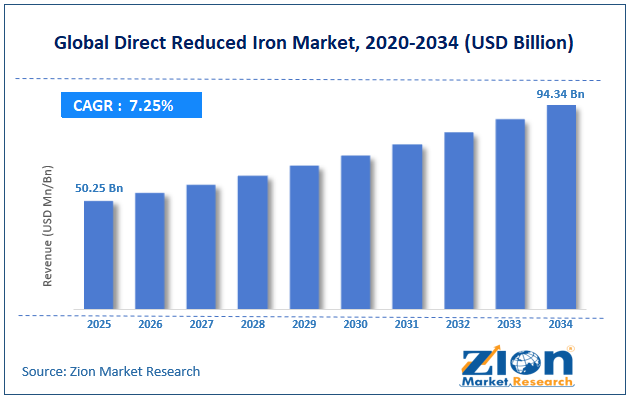
The global direct reduced iron market size was approximately USD 50.25 billion in 2025 and is projected to reach USD 94.34 billion by 2034, growing at a compound annual growth rate of approximately 7.25% between 2026 and 2034.
Key Insights
- According to our research team's analysis, the global direct reduced iron market is expected to grow at a compound annual growth rate of approximately 7.25% over the forecast period from 2026 to 2034.
- In terms of revenue, the global direct reduced iron market was valued at approximately USD 50.25 billion in 2025 and is projected to reach USD 94.34 billion by 2034.
- The direct reduced iron market is expected to grow steadily due to rising demand for cleaner steel production methods, increasing construction and infrastructure activity, and continuous advancements in direct reduction technology.
- Based on product type, hot briquetted iron holds the largest market share, as manufacturers increasingly prefer its ease of handling, storage, and transport, while direct reduced iron pellets are growing the fastest due to rising demand in electric arc furnace steel making.
- Based on application, steel manufacturing leads the market as producers continue to expand cleaner production capacity, while alloy production applications are growing steadily as more industries adopt specialized metal blends for advanced manufacturing.
- Based on end users, steel producers hold the largest market share due to the widespread use of direct reduced iron across countless steel-making operations, while construction and infrastructure companies are growing rapidly as building activity increases worldwide.
- Based on distribution channel, direct sales lead the market because large steel producers prefer working directly with iron ore and reduction facility suppliers, while metal and ore distributors are expanding steadily to serve smaller foundries and specialized buyers.
- Based on region, Asia Pacific leads the global direct reduced iron market due to strong steel production capacity and growing infrastructure development, followed by the Middle East, where abundant natural gas resources and expanding production facilities are driving further growth.
Direct Reduced Iron Market: Overview
A direct reduced iron (DRI) is a high-quality form of iron made by removing oxygen from iron ore without melting it. This process produces a solid, sponge-like iron product that is rich in iron and widely used as a raw material for steel-making. Unlike the traditional blast furnace process, DRI is produced at lower temperatures, which helps reduce energy use and carbon emissions. It provides steel manufacturers with a clean, reliable, and consistent source of iron for producing high-quality steel. Direct reduced iron is widely used in steel plants, foundries, automotive manufacturing, construction, and infrastructure projects. It helps improve steel quality, reduces the need for scrap metal, lowers production costs, and supports more efficient steel manufacturing. DRI is also easier to transport and store because of its high purity and consistent quality. Growing demand for steel from the construction, automotive, and infrastructure sectors is increasing the need for cleaner and more sustainable iron production. Manufacturers are investing in advanced direct reduction technologies to improve production efficiency, lower emissions, and support environmentally friendly steel-making. These factors are driving the steady growth of the direct reduced iron market across industries worldwide.
The direct reduced iron industry is expanding steadily as steel producers, foundries, and construction companies seek cleaner, more dependable iron sources to support their manufacturing processes.
Impact of the USA-Israel War on Iran on the Direct Reduced Iron Market
Rising tensions among the United States, Israel, and Iran may temporarily disrupt the supply of iron ore, natural gas used in reduction processes, and shipping routes for finished direct-reduced iron products. However, the demand for direct-reduced iron remains strong because steel manufacturing, construction, and automotive production need to keep functioning regardless of global events. As more countries continue to invest in cleaner steelmaking methods, the direct reduced iron market is expected to grow despite short-term disruptions.
Direct Reduced Iron Market: Technology Roadmap 2026–2034
What is the projected development roadmap of the direct reduced iron market over the forecast period?
The direct reduced iron market is advancing through cleaner reduction processes, improved energy efficiency, lower emission technologies, and the growing use of hydrogen-based reduction methods to support sustainable steel production. The market is expected to grow at a compound annual growth rate of approximately 7.25% during the forecast period, driven by rising demand for cleaner steel, growing infrastructure activity, and continuous innovation in reduction technology.
The following roadmap outlines key development phases expected through 2034.
2026-2028: Efficiency and Emission Reduction Phase
- Lower-emission reduction processes are expected to see wider adoption as steel producers seek cleaner alternatives to traditional iron-making methods.
- Improved energy-efficient production techniques are expected to make it easier for manufacturers to reduce operating costs while maintaining product quality.
- Expanding distributor networks are expected to make it easier for smaller foundries and steelmakers to access direct reduced iron conveniently.
2029-2032: Hydrogen Integration and Automation Phase
- Hydrogen-based reduction technology is expected to help producers significantly cut carbon emissions during the iron-making process.
- Automated production monitoring systems are expected to allow manufacturers to maintain consistent product quality with less manual oversight.
- Hybrid reduction solutions that combine natural gas and hydrogen are expected to offer more flexible and reliable production across different facility types.
2033-2034: Advanced Sustainability and Integration Phase
- Advanced green hydrogen production technology is expected further to reduce the carbon footprint of direct reduced iron manufacturing.
- Next-generation reduction facilities with higher output and better efficiency are expected to improve the overall value of steel production.
- Stronger recycling and sustainable sourcing practices are expected to reduce the environmental impact of iron ore extraction and processing.
Direct Reduced Iron Market: Dynamics
Growth Drivers
How is the rising demand for cleaner steel production driving the direct reduced iron market?
The direct reduced iron market is growing as steel manufacturers look for cleaner and more efficient raw materials for steel production. Direct reduced iron (DRI) provides a high-purity source of iron that helps produce better-quality steel while reducing the need for traditional blast furnace methods. It also lowers carbon emissions, uses less energy, and helps reduce overall production costs. The increasing demand for green steel and environmentally friendly manufacturing is encouraging more companies to adopt DRI in their production processes. The growing use of electric arc furnaces, which require high-quality iron inputs, is also boosting demand for direct reduced iron.
Manufacturers are investing in advanced production technologies to improve DRI quality, increase production efficiency, and reduce energy consumption. Direct reduced iron is widely used in steel plants, foundries, automotive manufacturing, construction, and infrastructure projects because it improves the strength and quality of finished steel products. Rapid industrial growth, urbanization, and infrastructure development in many countries are further increasing the need for reliable steel production materials. These factors are supporting the steady growth of the direct reduced iron market and encouraging wider adoption across the global steel industry.
The growing demand for sustainable steelmaking and infrastructure development drives the direct reduced iron market.
The direct reduced iron market is growing as steel manufacturers and construction companies seek cleaner, more reliable raw materials. Direct reduced iron (DRI) helps produce high-quality steel, improves furnace performance, and provides consistent production results. The rising demand for green steel, infrastructure projects, and electric vehicles is increasing the need for cleaner iron used in steel-making. DRI can be produced using natural gas or hydrogen, thereby reducing carbon emissions compared to traditional iron production methods. It is widely used in steel plants, foundries, automotive manufacturing, and construction industries. Manufacturers are investing in advanced technologies to improve iron quality, reduce energy use, and make production more efficient. These improvements are also helping lower production costs, making DRI more affordable for more steel producers. As industries focus on sustainable manufacturing and reducing their environmental impact, the demand for direct reduced iron continues to increase. These factors are creating new growth opportunities and driving the steady expansion of the market worldwide.
Restraints
How are production costs and infrastructure requirements affecting the direct reduced iron market?
The direct reduced iron industry faces several challenges that could slow its growth. One of the biggest challenges is the high cost of building direct reduced iron production plants, which makes it difficult for small and medium-sized companies to invest. Producing DRI also requires a steady supply of natural gas or hydrogen, and these resources may be expensive or unavailable in some regions. Many steel manufacturers still use traditional blast furnace methods because they are well established and require less initial investment. Changes in iron ore supply and fluctuations in natural gas prices can also increase production costs and affect the availability of DRI. Another challenge is limited access to advanced production technology and a shortage of skilled workers to operate modern DRI facilities. Companies must also continue investing in new technologies and plant upgrades to remain competitive and meet environmental standards.
Although these challenges may slow the growth of the direct reduced iron market, ongoing improvements in production technology, greater use of clean energy, and increasing demand for sustainable steel are expected to support long-term market growth.
Opportunities
How are emerging technologies and expanding infrastructure development creating opportunities in the direct reduced iron market?
The direct reduced iron market offers strong growth opportunities as countries increase steel production and invest in cleaner manufacturing technologies. The rising demand for green steel across Asia Pacific, the Middle East and Africa, Latin America, and Europe is creating new opportunities for direct reduced iron producers. More steel manufacturers are adopting electric arc furnaces, which require high-quality iron feedstocks such as DRI to produce higher-quality steel with lower carbon emissions. Growing investments in sustainable construction, infrastructure projects, and low-carbon manufacturing are also increasing demand for direct reduced iron. In addition, the automotive industry is using more high-quality steel, further supporting market growth. Governments in many countries are encouraging cleaner steel production through supportive policies, financial incentives, and investments in modern manufacturing facilities.
At the same time, manufacturers are developing advanced production technologies that improve iron quality, reduce energy use, lower emissions, and cut production costs. Improved production methods are making direct reduced iron easier to use across different steelmaking processes. As industries continue to focus on sustainability, energy efficiency, and environmentally friendly production, the demand for direct reduced iron is expected to grow steadily, supporting the long-term expansion of the direct reduced iron market across the global steel industry.
Challenges
What challenges does the direct reduced iron market face in achieving broad adoption and delivering long-term value?
The direct reduced iron industry faces several challenges that could affect its growth. One of the main challenges is maintaining consistent product quality, as differences in iron ore quality and production methods can impact the final iron produced. Manufacturers also depend on a steady supply of natural gas or hydrogen, and shortages or price increases can raise production costs and delay operations. Many small and medium-sized steel companies cannot afford the high investment needed to build direct reduced iron production plants.
In addition, companies must follow strict environmental regulations and emission standards, which can increase operating costs and require regular upgrades to production facilities. Strong competition among iron and steel manufacturers also puts pressure on prices, making it important to improve quality while keeping costs low. Rapid advancements in production technology require continuous investment in research, innovation, and modern equipment. Despite these challenges, the growing demand for green steel, cleaner manufacturing, and high-quality steel for construction, automotive, and infrastructure projects is expected to support the long-term growth of the direct reduced iron market worldwide.
Direct Reduced Iron Market: Report Scope
| Report Attributes | Report Details |
|---|---|
| Report Name | Direct Reduced Iron Market |
| Market Size in 2025 | USD 50.25 Billion |
| Market Forecast in 2034 | USD 94.34 Billion |
| Growth Rate | CAGR of 7.25% |
| Number of Pages | 229 |
| Key Companies Covered | Tata Steel, ArcelorMittal, Nucor Corporation, Cleveland Cliffs, JSW Steel, Essar Steel, Emirates Steel Arkan, Voestalpine AG, Metinvest Group, Jindal Steel and Power, and others. |
| Segments Covered | By Product Type, By Application, By End-User, By Distribution Channel, and By Region |
| Regions Covered | North America, Europe, Asia Pacific (APAC), Latin America, Middle East, and Africa (MEA) |
| Base Year | 2025 |
| Historical Year | 2020 to 2024 |
| Forecast Year | 2026 - 2034 |
| Customization Scope | Avail customized purchase options to meet your exact research needs. Request For Customization |
Direct Reduced Iron Market: Segmentation
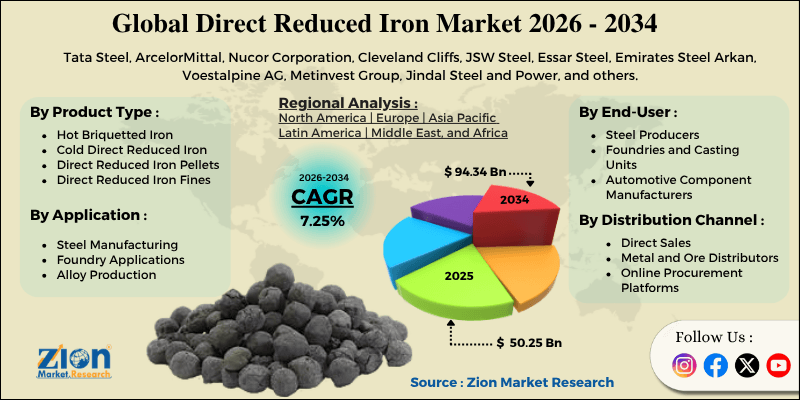
The global direct reduced iron market is segmented by product type, application, end-user, distribution channel, and region.
How does hot briquetted iron maintain its leading position in the direct reduced iron market?
Based on product type, the global direct reduced iron market is segregated into hot briquetted iron, cold direct reduced iron, direct reduced iron pellets, and direct reduced iron fines. Hot briquetted iron leads with about a 40% share because it offers steel producers easier handling, safer storage, and simpler transportation compared to other forms. The direct reduced iron pellets segment holds around 27% of the market share. It is growing rapidly due to increasing demand in electric arc furnace steel production.
What is driving the dominance of steel manufacturing in the direct reduced iron market?
Based on application, the market is classified into steel manufacturing, foundry applications, alloy production, and construction material production. Steel manufacturing accounts for about 44% of market share, as producers continue to expand cleaner and more efficient steel production capacity worldwide. The alloy production segment holds around 22% share. It is growing steadily as more industries adopt specialized metal blends for advanced manufacturing applications.
Why do steel producers account for the largest share of the direct reduced iron market?
Based on end user, the direct reduced iron market is segmented into steel producers, foundries and casting units, automotive component manufacturers, and construction and infrastructure companies. Steel producers hold around a 47% share because direct reduced iron is used extensively in countless steelmaking operations worldwide. The construction and infrastructure companies segment accounts for about 21% of the market share. It is growing rapidly due to rising building activity and infrastructure development across regions.
Which factors are driving the growth of direct sales in the direct reduced iron market?
Based on distribution channel, the direct reduced iron industry is divided into direct sales, metal and ore distributors, online procurement platforms, and government and institutional tender procurement. Direct sales account for about 45% of market share because large steel producers prefer purchasing directly from iron ore and reduction facility suppliers. The metal and ore distributors segment holds around 28% of the market share. It continues expanding by serving smaller foundries and specialized buyers across various regions.
Direct Reduced Iron Market: Regional Analysis
How is the expansion of steel production strengthening the Asia-Pacific direct reduced iron market?
The Asia Pacific direct reduced iron market is expected to grow at a CAGR of 8.1% during the forecast period, driven by strong steel production capacity, rising infrastructure development, and growing investment in cleaner manufacturing technologies. India holds the largest market share due to the presence of major direct reduced iron producers, expanding steel manufacturing capacity, and rising demand for construction and infrastructure materials. Steel producers are increasingly using direct reduced iron to improve product quality, reduce dependence on scrap metal, and enhance production efficiency. China is also contributing to market growth through investments in cleaner steel-making technology and government support to reduce industrial emissions.
Southeast Asian countries are emerging as important markets, supported by expanding construction activity and increasing demand for quality steel products. The region benefits from a well-developed steel manufacturing base, growing iron ore processing capacity, and ongoing technological innovation. The growing adoption of electric arc furnace steelmaking, green construction practices, and infrastructure modernization is further increasing demand for direct-reduced iron. These factors are expected to maintain Asia Pacific's leadership in the direct reduced iron market while supporting long-term industry growth and technological advancement.
Why is the abundance of natural gas resources accelerating the direct reduced iron market in the Middle East?
The Middle East direct reduced iron market is expected to grow at a CAGR of 7.6% during the forecast period, driven by abundant natural gas resources, expanding steel production, and increasing investment in modern manufacturing facilities. Saudi Arabia leads the regional market because of its large natural gas reserves, growing steel industry, and government initiatives to diversify the economy and strengthen industrial development. The United Arab Emirates is also a key contributor, supported by expanding steel manufacturing, rapid infrastructure development, and strong demand from the construction sector.
Countries across the Middle East are increasingly using natural gas-based direct reduction technology to produce high-quality iron while reducing carbon emissions and improving production efficiency. Governments are encouraging cleaner steel production through investments in advanced manufacturing technologies and industrial development programs. Rising construction activity, infrastructure projects, and the growing demand for green steel are further increasing the need for direct-reduced iron across the region. Continuous improvements in direct reduction technology are helping manufacturers lower production costs, improve iron quality, and meet environmental goals. These factors are expected to support the long-term growth of the Middle East direct reduced iron market and strengthen the region's role in the global steel industry.
Recent Market Developments
- In January 2026, Tosyalı Algerie announced that its second MIDREX® direct reduced iron (DRI) module produced 2.43 million metric tons in 2025, setting a new world record for annual DRI production by a single direct-reduction module and strengthening its leadership in low-carbon iron production.
Direct Reduced Iron Market: Competitive Analysis
The leading players in the global direct reduced iron market are:
- Tata Steel
- ArcelorMittal
- Nucor Corporation
- Cleveland Cliffs
- JSW Steel
- Essar Steel
- Emirates Steel Arkan
- Voestalpine AG
- Metinvest Group
- Jindal Steel and Power
The global direct reduced iron market is segmented as follows:
By Product Type
- Hot Briquetted Iron
- Cold Direct Reduced Iron
- Direct Reduced Iron Pellets
- Direct Reduced Iron Fines
By Application
- Steel Manufacturing
- Foundry Applications
- Alloy Production
- Construction Material Production
By End-User
- Steel Producers
- Foundries and Casting Units
- Automotive Component Manufacturers
- Construction and Infrastructure Companies
By Distribution Channel
- Direct Sales
- Metal and Ore Distributors
- Online Procurement Platforms
- Government and Institutional Tender Procurement
By Region
- North America
- The U.S.
- Canada
- Mexico
- Europe
- France
- The UK
- Spain
- Germany
- Italy
- Rest of Europe
- Asia Pacific
- China
- Japan
- India
- Australia
- South Korea
- Rest of Asia Pacific
- The Middle East & Africa
- Saudi Arabia
- UAE
- Egypt
- Kuwait
- South Africa
- Rest of the Middle East & Africa
- Latin America
- Brazil
- Argentina
- Rest of Latin America
Table Of Content
Methodology
FrequentlyAsked Questions
A direct reduced iron (DRI) is a high-quality form of iron made by removing oxygen from iron ore without melting it. This process produces a solid, sponge-like iron product that is rich in iron and widely used as a raw material for steel-making.
The global direct reduced iron market is expected to grow, driven by rising demand for cleaner steel production worldwide, increasing infrastructure and construction activity, growing adoption of electric arc furnace steel making, and continuous improvements in reduction technology.
According to research, the global direct reduced iron market was valued at approximately USD 50.25 billion in 2025 and is projected to reach approximately USD 94.34 billion by 2034.
The compound annual growth rate of the direct reduced iron market is expected to be approximately 7.25% from 2026 to 2034.
Asia Pacific is expected to lead the global direct reduced iron market throughout the forecast period, driven by strong steel production capacity, expanding infrastructure development, and rising demand for cleaner manufacturing methods.
The major players in the global direct reduced iron market include Tata Steel, ArcelorMittal, Nucor Corporation, Cleveland Cliffs, JSW Steel, Essar Steel, Emirates Steel Arkan, Voestalpine AG, Metinvest Group, and Jindal Steel and Power.
The report examines key aspects of the direct reduced iron market, including growth drivers, adoption barriers, emerging opportunities, competitive dynamics, detailed regional performance, and a forward-looking outlook across all major product types, applications, end-user segments, and geographic regions through 2034.
The direct reduced iron market will be influenced by infrastructure spending, industrial growth, energy prices, steel demand, and government investments in cleaner manufacturing. At the same time, fluctuations in raw material costs and global trade policies may affect production costs and market expansion.
Stakeholders in the direct reduced iron market should invest in energy-efficient, low-carbon production technologies and improve operational efficiency. Building reliable raw material supply chains and expanding production capacity can also help meet the growing demand for sustainable steel.
The direct reduced iron market faces challenges such as high initial investment costs, fluctuating natural gas and iron ore prices, and limited access to advanced production technologies. Strict environmental regulations and the need for continuous facility upgrades also increase production costs and slow market growth.

HappyClients

