
Global Digital Dose Inhaler Market Size, Share, Trends Analysis Report 2032

Digital Dose Inhaler Market By Product (Dry Powder Inhalers (DPIs) and Metered Dose Inhalers (MDIs)), By Application (Chronic Obstructive Pulmonary Disease (COPD), Asthma, and Other Applications), and By Region: Global Industry Perspective, Comprehensive Analysis and Forecast, 2024 - 2032
| Market Size in 2023 | Market Forecast in 2032 | CAGR (in %) | Base Year |
|---|---|---|---|
| USD 15.37 Billion | USD 69.38 Billion | 18.23% | 2023 |
Digital Dose Inhaler Industry Perspective
What will be the global digital dose inhaler market size during the forecast period?
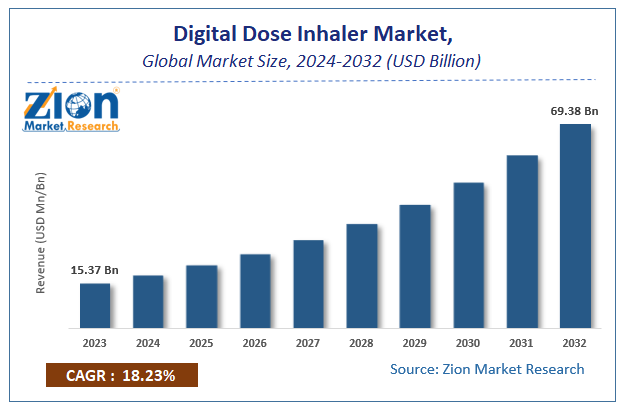
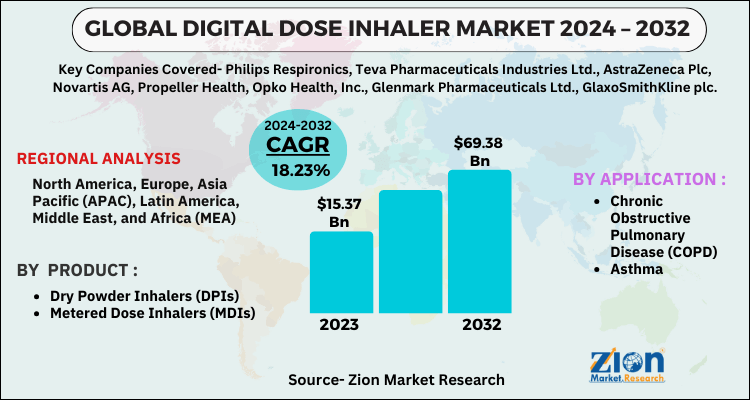
The global digital dose inhaler market size was worth around USD 15.37 billion in 2023 and is predicted to grow to around USD 69.38 billion by 2032, with a compound annual growth rate (CAGR) of roughly 18.23% between 2024 and 2032.
This report provides a comprehensive analysis of the growth drivers, restraints, and challenges shaping demand across the global digital dose inhaler market throughout the forecast period, while highlighting high-potential emerging opportunities within the industry.
Key Insights
- As per the analysis shared by our research analyst, the global digital dose inhaler market is estimated to grow annually at a CAGR of around 18.23% over the forecast period (2024-2032).
- In terms of revenue, the global digital dose inhaler market size was valued at around USD 15.37 billion in 2023 and is projected to reach USD 69.38 billion by 2032.
- The digital dose inhaler market is projected to grow at a significant rate due to the increasing prevalence of chronic respiratory diseases, growing geriatric population, rising adoption of digital devices, and the need for improved medication compliance and dose tracking.
- Based on the product segment, the metered dose inhalers (MDIs) segment accounted for about two-thirds of the market share in 2023 due to significant innovations such as automatic PK/PD modeling, electronic monitoring systems with patient feedback, and controlled release of formulations.
- Based on the application segment, the asthma application segment accounted for the largest market share in 2023 owing to rising asthma prevalence across the globe, while the chronic obstructive pulmonary disease (COPD) segment is expected to witness rapid growth.
- Based on region, North America dominated the global digital dose inhaler market in 2023 due to the increasing prevalence of chronic respiratory disorders, rising preference for digital devices, presence of major market players, and a growing aging population.
Digital Dose Inhaler Market: Overview
An inhaler is a medical device that delivers medication into the body via the lungs. These inhalers are also called allergy sprays, pumps, or puffers. Inhalers are widely used for treatment and medication delivery for respiratory diseases such as chronic obstructive pulmonary disease and asthma. Inhalers reduce medication deposition in the throat or mouth and also minimize the need for exact synchronization with the actuation of the device. Digital inhalers are equipped with built-in sensors that help track inhalation usage, dose management, and dose compliance.
Digital Dose Inhaler Market: Dynamics
What factors are propelling the expansion of the digital dose inhaler market?
The demand for the digital dose inhaler market is driven by the increasing prevalence of chronic respiratory diseases such as asthma, chronic obstructive pulmonary disease (COPD), and the related decrease in patients' quality of life. The increasing geriatric population across the world, increasing preference and adoption of digital devices, increasing R&D investment for technological improvement and device miniaturization, and the growing need to achieve medication compliance, patient care enhancement, and dose tracking are other important factors that boost the market growth.
What factors are limiting the growth of the digital dose inhaler market?
However, the high cost of digital dose inhalers may limit the market growth over the forecast period. Integration of artificial intelligence for digital dose tracking and compliance is expected to bring new opportunities for major market players operating in the global digital dose inhaler along with growth opportunities in emerging markets.
Digital Dose Inhaler Market: Report Scope
| Report Attributes | Report Details |
|---|---|
| Report Name | Digital Dose Inhaler Market |
| Market Size in 2023 | USD 15.37 Billion |
| Market Forecast in 2032 | USD 69.38 Billion |
| Growth Rate | CAGR of 18.23% |
| Number of Pages | 220 |
| Key Companies Covered | Philips Respironics, Teva Pharmaceuticals Industries Ltd., AstraZeneca Plc, Novartis AG, Propeller Health, Opko Health, Inc., Glenmark Pharmaceuticals Ltd., GlaxoSmithKline plc., AptarGroup, Inc., Cipla, Inc., and others |
| Segments Covered | By Product, By Application and By Region |
| Regions Covered | North America, Europe, Asia Pacific (APAC), Latin America, Middle East, and Africa (MEA) |
| Base Year | 2023 |
| Historical Year | 2018 - 2022 |
| Forecast Year | 2024 - 2032 |
| Customization Scope | Avail customized purchase options to meet your exact research needs. Request For Customization |
Digital Dose Inhaler Market: Segmentation Analysis
The study provides a crucial view of the digital dose inhaler by segmenting the market based on product, application, and region. All the segments of the digital dose inhaler market have been analyzed based on present and future trends and the market is estimated from 2024 to 2032.
Based on the product, the global digital dose inhaler market comprises dry powder inhalers (DPIs) and metered dose inhalers (MDIs). The metered dose inhalers (MDIs) product segment accounted for about two-thirds of the market share in 2023 due to significant innovations such as automatic PK/PD (pharmacokinetic/pharmacodynamics) modeling, an electronic monitoring system with patient feedback, and controlled release of formulations. The dry powder inhalers (DPIs) product type segment is expected to witness rapid CAGR over the forecast period.
Based on application, the digital dose inhaler market is categorized into asthma, chronic obstructive pulmonary disease (COPD), and other applications. The asthma application segment accounted for the largest market share in 2023, whereas the chronic obstructive pulmonary disease (COPD) segment will see rapid growth over the forecast period. Rising asthma prevalence across the globe has been attributed to the large market share.
Digital Dose Inhaler Market: Regional Analysis
Why will North America continue to dominate the global market during the projection period?
North America dominated the global digital dose inhaler market in 2023. The increasing prevalence of chronic respiratory disorders, increasing preference for digital devices, presence of major market players, and increasing aging population are factors driving the market in this region. The United States, in particular, drives regional leadership through high awareness of respiratory disease management, robust clinical research activity, and continuous introduction of connected inhalation solutions that elevate treatment standards and expand market opportunities.
Europe was the second-largest regional market. Availability of developed infrastructure, increasing awareness and the prevalence of respiratory disorders are major factors that boost market growth in this region. Countries such as Germany, the United Kingdom, France, and Italy contribute significantly through established pharmaceutical industries and progressive digital health initiatives.
Latin America is expected to witness moderate growth over the forecast period. Asia Pacific region will exhibit the highest growth for the digital dose inhaler market in the coming years. The increasing aging population with high vulnerability to chronic respiratory disorders, growing prevalence of asthma, COPD, and increasing healthcare expenditure are factors promoting digital dose inhaler market growth in Asia Pacific. Middle East and Africa will see considerable growth in the coming years.
Digital Dose Inhaler Market: Competitive Analysis
Some of the major players in the global digital dose inhaler market include:
- Philips Respironics
- Teva Pharmaceuticals Industries Ltd.
- AstraZeneca Plc
- Novartis AG
- Propeller Health
- Opko Health Inc.
- Glenmark Pharmaceuticals Ltd.
- GlaxoSmithKline plc.
- AptarGroup Inc.
- Cipla Inc.
Digital Dose Inhaler Market: Key Trends
Integration of sensors and digital connectivity for adherence monitoring
Digital dose inhalers increasingly incorporate built-in sensors and connectivity features that track usage patterns, provide real-time feedback, and support remote patient monitoring. This trend addresses the critical challenge of medication non-adherence in chronic respiratory disease management and enables more personalized care pathways.
Focus on sustainable propellants and environmentally conscious device design
Manufacturers are prioritizing the development of inhalers with lower global warming potential propellants and more sustainable materials. Regulatory and environmental pressures, combined with corporate sustainability commitments, are accelerating the transition toward greener formulations while maintaining therapeutic performance and patient convenience.
The report segments the global digital dose inhaler market as follows:
By Product
- Dry Powder Inhalers (DPIs)
- Metered Dose Inhalers (MDIs)
By Application
- Chronic Obstructive Pulmonary Disease (COPD)
- Asthma
- Other Applications
By Region
- North America
- The U.S.
- Canada
- Mexico
- Europe
- France
- The UK
- Spain
- Germany
- Italy
- Rest of Europe
- Asia Pacific
- China
- Japan
- India
- Australia
- South Korea
- Rest of Asia Pacific
- The Middle East & Africa
- Saudi Arabia
- UAE
- Egypt
- Kuwait
- South Africa
- Rest of the Middle East & Africa
- Latin America
- Brazil
- Argentina
- Rest of Latin America
Table Of Content
Methodology
FrequentlyAsked Questions
A digital dose inhaler is a type of inhaler that incorporates technology to provide additional features beyond simply delivering medication. It typically refers to a metered-dose inhaler (MDI) with a built-in digital counter that accurately tracks the number of doses remaining.
According to a study, the global digital dose inhaler market size was worth around USD 15.37 billion in 2023 and is expected to reach USD 69.38 billion by 2032.
The global digital dose inhaler market is expected to grow at a CAGR of 18.23% during the forecast period.
North America is expected to dominate the digital dose inhaler market over the forecast period.
Leading players in the global digital dose inhaler market include Philips Respironics, Teva Pharmaceuticals Industries Ltd., AstraZeneca Plc, Novartis AG, Propeller Health, Opko Health, Inc., Glenmark Pharmaceuticals Ltd., GlaxoSmithKline plc., AptarGroup, Inc., and Cipla, Inc., among others.
Key growth drivers include the increasing prevalence of chronic respiratory diseases such as asthma and COPD, the growing geriatric population, rising preference and adoption of digital devices, increasing R&D investment for technological improvement and device miniaturization, and the growing need to achieve medication compliance, patient care enhancement, and dose tracking.

HappyClients

