
Global Data Fabric Market Size, Share Analysis, Trends, Growth, Forecasts, 2032

Data Fabric Market By Type (Disk-Based and In-Memory), By Service (Professional and Managed), By Vertical (Manufacturing, BFSI, and Automotive), and By Region - Global and Regional Industry Overview, Market Intelligence, Comprehensive Analysis, Historical Data, and Forecasts 2024 - 2032
| Market Size in 2023 | Market Forecast in 2032 | CAGR (in %) | Base Year |
|---|---|---|---|
| USD 1.78 Billion | USD 27.00 Billion | 31.2% | 2023 |
Data Fabric Industry Perspective
What will be the global data fabric market size during the forecast period?
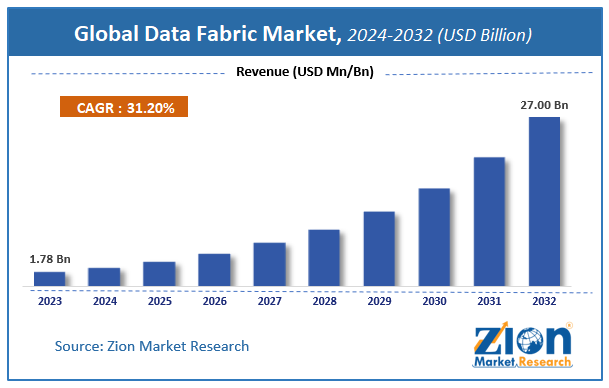
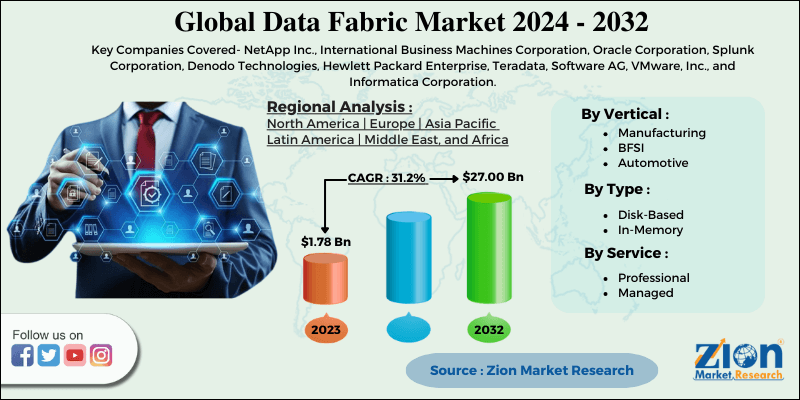
The global data fabric market size was worth around USD 1.78 billion in 2023 and is predicted to reach around USD 27.00 billion by 2032, with a compound annual growth rate (CAGR) of roughly 31.2% between 2024 and 2032.
This report provides a comprehensive analysis of the growth drivers, restraints, and challenges shaping demand across the global data fabric market throughout the forecast period, while highlighting high-potential emerging opportunities within the industry.
Key Insights
- According to our research analyst, the global data fabric market is estimated to grow at a CAGR of around 31.2% over the forecast period (2024-2032).
- In terms of revenue, the global data fabric market size was valued at around USD 1.78 billion in 2023 and is projected to reach USD 27.00 billion by 2032.
- The data fabric market is projected to grow at a significant rate due to the need for a unified environment to access and manage data regardless of location, support for hybrid and multi-cloud deployments, unified data management capabilities, and demand for scalable, governed, and real-time data processing.
- Based on the type, disk-based segment is growing at a high rate and is projected to dominate the global market.
- Based on the service, the professional services segment plays an important role in implementation, integration, and ongoing operation of data fabric environments across enterprises.
- Based on the vertical, the BFSI segment held the largest market share in 2023 and is expected to grow at a significant rate over the forecast period
- Based on region, North America is expected to lead and witness strong growth during the forecast period due to high acceptance of data management tools, significant private and government funding, presence of major vendors, and rapid adoption of IoT-driven techniques.
Data Fabric Market: Overview
In simple language, data fabric is defined as an environment comprising of unified architecture, services, and technologies that assist the firms in effectively handling the information. Furthermore, data fabric helps in optimizing the data value along with accelerating data transformation digitally. It provides seamless integrated hybrid cloud solutions for data visualization along with offering security to the data. Moreover, data fabric links to any kind of data source through pre-packaged components & connectors, thereby eliminating the coding requirement. Apart from this, it offers functionalities such as data integration & data ingestion abilities for data sources.
In addition to this, data fabric aids big data analytics and batch as well as real-time data processing. Apparently, it effectively handles multi-cloud, on-premises, and hybrid cloud environments. Additionally, data fabric also provides built-in data quality, data governance abilities, and data preparation capabilities with the help of machine learning algorithms. It also aids data sharing with external & internal stakeholders through support of API interface.
Data Fabric Market: Dynamics
The expansion of the data fabric industry over the forecast time span is due to its ability to offer a single environment for firms to access & gather all the data irrespective of its location and storage destination. In addition to this, data fabric facilitates unified data management activities such as data integration, data governance, and data sharing through the elimination of multiple tools, along with giving access to credible & authentic data. Furthermore, its ability to deliver scalability so that firms can adapt to voluminous data will further proliferate the expansion of the data fabric industry in the coming years.
Moreover, beneficial features offered by data fabric, such as its ability to support on-premises, cloud, multi-cloud, and hybrid cloud deployments, as well as migration between different cloud environments, will define the growth of the data fabric industry over 2024-2032. The ability of data fabric to detect fraudulent incidents as well as offload data warehouses will offer new growth avenues for the data fabric industry over the ensuing years.
Data Fabric Market: Report Scope
| Report Attributes | Report Details |
|---|---|
| Report Name | Data Fabric Market |
| Market Size in 2023 | USD 1.78 Billion |
| Market Forecast in 2032 | USD 27.00 Billion |
| Growth Rate | CAGR of 31.2% |
| Number of Pages | 220 |
| Key Companies Covered | NetApp Inc., International Business Machines Corporation, Oracle Corporation, Splunk Corporation, Denodo Technologies, Hewlett Packard Enterprise, Teradata, Software AG, VMware, Inc., and Informatica Corporation. |
| Segments Covered | By Type, By Service, By Vertical, and By Region |
| Regions Covered | North America, Europe, Asia Pacific (APAC), Latin America, Middle East, and Africa (MEA) |
| Base Year | 2023 |
| Historical Year | 2018 - 2022 |
| Forecast Year | 2024 - 2032 |
| Customization Scope | Avail customized purchase options to meet your exact research needs. Request For Customization |
Data Fabric Market: Segmentation
The data fabric market is segmented by type, service, vertical, and region. All the segments of the data fabric market have been analyzed based on present and future trends and the market is estimated from 2024 to 2032.
Based on Type Segment, the data fabric market is divided into disk-based and in-memory. Disk-based data fabric solutions support large-scale persistent storage and are suited to environments where cost-effective capacity and durability are priorities. In-memory architectures deliver high-speed access and processing, enabling real-time analytics and low-latency use cases. Both approaches address complementary enterprise requirements. The availability of disk-based and in-memory options allows organizations to balance performance, cost, and scale, thereby supporting broader adoption of data fabric architectures across analytics, operational, and hybrid workloads and contributing to overall market growth.
Based on Service Segment, the data fabric market is divided into professional and managed. Professional services support design, implementation, integration, and customization of data fabric environments, helping organizations navigate complex hybrid and multi-cloud landscapes. Managed services provide ongoing operation, monitoring, and optimization, reducing the operational burden on internal teams. Together, these service models enable successful deployment and sustained value realization. Strong demand for both professional and managed offerings helps drive market expansion by lowering barriers to adoption and ensuring long-term platform effectiveness.
Based on Vertical Segment, the data fabric market is divided into manufacturing, BFSI, and automotive. BFSI organizations adopt data fabric solutions to support real-time data integration, fraud detection, regulatory compliance, and customer analytics. Manufacturing leverages unified data access to improve operational visibility, supply-chain insights, and quality processes. The automotive sector uses data fabric capabilities to manage data from design, production, and connected vehicle sources. These verticals generate substantial demand for scalable, governed, and real-time data architectures, reinforcing overall market growth and encouraging continued platform innovation.
Data Fabric Market: Regional Analysis
Why will North America continue to dominate the global market during the projection period?
North America is expected to lead the data fabric market and witness strong growth during the forecast period. The regional market expansion during the forecast time span can be credited to the rise in the acceptance of data management tools in North America. In addition to this, large-scale private & government funding for developing more proficient data virtualization systems in Canada and the U.S. will expand the growth of the data fabric industry over the upcoming years.
Additionally, the large-scale presence of reputed vendors in the sub-continent will further contribute towards the regional market size. Rapid acceptance of IoT-driven techniques by many of the firms based in the U.S. will steer the business growth in North America over the years ahead.
Europe maintains an important role through strong enterprise IT investment, regulatory emphasis on data governance, and adoption of hybrid and multi-cloud strategies. Asia Pacific is expected to register rapid growth as digital transformation accelerates, cloud adoption expands, and organizations modernize data platforms to support analytics and AI initiatives. Latin America and the Middle East and Africa are anticipated to see gradual uptake as enterprises invest in unified data management and hybrid cloud capabilities.
Data Fabric Market: Competitive Analysis
Key players profiled in the report include:
- NetApp Inc.
- International Business Machines Corporation
- Oracle Corporation
- Splunk Corporation
- Denodo Technologies
- Hewlett Packard Enterprise
- Teradata
- Software AG
- VMware, Inc.
- Informatica Corporation.
The global data fabric market is segmented as follows
By Type
- Disk-Based
- In-Memory
By Service
- Professional
- Managed
By Vertical
- Manufacturing
- BFSI
- Automotive
By Region
- North America
- The U.S.
- Canada
- Mexico
- Europe
- France
- The UK
- Spain
- Germany
- Italy
- Rest of Europe
- Asia Pacific
- China
- Japan
- India
- Australia
- South Korea
- Rest of Asia Pacific
- The Middle East & Africa
- Saudi Arabia
- UAE
- Egypt
- Kuwait
- South Africa
- Rest of the Middle East & Africa
- Latin America
- Brazil
- Argentina
- Rest of Latin America
Table Of Content
Methodology
FrequentlyAsked Questions
Data fabric is an integrated data management architecture that enables seamless data access across systems. It comprises a unified architecture, services, and technologies that help organizations handle information effectively, support hybrid and multi-cloud environments, and deliver integration, governance, and analytics capabilities.
Key growth drivers include the need for a single environment to access data regardless of location, unified data management (integration, governance, and sharing), scalability for growing data volumes, support for hybrid and multi-cloud deployments, and capabilities related to fraud detection and data warehouse offloading.
According to the study, the global data fabric market size was worth around USD 1.78 billion in 2023 and is predicted to grow to around USD 27.00 billion by 2032.
The global data fabric market is expected to grow at a compound annual growth rate (CAGR) of around 31.2% during the forecast period from 2024 to 2032.
Major challenges include integration complexity, high implementation costs, and governance challenges related to data quality, security, and compliance across distributed environments.
Emerging trends include unified data access across hybrid clouds, metadata-driven automation, and real-time data orchestration and governance that improve agility, quality, and operational efficiency.
The value chain typically includes platform development and software engineering, data integration and connectivity components, professional services for design and implementation, managed services for ongoing operations, distribution through direct and partner channels, and continuous support for governance, security, and analytics use cases.
North America is expected to lead the data fabric market during the forecast period.
Key players profiled include NetApp Inc., International Business Machines Corporation, Oracle Corporation, Splunk Corporation, Denodo Technologies, Hewlett Packard Enterprise, Teradata, Software AG, VMware, Inc., and Informatica Corporation, among others.
The report explores crucial aspects of the data fabric market, including a detailed discussion of existing growth factors and restraints, while also examining future growth opportunities and challenges that impact the market.

HappyClients

