
Crispr and CAS Genes Market Size, Trend, Growth, Industry Analysis 2034

Crispr and CAS Genes Market By Services & Product (DNA Synthesis, Cell Line Engineering, Microbial Gene Editing, and gRNA Design, Libraries, Kits & Enzymes, Design Tools, Antibodies, and Others), By Application (Biomedical, Agricultural, and Others), By End-Use (Academics & Government Research Institutes, Contract Research Organizations (CROs), and Biotechnology & Pharmaceutical Companies), and By Region - Global and Regional Industry Overview, Market Intelligence, Comprehensive Analysis, Historical Data, and Forecasts 2026 - 2034
| Market Size in 2025 | Market Forecast in 2034 | CAGR (in %) | Base Year |
|---|---|---|---|
| USD 5.6 Billion | USD 23.4 Billion | 17.23% | 2025 |
CRISPR and CAS Genes Industry Perspective:
What is the anticipated size of the CRISPR and CAS genes market during the projection period?
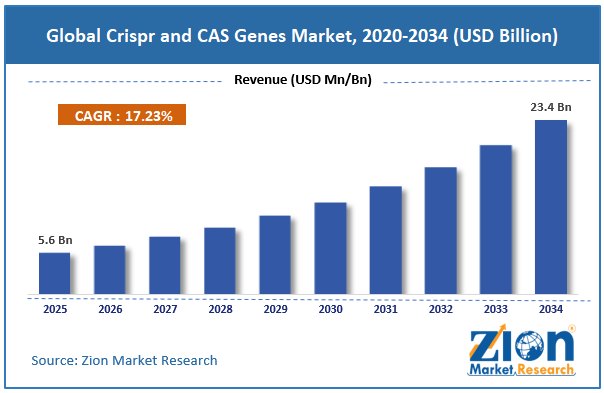
The global CRISPR and CAS genes market size was worth around USD 5.6 billion in 2025 and is predicted to grow to around USD 23.4 billion by 2034, with a compound annual growth rate (CAGR) of roughly 17.23% between 2026 and 2034.
Key Insights:
- As per the analysis shared by our research analyst, the global CRISPR and CAS genes market is estimated to grow annually at a CAGR of around 17.23% over the forecast period (2026-2034)
- In terms of revenue, the global CRISPR and CAS genes market size was valued at around USD 5.6 billion in 2025 and is projected to reach USD 23.4 billion, by 2034.
- The CRISPR and CAS genes market is projected to grow at a significant rate due to rising biotech investments, accelerating vaccine development, and use in agricultural research.
- Based on the services & products, the products segment is growing at a high rate and will continue to dominate the global market as per industry projections.
- Based on the application, the biomedical segment is anticipated to command the largest market share.
- Based on the end-use, the biotechnology & pharmaceutical companies segment is expected to lead the market growth trends.
- Based on region, North America is projected to dominate the global market during the forecast period.
CRISPR and CAS Genes Market: Overview
Clustered Regularly Interspaced Short Palindromic Repeats (CRISPR)-CAS genes are gene-editing mechanisms used to make targeted changes to Deoxyribonucleic Acid (DNA). CRISPR is a naturally occurring specialized DNA stretch that acts as genetic memory. They allow body cells to recognize future identical infections. On the other hand, CAS genes produce CAS proteins that are eventually useful in cutting DNA at targeted locations. CRISPR and CAS genes are widely used in modern biotechnology. Researchers are investigating them for potential applications in treating cancer and genetic disorders. During the forecast period, demand in the CRISPR and CAS genes market is expected to grow due to rising biotech investments, accelerating vaccine development, and use in agricultural research. However, factors such as a lack of skilled professionals, high investment cost, and a lack of supportive infrastructure will affect market revenue in the long run.
Impact of the USA-Israel and Iran war on the CRISPR and CAS Genes Market:
The USA-Israel and Iran war has increased transportation and laboratory supply costs concerning the CRISPR and CAS genes market. Supply chain disruptions and increased research & development (R&D) expenses will further affect market revenue. However, investments in CRISPR and CAS gene-editing mechanisms will continue to grow in the long run as governments focus on ensuring healthcare security for their population. More resilient supply chain networks and production lines are expected to emerge in the coming years.
CRISPR and CAS Genes Market: Dynamics
Growth Drivers
How will rising applications in biotech shape growth in the CRISPR and CAS genes market?
The global CRISPR and CAS genes market is expected to be significantly influenced by the growing application of the gene-editing tool in biotechnology. CRISPR systems play a pivotal role in drug research and development. They are also essential for comprehensive gene-based studies. A surge in global healthcare standards and strategic partnerships is expected to shape biotech investments in the coming years. According to the Innovative Genomics Institute, CRISPR-based clinical trials continued to grow in the US in 2025 despite challenging conditions, such as diminished venture capital funding. In July 2026, India’s Natco Pharma announced an investment of INR 2500 crore in South Africa’s healthcare market. The company will offer major funds to the region’s biotech assets.
Rising number of gene-editing research projects will aid market expansion in the long run
Gene-editing research & development projects have registered record investments in the last decade. Comprehensive understanding of genes and how to modify them has emerged as crucial to the next stage of healthcare standards. Gene editing can help medical researchers better understand serious conditions and develop new therapies to treat conditions such as genetic disorders and cancer. In addition, solutions in the global CRISPR and CAS genes market can open new growth avenues for next-generation drugs, improving access to medical care.
Restraints
Which are the leading restrictions affecting growth in the CRISPR and CAS genes industry?
The global CRISPR and CAS genes industry is projected to be restricted due to high cost of investment, a lack of skilled workforce, and safety concerns. Developing CRISPR-based systems requires years of research. It is also highly expensive. Comprehensive clinical trials and testing further increase the overall cost of production. In addition, the industry faces a significant lack of a sufficient skilled workforce. There is a high risk of adverse reactions if cells misidentify edited genes as foreign material, raising questions about process efficiency.
Opportunities
Which applications in the agricultural sector will create growth opportunities for the CRISPR and CAS genes market players?
The global CRISPR and CAS genes market is expected to grow as the system becomes more widely used in agriculture. Gene-editing mechanisms help develop modified, highly resistant crops that can withstand climate change, pest infestation, and natural disasters. In August 2026, researchers from India’s National Agri-Food and Biomanufacturing Institute announced that they had successfully conducted gene-editing in peas. The researchers overcame a critical hurdle in the gene-editing process by genetically transforming pea cells to develop into plants using the CRISPR-Cas9 tool. Growing integration of next-generation technologies such as Artificial Intelligence (AI), single-cell sequencing, next-generation sequencing (NGS), and automation & high-throughput screening will further create more expansion possibilities for market players.
Challenges
Strict regulatory frameworks to challenge the CRISPR and CAS genes industry
The global CRISPR and CAS genes industry is expected to face challenges from strict regulatory frameworks governing research, trials, and testing. Lack of standard regulations creates additional complexities for players planning to expand into new markets. Moreover, the absence of supportive infrastructure, limited funds, and difficulty achieving editing accuracy may affect overall industry revenue.
Crispr and CAS Genes Market: Report Scope
| Report Attributes | Report Details |
|---|---|
| Report Name | Crispr and CAS Genes Market |
| Market Size in 2025 | USD 5.6 Billion |
| Market Forecast in 2034 | USD 23.4 Billion |
| Growth Rate | CAGR of 17.23% |
| Number of Pages | 228 |
| Key Companies Covered | Editas Medicine, Thermo Fisher Scientific, Sangamo Therapeutics, Intellia Therapeutics, Horizon Discovery, Cellectis, CRISPR Therapeutics, Mammoth Biosciences, Beam Therapeutics, Takara Bio, Agilent Technologies, GenScript, Merck KGaA, Synthego, Caribou Biosciences, and others. |
| Segments Covered | By Services & Product, By Application, By End-Use, and By Region |
| Regions Covered | North America, Europe, Asia Pacific (APAC), Latin America, Middle East, and Africa (MEA) |
| Base Year | 2025 |
| Historical Year | 2020 - 2024 |
| Forecast Year | 2026 - 2034 |
| Customization Scope | Avail customized purchase options to meet your exact research needs. Request For Customization |
CRISPR and CAS Genes Market: Segmentation
The global CRISPR and CAS genes market is segmented based on services & product, application, end-use, and region.
Why will the products segment lead the CRISPR and CAS genes industry revenue during the forecast period?
Based on services, the market is further segmented into DNA synthesis, cell line engineering, microbial gene editing, and gRNA design. The product segment is fragmented into libraries, kits & enzymes, design tools, antibodies, and others. In 2025, the highest growth was listed in the products segment. It accounted for 45% of the global revenue and will continue growing at a CAGR of 24.7% during the forecast period. Increasing development of engineered enzymes and their research applications will drive segmental growth.
Which will be the fastest-growing application during the forecast period in the CRISPR and CAS genes market?
Based on application, the global CRISPR and CAS genes industry is divided into biomedical, agricultural, and others. In 2025, the biomedical segment led market growth, accounting for 81.41% of global revenue. During the forecast period, it is expected to generate the fastest growth with a CAGR of 16.32%, due to rapid investments in biotechnology industries, growing pressure on existing healthcare infrastructure, and rising demand for effective medical care.
Which factors drive demand in the contract research organizations (CROs) segment in the CRISPR and CAS genes industry?
Based on end-use, the global market segments are academic & government research institutes, contract research organizations (CROs), and biotechnology & pharmaceutical companies. In 2025, the biotechnology & pharmaceutical companies segment was the leading revenue generator, accounting for over 50% of the total market share. During the forecast period, the contract research organizations (CROs) segment is expected to generate a higher CAGR of 23.92%. Companies are actively sourcing research & development projects to CROs because they have access to necessary research equipment and skilled experts. Additionally, the growing number of CROs worldwide will further help the segment thrive.
CRISPR and CAS Genes Market: Regional Analysis
Why will North America lead the CRISPR and CAS genes market in the coming years?
The global CRISPR and CAS genes market is currently led by North America. In 2025, it accounted for 47.12% of the global revenue and will grow at a strong CAGR of 15.9% during the forecast period. Growth across North America is supported by growing government and private funding in the region’s biotech sector. Additionally, rising demand for advanced healthcare, growing focus on precision medicine, and a favorable regulatory environment will aid regional prominence in the coming years.
Why will Asia-Pacific generate the fastest CAGR in the CRISPR and CAS genes market during the forecast period?
Asia-Pacific is expected to emerge as the fastest-growing region in the CRISPR and CAS genes market with a CAGR of 16.22% during the forecast period. In 2025, it accounted for 25.1% of the global revenue. China and India are expected to emerge as leading revenue generators. Asia-Pacific is expected to see increased domestic investment to strengthen its regional medical R&D industry. Additionally, the growing prominence of CROs across Asia-Pacific and a surge in agriculture applications of CRISPR systems will promote regional revenue.
CRISPR and CAS Genes Market: Competitive Analysis
The global CRISPR and CAS genes market is led by players like:
- Editas Medicine
- Thermo Fisher Scientific
- Sangamo Therapeutics
- Intellia Therapeutics
- Horizon Discovery
- Cellectis
- CRISPR Therapeutics
- Mammoth Biosciences
- Beam Therapeutics
- Takara Bio
- Agilent Technologies
- GenScript
- Merck KGaA
- Synthego
- Caribou Biosciences
What are the latest key trends in the CRISPR and CAS genes market?
Technology commercialization
Ongoing efforts to commercialize the CRISPR-Cas9 system for medical treatments are a prominent market trend. The US Food & Drug Administration (FDA) recently approved CRISPR/Cas9 therapy Casgevy to treat children with transfusion-dependent beta-thalassemia and sickle-cell disease.
Use of bioinformatics
Companies are leveraging bioinformatics systems and AI to identify gene targets, predict outcomes, and analyze data for further research. Use of sophisticated technologies in improving CRISPR systems will create more growth avenues for the industry leaders.
The global CRISPR and CAS genes market is segmented as follows:
By Services & Product
- DNA Synthesis
- Cell Line Engineering
- Microbial Gene Editing
- gRNA Design
- Libraries
- Kits & Enzymes
- Design Tools
- Antibodies
- Others
By Application
- Biomedical
- Agricultural
- Others
By End-Use
- Academics & Government Research Institutes
- Contract Research Organizations (CROs)
- Biotechnology & Pharmaceutical Companies
By Region
- North America
- The U.S.
- Canada
- Mexico
- Europe
- France
- The UK
- Spain
- Germany
- Italy
- Rest of Europe
- Asia Pacific
- China
- Japan
- India
- Australia
- South Korea
- Rest of Asia Pacific
- The Middle East & Africa
- Saudi Arabia
- UAE
- Egypt
- Kuwait
- South Africa
- Rest of the Middle East & Africa
- Latin America
- Brazil
- Argentina
- Rest of Latin America
Table Of Content
Methodology
FrequentlyAsked Questions
Clustered Regularly Interspaced Short Palindromic Repeats (CRISPR)-CAS genes are a gene-editing mechanism used to make targeted changes to Deoxyribonucleic Acid (DNA).
The global CRISPR and CAS genes market is expected to be significantly influenced by the growing application of the gene-editing tool in biotechnology.
According to study, the global CRISPR and CAS genes market size was worth around USD 5.6 billion in 2025 and is predicted to grow to around USD 23.4 billion by 2034.
The CAGR value of the CRISPR and CAS genes market is expected to be around 17.23% during 2026-2034.
The global CRISPR and CAS genes industry is anticipated to be challenged by strict regulatory frameworks concerning research, trials, and testing.
Technology commercialization and the use of bioinformatics are the emerging trends and innovations impacting the CRISPR and CAS genes market.
The global CRISPR and CAS genes market has performed well so far and will offer similar trends in the coming years.
North America will contribute notably towards the CRISPR and CAS genes market value.
The global CRISPR and CAS genes market is led by players like Editas Medicine, Thermo Fisher Scientific, Sangamo Therapeutics, Intellia Therapeutics, Horizon Discovery, Cellectis, CRISPR Therapeutics, Mammoth Biosciences, Beam Therapeutics, Takara Bio, Agilent Technologies, GenScript, Merck KGaA, Synthego, and Caribou Biosciences.
The report explores crucial aspects of the CRISPR and CAS genes market, including a detailed discussion of existing growth factors and restraints, while also browsing future growth opportunities and challenges that impact the market.

List of Contents
CRISPR and CAS GenesIndustry Perspective:Key Insights:CRISPR and CAS Genes OverviewCRISPR and CAS Genes DynamicsReport ScopeCRISPR and CAS Genes SegmentationCRISPR and CAS Genes Regional AnalysisCRISPR and CAS Genes Competitive AnalysisWhat are the latest key trends in the CRISPR and CAS genes market?The global CRISPR and CAS genes market is segmented as follows:HappyClients

