
Corn Tortilla Market Size, Share, Growth, Opportunities 2034

Corn Tortilla Market By Type (White Corn Tortillas, Yellow Corn Tortillas, Blue Corn Tortillas, Organic Corn Tortillas), By Application (Household Consumption, Food Service Industry, Quick Service Restaurants, Institutional Catering), By Distribution Channel (Supermarkets and Hypermarkets, Convenience Stores, Online Retail, Specialty Food Stores), By Packaging Type (Flexible Packaging, Rigid Packaging), and By Region - Global and Regional Industry Overview, Market Intelligence, Comprehensive Analysis, Historical Data, and Forecasts 2026 - 2034
| Market Size in 2025 | Market Forecast in 2034 | CAGR (in %) | Base Year |
|---|---|---|---|
| USD 12.81 Billion | USD 19.26 Billion | 4.56% | 2025 |
Corn Tortilla Industry Perspective:
What will be the size of the corn tortilla market during the forecast period?
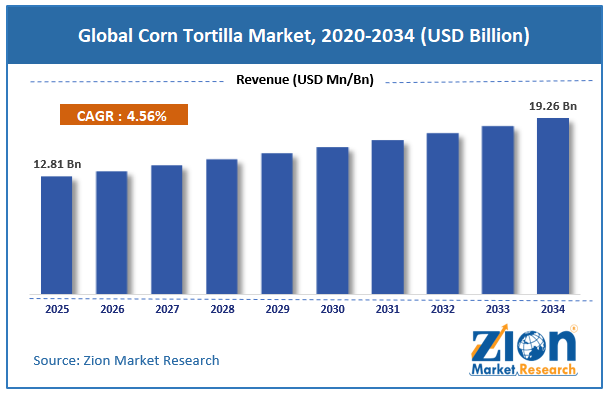
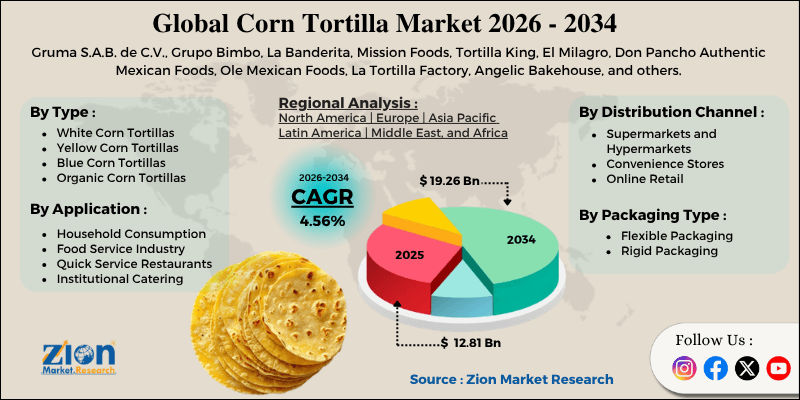
The global corn tortilla market size was approximately USD 12.81 billion in 2025 and is projected to reach around USD 19.26 billion by 2034, with a compound annual growth rate of roughly 4.56% between 2026 and 2034.
Key Insights
- As per the analysis shared by our research analyst, the global corn tortilla market is estimated to grow annually at a compound annual growth rate of around 4.56% over the forecast period from 2026 to 2034.
- In terms of revenue, the global corn tortilla market size was valued at approximately USD 12.81 billion in 2025 and is projected to reach USD 19.26 billion by 2034.
- The corn tortilla market is expected to grow steadily, driven by rising demand for gluten-free foods, the growing popularity of Mexican-style cuisine, the expansion of quick-service restaurant chains, and continuous improvements in packaging and shelf life.
- Based on type, white corn tortillas are expected to lead the market, while organic corn tortillas are anticipated to grow steadily as demand for clean-label and pesticide-free food products rises.
- Based on application, household consumption is expected to lead the corn tortilla market. At the same time, the quick-service restaurant segment is anticipated to grow rapidly, driven by rising demand for authentic ethnic meals at restaurants.
- Based on distribution channel, supermarkets and hypermarkets form the largest current distribution group. At the same time, online retail is expected to grow rapidly during the forecast period as more consumers prefer home delivery of grocery items.
- Based on packaging type, flexible packaging is expected to lead the market. In contrast, rigid packaging is anticipated to grow steadily as demand increases for stackable and long-shelf-life tortilla products.
- Based on region, North America is projected to dominate the global corn tortilla market during the estimated period, followed by Latin America.
Corn Tortilla Market: Overview
A corn tortilla is a soft, round, thin flatbread made from ground corn, water, and a small amount of lime, commonly used to prepare dishes such as tacos, enchiladas, quesadillas, and wraps. Unlike wheat tortillas, corn tortillas are naturally gluten-free, making them a popular choice for people seeking healthier, easier-to-digest options. They are widely used in homes, restaurants, and food service outlets across many countries. The growing popularity of Mexican and Latin American cuisine has increased demand for ready-to-eat corn tortillas in supermarkets and online stores. Consumers also prefer corn tortillas because they are generally low in fat and can provide fiber when made from whole corn. Rising interest in clean-label foods with simple ingredients is encouraging manufacturers to reduce the use of artificial preservatives. The expansion of quick-service restaurants serving Mexican-style meals is further supporting demand for corn tortillas. In addition, government support for corn farming and food processing industries in several countries is helping improve production and strengthen the overall supply chain for the corn tortilla market.
The corn tortilla industry is growing due to rising demand for gluten-free food products, the increasing popularity of ethnic and fusion cuisine, and a growing preference for convenient, ready-to-eat meal options.
Impact of the USA-Israel War on Iran on the Corn Tortilla Market
Tensions among the United States, Israel, and Iran could create short-term challenges for the global food supply chain, particularly for packaging materials and transportation routes that some corn tortilla producers rely on to export their goods. Some manufacturers may experience temporary delays in receiving certain packaging supplies or shipping containers, which could slow near-term distribution timelines in some export markets. However, steady demand from households and food service businesses is expected to keep the corn tortilla market on a stable growth path despite short-term regional disruptions.
Corn Tortilla Market: Technology Roadmap 2026–2034
What is the projected development roadmap for the corn tortilla market over the forecast period?
The corn tortilla market is progressing through improved production methods, smarter packaging solutions, and wider integration with modern retail and food service systems. The market is expected to grow at a compound annual growth rate of around 4.56% over the forecast period, supported by rising global demand for gluten-free and convenient food products.
The following roadmap outlines key development phases expected through 2034.
2026–2028: Production Efficiency and Freshness Improvement Phase
- Manufacturers are expected to develop faster, more hygienic production lines that improve tortilla texture and freshness without adding unnecessary preservatives.
- Automated dough mixing and cooking technology is expected to expand, allowing producers to maintain consistent quality across large batches rather than relying only on manual processes.
- Improved cooling and packaging designs are expected to extend the shelf life of corn tortillas, reducing food waste throughout the supply chain.
2029–2032: Smart Supply Chain and Nutrition Optimization Phase
- Companies are expected to integrate corn tortilla production with digital supply chain tracking systems to manage ingredient sourcing and delivery timing more efficiently.
- Integration between tortilla makers and nutrition-focused food brands is expected to grow, giving consumers better access to fortified and whole-grain tortilla options.
- Cloud-connected inventory platforms are expected to help retailers monitor tortilla freshness across thousands of stores simultaneously, improving stock rotation and reducing spoilage.
2033–2034: Fully Connected Sustainable Production Phase
- Corn tortilla production is expected to become part of larger, interconnected food ecosystems that link farming, processing, and retail into a single, coordinated system.
- Self-monitoring production equipment is expected to reduce the need for manual quality checks, making large-scale manufacturing more consistent and less dependent on constant supervision.
- Fully automated freshness alert systems are expected to notify retailers and distributors instantly when a batch nears its expiry date, thereby improving food safety and reducing waste.
Corn Tortilla Market: Dynamics
Growth Drivers
Rising demand for gluten-free and traditional foods is driving growth in the corn tortilla market.
The corn tortilla market is growing as more people look for gluten-free alternatives to wheat-based bread and wraps. Unlike many packaged breads, corn tortillas are naturally gluten-free, making them suitable for people with wheat sensitivities and anyone seeking lighter meal options. They are widely used in tacos, enchiladas, wraps, and other everyday meals, making them a versatile choice for homes and restaurants. Growing interest in Mexican and Latin American cuisine is increasing demand for corn tortillas across many countries. Health-conscious consumers also prefer products with simple, clean ingredient lists, encouraging manufacturers to develop tortillas that stay soft and fresh longer without unnecessary additives. Government support for corn farming and food safety standards is helping improve production and supply chains in several regions. Investments in modern food processing technology are also improving manufacturing efficiency and product quality.
As a result, the corn tortilla industry is experiencing strong demand from households, supermarkets, restaurants, catering services, and food manufacturers worldwide, driven by shifting consumer preferences, broader retail availability, and ongoing product innovation.
How is rising investment in quick service restaurants and packaged food innovation driving the corn tortilla market?
The corn tortilla market is growing as fast food chains, quick-service restaurants, and casual dining restaurants add more Mexican-inspired dishes to their menus. Corn tortillas are widely used to prepare tacos, burritos, wraps, quesadillas, and other popular meals that are quick, tasty, and easy to customize. The increasing popularity of build-your-own meal options is creating strong demand for high-quality corn tortillas with consistent size, texture, and freshness. Manufacturers are developing tortillas that remain soft, flexible, and durable even after being filled with hot ingredients. Many companies are also launching flavored, multigrain, vegetable-based, and colorful corn tortillas made from ancient corn varieties to attract health-conscious and adventurous consumers. These innovations improve menu choices, encourage repeat purchases, and support changing food preferences. Packaged food manufacturers are expanding their frozen and refrigerated corn tortilla products, allowing consumers to enjoy fresh-tasting tortillas at home. Investments in modern food processing, cold chain logistics, and food safety technologies are further supporting market growth. As convenience, authentic flavors, and healthier food choices gain popularity, the market is expected to witness steady demand across retail stores, supermarkets, restaurants, and foodservice channels worldwide.
Restraints
High production costs and short shelf life are key challenges in the corn tortilla market.
The corn tortilla market faces several challenges that may slow its growth. One of the biggest issues is the rising cost of high-quality corn and the traditional lime treatment process, which is essential for achieving the authentic taste, texture, and quality of corn tortillas. Small manufacturers often struggle to invest in modern equipment and production technology needed to compete with larger brands. Another challenge is maintaining freshness, as corn tortillas can dry out or spoil quickly without proper packaging and storage. Extending shelf life while preserving taste and texture remains a key concern for manufacturers and retailers.
In addition, changing corn prices, supply chain disruptions, and higher transportation costs can increase production expenses and affect product availability. Companies must also comply with strict food safety, quality, and labeling regulations, which add to operating costs. Although demand for gluten-free and Mexican food continues to grow, production, storage, and cost-related challenges still limit market growth in several regions.
Opportunities
Expanding retail presence and rising interest in ethnic cuisine are driving growth in the corn tortilla market.
The corn tortilla market offers strong growth opportunities as demand for Mexican food, ethnic cuisine, and convenient meal options continues to rise worldwide. The expansion of supermarkets, hypermarkets, and modern grocery stores is increasing the availability of authentic corn tortillas in many countries. Growing sales of Mexican-style snacks, taco kits, and ready-to-cook meal kits across Europe, the Middle East, and Southeast Asia are creating new opportunities for manufacturers. Corn tortillas are also being used in fusion recipes such as breakfast burritos, wraps, and creative street food, encouraging companies to introduce products that suit local tastes. Many producers are launching organic, non-GMO, and clean-label corn tortillas to meet the growing demand for healthier food choices. The rapid growth of online grocery shopping is making specialty and ethnic food products easier for consumers to purchase.
At the same time, improvements in food packaging, natural preservation techniques, and production technology are extending shelf life while maintaining freshness and quality. These developments are expected to drive long-term growth in the corn tortilla market by improving product variety, accessibility, nutrition, and overall consumer satisfaction across global markets.
Challenges
What challenges does the corn tortilla market face in quality consistency and supply chain readiness amid rising competition?
The corn tortilla industry faces several challenges that could affect its growth. One of the biggest challenges is maintaining consistent taste, texture, size, and quality across different production batches. Poor quality can reduce customer satisfaction, harm brand reputation, and lead to product returns. Manufacturers must invest in high-quality corn, strict quality checks, and employee training to meet consumer expectations. Another challenge is the shortage of skilled workers with knowledge of both traditional corn processing and modern food manufacturing techniques. As production becomes more automated, companies need trained professionals to operate advanced equipment efficiently. Competition from wheat tortillas, flatbreads, and other convenient snack options also makes it difficult for manufacturers to attract and retain customers. These production, workforce, and cost-related challenges can increase operating expenses and slow the introduction of premium products. As a result, smaller manufacturers with limited resources often struggle to compete effectively in the growing corn tortilla market.
Corn Tortilla Market: Report Scope
| Report Attributes | Report Details |
|---|---|
| Report Name | Corn Tortilla Market |
| Market Size in 2025 | USD 12.81 Billion |
| Market Forecast in 2034 | USD 19.26 Billion |
| Growth Rate | CAGR of 4.56% |
| Number of Pages | 228 |
| Key Companies Covered | Gruma S.A.B. de C.V., Grupo Bimbo, La Banderita, Mission Foods, Tortilla King, El Milagro, Don Pancho Authentic Mexican Foods, Ole Mexican Foods, La Tortilla Factory, Angelic Bakehouse, and others. |
| Segments Covered | By Type, By Application, By Distribution Channel, By Packaging Type, and By Region |
| Regions Covered | North America, Europe, Asia Pacific (APAC), Latin America, Middle East, and Africa (MEA) |
| Base Year | 2025 |
| Historical Year | 2020 - 2024 |
| Forecast Year | 2026 - 2034 |
| Customization Scope | Avail customized purchase options to meet your exact research needs. Request For Customization |
Corn Tortilla Market: Segmentation
The global corn tortilla market is segmented by type, application, distribution channel, packaging type, and region.
What makes white corn tortillas the expected leader in the corn tortilla market?
Based on type, the global corn tortilla market is divided into white, yellow, blue, and organic varieties. White corn tortillas hold about 44% of the market share, leading due to their mild flavor, soft texture, and wide acceptance across different cuisines and age groups. Organic corn tortillas hold around 25% of the market share. It is one of the fastest-growing segments, driven by increasing consumer interest in nutrient-rich food options.
How does the household consumption application segment maintain its leading position in the corn tortilla market?
Based on application, the corn tortilla industry is categorized into household consumption, food service industry, quick service restaurants, and institutional catering. The household consumption segment accounts for about 45% of the global corn tortilla market, driven by rising home cooking trends and growing demand for gluten-free meal options. The quick service restaurant segment holds around 22% of the market share. It is one of the fastest-growing segments, driven by rising consumer interest in fast, customizable, and flavorful meal choices.
What makes supermarkets and hypermarkets the leading distribution channel for corn tortillas?
Based on distribution channel, the market is classified into supermarkets and hypermarkets, convenience stores, online retail, and specialty food stores. Supermarkets and hypermarkets lead with about a 40% share, driven by wide product availability and frequent in-store promotions. Online retail holds around 24% of the market share. It is growing rapidly as more consumers prefer ordering groceries and specialty foods through home delivery services.
How does flexible packaging dominate the packaging type landscape in the corn tortilla market?
Based on packaging type, the corn tortilla market is segregated into flexible and rigid packaging. Flexible packaging accounts for about 63% of the market, due to its ability to keep tortillas fresh while remaining lightweight and cost-effective for large-scale distribution. Rigid packaging holds around 37% of the market share. It is growing steadily as demand for stackable, tamper-proof packaging increases among premium and export-focused brands.
Corn Tortilla Market: Regional Analysis
What is driving North America's leadership in the corn tortilla market?
The North America corn tortilla market accounts for around 42% of the global market, making it the leading regional market. This strong position is supported by the widespread popularity of Mexican cuisine, a well-developed food industry, and growing demand for gluten-free food products. The United States holds the largest market share due to its large Hispanic population, extensive network of Mexican restaurants, and strong supermarket and retail presence. Mexico remains a major producer and consumer of corn tortillas, while Canada is witnessing increasing demand as interest in ethnic foods continues to grow. The popularity of home cooking, meal kits, and convenient ready-to-use foods is further boosting sales of corn tortillas across the region.
Health-conscious consumers are also driving demand for organic, non-GMO, and clean-label corn tortillas. Manufacturers are investing in advanced food processing, improved recipes, and innovative packaging solutions to maintain freshness, extend shelf life, and enhance product quality. Strong partnerships between corn farmers, food manufacturers, distributors, and retailers continue to strengthen the supply chain. Ongoing investments in food safety, cold chain logistics, sustainable farming, and product innovation are expected to help North America maintain its leadership in the global corn tortilla market over the coming years.
What factors are supporting the expansion of the corn tortilla market across Latin America?
The Latin America corn tortilla market accounts for around 29% of the global market, making it the second-largest regional market. Growth is driven by the region's strong tradition of consuming corn-based foods, large-scale corn cultivation, and rising demand for convenient packaged food products. Mexico leads the regional market because corn tortillas are a daily staple, supported by strong domestic corn production and ongoing investments in food-processing technology. Manufacturers are improving production methods to preserve authentic flavor while extending shelf life for wider distribution. Brazil is also experiencing steady market growth due to rapid urbanization, changing dietary habits, and rising demand for quick-meal options.
Countries such as Argentina and Colombia are witnessing higher consumption of corn tortillas in households, restaurants, and street food businesses. Government initiatives supporting corn farming and food processing are strengthening regional supply chains. Companies are introducing affordable, high-quality, and clean-label corn tortillas to meet the needs of both urban and rural consumers. Investments in modern packaging, food safety, agricultural infrastructure, and manufacturing technology are expected to support the long-term growth of the Latin America corn tortilla market while improving product quality and availability.
Recent Market Developments
- In March 2026, Gruma announced that Mission Foods now adds folic acid to all of its branded and private-label corn tortillas sold in the United States, supporting compliance with California's new fortification requirements and reinforcing its commitment to nutrition and product quality.
Corn Tortilla Market: Competitive Analysis
The leading players in the global corn tortilla market are:
- Gruma S.A.B. de C.V.
- Grupo Bimbo
- La Banderita
- Mission Foods
- Tortilla King
- El Milagro
- Don Pancho Authentic Mexican Foods
- Ole Mexican Foods
- La Tortilla Factory
- Angelic Bakehouse
The global corn tortilla market is segmented as follows:
By Type
- White Corn Tortillas
- Yellow Corn Tortillas
- Blue Corn Tortillas
- Organic Corn Tortillas
By Application
- Household Consumption
- Food Service Industry
- Quick Service Restaurants
- Institutional Catering
By Distribution Channel
- Supermarkets and Hypermarkets
- Convenience Stores
- Online Retail
- Specialty Food Stores
By Packaging Type
- Flexible Packaging
- Rigid Packaging
By Region
- North America
- The U.S.
- Canada
- Mexico
- Europe
- France
- The UK
- Spain
- Germany
- Italy
- Rest of Europe
- Asia Pacific
- China
- Japan
- India
- Australia
- South Korea
- Rest of Asia Pacific
- The Middle East & Africa
- Saudi Arabia
- UAE
- Egypt
- Kuwait
- South Africa
- Rest of the Middle East & Africa
- Latin America
- Brazil
- Argentina
- Rest of Latin America
Table Of Content
Methodology
FrequentlyAsked Questions
A corn tortilla is a soft, round, thin flatbread made from ground corn, water, and a small amount of lime, commonly used to prepare dishes such as tacos, enchiladas, quesadillas, and wraps.
The global corn tortilla market is expected to grow, driven by rising demand for gluten-free foods, the growing popularity of Mexican and Latin American cuisine, expanding quick-service restaurant chains, and continuous improvements in packaging and shelf life.
According to research, the global corn tortilla market size was valued at around USD 12.81 billion in 2025 and is projected to reach around USD 19.26 billion by 2034.
The compound annual growth rate value of the corn tortilla market is expected to be around 4.56% during 2026 to 2034.
North America is expected to lead the global corn tortilla market during the forecast period, driven by strong Mexican food culture, well-developed retail infrastructure, and rising consumer demand for gluten-free products.
The major players in the global corn tortilla market include Gruma S.A.B. de C.V., Grupo Bimbo, La Banderita, Mission Foods, Tortilla King, El Milagro, Don Pancho Authentic Mexican Foods, Ole Mexican Foods, La Tortilla Factory, and Angelic Bakehouse.
The report examines key aspects of the corn tortilla market, including growth drivers, restraints, emerging opportunities, challenges, a competitive landscape analysis, regional breakdowns, and a detailed future outlook across all major types, applications, distribution channels, and geographies.
The corn tortilla market requires stakeholders to invest in improved production technologies, better packaging solutions, healthier product formulations, strategic partnerships with retailers and restaurants, and continuous product innovation. Expanding production capacity, strengthening supply chains, and investing in research and development can also improve long-term competitiveness.
The corn tortilla market is advancing through automated production lines, digital supply chain tracking, improved packaging for extended freshness, and nutrition-focused product development, thereby improving quality, efficiency, and consumer satisfaction.
The corn tortilla market is driven by food safety standards, labeling regulations, sustainable farming incentives, import and export policies, and clean label requirements that promote healthier and more transparent food production practices.

HappyClients

