Global Cold Chain Equipment Market Size, Share, Growth Analysis Report - Forecast 2034

Cold Chain Equipment Market By Equipment Type (Storage Equipment and Transportation Equipment), By Application (Meat, Dairy & Frozen Desserts, Bakery & Confectionary, Processed Food, Pharmaceuticals, and Vegetables & Fruits), and By Region: Global and Regional Industry Overview, Market Intelligence, Comprehensive Analysis, Historical Data, and Forecasts 2025 - 2034
| Market Size in 2024 | Market Forecast in 2034 | CAGR (in %) | Base Year |
|---|---|---|---|
| USD 19.26 Billion | USD 104.44 Billion | 18.4% | 2024 |
Cold Chain Equipment Industry Perspective
What will be the global cold chain equipment market size during the forecast period?
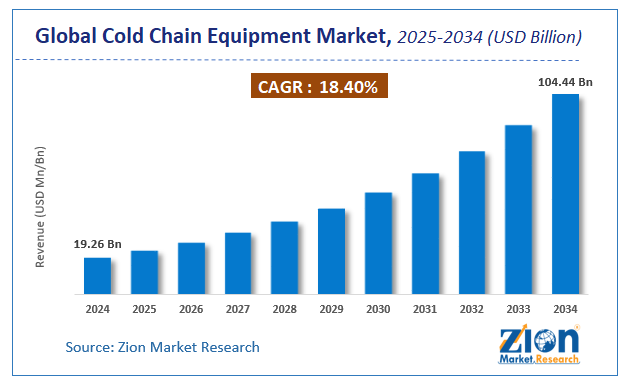
The global cold chain equipment market size was valued at around USD 19.26 billion in 2024 and is projected to reach about USD 104.44 billion by 2034, with a compound annual growth rate (CAGR) of roughly 18.4% between 2025 and 2034.
This report provides a comprehensive analysis of the growth drivers, restraints, and challenges shaping demand across the global cold chain equipment market throughout the forecast period, while highlighting high-potential emerging opportunities within the industry.
Key Insights
- As per the analysis shared by our research analyst, the global cold chain equipment market is estimated to grow at a CAGR of approximately 18.4% during the forecast period from 2025 to 2034.
- In terms of revenue, the global cold chain equipment market size was valued at around USD 19.26 billion in 2024 and is projected to reach USD 104.44 billion by 2034.
- The market is driven by increasing demand for temperature-sensitive goods in the food and pharmaceutical sectors, growth in frozen and processed food consumption, strict government norms for food and pharmaceutical safety during storage and transit, and advancements in refrigeration and monitoring technologies.
- Based on the equipment type, the storage equipment segment is expected to lead the global market, supported by the essential role of refrigerators, freezers, cold rooms, and related systems in preserving perishable products.
- Based on the application, the meat segment is growing at a high rate and is expected to continue dominating the global market due to the critical need for temperature control in meat storage and distribution.
- Regionally, North America is predicted to dominate the global market during the forecast period, supported by established cold chain infrastructure, strong demand for temperature-sensitive food and pharmaceuticals, and the presence of major logistics and storage providers.
Cold Chain Equipment Market: Overview
Vaccines, specialty chemicals, and medicines are to be stored & transported at a specific temperature to retain their properties, and cold chain equipment serves this purpose. Moreover, cold chain equipment includes ice packs, refrigerators, vaccine carriers, foam pads, biotech items, insulin, and cold boxes. Escalating demand for frozen diets across the world has resulted in a huge need for cold chain equipment in recent years. Furthermore, cold chain equipment is a key component of the immunization supply chain in the healthcare sector. Reportedly, cold chain equipment such as freezers, cold rooms, vaccine carriers, cold boxes, and refrigerators are expected to comply with performance protocols set by the World Health Organization.
Cold Chain Equipment Market: Growth Drivers
Growth of the cold chain equipment market over the ensuing years can be credited to the storage of processed food & frozen products. In addition to this, altering lifestyle of individuals has resulted into rise in intake of food & drinks and this will prop up cold chain equipment demand over forecasting years. Furthermore, strict government norms for food & pharmaceutical safety during storage & transit will propel expansion in the size of the cold chain equipment market. Moreover, escalating popularity of chilled & frozen, ready-to-eat diets, and packaged foods will open new growth avenues for the cold chain equipment industry.
Additionally, consumers are shifting their food preferences towards value-added food categories including salads, cheese, ready-to-eat diet, fresh vegetables, and processed meat. Apparently, the most commonly utilized cold chain equipment for storing & transporting these kinds of foods includes boxes, walk-in-refrigerators, and milk coolers. This will enlarge the scope of the cold chain equipment business. Apart from this, there is a humongous need for baby food & organic fruit pulps and cold chain equipment is used to store these products along with maintaining their key nutrients for elongated timespan.
Supply chain management that facilitates the transportation and storage of perishable goods is called a cold chain. A cold chain is a series of storage and distribution activities at the desired temperature. The cold chain is helpful to preserve food and various products such as pharmaceutical and agricultural products. Cold chain equipment is the heart of the cold chain industry. Cold chain equipment includes storage and transportation equipment or components. The cold chain equipment market is growing at a rapid pace owing to the rising market for frozen food products.
Cold chain equipment such as refrigerators, deep freezers, and warehouses helps to preserve and avoid the wastage of agricultural produce and perishable food products such as meat, seafood, fruit & vegetables, and fish. The advancements in the pharmaceutical industry are also expected to drive the market for cold chain equipment in the years to come. Moreover, increasing the population of the world has resulted in growing demand for both food and pharmaceuticals. This, in turn, has resulted in a growing need for cold chains equipment.
Cold Chain Equipment Market: Report Scope
| Report Attributes | Report Details |
|---|---|
| Report Name | Cold Chain Equipment Market |
| Market Size in 2024 | USD 19.26 Billion |
| Market Forecast in 2034 | USD 104.44 Billion |
| Growth Rate | CAGR of 18.4% |
| Number of Pages | 255 |
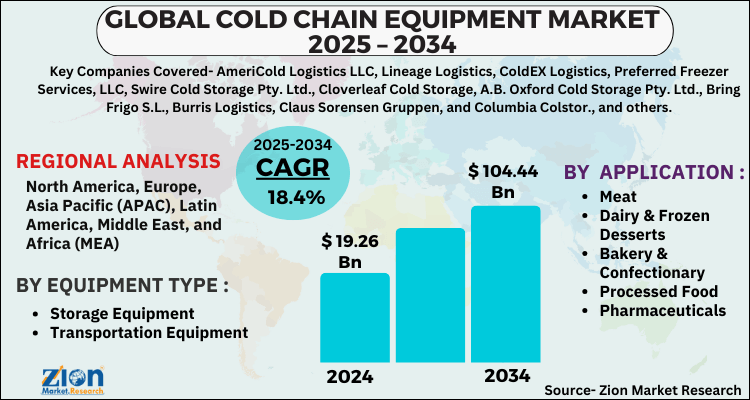
| Key Companies Covered | AmeriCold Logistics LLC, Lineage Logistics, ColdEX Logistics, Preferred Freezer Services, LLC, Swire Cold Storage Pty. Ltd., Cloverleaf Cold Storage, A.B. Oxford Cold Storage Pty. Ltd., Bring Frigo S.L., Burris Logistics, Claus Sorensen Gruppen, and Columbia Colstor, and others. |
| Segments Covered | By Equipment Type, By Application, and By Region |
| Regions Covered | North America, Europe, Asia Pacific (APAC), Latin America, The Middle East and Africa (MEA) |
| Base Year | 2024 |
| Historical Year | 2020 - 2023 |
| Forecast Year | 2025 - 2034 |
| Customization Scope | Avail customized purchase options to meet your exact research needs. Request For Customization |
Cold Chain Equipment Market: Segmentation
The cold chain equipment market is segmented by equipment type, application, and region. All the segments of the cold chain equipment market have been analyzed based on present and future trends and the market is estimated from 2025 to 2034.
Based on Equipment Type, the cold chain equipment market is divided into storage equipment and transportation equipment. The storage equipment segment is expected to lead the global market. Storage solutions such as refrigerators, freezers, cold rooms, and related systems form the foundation of cold chain operations by providing the stationary capacity needed to hold temperature-sensitive products before and after transport. Their central role in food processing, retail distribution, pharmaceutical inventory, and healthcare operations supports continued leadership of this segment and drives overall market development through capacity expansion and technology upgrades.
Based on Application, the cold chain equipment market is divided into meat, dairy and frozen desserts, bakery and confectionery, processed food, pharmaceuticals, and vegetables and fruits. The meat segment is growing at a high rate and is expected to continue dominating the global market. Temperature control is essential for meat safety, quality, and shelf life throughout storage and distribution. Strong demand for processed and fresh meat products, together with regulatory requirements for cold chain integrity, reinforces the importance of this application. Pharmaceuticals represent another critical application area, while dairy, frozen desserts, processed foods, bakery items, and fresh produce contribute additional volume as cold chain networks expand.
Cold Chain Equipment Market: Regional Analysis
Why will North America continue to dominate the global market during the projection period?
North America is predicted to dominate the global cold chain equipment market during the forecast period. The region benefits from established cold storage and logistics infrastructure, high demand for temperature-sensitive food products and pharmaceuticals, and the presence of major providers such as AmeriCold Logistics and Lineage Logistics. Strict food and drug safety requirements and ongoing investment in refrigerated warehousing and transport support sustained leadership. These conditions enable North America to set operational standards, absorb advanced monitoring and automation technologies, and remain a primary contributor to global market value.
Asia Pacific is expected to register strong double-digit growth, driven by increasing transport of temperature-sensitive medicines, rapid expansion of the food sector, and the presence of key manufacturers. Europe maintains significant demand supported by mature food and pharmaceutical logistics and regulatory standards. Latin America and the Middle East and Africa represent emerging opportunities where investment in cold chain infrastructure and rising demand for perishable foods and medicines are expected to support gradual market development over the forecast period.
Cold Chain Equipment Market: Competitive Analysis
The report provides a company market share analysis to give a broader overview of the key market players. In addition, the report also covers key strategic developments of the market, including acquisitions & mergers, new product launches, agreements, partnerships, collaborations & joint ventures, research & development, and regional expansion of major participants involved in the cold chain equipment market on a global and regional basis.
Some of the major players in the global cold chain equipment market include;
- AmeriCold Logistics LLC
- Lineage Logistics
- ColdEX Logistics
- Preferred Freezer Services, LLC
- Swire Cold Storage Pty. Ltd.
- Cloverleaf Cold Storage
- A.B. Oxford Cold Storage Pty. Ltd.
- Bring Frigo S.L.
- Burris Logistics
- Claus Sorensen Gruppen
- Columbia Colstor.
Segments Covered
The global cold chain equipment market is segmented as follows:
By Equipment Type
- Storage Equipment
- Transportation Equipment
By Application
- Meat
- Dairy & Frozen Desserts
- Bakery & Confectionary
- Processed Food
- Pharmaceuticals
- and Vegetables & Fruits
By Region
- North America
- The U.S.
- Canada
- Mexico
- Europe
- France
- The UK
- Spain
- Germany
- Italy
- Rest of Europe
- Asia Pacific
- China
- Japan
- India
- Australia
- South Korea
- Rest of Asia Pacific
- The Middle East & Africa
- Saudi Arabia
- UAE
- Egypt
- Kuwait
- South Africa
- Rest of the Middle East & Africa
- Latin America
- Brazil
- Argentina
- Rest of Latin America
Table Of Content
Methodology
FrequentlyAsked Questions
Cold chain equipment comprises systems and components used to store and transport products at controlled temperatures. It includes refrigerators, freezers, cold rooms, vaccine carriers, cold boxes, and related solutions that help maintain the quality and efficacy of temperature-sensitive foods, pharmaceuticals, and other products.
The global cold chain equipment market is driven by rising demand for temperature-sensitive goods in food and pharmaceuticals, growth in frozen and processed foods, strict safety regulations for storage and transit, changing consumer preferences toward ready-to-eat and value-added products, and advances in refrigeration and monitoring technologies.
The global cold chain equipment market size was valued at approximately USD 19.26 billion in 2024 and is expected to reach around USD 104.44 billion by 2034.
The global cold chain equipment market is expected to grow at a compound annual growth rate (CAGR) of approximately 18.4% during the forecast period from 2025 to 2034.
North America is expected to dominate and contribute notably to the global cold chain equipment market, supported by established infrastructure, high demand for temperature-sensitive food and pharmaceuticals, and the presence of major logistics and storage providers.
Some of the major players leveraging the cold chain equipment market growth are AmeriCold Logistics LLC, Lineage Logistics, ColdEX Logistics, Preferred Freezer Services, LLC, Swire Cold Storage Pty. Ltd., Cloverleaf Cold Storage, A.B. Oxford Cold Storage Pty. Ltd., Bring Frigo S.L., Burris Logistics, Claus Sorensen Gruppen, and Columbia Colstor.

HappyClients