
Global Cheese Liners Market Size, Share, Growth Analysis Report - Forecast 2034

Cheese Liners Market By Source (Conventional and Fiber-based), By Distribution Channel (B2C, B2B, and Online Retail), By Type (Poly Drum Liner, Box Liner, 640 Block Liner, and Barrel Liner), By Application (Pharmaceuticals, Food & Beverage, and Health Supplements), and By Region: Global and Regional Industry Overview, Market Intelligence, Comprehensive Analysis, Historical Data, and Forecasts 2025 - 2034
| Market Size in 2024 | Market Forecast in 2034 | CAGR (in %) | Base Year |
|---|---|---|---|
| USD 1448.45 Million | USD 2076.99 Million | 3.67% | 2024 |
Cheese Liners Industry Perspective
What will be the global cheese liners market size during the forecast period?
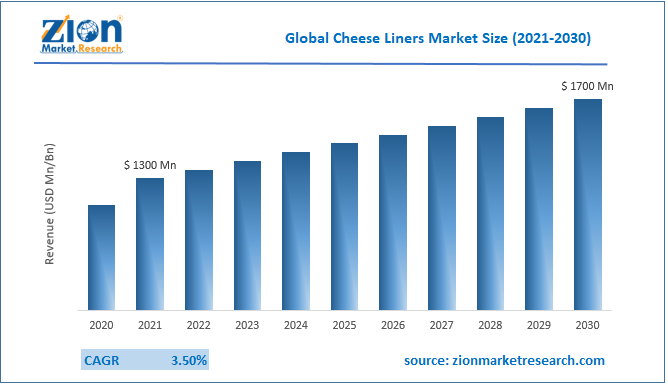
The global cheese liners market size was valued at around USD 1448.45 million in 2024 and is predicted to grow to around USD 2076.99 million by 2034 with a compound annual growth rate (CAGR) of roughly 3.67% between 2025 and 2034.
This report provides a comprehensive analysis of the growth drivers, restraints, and challenges shaping demand across the global cheese liners market throughout the forecast period, while highlighting high-potential emerging opportunities within the industry.
Key Insights
- As per the analysis shared by our research analyst, the global cheese liners market is estimated to grow annually at a CAGR of around 3.67% over the forecast period (2025-2034).
- Regarding revenue, the global cheese liners market size was valued at around USD 1448.45 million in 2024 and is projected to reach USD 2076.99 million by 2034.
- The cheese liners market is projected to grow at a significant rate due to rising cheese consumption, increasing demand for sustainable and hygienic packaging, growth in dairy product exports, and advancements in food-grade barrier materials.
- Based on the source segment, the fiber-based segment is expected to lead the global market.
- Based on the distribution channel segment, the B2B segment is growing at a high rate and will continue to dominate the global market.
- Based on the type segment, the 640 block liner segment is projected to swipe the largest market share.
- Based on the application segment, the food & beverages segment is expected to dominate the global market.
- Based on region, North America is predicted to dominate the global market during the forecast period owing to rising awareness among manufacturers and end-consumers about environmentally friendly packaging.
Cheese Liners Market: Overview
Cheese liners refer to a packaging solution for cheese, which is a growing dairy food product. Cheese liners are used to prevent food deterioration by maintaining the quality of the food until it reaches the end user. There is a growing trend of increased adoption of protein or high-fat diets, and cheese has become a staple in those diet forms.
Given the potential of the cheese market and its reach, it has become imperative to develop packaging solutions that can aid the maintenance of food quality from production to the final consumption stage. Cheese has been in existence for a long time and is available in various textures and flavors, which are created by the coagulation of milk protein called casein. Cheese is an excellent source of fat and protein and is created with milk from buffaloes, cows, sheep, or goats.
The product is manufactured by first acidifying the milk, then adding bacterial enzymes like rennet to aid the casein coagulation. The curd thus formed is then separated from the liquid known as whey, and is pressed to create the final cheese product. Since cheese is a dairy product, it is highly prone to deterioration in case of exposure to oxygen, heat, and light, since they can lead to enzymatic oxidation reactions which can cause cheese degradation resulting in a foul smell, change in color, nutrient loss, and formation of other toxic substances.
Cheese Liners Market: Growth Drivers
The ability of cheese liners to replace hardboard and wood liners may propel global market growth
The global cheese liner market growth may be attributed to the quality of cheese liners to replace wood liners or hardboards used for food packaging. Since dairy products can easily get contaminated if not stored in a suitable environment, it is important that they are stored and packaged in an ideal environment. The chances of food getting contaminated during the packaging process are higher than contamination during any other supply chain process. Since cheese liners are contamination-free, they eliminate the risk of the final cheese product getting contaminated.
The global market size may also benefit from the rising cheese consumption across the world. In 2021, around 21.86 million metric tons of cheese were produced globally, and the number is expected to rise in the coming years, which will be beneficial for cheese liner manufacturers owing to the growing demand. The higher demand for cheese is mainly driven by the food & beverages industry. There is also a growing number of cheese manufacturers across the globe, ranging from international players to domestic producers, which are propelled by the higher adoption rate of cheese in diets.
The global market expansion is also contributed to by the flexibility offered by cheese liners during the packaging process since they can be manufactured to fit all types of cheese, including Swiss, Cheddar, and others. The qualities like aroma, taste and nutritional value are very well preserved by cheese liners and hence their demand is surging in the global market.
Cheese Liners Market: Restraints
Strict packaging guidelines to restrain global market growth
The packaging industry has to adhere to strict guidelines when it comes to packaging solutions. The industry is regulated by many rules and laws which differ from country to country. There is an absence of standard packaging guidelines, which makes it difficult for manufacturers to cater to the needs of the population in other regions, thus restricting their global reach.
For example, Packaging manufacturers in India have to comply with rules like the Prevention of Food Adulteration Act, 1954, Meat Food Products Order, 1973, etc., restraining entry of international producers. Other regions also have their individual laws, thus restricting the growth of the global market size.
Cheese Liners Market: Opportunities
The emergence of domestic players to provide growth opportunities
The global cheese liner market may be filled with growth opportunities owing to the rising trend of increasing domestic players across regions. Countries like China and Singapore are employing technologically advanced systems in their packaging industry.
The Chinese market relies on packaging and is known to rely on modern technology, aiding its mission towards becoming a world leader. As per reports published by Deloitte, Africa is expected to become a high revenue-generating region in the packaging sector during the next few years. The growth in such regions may provide lucrative growth opportunities for the global market cap.
Cheese Liners Market: Challenges
High cost of raw materials challenges global market expansion
The raw material used to manufacture cheese liners is expensive and may not be affordable for small-scale manufacturers, thus creating challenges for global market growth. Importing the raw material increases the overall production expense thus reducing cost efficiency. The high cost may be attributed to the rising political tension across regions and the globally rising inflation rate.

Cheese Liners Market: Report Scope
| Report Attributes | Report Details |
|---|---|
| Report Name | Cheese Liners Market |
| Market Size in 2024 | USD 1448.45 Million |
| Market Forecast in 2034 | USD 2076.99 Million |
| Growth Rate | CAGR of 3.67% |
| Number of Pages | 255 |
| Key Companies Covered | WINPAK LTD., PLASTOPIL, Graphic Packaging International, LLC, LD PACKAGING CO., LTD, Arena Products, Inc., Mondi, Kelley Supply, Inc., Safepack Industries Ltd., and others. |
| Segments Covered | By Source, By Distribution Channel, By Type, By Application, and By Region |
| Regions Covered | North America, Europe, Asia Pacific (APAC), Latin America, The Middle East and Africa (MEA) |
| Base Year | 2024 |
| Historical Year | 2020 to 2023 |
| Forecast Year | 2025 - 2034 |
| Customization Scope | Avail customized purchase options to meet your exact research needs. Request For Customization |
Cheese Liners Market: Segmentation
The global cheese liner market is segmented based on source, distribution channel, type, application, and region.
Based on the Source, the global market segments are conventional and fiber-based. The global market is expected to be dominated by fiber-based sources because it uses reusable, renewable, and biodegradable materials for manufacturing the end product. In general, fiber-based packaging solutions are expected to grow at a CAGR of 3% in the coming few years.
Based on Distribution Channels, the global market is segmented into B2C, B2B, and online retail. The global market is expected to be dominated by the B2B segment because of higher demand from many small-scale and large-scale end-users of the product. In the USA, 23.6% of the total businesses are generally B2B, and the same trend is projected in various other regions as well.
Based on Type, the segments in the global market are poly drum liner, box liner, 640 block liner, and barrel liner. 640 lb block liners are more in demand given their extreme strength, along with other mechanical properties that keep the product intact during the packaging process.
By Application, pharmaceuticals, food & beverage, and health supplements are the global market segments. Food & beverages are the largest consumers of cheese liners given the high demand for cheese in this sector. The Indian cheese market in 2024 is valued at over USD 56 billion, which is expected to grow even further during the forecast period.
Cheese Liners Market: Regional Analysis
Why will North America continue to dominate the global market during the projection period?
The global cheese liner market is expected to be led by North America in the next few years owing to the rising awareness amongst manufacturers and end-consumers about environmentally friendly packaging. As per official reports, more than 40% of the US population is inclined toward sustainable forms of packaging, which is anticipated to aid regional growth. In March 2021, Unilever North America announced an investment of USD 15 million to recycle an estimated 60,000 metric tons of U.S. plastic packaging waste by 2025.
Asia-Pacific may also generate high revenue in the coming years owing to advancements in the field of cheese liner production. The growing population and the subsequent rising demand in the F & B sector may aid regional growth. As of 2020, China was the leading country in the food & beverages sector with a revenue of USD 1.3 trillion, whereas India contributed around USD 575 billion in the same year.
Recent Development
- In June 2021, Graphic Packaging International launched a new dual and ovenable paper seal cook range. The news followed another announcement by the same firm related to the launch of PaperSeal Slice® and PaperSeal Wedge, specifically designed for cheese and meat applications
- In June 2021, Mondi, which is a leading packaging and paper group solutions provider, worked alongside Hazeleger Kaas to package the Dutch Maaslander brand in EnvelopeForm, which is a 100% recyclable polypropylene (PP) mono-material packaging solution
Cheese Liners Market: Competitive Analysis
Some of the major players in the global cheese liners market include:
- WINPAK LTD.
- PLASTOPIL
- Graphic Packaging International LLC.
- LD PACKAGING Co. Ltd
- Arena Products Inc.
- Mondi
- Kelley Supply Inc.
- Safepack Industries Ltd.
Segments Covered
The global cheese liners market is segmented as follows;
By Source
- Conventional
- Fiber-based
By Distribution Channel
- B2C
- B2B
- Online Retail
By Type
- Poly Drum Liner
- Box Liner
- 640 Block Liner
- Barrel Liner
By Application
- Pharmaceuticals
- Food & Beverage
- Health Supplements
By Region
- North America
- The U.S.
- Canada
- Mexico
- Europe
- France
- The UK
- Spain
- Germany
- Italy
- Rest of Europe
- Asia Pacific
- China
- Japan
- India
- Australia
- South Korea
- Rest of Asia Pacific
- The Middle East & Africa
- Saudi Arabia
- UAE
- Egypt
- Kuwait
- South Africa
- Rest of the Middle East & Africa
- Latin America
- Brazil
- Argentina
- Rest of Latin America
Table Of Content
Methodology
FrequentlyAsked Questions
Cheese liners are specialized packaging solutions used to protect cheese from deterioration caused by oxygen, heat, and light. They help maintain quality, aroma, taste, and nutritional value from production through to final consumption.
According to a study, the global cheese liners market size was worth around USD 1448.45 Million in 2024 and is expected to reach USD 2076.99 Million by 2034.
The global cheese liners market is expected to grow at a CAGR of 3.67% during the forecast period.
North America is expected to dominate the cheese liners market over the forecast period.
Leading players in the global cheese liners market include WINPAK LTD., PLASTOPIL, Graphic Packaging International, LLC, LD PACKAGING CO., LTD, Arena Products, Inc., Mondi, Kelley Supply, Inc., Safepack Industries Ltd., among others.
Key growth drivers include rising cheese consumption, increasing demand for sustainable and hygienic packaging, growth in dairy product exports, advancements in food-grade barrier materials, and the ability of cheese liners to replace traditional wood or hardboard liners while preventing contamination.
The report explores crucial aspects of the cheese liners market, including a detailed discussion of existing growth factors and restraints, while also examining future growth opportunities and challenges that impact the market.

HappyClients

