
Global CD Antigen Cancer Therapy Market Size, Share, Trends, Growth and Forecast 2034

CD Antigen Cancer Therapy Market By Type (Monoclonal Antibody Based Therapy, CAR T Cell Therapy, Bispecific Antibody Therapy, Antibody Drug Conjugate Therapy), By Application (Hematological Cancers, Solid Tumors, Lymphoma Treatment, Leukemia Treatment), By End User (Hospitals and Cancer Treatment Centers, Specialty Oncology Clinics, Research and Academic Institutes, Biopharmaceutical Companies), By Target Antigen (CD19, CD20, CD22, CD30), and By Region - Global and Regional Industry Overview, Market Intelligence, Comprehensive Analysis, Historical Data, and Forecasts 2026 - 2034
| Market Size in 2025 | Market Forecast in 2034 | CAGR (in %) | Base Year |
|---|---|---|---|
| USD 4.91 Billion | USD 14.68 Billion | 12.94% | 2025 |
CD Antigen Cancer Therapy Industry Perspective:
What will be the size of the CD antigen cancer therapy market during the forecast period?
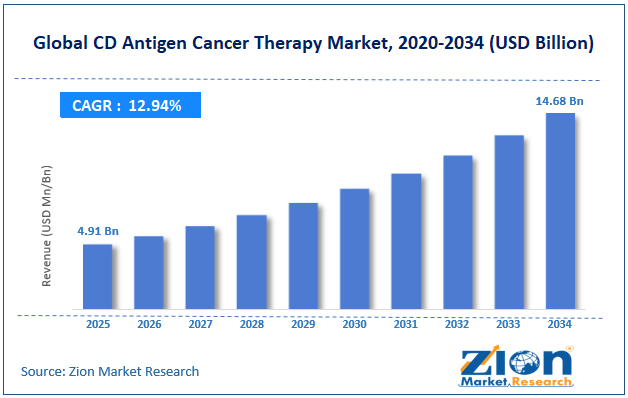
The global CD antigen cancer therapy market size was valued at approximately USD 4.91 billion in 2025 and is projected to reach around USD 14.68 billion by 2034, growing at a compound annual growth rate of approximately 12.94% between 2026 and 2034.
Key Insights
- As per the analysis shared by our research team, the global CD antigen cancer therapy market is estimated to grow at a compound annual growth rate of approximately 12.94% during the forecast period from 2026 to 2034.
- In terms of revenue, the global CD antigen cancer therapy market was valued at approximately USD 4.91 billion in 2025 and is projected to reach USD 14.68 billion by 2034.
- The CD antigen cancer therapy market is expected to grow strongly due to rising cancer diagnosis rates, increasing approval of targeted immunotherapies, growing preference for personalized cancer treatment, and expanding research into new CD antigen targets.
- Based on type, monoclonal antibody-based therapy leads the market because of its proven track record and wide clinical use, while CAR T cell therapy is gaining strong momentum as one of the fastest-growing treatment options for blood cancers.
- Based on application, hematological cancers lead the market due to the well-established use of CD antigen-targeted drugs in leukemia and lymphoma. At the same time, solid tumor treatment is the fastest-growing segment as new research expands treatment possibilities.
- Based on end user, hospitals and cancer treatment centers lead the market due to high patient volumes and specialized infrastructure, while specialty oncology clinics are steadily growing as more advanced therapies become available outside large hospital settings.
- Based on target antigen, CD19 leads the market because it is the most clinically validated target for B cell malignancies and underpins many approved antibody and CAR T therapies.
- Based on region, North America leads the global CD antigen cancer therapy market. At the same time, the Asia Pacific is the fastest-growing region due to rising cancer cases and improving access to advanced treatments.
CD Antigen Cancer Therapy Market: Overview
Cluster of Differentiation (CD) antigen cancer therapy is a type of targeted cancer treatment that uses special proteins called CD antigens on the surface of cancer cells to find and destroy cancer while causing less damage to healthy cells. Doctors use these therapies to treat blood cancers such as leukemia, lymphoma, and multiple myeloma, and researchers are also testing them for several solid tumors. The main types of CD antigen cancer therapy include monoclonal antibodies, CAR T-cell therapy, bispecific antibodies, and antibody-drug conjugates (ADCs). Each treatment targets a specific CD marker, helping the body's immune system recognize and attack cancer cells more accurately than traditional chemotherapy. Because these therapies are more precise, many patients experience better treatment outcomes and fewer side effects. The market is growing rapidly due to the rising number of cancer cases, increasing demand for targeted treatments, growing investment in cancer research, and the approval of new therapies by health authorities. Hospitals, cancer centers, and specialty clinics are adopting these treatments more widely as clinical studies continue to prove their safety, effectiveness, and long-term benefits for patients across different types of cancer.
The CD antigen cancer therapy industry continues to expand as researchers and doctors work together to bring safer and more precise cancer treatments to patients around the world.
Impact of the USA-Israel War on Iran on the CD Antigen Cancer Therapy Market
The CD antigen cancer therapy market may face short-term supply challenges because of ongoing geopolitical tensions between the United States, Israel, and Iran, which can affect the availability of raw materials and laboratory equipment. Pharmaceutical and biotechnology companies are strengthening their supply chains and expanding manufacturing to reduce these risks. Despite these temporary challenges, rising demand for advanced cancer treatments and growing investment in cancer research are expected to support the continued growth of the market.
CD Antigen Cancer Therapy Market: Technology Roadmap 2026–2034
What is the projected development roadmap of the CD antigen cancer therapy market over the forecast period?
The CD antigen cancer therapy market is advancing through improved antigen identification methods, more precise antibody engineering, expanded clinical trial activity, and growing use of personalized treatment approaches, making cancer care safer and more effective for patients. The market is expected to grow at a compound annual growth rate of approximately 12.94% over the forecast period, driven by accelerating research investment, developing regulatory pathways, and continuous refinement of antibody and cell therapy technology.
The following roadmap outlines key development phases expected through 2034.
2026-2028: Research Expansion and Clinical Validation Phase
- Researchers are expected to identify new CD antigen targets that allow treatments to reach a wider range of cancer types, including certain solid tumors that have been difficult to treat with existing therapies.
- Stricter global clinical trial standards are expected to encourage companies to improve testing processes, helping ensure new CD antigen therapies are both safe and effective before reaching patients.
- Growing collaboration between biotechnology companies, hospitals, and research institutes is expected to speed up the development of new and improved CD antigen-based treatments.
2029-2031: Precision Treatment and Broader Access Phase
- Advanced manufacturing methods are expected to become more widely used, helping produce CD antigen therapies with greater consistency, fewer production issues, and more manageable costs.
- The growing use of combination treatments, where CD antigen therapies are paired with other cancer treatments, is expected to improve outcomes for patients with more advanced or resistant cancers.
- Improved diagnostic tools are expected to help doctors identify which patients will benefit most from specific CD antigen therapies, supporting more personalized treatment plans.
2032-2034: Next Generation Immunotherapy Phase
- CD antigen therapies are expected to become more refined, with treatments designed to reduce side effects while improving the strength and duration of the cancer-fighting response in patients.
- Smaller and more targeted treatment approaches are expected to support the growing demand for therapies that can be tailored closely to each patient's specific cancer profile.
- New technologies combining CD antigen therapy with real-time monitoring tools are expected to help doctors track patient response closely, improving safety and treatment adjustments during care.
CD Antigen Cancer Therapy Market: Dynamics
Growth Drivers
What is driving growth of the CD antigen cancer therapy market as demand for targeted cancer treatment rises?
The CD antigen cancer therapy market is growing steadily as hospitals, research centers, and biopharmaceutical companies focus more on targeted cancer treatment and personalized medicine. The rising number of cancer cases, increasing demand for immunotherapy, and continuous progress in cancer research are driving market growth worldwide. CD antigen cancer therapies target specific markers on cancer cells, helping doctors treat cancer more accurately while causing less damage to healthy cells. These treatments are widely used for blood cancers such as leukemia, lymphoma, and multiple myeloma, and researchers are expanding their use for several solid tumors. Growing clinical trials and new drug approvals are further supporting the CD antigen cancer therapy market. Pharmaceutical and biotechnology companies are investing heavily in developing safer and more effective therapies with improved targeting capabilities.
At the same time, healthcare providers are adopting advanced cancer treatments to improve patient outcomes and survival rates. Rising healthcare spending and growing awareness of targeted therapies are supporting market growth.
The growing demand for personalized cancer treatment is driving the CD antigen cancer therapy market.
The CD antigen cancer therapy market is creating strong growth opportunities as doctors focus more on personalized cancer treatment. These therapies target specific CD markers found on cancer cells, helping doctors choose treatments that match each patient's condition. This targeted approach can improve treatment success while reducing damage to healthy cells and lowering side effects. Hospitals, cancer centers, and biopharmaceutical companies are increasing the use of CD antigen therapies because of their proven benefits in treating blood cancers such as leukemia, lymphoma, and multiple myeloma. Researchers are also studying these therapies for several solid tumors, creating new opportunities for the market. Growing clinical trials and continuous drug development are expanding treatment options for patients worldwide.
At the same time, rising investment in immunotherapy research and stronger healthcare infrastructure are supporting market growth. Governments and private companies are also funding advanced cancer research to develop safer and more effective therapies. As awareness of targeted cancer treatment continues to increase, the market is expected to see steady demand and long-term growth during the forecast period.
Restraints
Why are high treatment costs and strict regulations challenging the CD antigen cancer therapy market?
The CD antigen cancer therapy industry faces several challenges that may slow its growth. Developing these therapies requires years of research, advanced laboratory facilities, and costly clinical trials, making the process expensive and time-consuming. Smaller biotechnology companies often struggle to secure enough funding and resources to develop new treatments and compete with large pharmaceutical companies. In addition, strict regulatory approvals require detailed safety and effectiveness testing before new therapies can reach patients, delaying product launches. Companies must also continue monitoring approved treatments, which increases long-term costs.
Another challenge is the shortage of trained immunotherapy specialists, researchers, and healthcare professionals needed to develop and deliver these advanced treatments. Limited research facilities and healthcare infrastructure in developing countries also reduce access to these therapies. Despite these challenges, the market is expected to grow as research technologies improve, industry experience increases, and partnerships between pharmaceutical companies, biotechnology firms, hospitals, and research institutes help lower costs and expand access to advanced cancer treatments.
Opportunities
Will expanding treatment applications and emerging markets drive growth opportunities in the CD antigen cancer therapy market?
The CD antigen cancer therapy market offers strong growth opportunities as pharmaceutical and biotechnology companies develop more targeted cancer treatments. These therapies are widely used to treat blood cancers such as leukemia, lymphoma, and multiple myeloma by targeting specific CD markers on cancer cells. This approach helps improve treatment results while reducing damage to healthy cells. Researchers are also expanding the use of CD antigen therapies for several solid tumors, creating new opportunities for the market. Rising demand for immunotherapy and personalized medicine is encouraging hospitals, cancer centers, and research institutes to adopt these advanced treatments. Emerging countries such as China, India, Brazil, and Southeast Asian nations are investing more in healthcare infrastructure, cancer care, and clinical research, supporting market expansion.
Pharmaceutical companies are also improving manufacturing technologies to make these therapies safer, more affordable, and easier to produce. In addition, growing clinical trials and new drug approvals are increasing treatment options for patients worldwide. Rising healthcare spending, continuous innovation in targeted therapies, and increasing awareness of advanced cancer treatment are expected to drive steady growth in the market throughout the forecast period.
Challenges
What challenges does the CD antigen cancer therapy market face in sustaining growth and achieving widespread adoption?
The CD antigen cancer therapy industry faces several challenges that may slow its growth. Developing these advanced therapies requires high research costs, modern laboratory facilities, and years of clinical testing, making it difficult for smaller companies to compete. Strict regulatory approvals also require strong proof of safety and effectiveness before new treatments can reach patients, which often delays product launches. Different regulations across countries further increase the time and cost of development. The market also needs more trained researchers, doctors, and laboratory specialists to support the development and use of these therapies.
In addition, companies must maintain a steady supply of specialized materials and advanced technology to avoid production delays. The market also competes with other advanced cancer treatments, including gene therapy and newer immunotherapy approaches. Despite these challenges, continued improvements in research technology, stronger partnerships between healthcare organizations and pharmaceutical companies, and growing investment in cancer research are expected to support the long-term growth of the CD antigen cancer therapy market.
CD Antigen Cancer Therapy Market: Report Scope
| Report Attributes | Report Details |
|---|---|
| Report Name | CD Antigen Cancer Therapy Market |
| Market Size in 2025 | USD 4.91 Billion |
| Market Forecast in 2034 | USD 14.68 Billion |
| Growth Rate | CAGR of 12.94% |
| Number of Pages | 231 |
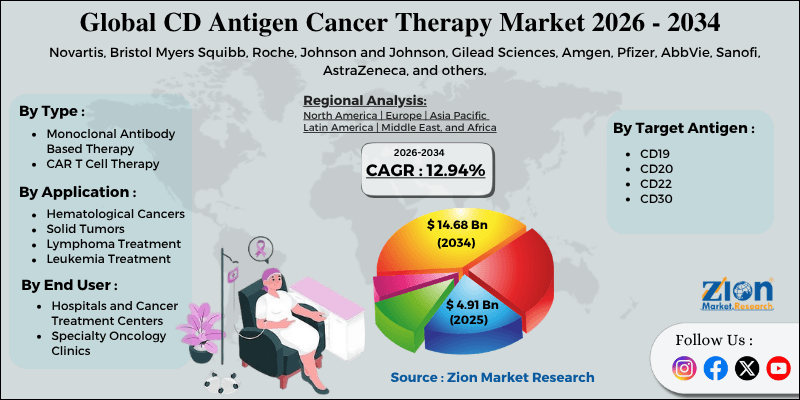
| Key Companies Covered | Novartis, Bristol Myers Squibb, Roche, Johnson and Johnson, Gilead Sciences, Amgen, Pfizer, AbbVie, Sanofi, AstraZeneca, and others. |
| Segments Covered | By Type, By Application, By End User, By Target Antigen, and By Region |
| Regions Covered | North America, Europe, Asia Pacific (APAC), Latin America, Middle East, and Africa (MEA) |
| Base Year | 2025 |
| Historical Year | 2020 - 2024 |
| Forecast Year | 2026 - 2034 |
| Customization Scope | Avail customized purchase options to meet your exact research needs. Request For Customization |
CD Antigen Cancer Therapy Market: Segmentation
The global CD antigen cancer therapy market is segmented by type, application, end-user, distribution channel, and region.
What makes monoclonal antibody-based therapy the dominant type in the CD antigen cancer therapy market?
Based on type, the global CD antigen cancer therapy market is classified into monoclonal antibody-based therapy, CAR T cell therapy, bispecific antibody therapy, and antibody drug conjugate therapy. Monoclonal antibody-based therapy holds about 42% of the market share, leading due to its long history of clinical use, well-established safety profile, and strong effectiveness across multiple blood cancer types. CAR T cell therapy holds around 27% market share. It is the fastest-growing segment because of its strong results in treating certain hard-to-treat blood cancers.
How does hematological cancer treatment maintain its leading position in the CD antigen cancer therapy market?
Based on application, the CD antigen cancer therapy industry is segregated into hematological cancers, solid tumors, lymphoma treatment, and leukemia treatment. Hematological cancers account for approximately 38% of the global market share, driven by the well-established role of CD antigen therapies in treating various blood cancers. Solid tumor treatment holds around 22% market share. It is the fastest-growing segment due to expanding research into new applications beyond blood cancers.
What makes hospitals the dominant end-users in the CD antigen cancer therapy market?
Based on end-user, the market is divided into hospitals and cancer treatment centers, specialty oncology clinics, research and academic institutes, and biopharmaceutical companies. Hospitals and cancer treatment centers lead with about a 47% share because of their advanced infrastructure and ability to manage complex cancer treatment protocols. Specialty oncology clinics hold around 24% market share. They are growing steadily as more advanced cancer therapies become available outside traditional hospital settings.
How does the CD19 antigen target shape the treatment landscape of the CD antigen cancer therapy market?
Based on target antigen, the CD antigen cancer therapy market is categorized into CD19, CD20, CD22, and CD30. CD19 accounts for about 39% of the market, leading because it is one of the most well-validated targets for B cell malignancies and forms the basis of several widely used monoclonal antibody and CAR T cell therapies. CD20 holds around 28% market share. It is supported by its long-standing use in monoclonal antibody treatments for lymphoma.
CD Antigen Cancer Therapy Market: Regional Analysis
Why is North America leading the global CD antigen cancer therapy market?
The North America CD antigen cancer therapy market leads the global market and is expected to grow at a CAGR of around 8.1% during the forecast period. This leadership comes from the region's well-established healthcare systems, high research funding, and early adoption of advanced immunotherapy treatments across major markets. The United States leads the regional market because of its advanced healthcare system, strong biopharmaceutical industry, and high investment in cancer research and immunotherapy. The country is home to many leading pharmaceutical and biotechnology companies that are developing innovative CD antigen cancer therapies. Rising cancer cases, increasing use of targeted treatments, and a growing number of clinical trials are driving market growth. Canada is also expanding its presence through higher healthcare spending, stronger cancer research programs, and wider adoption of advanced treatment options.
Universities, research institutes, and healthcare organizations continue to support the development of new therapies. Mexico is emerging as a growing market due to improving healthcare infrastructure, better access to cancer care, and increasing awareness of advanced treatments. Rising government support, continuous medical innovation, and expanding healthcare investments are further strengthening the regional market. The growing focus on personalized medicine, better patient outcomes, and targeted cancer therapies is expected to drive the long-term growth of the North America CD antigen cancer therapy market.
What makes Asia Pacific the fastest-growing region in the CD antigen cancer therapy market?
The Asia Pacific CD antigen cancer therapy market is one of the fastest-growing regional markets and is expected to grow at a CAGR of around 10.4% during the forecast period. This strong growth is driven by a large and rising patient population, fast-expanding biotechnology industries, and growing government focus on making advanced cancer treatments more accessible across the region. China leads the market because of its rapidly growing biotechnology industry, rising cancer cases, and strong government support for cancer research and innovation. Japan is another major market, supported by its advanced healthcare system, high-quality medical research, and continuous development of targeted cancer therapies.
South Korea is also expanding quickly as pharmaceutical and biotechnology companies invest more in immunotherapy and precision medicine. India offers significant growth opportunities due to its large patient population, improving healthcare infrastructure, expanding pharmaceutical industry, and increasing access to advanced cancer treatments. Countries such as Australia, Singapore, Thailand, and Malaysia are also contributing to regional growth through higher healthcare spending, growing cancer awareness, and better access to modern therapies. Rising demand for personalized cancer treatment, increasing clinical trials, and continuous investment in biotechnology research are driving the Asia Pacific market. Strong government support and ongoing innovation are expected to drive long-term growth of the Asia Pacific CD antigen cancer therapy market.
Recent Market Developments
- In July 2026, Bristol Myers Squibb announced that the U.S. FDA accepted its New Drug Application (NDA) for mezigdomide for patients with relapsed or refractory multiple myeloma, reinforcing the company's focus on advancing innovative therapies for blood cancers alongside its broader immuno-oncology portfolio.
- In July 2026, Novartis agreed to acquire Myricx Bio to strengthen its oncology pipeline with a next-generation antibody-drug conjugate (ADC) platform, supporting the development of more targeted cancer therapies, including treatments relevant to CD antigen–based oncology.
CD Antigen Cancer Therapy Market: Competitive Analysis
The leading players in the global CD antigen cancer therapy market are:
- Novartis
- Bristol Myers Squibb
- Roche
- Johnson and Johnson
- Gilead Sciences
- Amgen
- Pfizer
- AbbVie
- Sanofi
- AstraZeneca
The global CD antigen cancer therapy market is segmented as follows:
By Type
- Monoclonal Antibody Based Therapy
- CAR T Cell Therapy
- Bispecific Antibody Therapy
- Antibody Drug Conjugate Therapy
By Application
- Hematological Cancers
- Solid Tumors
- Lymphoma Treatment
- Leukemia Treatment
By End User
- Hospitals and Cancer Treatment Centers
- Specialty Oncology Clinics
- Research and Academic Institutes
- Biopharmaceutical Companies
By Target Antigen
- CD19
- CD20
- CD22
- CD30
By Region
- North America
- The U.S.
- Canada
- Mexico
- Europe
- France
- The UK
- Spain
- Germany
- Italy
- Rest of Europe
- Asia Pacific
- China
- Japan
- India
- Australia
- South Korea
- Rest of Asia Pacific
- The Middle East & Africa
- Saudi Arabia
- UAE
- Egypt
- Kuwait
- South Africa
- Rest of the Middle East & Africa
- Latin America
- Brazil
- Argentina
- Rest of Latin America
Table Of Content
Methodology
FrequentlyAsked Questions
Cluster of Differentiation (CD) antigen cancer therapy is a type of targeted cancer treatment that uses special proteins called CD antigens on the surface of cancer cells to find and destroy cancer while causing less damage to healthy cells. Doctors use these therapies to treat blood cancers such as leukemia, lymphoma, and multiple myeloma, and researchers are also testing them for several solid tumors.
The global CD antigen cancer therapy market is expected to grow due to rising cancer diagnosis rates, increasing approval of targeted immunotherapies, growing demand for personalized treatment, and expanding research into new antigen targets worldwide.
According to research, the global CD antigen cancer therapy market was valued at approximately USD 4.91 billion in 2025 and is projected to reach approximately USD 14.68 billion by 2034.
The compound annual growth rate of the CD antigen cancer therapy market is expected to be approximately 12.94% from 2026 to 2034.
North America is expected to lead the global CD antigen cancer therapy market throughout the forecast period, driven by its strong biopharmaceutical research base, advanced healthcare system, and significant investment in cancer immunotherapy.
The major players in the global CD antigen cancer therapy market include Novartis, Bristol Myers Squibb, Roche, Johnson and Johnson, Gilead Sciences, Amgen, Pfizer, AbbVie, Sanofi, and AstraZeneca.
The report examines key aspects of the CD antigen cancer therapy market, including research and development drivers, adoption barriers, application opportunities, competitive landscape dynamics, detailed regional market performance analysis, and a comprehensive forward-looking outlook across all major types, applications, end user segments, distribution channels, and geographic regions through 2034.
Leading players in the CD antigen cancer therapy market focus on clinical trials, strategic partnerships, acquisitions, product launches, and manufacturing expansion. These strategies help companies strengthen their product portfolios and increase their global market presence.
The CD antigen cancer therapy market features strong competition among global pharmaceutical and biotechnology companies. Leading players compete through innovation, research investments, advanced immunotherapy platforms, and strategic collaborations.
The United States leads the global CD antigen cancer therapy market. The country benefits from advanced healthcare infrastructure, strong biotechnology research, high healthcare spending, and continuous investment in targeted cancer therapies.

HappyClients

