
Camera Technology Market Size, Share, Growth & Forecast 2032

Camera Technology Market: By Component (Sensor, Microcontroller & Microprocessor, and IC), By Technology (SCMOS Image Sensor, 3D Depth Sensing, 4K Pixel & UHD, IR Thermal, and Panoramic), By Application (Healthcare, Industrial, Media and Entertainment, Consumer Electronics, Robotics and Gaming, Automotive, Defense and Aerospace, Automotive, and Others): Global Industry Perspective, Comprehensive Analysis and Forecast, 2024 - 2032
| Market Size in 2023 | Market Forecast in 2032 | CAGR (in %) | Base Year |
|---|---|---|---|
| USD 8.42 Billion | USD 24.26 Billion | 12.47% | 2023 |
How big is the Camera Technology Market?
According to Zion Market Research, the global Camera Technology Market was worth USD 8.42 Billion in 2023. The market is forecast to reach USD 24.26 Billion by 2032, growing at a compound annual growth rate (CAGR) of 12.47% during the forecast period 2024-2032. The report offers a comprehensive analysis of the market, highlighting the factors that will determine growth, potential challenges, and opportunities that could emerge in the Camera Technology industry over the next decade.
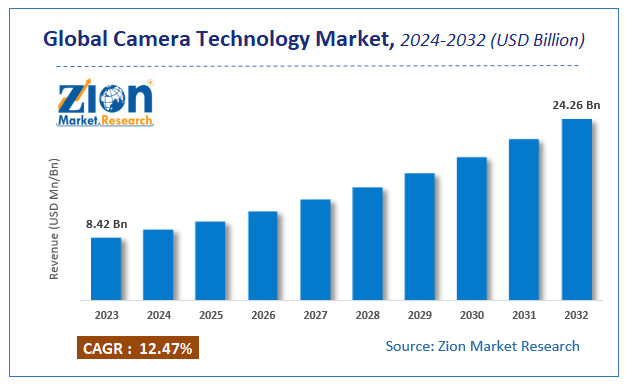
Global Camera Technology Market: Overview
Camera technology is on the rise mostly due to advances in the technological area of digital camera systems. Camera manufacturers are focused heavily on advances and developments in camera technology. These advances and inventions are primarily targeted at extending the use of cameras in manufacturing fields such as media and television, consumer electronics and robotics. Various benefits of modern camera technology include higher speed, higher resolution, accurate images and videos, and increased image quality. These features help end-users achieve additional sustainability impacts. In order to scan and achieve the high quality of the products, many production plants use sophisticated camera based technology.
Global Camera Technology Market: Growth Factors
Low prices combined with advanced camera technologies result in high demand for high-end digital cameras. This in turn, is driving the growth of the global market for camera technology. Cameras are often known to be a trendy and cool piece for high-quality people. Furthermore, advanced camera technology allow users to take detailed and well-defined images. Consequently, in view of all of the above, photojournalists, professional photographers and quality inspectors opt for modern and state-of-the-art cameras with advanced technologies. This has strengthened the worldwide demand for camera technology which is predicted to continue in the near future. In addition, there is a growing market for quicker, cheaper, wider and more reliable images from the manufacturing, consumer electronics and automotive applications industries. These advancements in camera technologies are largely based on the type and possible use of electronic components, including microprocessors, sensors, microcontrollers and integrated circuits.
Global Camera Technology Market: Segmentation
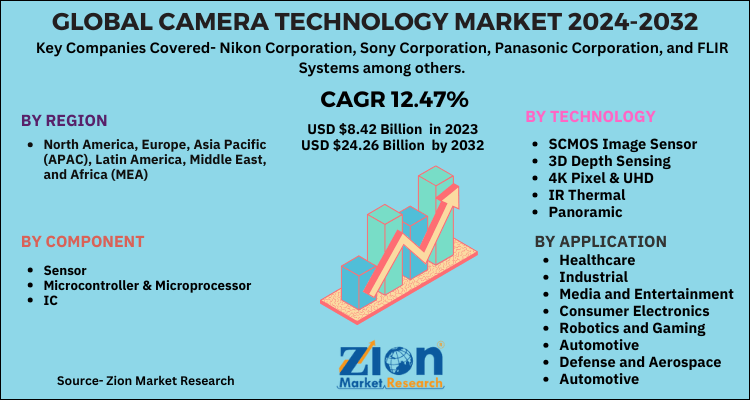
The global camera technology market is segmented based on component, technology, application, and region. On the basis of a component, the global market is segmented as the sensor, microcontroller & microprocessor, and IC. Further based on the technology used, the global camera technology market is classified as SCMOS image sensor, 3D depth sensing, 4K pixel & UHD, IR thermal, and panoramic. On the basis of application, the global market is diversified as healthcare, industrial, media and entertainment, consumer electronics, robotics and gaming, automotive, defense and aerospace, automotive, and others. Furthermore, North America, Europe, Asia-Pacific, Latin America, and the Middle East & Africa give a geographic breakdown.
Camera Technology Market: Report Scope
| Report Attributes | Report Details |
|---|---|
| Report Name | Camera Technology Market |
| Market Size in 2023 | USD 8.42 Billion |
| Market Forecast in 2032 | USD 24.26 Billion |
| Growth Rate | CAGR of 12.47% |
| Number of Pages | 110 |
| Key Companies Covered | Nikon Corporation, Sony Corporation, Panasonic Corporation, and FLIR Systems among others |
| Segments Covered | By Component, By Technology, By Application And By Region |
| Regions Covered | North America, Europe, Asia Pacific (APAC), Latin America, Middle East, and Africa (MEA) |
| Base Year | 2023 |
| Historical Year | 2018 - 2022 |
| Forecast Year | 2024 - 2032 |
| Customization Scope | Avail customized purchase options to meet your exact research needs. Request For Customization |
Global Camera Technology Market: Regional Analysis
Regionally, the global market for camera technology is segmented as North America, Latin America, Asia-Pacific, Europe and the rest of the world (RoW). North America is a major consumer in the global market for camera technology due to the extensive use of cameras in the development of military applications. The U.S. has been the key driver of the North American market for both industrial and individual applications.
Global Camera Technology Market: Competitive Players
Some main participants of the camera technology market are:
- Nikon Corporation
- Sony Corporation
- Panasonic Corporation
- FLIR Systems, among others.
The Global Camera Technology Market is segmented as follows:
By Component
- Sensor
- Microcontroller & Microprocessor
- IC
By Technology
- SCMOS Image Sensor
- 3D Depth Sensing
- 4K Pixel & UHD
- IR Thermal
- Panoramic
By Application
- Healthcare
- Industrial
- Media and Entertainment
- Consumer Electronics
- Robotics and Gaming
- Automotive
- Defense and Aerospace
- Automotive
- and Others
By Region
- North America
- The U.S.
- Canada
- Mexico
- Europe
- France
- The UK
- Spain
- Germany
- Italy
- Rest of Europe
- Asia Pacific
- China
- Japan
- India
- Australia
- South Korea
- Rest of Asia Pacific
- The Middle East & Africa
- Saudi Arabia
- UAE
- Egypt
- Kuwait
- South Africa
- Rest of the Middle East & Africa
- Latin America
- Brazil
- Argentina
- Rest of Latin America
Table Of Content
Methodology
FrequentlyAsked Questions
Camera technology refers to systems used to capture images or videos. It is applied in photography, surveillance, and industrial inspection.
The global Camera Technology market is expected to be driven by the increasing use in smartphones, automotive systems, surveillance, and industrial automation. Advancements in imaging quality and AI-based features boost demand.
According to study, the global Camera Technology market size was worth around USD 8.42 Billion in 2023 and is predicted to grow to around USD 24.26 Billion By 2032.
The global Camera Technology market is expected to grow at a Compound Annual Growth Rate (CAGR) of around CAGR 12.47% during the forecast period from 2024-2032.
The global Camera Technology industry is projected to be challenged by Challenges include rapid technological obsolescence, pricing pressure, and supply chain disruptions.
Which application areas will offer significant growth opportunities in the Camera Technology market?
The Opportunities include growth in smartphones, automotive vision systems, surveillance, AI-enabled imaging, and AR/VR applications will offer significant growth opportunities in the Camera Technology market.
AI-powered image processing and edge analytics; miniaturized high-resolution sensors; growth in automotive, security, and mobile imaging are the emerging trends and innovations impacting the Camera Technology market.
The global Camera Technology market is expected to be led by APAC during the forecast period.
Some of the prominent players operating in the global Camera Technology market are; Nikon Corporation, Sony Corporation, Panasonic Corporation, and FLIR Systems among others and others.
The report explores crucial aspects of the Camera Technology market, including a detailed discussion of existing growth factors and restraints, while also browsing future growth opportunities and challenges that impact the market.

HappyClients

