
Camel Milk Products Market Size, Share, Growth, Opportunities 2034

Camel Milk Products Market By Product (Powder, Flavored Milk, Plain Milk, Fermented Products, Ice Cream, and Others), By Distribution Channel (Offline and Online), and By Region - Global and Regional Industry Overview, Market Intelligence, Comprehensive Analysis, Historical Data, and Forecasts 2026 - 2034
| Market Size in 2025 | Market Forecast in 2034 | CAGR (in %) | Base Year |
|---|---|---|---|
| USD 15.49 Billion | USD 34.90 Billion | 9.45% | 2025 |
Camel Milk Products Industry Perspective:
What is the anticipated size of the camel milk products market during the projection period?
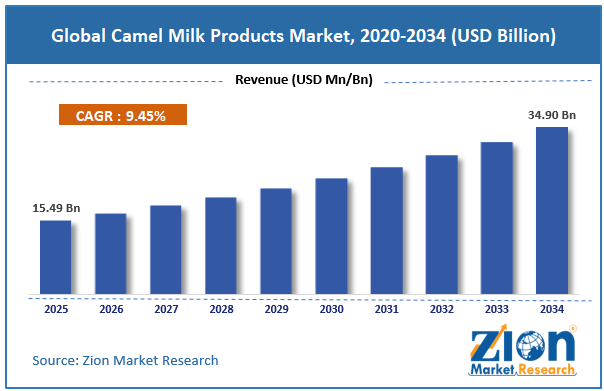
The global camel milk products market size was worth around USD 15.49 billion in 2025 and is predicted to grow to around USD 34.90 billion by 2034, with a compound annual growth rate (CAGR) of roughly 9.45% between 2026 and 2034.
Key Insights:
- As per the analysis shared by our research analyst, the global camel milk products market is estimated to grow annually at a CAGR of around 9.45% over the forecast period (2026-2034)
- In terms of revenue, the global camel milk products market size was valued at around USD 15.49 billion in 2025 and is projected to reach USD 34.90 billion, by 2034.
- The camel milk products market is projected to grow at a significant rate due to the rising health consciousness among the general population, growing applications in food innovation, a surge in food tourism, and new product introduction.
- Based on the product, the plain milk segment is growing at a high rate and will continue to dominate the global market as per industry projections.
- Based on the distribution channel, the offline segment is anticipated to command the largest market share.
- Based on region, the Middle East is projected to dominate the global market during the forecast period.
Camel Milk Products Market: Overview
Camel milk products are items made from camel milk, including bottled milk, baked goods, and consumer products. Camel’s milk is highly nutritious and a common part of the staple diet across cultures, especially in arid and semi-arid zones. Common health benefits of camel milk include treatment of diseases such as gastrointestinal conditions, asthma, and tuberculosis. In addition, whey proteins in camel milk have several chemical, physical, functional, physiological, and technological features that make them suitable for food applications. During the forecast period, demand for camel milk products is expected to grow due to rising health consciousness among the general population, growing applications in food innovation, a surge in food tourism, and new product introduction. However, uneven availability, competition from other products, technical complexities, and limited public awareness may affect market revenue in the long run.
Impact of the USA-Israel and Iran war on the Camel Milk Products Market:
The USA-Israel and Iran war has affected the camel milk products market by driving up transportation costs, insurance premiums, and shipment delays. The war has increased fertilizer costs, directly influencing the final market price for specialty items such as camel milk products. However, market demand remains significantly high, especially in Middle Eastern countries.
Camel Milk Products Market: Dynamics
Growth Drivers
How will growing health awareness promote demand in the camel milk products market?
The global camel milk products market is expected to be driven by the rising health awareness among the general population. According to the National Library of Medicine, camel’s milk is a rich source of vitamins such as B1, B2, and C. Furthermore, the vitamin C content in camel’s milk is three times higher than in cow’s milk. Public health awareness has improved significantly in recent years due to access to information through digital channels and increased government awareness initiatives. Research suggests that camel’s milk has antidiabetic and antibacterial activities, further driving camel milk product demand.
Steady shift away from cow milk products to promote market revenue in the long run
Consumers are actively shifting away from conventional dairy-based products. The growing prevalence of lactose intolerance is a main driver of this shift. According to official findings, more than 65% of the global population can't digest lactose after infancy. Moreover, concerns about the unethical treatment of cows to produce dairy products are another major driver. A recent study titled ‘Don't mind milk? The role of animal suffering, speciesism, and guilt in the denial of mind and moral status of dairy cows, published in the journal Appetite, highlighted how consumer awareness of animal cruelty in the dairy sector affects purchasing decisions. The global camel milk products market can benefit as consumers seek healthier alternatives to cow-milk-based products.
Restraints
Which are the leading restraints in the camel milk products industry during the forecast period?
The global camel milk products industry is projected to be restricted due to the high cost of the items and limited supply. Camel milk products do not have a well-established, mature supply chain, unlike conventionally consumed alternatives. In addition, camel milk products are expensive to produce because camels have lower milk yields. At present, camel milk production is more established in specific regions globally, thus limiting global expansion aspirations of the industry players.
Opportunities
Why are camel milk products market players investing in product innovation?
The global camel milk products market is expected to grow as leaders adopt research & innovation strategies. This includes new product introductions, development of camel milk powder, and expansion of value-added items. In January 2026, a couple from Kazakhstan’s Almaty region launched an ice-cream brand made of camel milk. The launch is part of a Kazakhstani cultural and educational program, and the product line includes 20 flavors made with natural ingredients. In September 2025, Camelicious, operated by the Emirates Industry for Camel Milk & Products (EICMP), announced the relaunch of a fresh-flavored camel milk range. The novel portfolio includes three naturally indulgent flavors: strawberry, chocolate, and dates. In July 2026, India’s National Research Center on Camel (NRCC) introduced Rajbhog-flavored camel milk-based ice cream.
How will organized supply chains influence growth in the market in the coming years?
Government initiatives to organize production and supply of camel milk and its derivatives will open new growth avenues for the market leaders. Investments in processing facilities, quality testing, and cold chains will build a more robust infrastructure that supports market growth and boosts consumer confidence. Sustainable business practices will further help market growth in the coming years.
Challenges
Lack of standardization and competition from alternative products to challenge the camel milk products industry
The global camel milk products industry is expected to be challenged by a lack of standardization in terms of milk collection, processing, quality checks, and labeling. These parameters are more standardized for alternative products across global networks. Furthermore, lower consumer acceptance due to taste differences in camel milk and other conventional dairy items may further inhibit industry expansion trends.
Camel Milk Products Market: Report Scope
| Report Attributes | Report Details |
|---|---|
| Report Name | Camel Milk Products Market |
| Market Size in 2025 | USD 15.49 Billion |
| Market Forecast in 2034 | USD 34.90 Billion |
| Growth Rate | CAGR of 9.45% |
| Number of Pages | 228 |
| Key Companies Covered | Al Ain Farms, Asafar Enterprise, Camelicious, DromeDairy Naturals, Aadvik Foods and Products Pvt. Ltd., The Good Earth Dairy, UK Camel Milk Ltd., Camel Milk South Africa, Desert Farms Inc., Gujarat Cooperative Milk Marketing Federation Ltd., QCamel, Tiviski Pvt Ltd., Camel Charisma Pvt. Ltd., Camel Dairy Smits, Australia Pty Ltd., The Camel Milk Co., and others. |
| Segments Covered | By Product, By Distribution Channel, and By Region |
| Regions Covered | North America, Europe, Asia Pacific (APAC), Latin America, Middle East, and Africa (MEA) |
| Base Year | 2025 |
| Historical Year | 2020 - 2024 |
| Forecast Year | 2026 - 2034 |
| Customization Scope | Avail customized purchase options to meet your exact research needs. Request For Customization |
Camel Milk Products Market: Segmentation
The global camel milk products market is segmented based on product, distribution channel, and region.
Why will the plain milk segment lead the camel milk products industry revenue during the forecast period?
Based on product, the global market segments are powder, flavored milk, plain milk, fermented products, ice cream, and others. In 2025, the plain milk segment showed the highest growth. It accounted for 41% of the total market share and will continue growing at a CAGR of 7.1%. Camel milk has a high traditional consumption rate in arid and semi-arid regions. In addition, camel milk is positioned as a more nutritious alternative to cow milk, further pulling segmental growth trends.
Which will be the fastest-growing distribution channel during the forecast period in the camel milk products market?
By distribution channel, the global market is divided into offline and online. The offline segment recorded the highest revenue in 2025. It is projected to deliver a CAGR of 6.91% during the forecast period. Offline channels include supermarkets/hypermarkets and specialty retail outlets. The online segment will grow strongly due to the emergence of quick commerce groups. This segment may also register higher demand for value-added items such as nutritional supplements and ice cream.
Camel Milk Products Market: Regional Analysis
Why will the Middle East lead the camel milk products market during the forecast period?
The Middle East is expected to dominate the global camel milk products market during the forecast period. In 2025, it accounted for 59% of the global revenue and is projected to grow at a significant CAGR during the forecast period. Middle Eastern countries have a high consumption rate of camel milk due to the large camel population and market commercialization. Rising investments in upgrading supply chain and storage infrastructure for camel milk products will further help the region thrive.
How is Asia-Pacific expected to perform in the camel milk products market during the projection period?
Asia-Pacific is anticipated to deliver a strong CAGR in the global camel milk products market during the forecast period. It is the second-leading region and will continue to hold this position in the coming years. Countries such as China and India will lead the regional growth trends. India is investing heavily in generating awareness about the benefits of camel milk products. Moreover, several private companies focused on research & development, along with a growing number of health-conscious consumers, will benefit regional players.
Camel Milk Products Market: Competitive Analysis
The global camel milk products market is led by players like:
- Al Ain Farms
- Asafar Enterprise
- Camelicious
- DromeDairy Naturals
- Aadvik Foods and Products Pvt. Ltd.
- The Good Earth Dairy
- UK Camel Milk Ltd.
- Camel Milk South Africa
- Desert Farms Inc.
- Gujarat Cooperative Milk Marketing Federation Ltd.
- QCamel
- Tiviski Pvt Ltd.
- Camel Charisma Pvt. Ltd.
- Camel Dairy Smits
- Australia Pty Ltd.
- The Camel Milk Co.
What are the latest key trends in the camel milk products market?
High demand for fermented camel milk products
Fermented camel milk products are gaining significant attention among the end buyers. It is expected to become a significant revenue driver in the coming years, especially with ongoing advancements in fermentation technologies.
Premiumization of products
The growing effort to position camel milk and its products into the premium category is a prominent market trend. Developed economies are expected to register higher demand for premium camel milk products in the coming years.
The global camel milk products market is segmented as follows:
By Product
- Powder
- Flavored Milk
- Plain Milk
- Fermented Products
- Ice cream
- Others
By Distribution Channel
- Offline
- Online
By Region
- North America
- The U.S.
- Canada
- Mexico
- Europe
- France
- The UK
- Spain
- Germany
- Italy
- Rest of Europe
- Asia Pacific
- China
- Japan
- India
- Australia
- South Korea
- Rest of Asia Pacific
- The Middle East & Africa
- Saudi Arabia
- UAE
- Egypt
- Kuwait
- South Africa
- Rest of the Middle East & Africa
- Latin America
- Brazil
- Argentina
- Rest of Latin America
Table Of Content
Methodology
FrequentlyAsked Questions
Camel milk products are items produced using milk obtained from camels, including bottled milk, baked goods, and consumer items.
The global camel milk products market is expected to be driven by the rising health awareness among the general population.
According to study, the global camel milk products market size was worth around USD 15.49 billion in 2025 and is predicted to grow to around USD 34.90 billion by 2034.
The CAGR value of the camel milk products market is expected to be around 9.45% during 2026-2034.
The global camel milk products industry is expected to be challenged by a lack of standardization in terms of milk collection, processing, quality checks, and labeling.
High demand for fermented camel milk products and premiumization of products are the emerging trends and innovations impacting the camel milk products market.
The global camel milk products market has performed well so far and will offer similar trends in the coming years.
The Middle East will contribute notably towards the camel milk products market value.
The global camel milk products market is led by players like Al Ain Farms, Asafar Enterprise, Camelicious, DromeDairy Naturals, Aadvik Foods and Products Pvt. Ltd., The Good Earth Dairy, UK Camel Milk Ltd., Camel Milk South Africa, Desert Farms Inc., Gujarat Cooperative Milk Marketing Federation Ltd., QCamel, Tiviski Pvt Ltd., Camel Charisma Pvt. Ltd., Camel Dairy Smits, Australia Pty Ltd., and The Camel Milk Co.
The report explores crucial aspects of the camel milk products market, including a detailed discussion of existing growth factors and restraints, while also browsing future growth opportunities and challenges that impact the market.

HappyClients

