
Global Business Process Management Market Size, Share, Trends, Growth 2032

Business Process Management Market By Department (Manufacturing, Operation and Support, Human Resources, Sales and Marketing, Supply Chain Management, Accounting and Finance, and Others), By IT Service (Consulting, System Integration, and Training and Education), By Solution (Integration, Process Improvement, Monitoring and Optimization, Automation, and Content and Document Management), and By Deployment Type (Healthcare, Manufacturing, BFSI, Retail, IT & Telecom, Government & Defense, and Others): Global Industry Perspective, Comprehensive Analysis, and Forecast, 2024-2032
| Market Size in 2023 | Market Forecast in 2032 | CAGR (in %) | Base Year |
|---|---|---|---|
| USD 13.87 Billion | USD 37.71 Billion | 10.5% | 2023 |
How big is the Business Process Management Market?
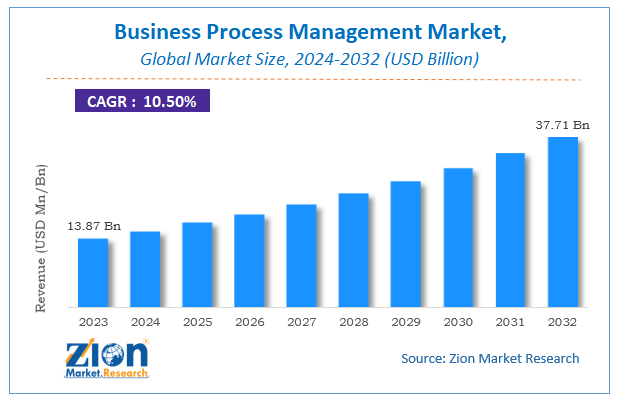
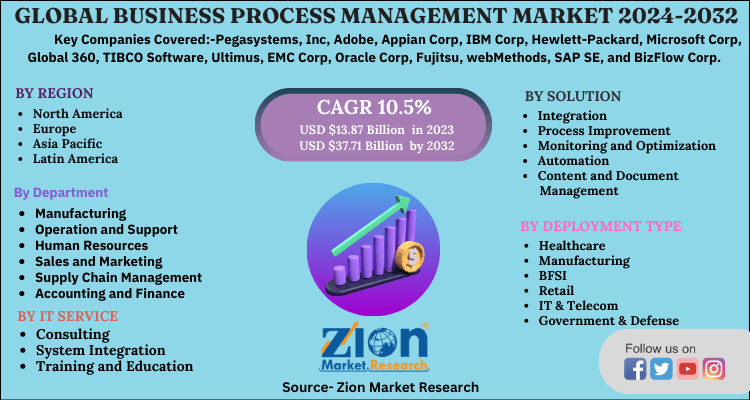
According to a report from Zion Market Research, the global business process management market was valued at USD 13.87 billion in 2023 and is projected to hit USD 37.71 billion by 2032, with a compound annual growth rate (CAGR) of 10.5% during the forecast period 2024-2032. This report provides a comprehensive analysis of the growth drivers, restraints, and challenges shaping demand across the global business process management market throughout the forecast period, while highlighting high-potential emerging opportunities within the industry.
Key Insights
- As per the analysis shared by our research analyst, the global business process management market is estimated to grow annually at a CAGR of around 10.5% over the forecast period (2024-2032).
- In terms of revenue, the global business process management market size was valued at around USD 13.87 billion in 2023 and is projected to reach USD 37.71 billion by 2032.
- The business process management market is projected to grow at a significant rate due to the need for improved risk management, higher productivity, better cost control, operational excellence, defect reduction, and enhanced efficiency under competitive pressure.
- Based on the department segment, the IT-related functions hold a dominant position due to their central role in digital transformation initiatives, integration of automation tools, and process optimization strategies across business units.
- Based on the IT service segment, system integration is the most dominant as organizations seek to streamline workflows and connect legacy systems with modern BPM platforms for seamless data exchange and real-time analytics.
- Based on the solution segment, process automation emerges as the leading solution because businesses prioritize automation to reduce operational costs, enhance efficiency, and improve process accuracy with growing AI and machine learning adoption.
- Based on the deployment type segment, BFSI drive significant adoption due to flexibility, scalability, and the need for real-time collaboration.
- Based on region, North America leads the market, driven by the presence of major BPM vendors, rapid technological advancements, early adoption of automation technologies, robust IT infrastructure, and high demand for process optimization in sectors such as BFSI, healthcare, and retail.
Business Process Management Market: Overview
A business solution approach that consists of a set of workflows is known as business process management (BPM). This software helps businesses to execute, model, monitor, implement, and optimize their processes. Owing to the capability of BPM software to connect people across various applications, this software is widely preferred. Business process management software provides automated processes and is a key factor for the success of any company. It is a strategic business solution that may offer new market opportunities.
These business processes are a series of value-added activities collaborated to achieve a common goal. It helps to enhance the productivity of the company. A wide range of business processes are available and utilized by different business domains. They are adapted for service-oriented architecture (SOA) process management, connection, and integration. Some manufacturing business domains need very consistent outcomes; hence, they focus on strictly controlled processes.
Business Process Management Market: Growth Factors
How does the demand for operational excellence and cost control drive the business process management market?
In the rapidly changing business environment, the fact that achieving improved risk management, higher productivity, and better cost control to deal with competitive pressure is of great importance; this is anticipated to boost the global business process management market growth in the future. It is designed to offer improvement and operational business excellence. It helps reduce defects and expenses associated with running costs and eliminates unclear data.
It also minimizes the risk of identifying issues and intervenes promptly to avoid moderate risks; all these factors are anticipated to contribute to the growth of the global market in the future. Business process management improves the efficiency of the cornerstone metric of the business process. It enhances operational efficiency and hence productivity, and lower cost advantages are provided.
Business Process Management Market: Restraints
What factors related to implementation complexity and change management restrain market growth?
Implementation of comprehensive BPM solutions often involves significant organizational change, process redesign, and integration with existing systems, which can create resistance and extend project timelines. The complexity of mapping and optimizing intricate enterprise workflows requires specialized expertise that may not be readily available in all organizations.
High initial investment costs for advanced platforms, combined with ongoing customization and training requirements, can deter smaller enterprises or those with limited IT budgets. Integration challenges with legacy systems further complicate deployment and may slow adoption in certain traditional industries.
Global Business Process Management Market: Report Scope
| Report Attributes | Report Details |
|---|---|
| Report Name | Business Process Management Market |
| Market Size in 2023 | USD 13.87 Billion |
| Market Forecast in 2032 | USD 37.71 Billion |
| Growth Rate | CAGR of 10.5% |
| Number of Pages | 220 |
| Key Companies Covered | Pegasystems, Inc., Adobe, Appian Corp, IBM Corp, Hewlett-Packard, Microsoft Corp, Global 360, TIBCO Software, Ultimus, EMC Corp, Oracle Corp, Fujitsu, webMethods, SAP SE, BizFlow Corp, and Others. |
| Segments Covered | By Department, By IT Service, By Solution, By Deployment Type, and By Region |
| Regions Covered | North America, Europe, Asia Pacific (APAC), Latin America, Middle East, and Africa (MEA) |
| Base Year | 2023 |
| Historical Year | 2018 - 2022 |
| Forecast Year | 2024 - 2032 |
| Customization Scope | Avail customized purchase options to meet your exact research needs. Request For Customization |
Business Process Management Market: Segmentation
The business process management market is segmented by department, IT service, solution, deployment type, and region. All the segments of the business process management market have been analyzed based on present and future trends and the market is estimated from 2024 to 2032.
Based on Department, the business process management market is divided into manufacturing, operation and support, human resource, sales and marketing, supply chain management, accounting and finance, and others. Functions closely aligned with IT and digital transformation hold a dominant position because of their central responsibility for implementing BPM platforms, integrating automation tools, and driving process optimization across the enterprise. This leadership helps propel overall market growth by ensuring BPM solutions are embedded in core operational and technological frameworks. Operations and support, along with accounting and finance, represent strong secondary areas where process standardization and efficiency gains deliver measurable value and sustain demand.
Based on IT Service, the global market is classified as consulting, system integration, and training and education. System integration is the most dominant segment as organizations increasingly seek to connect legacy systems with modern BPM platforms, enable seamless data exchange, support real-time analytics, and achieve consistent workflow management across departments. This dominance drives market expansion by addressing the practical need for interoperability in complex IT environments. Consulting services form the second most significant category, providing strategic guidance on process redesign and platform selection that supports successful BPM adoption and long-term value realization.
Based on Solution, the business process management market is divided into integration, process improvement, monitoring and optimization, automation, and content and document management. Process automation emerges as the leading solution because businesses prioritize automation to reduce operational costs, enhance efficiency, and improve process accuracy. Growing adoption of AI and machine learning further strengthens automated BPM capabilities and reinforces this segment’s contribution to market growth. Monitoring and optimization, along with process improvement, rank as important secondary solutions that enable continuous refinement and performance tracking essential for sustained operational excellence.
Based on Deployment Type, the global market is segmented as healthcare, manufacturing, BFSI, retail, IT & telecom, government & defense, and others. BFSI segment is among the most prominent due to stringent regulatory requirements, high transaction volumes, and the critical need for accurate, auditable processes. These verticals drive substantial market demand through investments in compliance, customer experience, and operational efficiency solutions. Manufacturing and IT & telecom also contribute significantly by leveraging BPM for supply chain coordination, service delivery, and digital workflow automation that support broader industry expansion.
Business Process Management Market: Regional Analysis
Why will North America continue to dominate the global market during the projection period?
North America is expected to maintain its leading position through the strong presence of major BPM vendors, rapid technological advancements, and early adoption of automation technologies across industries. Robust IT infrastructure combined with high demand for process optimization in BFSI, healthcare, and retail sectors enables continuous innovation and large-scale deployments that influence global standards and best practices. Continuously evolving regulations, particularly in healthcare, further stimulate demand for solutions that support changing financial transactions and documentation requirements.
Europe demonstrates solid market activity supported by mature enterprise software adoption, emphasis on operational efficiency, and regulatory frameworks that encourage process transparency and compliance. Key countries contribute through investments in digital transformation initiatives that sustain steady regional demand and technology refinement.

Recent Developments
- In 2024 and 2025, leading vendors including Pegasystems and Appian continued to enhance their platforms with advanced AI-driven process mining, low-code capabilities, and intelligent automation features to support broader enterprise adoption.
- Throughout 2025–2026, major players such as IBM, Microsoft, and SAP expanded their business automation portfolios with deeper integration of generative AI and cloud-native process orchestration tools aimed at improving agility and outcome-based value delivery.
Business Process Management Market: Competitive Players
Some of the key players in the business process management market are:
- Pegasystems, Inc
- Adobe
- Appian Corp
- IBM Corp
- Hewlett-Packard
- Microsoft Corp
- Global 360
- TIBCO Software
- Ultimus
- EMC Corp
- Oracle Corp
- Fujitsu
- webMethods
- SAP SE
- BizFlow Corp
The global business process management market is segmented as follows:
By Department
- Manufacturing
- Operation and Support
- Human Resources
- Sales and Marketing
- Supply Chain Management
- Accounting and Finance
- Other
By IT Service
- Consulting
- System Integration
- Training and Education
By Solution
- Integration
- Process Improvement
- Monitoring and Optimization
- Automation
- Content and Document Management
By Deployment Type
- Healthcare
- Manufacturing
- BFSI
- Retail
- IT & Telecom
- Government & Defense
- Others
By Region
- North America
- The U.S.
- Canada
- Mexico
- Europe
- France
- The UK
- Spain
- Germany
- Italy
- Rest of Europe
- Asia Pacific
- China
- Japan
- India
- Australia
- South Korea
- Rest of Asia Pacific
- The Middle East & Africa
- Saudi Arabia
- UAE
- Egypt
- Kuwait
- South Africa
- Rest of the Middle East & Africa
- Latin America
- Brazil
- Argentina
- Rest of Latin America
Table Of Content
Methodology
FrequentlyAsked Questions
Business process management (BPM) is a methodical approach and set of software tools that enable organizations to design, model, execute, monitor, optimize, and automate their business processes. It aims to improve efficiency, adaptability, and alignment with organizational goals; reduce costs, raise productivity, and enhance customer satisfaction.
Key growth drivers include the need for improved risk management, higher productivity, better cost control, operational excellence, defect reduction, elimination of unclear data, timely risk intervention, and overall enhancement of operational efficiency under competitive business pressure.
The global business process management market was valued at approximately USD 13.87 billion in 2023 and is projected to reach around USD 37.71 billion by 2032.
The global business process management market is expected to grow at a compound annual growth rate (CAGR) of roughly 10.5% between 2024 and 2032.
North America is expected to contribute notably and maintain a leading position in the global business process management market value, supported by major vendor presence, early technology adoption, robust IT infrastructure, and strong demand from BFSI, healthcare, and retail sectors.
Some of the key players in the business process management market are Pegasystems, Inc, Adobe, Appian Corp, IBM Corp, Hewlett-Packard, Microsoft Corp, Global 360, TIBCO Software, Ultimus, EMC Corp, Oracle Corp, Fujitsu, webMethods, SAP SE, and BizFlow Corp among others.
The report provides comprehensive analysis of market size and growth projections, segmentation by department, IT service, solution, and deployment type, regional insights, competitive landscape, key drivers, restraints, opportunities, challenges, recent developments, and strategic outlook for the forecast period 2024-2032.

List of Contents
How big is the Market?Key InsightsOverviewGrowth FactorsRestraintsReport ScopeBusiness Process ManagementSegmentationBusiness Process ManagementMarket:Regional AnalysisRecent DevelopmentsBusiness Process ManagementCompetitive PlayersThe global business process management market is segmented as follows:HappyClients

