
BPA-Free Cans Market Size, Share, Analysis, Trends, Growth, Forecasts, 2032

BPA-Free Cans Market By Capacity (Less than 250 ml, 250-500 ml, 500-1,000 ml, and Above 1,000 ml), by Product (2-Piece, 3-Piece, and Monobloc), By Material Type (Plastic, Aluminum, and Steel), By Application (Food & Beverages, Pharmaceuticals, Personal Care & Homecare, and Others), and By Region: Global Industry Perspective, Comprehensive Analysis and Forecast, 2024 - 2032
| Market Size in 2023 | Market Forecast in 2032 | CAGR (in %) | Base Year |
|---|---|---|---|
| USD 7.69 Billion | USD 11.71 Billion | 4.78% | 2023 |
What is the BPA-Free Cans Market Size?
According to a report from Zion Market Research, the global BPA-Free Cans Market was valued at USD 7.69 Billion in 2023 and is projected to hit USD 11.71 Billion by 2032, with a compound annual growth rate (CAGR) of 4.78% during the forecast period 2024-2032. This report explores market strengths, weakness, opportunities, and threats. It also provides valuable insights into the market's growth drivers, challenges, and the future prospects that may emerge in the BPA-Free Cans industry over the next decade.
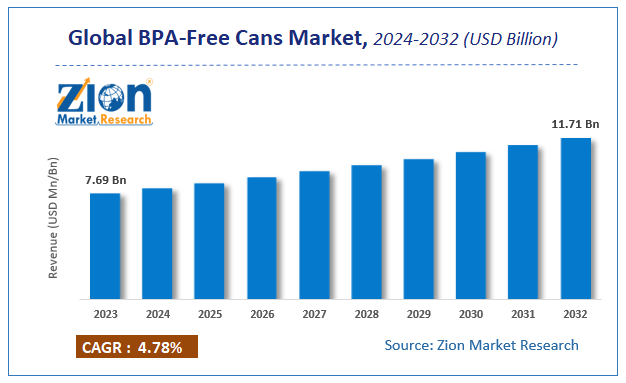
Global BPA-Free Cans Market: Overview
Concerns over the use of BPA-based products have increased significantly in the last few years. Many organizations have invested millions of dollars on the research activities to find out the serious health hazards of BPA-based products. Also, they are continuously engaged in creating public awareness to give up on BPA containing products such as metal cans. Hundreds of research papers depicting BPA as an endocrine disruptor have been published since last decade. This has enhanced the popularity as well as the use of BPA-free cans across the globe.
Global BPA-Free Cans Market: Growth Factors
The global BPA free cans market is observing robust growth as a result of massive awareness about health and food safety, thereby driving the demand for BPA-free cans. In addition to this, increasing food safety and health awareness has led to the requirement for the BPA-free cans for storage of food and beverages. Additionally, the flourishing food and beverage sector is increasing the demand for BPA-free cans, owing to the rising need for storage and selling various food items.
Furthermore, lead is one of the toxic metals and thus, the government has also taken actions for banning lead in any product. The lead contact with food is carcinogenic and may cause severe health damages to the consumers. The high amount of lead in food and other FMCG products may cause severe health disorders. This drives the market growth for lead-free products and also promotes the usage of BPA free cans across the globe. However, BPA is the major ingredient used in the industrial chemical. BPA prevents corrosion and thus considered to be the easy chemical to manufacture cans. Thus, the preference of several industries for BPA is expected to hamper the growth of BPA- free cans market in the foreseeable future.
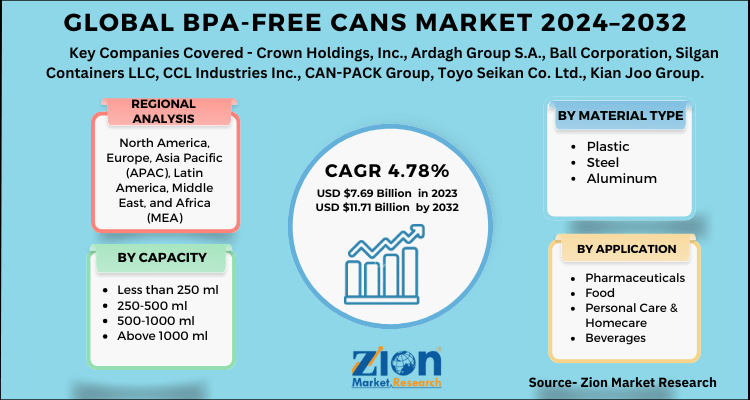
Global BPA-Free Cans Market: Segmentation
The global BPA-free cans market can be classified based on capacity, material type, product type, and application.
On the basis of capacity, the market is sectored into Less than 250 ml, 250-500 ml, 500-1000 ml, and Above 1000 ml.
Based on the material type, the BPA-free cans market is divided into Plastic, Aluminum, and Steel.
Product type wise, the market is classified into 2-Piece, 3-Piece, and Monobloc.
On the basis of application, the market is divided into Food, Beverages, Pharmaceuticals, and Personal Care & Homecare.
BPA-Free Cans Market: Report Scope
| Report Attributes | Report Details |
|---|---|
| Report Name | BPA-Free Cans Market |
| Market Size in 2023 | USD 7.69 Billion |
| Market Forecast in 2032 | USD 11.71 Billion |
| Growth Rate | CAGR of 4.78% |
| Number of Pages | 110 |
| Key Companies Covered | Crown Holdings, Inc., Ardagh Group S.A., Ball Corporation, Silgan Containers LLC, CCL Industries Inc., CAN-PACK Group, Toyo Seikan Co. Ltd., Kian Joo Group, CPMC Holdings Limited, HUBER Packaging Group GmbH, The Valspar Corporation, PPG Industries, Inc., DowDupont Inc., and Kangnam Jevisco Co., Ltd |
| Segments Covered | By Product, By Application And By Region |
| Regions Covered | North America, Europe, Asia Pacific (APAC), Latin America, Middle East, and Africa (MEA) |
| Base Year | 2023 |
| Historical Year | 2018 - 2022 |
| Forecast Year | 2024 - 2032 |
| Customization Scope | Avail customized purchase options to meet your exact research needs. Request For Customization |
Global BPA-Free Cans Market: Regional Analysis
Based on regions, the global BPA-free cans market can be divided into five main regions: North America, Europe, Asia Pacific, Latin America, and the Middle East and Africa. Massive intake of ready to eat foods is likely to drive the growth of BPA-free cans market in North America. Analysts have predicted that the region will dominate the global market trends over the years to come. Europe is anticipated to follow North America in terms of growth. Ban on use of BPA-based products such as baby bottles, baby food containers for children, and sippy cups by countries such as Denmark will embellish the demand for BPA- free cans in the region. In addition, the ban on the use of these BPA-based products by EU member nations such as Belgium, France, and Sweden for children in the age group of 0 to 3 will escalate the demand as well as supply curves on the growth graph of the BPA- free cans market. Moreover, Latin America and the Middle East and African markets are anticipated to witness moderate growths over the period.
Global BPA-Free Cans Market: Competitive Players
Some of key players in BPA-free cans market are
- Crown Holdings. Inc.
- Ardagh Group S.A.
- Ball Corporation
- Silgan Containers LLC
- CCL Industries Inc.
- CAN-PACK Group
- Toyo Seikan Co. Ltd.
- Kian Joo Group
- CPMC Holdings Limited
- HUBER Packaging Group GmbH
- The Valspar Corporation
- PPG Industries. Inc.
- DowDupont Inc.
- Kangnam Jevisco Co. Ltd.
The global BPA-free cans market is segmented as follows:
By capacity:
- Less than 250 ml
- 250-500 ml
- 500-1000 ml
- Above 1000 ml
By material type:
- Plastic
- Steel
- Aluminum
By application:
- Pharmaceuticals
- Food
- Meat & Seafood,
- Fresh Fruits & Vegetables
- Dairy Products
- Pet Food
- Tea & Coffee
- Dressings
- Sauces
- Condiments & Soups
- Ready-To-Eat Food
- Others
- Personal Care & Homecare
- Beverages
- Non-Alcoholic Beverages
- Carbonated Beverages
- Milk
- Juices
- Others
- Alcoholic Beverages
- Non-Alcoholic Beverages
By Region
- North America
- The U.S.
- Canada
- Mexico
- Europe
- France
- The UK
- Spain
- Germany
- Italy
- Rest of Europe
- Asia Pacific
- China
- Japan
- India
- Australia
- South Korea
- Rest of Asia Pacific
- The Middle East & Africa
- Saudi Arabia
- UAE
- Egypt
- Kuwait
- South Africa
- Rest of the Middle East & Africa
- Latin America
- Brazil
- Argentina
- Rest of Latin America
What Reports Provides
- Full in-depth analysis of the parent market
- Important changes in market dynamics
- Segmentation details of the market
- Former, on-going, and projected market analysis in terms of volume and value
- Assessment of niche industry developments
- Market share analysis
- Key strategies of major players
- Emerging segments and regional markets
- Testimonials to companies in order to fortify their foothold in the market.
Table Of Content
Methodology
FrequentlyAsked Questions
BPA-free cans are food and beverage containers made without bisphenol A. They reduce health risks associated with chemical leaching into food
The global BPA-Free Cans market is expected to be driven by the increasing health concerns over BPA exposure, strict food safety regulations, and rising adoption of sustainable packaging. Growing demand from food and beverage manufacturers supports market expansion.
According to study, the global BPA-Free Cans market size was worth around USD 7.69 Billion in 2023 and is predicted to grow to around USD 11.71 Billion By 2032.
The global BPA-Free Cans market is expected to grow at a Compound Annual Growth Rate (CAGR) of around CAGR 4.78% during the forecast period from 2024-2032.
The global BPA-Free Cans industry is projected to be challenged by Challenges include higher production costs, material performance trade-offs, and the need for regulatory compliance across regions.
The Opportunities arise from rising health awareness, regulatory bans on BPA, growing canned food and beverage demand, and innovation in safer coating technologies will offer significant growth opportunities in the BPA-Free Cans market.
Adoption of bio-based and plant-derived can linings; enhanced barrier coatings for shelf-life stability; regulatory-driven innovation in food-safe packaging are the emerging trends and innovations impacting the BPA-Free Cans market.
The global BPA-Free Cans market is expected to be led by Europe during the forecast period.
Some of the prominent players operating in the global BPA-Free Cans market are; Crown Holdings, Inc., Ardagh Group S.A., Ball Corporation, Silgan Containers LLC, CCL Industries Inc., CAN-PACK Group, Toyo Seikan Co. Ltd., Kian Joo Group, CPMC Holdings Limited, HUBER Packaging Group GmbH, The Valspar Corporation, PPG Industries, Inc., DowDupont Inc., and Kangnam Jevisco Co., Ltd and others.
The report explores crucial aspects of the BPA-Free Cans market, including a detailed discussion of existing growth factors and restraints, while also browsing future growth opportunities and challenges that impact the market.

HappyClients

