
Body Sensor Market Size, Share, And Growth Analysis Report 2032

Body Sensor Market By Sensor Type(EEG, ECG, A Respiration Sensor, Temperature Sensor, EMG Sensor Visual Sensor, And Blood Pressure Sensor), Based On Application(Defense, Healthcare, Sports Body Sensor, And Man-Machine Interface), By Placement Type(Implantable And Wearable), By Region - Global And Regional Industry Overview, market Intelligence, Comprehensive Analysis, Historical Data, And Forecasts 2024-2032
| Market Size in 2023 | Market Forecast in 2032 | CAGR (in %) | Base Year |
|---|---|---|---|
| USD 65.82 Billion | USD 317.36 Billion | 19.1% | 2023 |
Description
What is the Market size of the Body Sensor Industry?
The global body sensor market size was worth around USD 65.82 billion in 2023 and is predicted to grow to around USD 317.36 billion by 2032 with a compound annual growth rate (CAGR) of roughly 19.1% between 2024 and 2032.
The study provides historical data from 2018 to 2022 along with a forecast from 2024 to 2032 based on revenue (USD Billion). The report covers a forecast and an analysis of the Body Sensor market on a global and regional level.
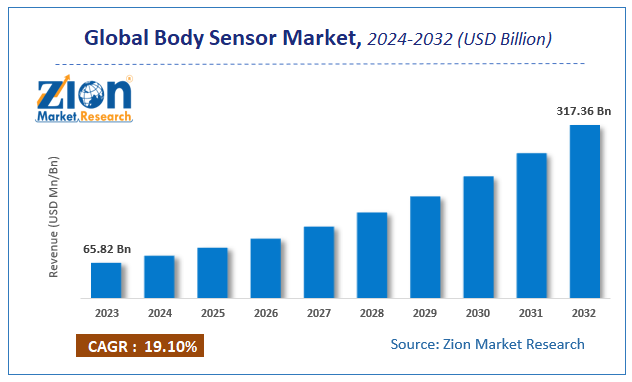
Global Body Sensor Market: Overview
A body sensor is basically a wireless system related to wearable computing devices. These gadgets or devices can be installed within the body implants and can be surface-mounted within the body in a settled point. The body sensors are a wearable invention, which humans can carry out in various positions, that is by hand, in clothes pockets, or in various bags.
Global Body Sensor Market: Growth Factors
The global body sensor market is increasing at a fast pace owing to the rising advantages of wearable devices particularly in the healthcare sector. The increasing development and the research activities by making use of (IoT) Internet of Things technology is favoring the global body sensors market expansion. Furthermore, physically disabled people or sports professionals also make use of the body sensors in order to maintain a track and monitor their various body activities thus propelling the demand for the body sensors in the global market.
In addition to this, several important factors fueling the demand and popularity of the body sensor market are: quickly growing geriatrics population percentage who require monitoring and real-time care, increasing fitness and health-related awareness and knowledge amongst the high-income consumers, verified value of the body sensors is increasing its usage in the clinical trials, trained sports leagues, additional comfort with particularly fabric-based sensors, and the expansion of smart textiles mainly as mobile user interface.
Lack of appropriate distribution channel and supply chain, adequate methods for data limitations, and security concerns related to body sensor wearability are anticipated to be the few obstructions which can be faced by the global body sensor market.
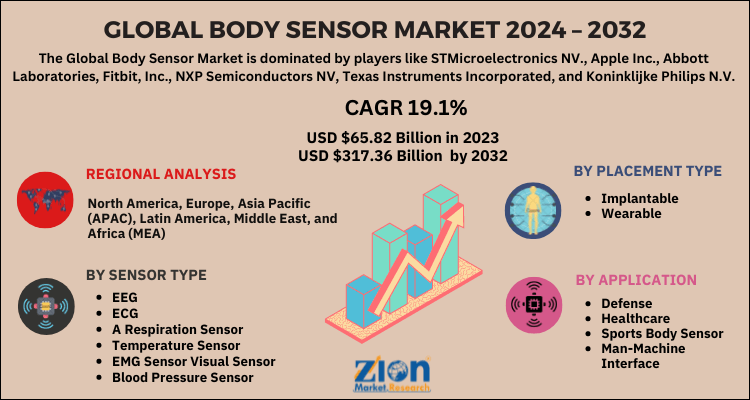
Global Body Sensor Market: Segmentation
In terms of sensor type, the body sensor market is globally classified into EEG, ECG, a respiration sensor, temperature sensor, EMG sensor visual sensor, and blood pressure sensor.
Based on application, the global body sensor market is divided into defense, healthcare, sports body sensor, and man-machine interface.
Based on the placement type, the body sensor market is divided into implantable and wearable.
Body Sensor Market: Report Scope
| Report Attributes | Report Details |
|---|---|
| Report Name | Body Sensor Market |
| Market Size in 2023 | USD 65.82 Billion |
| Market Forecast in 2032 | USD 317.36 Billion |
| Growth Rate | CAGR of 19.1% |
| Number of Pages | 202 |
| Key Companies Covered | STMicroelectronics NV., Apple Inc., Abbott Laboratories, Fitbit, Inc., NXP Semiconductors NV, Texas Instruments Incorporated, and Koninklijke Philips N.V., are among others |
| Segments Covered | By sensor type, By application, By placement type and By Region |
| Regions Covered | North America, Europe, Asia Pacific (APAC), Latin America, Middle East, and Africa (MEA) |
| Base Year | 2023 |
| Historical Year | 2018 - 2022 |
| Forecast Year | 2024 - 2032 |
| Customization Scope | Avail customized purchase options to meet your exact research needs. Request For Customization |
Global Body Sensor Market: Regional Analysis
Geographically, the global body sensor market is classified into Europe, North America, Asia Pacific, and the Middle East & Africa. The U.S. is expected to drive the development in North America as it is considered as the biggest market in the region. The Asia Pacific region is projected to offer a considerable prospective for the market development due to the rapid development in markets such as China and India. The Asia Pacific region is anticipated to witness the highest growth rate in the coming future; whereas, the body sensor market in the Middle East and Africa is expected to develop at a slow pace in the coming years.
Global Body Sensor Market: Competitive Players
Some of the most important market players in the global body sensor market are:
- ST Micro electronics NV.
- Apple Inc.
- Abbott Laboratories
- Fitbit Inc.
- NXP Semiconductors NV
- Texas Instruments Incorporated
- Koninklijke Philips N.V.
- Among others
The Global Body Sensor Market is segmented as follows:
By Sensor Type
- EEG
- ECG
- A Respiration Sensor
- Temperature Sensor
- EMG Sensor Visual Sensor
- Blood Pressure Sensor
By Application
- Defense
- Healthcare
- Sports Body Sensor
- Man-Machine Interface
By Placement Type
- Implantable
- Wearable
By Region
- North America
- The U.S.
- Canada
- Mexico
- Europe
- France
- The UK
- Spain
- Germany
- Italy
- Rest of Europe
- Asia Pacific
- China
- Japan
- India
- Australia
- South Korea
- Rest of Asia Pacific
- The Middle East & Africa
- Saudi Arabia
- UAE
- Egypt
- Kuwait
- South Africa
- Rest of the Middle East & Africa
- Latin America
- Brazil
- Argentina
- Rest of Latin America
What Reports Provides
- Full in-depth analysis of the parent market
- Important changes in market dynamics
- Segmentation details of the market
- Former, on-going, and projected market analysis in terms of volume and value
- Assessment of niche industry developments
- Market share analysis
- Key strategies of major players
- Emerging segments and regional markets
- Testimonials to companies in order to fortify their foothold in the market.
Table Of Content

FrequentlyAsked Questions
A body sensor is a wearable device that monitors physiological data. It is used in healthcare, fitness tracking, and remote patient monitoring.
The global Body Sensor market is expected to be driven by the Driven by increasing remote patient monitoring, wearable health devices, and chronic disease management needs. Advances in low-power sensors, wireless connectivity, and telehealth adoption support growth.
According to study, the global Body Sensor market size was worth around USD 65.82 Billion in 2023 and is predicted to grow to around USD 317.36 Billion By 2032.
The global Body Sensor market is expected to grow at a Compound Annual Growth Rate (CAGR) of around CAGR 19.1% during the forecast period from 2024-2032.
The global Body Sensor industry is projected to be challenged by Challenges include accuracy and calibration issues, data privacy and security concerns, and regulatory requirements for medical-grade applications.
The Opportunities include growth in remote patient monitoring, rising chronic disease management needs, advances in flexible electronics, and integration with consumer wearables and telehealth platforms will offer significant growth opportunities in the Body Sensor market.
Multi-parameter biosensing with better accuracy; skin-friendly flexible materials; edge processing + secure connectivity for remote patient monitoring are the emerging trends and innovations impacting the Body Sensor market.
The global Body Sensor market is expected to be led by APAC during the forecast period.
Some of the prominent players operating in the global Body Sensor market are; STMicroelectronics NV., Apple Inc., Abbott Laboratories, Fitbit, Inc., NXP Semiconductors NV, Texas Instruments Incorporated, and Koninklijke Philips N.V., are among others and others.
The report explores crucial aspects of the Body Sensor market, including a detailed discussion of existing growth factors and restraints, while also browsing future growth opportunities and challenges that impact the market.
HappyClients

