
Global Blood Preparation Market Size, Share, Trends, Growth, Forecasts, 2032

Blood Preparation Market By product type (blood components, whole blood, and blood derivatives), By Blood thinning agents (fibrinolytic, platelet aggregation inhibitor and anticoagulants) And By Region: - Global And Regional Industry Overview, Market Intelligence, Comprehensive Analysis, Historical Data, And Forecasts, 2024-2032
| Market Size in 2023 | Market Forecast in 2032 | Growth Rate (in %) | Base Year |
|---|---|---|---|
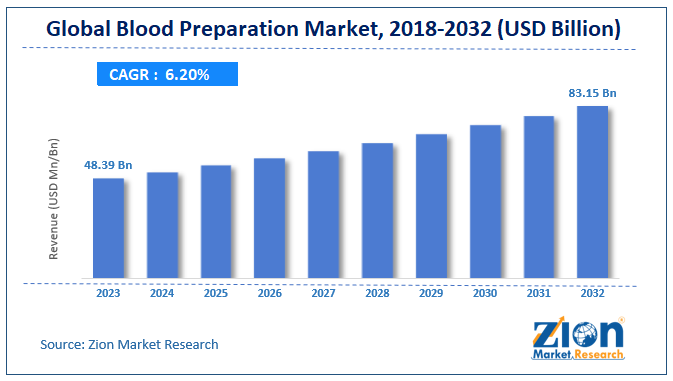
| USD 48.39 Billion | USD 83.15 Billion | CAGR at 6.20% | 2023 |
Description
What is the projected value for the Blood Preparation Market during 2024 to 2032?
Blood components preparation has a rising significance in the present age. It is a process in which one unit of whole blood goes through centrifugation. It is carried out in specialized equipment known as a refrigerated centrifuge. The whole blood is a mixture of crystalloids, cellular elements, and colloids of varying the relative size, density and sediment rate which can be separated by the application of centrifugal force.
Blood Preparation Market Overview
Blood preparation refers to the specialized process of separating whole blood into its individual components through centrifugation in refrigerated equipment. Whole blood consists of crystalloids, cellular elements, and colloids of differing size, density, and sedimentation rates that can be effectively separated by centrifugal force. The resulting preparations include packed red cells, plasma, platelets, leukocyte-reduced red blood cells, and other derivatives used for targeted medical treatments.
Market growth is supported by the rising volume of hospital casualties, increasing prevalence of blood disorders, and expanding demand for blood products during surgical interventions. Advancements in digital technology, the adoption of sophisticated instruments, and heightened requirements for specific blood constituents and source plasma further accelerate expansion. At the same time, the inherent risks of blood transfusion—including potential transmission of viral hemorrhagic fever, HIV, and Hepatitis B—act as limiting factors, restricting broader application primarily to critical cases. Continuous improvements in processing safety and component separation technologies help mitigate these concerns while sustaining overall industry progress.
Blood Preparation Market Key Insights
- As per the analysis shared by our research analyst, the global Blood Preparation market is estimated to grow annually at a CAGR of around 6.20% over the forecast period (2024-2032).
- In terms of revenue, the global Blood Preparation market size was valued at around USD 48.39 Billion in 2023 and is projected to reach USD 83.15 Billion by 2032.
- The market is driven by increasing numbers of hospital casualties, rising incidence of blood disorders, and growing demand for blood products in surgical procedures.
- Based on the Product Type segment, Blood Components held a leading position due to the ability to deliver targeted therapies with packed red cells, plasma, platelets, and leukocyte-reduced products that optimize clinical outcomes and reduce unnecessary exposure.
- Based on the Blood Thinning Agents segment, Anticoagulants dominated because of their widespread use in preventing clot formation during collection, processing, storage, and transfusion, supported by a broad range of heparins, direct thrombin inhibitors, and related agents.
- North America accounted for the largest share of the market, driven by advanced healthcare infrastructure, high-technology treatment capabilities, strict FDA oversight of the entire transfusion process from collection to storage, and favorable reimbursement frameworks in the United States.
Blood Preparation Market Dynamics
Growth Drivers
What factors are accelerating demand for blood preparation products?
The increasing number of hospital casualties and the rising prevalence of blood disorders are generating higher requirements for prepared blood products. Surgical procedures also continue to drive substantial demand for whole blood, components, and derivatives to support patient recovery and manage blood loss.
Developments in digital technology, the adoption of advanced processing instruments, and growing preference for specific blood constituents and source plasma further strengthen market expansion. These technological and clinical trends enable more efficient separation, safer handling, and better matching of products to patient needs.
Restraints
What is the primary factor limiting broader market growth?
The principal restraint is the risk associated with blood transfusion. Transfusion carries a significant potential for transmission of serious diseases such as viral hemorrhagic fever, HIV, and Hepatitis B.
These safety concerns restrict the use of blood products primarily to critical and life-threatening situations, thereby limiting volume growth in less urgent clinical settings and placing continuous pressure on manufacturers and blood banks to enhance screening and pathogen-reduction measures.
Opportunities
Where do the most promising opportunities lie?
Opportunities are expanding through rising transfusion needs, greater automation in blood banks, and increasing demand for safer component separation, storage, and pathogen-reduction solutions.
Advances in processing technology and the development of more reliable preservation methods that extend shelf life create additional avenues for growth, particularly as healthcare systems seek to improve blood supply efficiency and safety.
Challenges
What operational challenges does the industry face?
Stringent regulatory standards, high equipment costs, and ongoing contamination risks present persistent challenges. Shortages of skilled personnel also affect processing efficiency and quality control.
Maintaining consistent safety standards across collection, preparation, and storage while managing costs remains a complex operational requirement for blood banks and manufacturers worldwide.
Blood Preparation Market : Report Scope
| Report Attributes | Report Details |
|---|---|
| Report Name | Blood Preparation Market |
| Market Size in 2023 | USD 48.39 Billion |
| Market Forecast in 2032 | USD 83.15 Billion |
| Growth Rate | CAGR of 6.20% |
| Number of Pages | 196 |
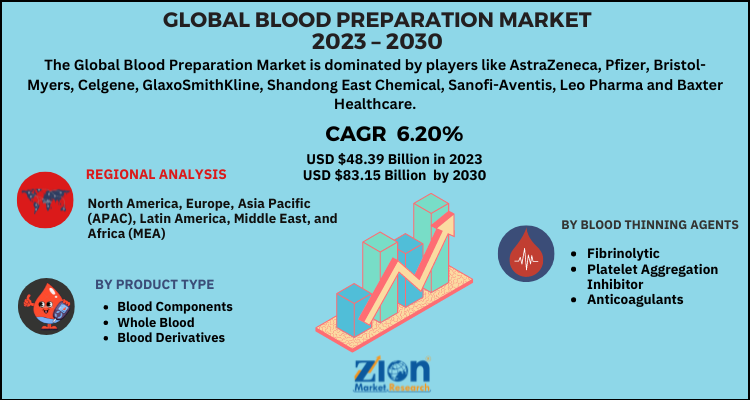
| Key Companies Covered | AstraZeneca, Pfizer, Bristol-Myers, Celgene, GlaxoSmithKline, Shandong East Chemical, Sanofi-Aventis, Leo Pharma and Baxter Healthcare |
| Segments Covered | By product type, By Blood thinning agents and By Region |
| Regions Covered | North America, Europe, Asia Pacific (APAC), Latin America, Middle East, and Africa (MEA) |
| Base Year | 2023 |
| Historical Year | 2018 - 2022 |
| Forecast Year | 2024 - 2032 |
| Customization Scope | Avail customized purchase options to meet your exact research needs. Request For Customization |
Global Blood Preparation Market: Segmentation
The Blood Preparation market is segmented by product type, blood thinning agents, and region.
Based on Product Type Segment,
The Blood Preparation market is divided into Blood Components, Whole Blood, Blood Derivatives, and others. Blood Components represent the most dominant sub-segment because centrifugation allows precise separation into packed red cells, plasma, platelets, leukocyte-reduced red blood cells, and platelet concentrates that enable targeted therapy, minimize volume overload, and reduce the risk of unnecessary antigen exposure. This precision supports better clinical outcomes across surgical, trauma, and chronic disease settings and drives higher utilization rates. Whole Blood ranks as the second most significant category, remaining essential for emergency transfusions and situations requiring rapid volume replacement, thereby sustaining substantial demand especially in acute care and trauma environments.
Based on Blood Thinning Agents Segment,
The Blood Preparation market is divided into Fibrinolytic, Platelet Aggregation Inhibitor, Anticoagulants, and others. Anticoagulants hold the dominant position due to their critical role in preventing clot formation during blood collection, processing, storage, and subsequent transfusion. Agents such as heparins, direct thrombin inhibitors, direct factor Xa inhibitors, and vitamin K antagonists ensure product integrity and safety throughout the supply chain, supporting large-scale adoption. Platelet Aggregation Inhibitors form the second major category, valued for their ability to manage platelet function in specific clinical scenarios and contribute to safer handling of platelet-rich preparations, thereby reinforcing overall market growth.
Global Blood Preparation Market: Regional Analysis
The largest share in the blood preparation market is held by North America and major growth can especially be seen in the U.S. This can be attributed to reasons such as an ultra-modern healthcare infrastructure, use of hi-technology for treatment purposes and strict control practiced by the FDA on the entire process of blood transfusion right from collection, preparation, and storage. Also, for favorable reimbursements for blood components, various other federal agencies are striving for health insurance portability standards to come into effect.
Asia Pacific is another major region showing a robust growth. Some of the major factors contributing to the growth in this region include rapid technological advancement and continual advancements made in the healthcare sector. Major countries showing growth in Asia Pacific include China, India, Japan and Australia. Also, a significant market share is contributed by regions such as Europe, Latin America and the Middle East and Africa.
Recent Developments
- Leading pharmaceutical and biotechnology firms have continued to advance anticoagulant formulations and pathogen-reduction technologies to improve the safety profile of blood products.
- Ongoing investments in automated blood processing systems and digital tracking solutions have been introduced by major players to enhance efficiency and traceability across blood banks.
- Regulatory agencies in key markets have strengthened guidelines for blood component preparation and storage, prompting manufacturers to upgrade equipment and quality-control processes.
- Collaborative efforts between blood banks and technology providers have focused on extending the shelf life of platelets and plasma through improved preservation methods.
Global Blood Preparation Market: Competitive Players
Some of the major companies in the blood preparation market are:
- AstraZeneca
- Pfizer
- Bristol-Myers
- Celgene
- GlaxoSmithKline
- Shandong East Chemical
- Sanofi-Aventis
- Leo Pharma
- Baxter Healthcare
The Global Blood Preparation Market is segmented as follows:
By Product Type
- Blood Components
- Whole Blood
- Blood Derivatives
By Blood Thinning Agents
- Fibrinolytic
- Platelet Aggregation Inhibitor
- Anticoagulants
By Region
- North America
- The U.S.
- Canada
- Mexico
- Europe
- France
- The UK
- Spain
- Germany
- Italy
- Rest of Europe
- Asia Pacific
- China
- Japan
- India
- Australia
- South Korea
- Rest of Asia Pacific
- The Middle East & Africa
- Saudi Arabia
- UAE
- Egypt
- Kuwait
- South Africa
- Rest of the Middle East & Africa
- Latin America
- Brazil
- Argentina
- Rest of Latin America
What Reports Provides
- Full in-depth analysis of the parent market
- Important changes in market dynamics
- Segmentation details of the market
- Former, on-going, and projected market analysis in terms of volume and value
- Assessment of niche industry developments
- Market share analysis
- Key strategies of major players
- Emerging segments and regional markets
- Testimonials to companies in order to fortify their foothold in the market.
Table Of Content

List of Contents
What is the projected value for the Market during 2024 to 2032?Blood PreparationMarket OverviewMarket Key InsightsBlood PreparationMarket DynamicsReport ScopeGlobal Blood PreparationSegmentationRegional AnalysisRecent DevelopmentsCompetitive PlayersThe Global Market is segmented as follows:What Reports ProvidesFrequentlyAsked Questions
Blood preparation refers to the processing of donated blood into components such as plasma, platelets, and red blood cells for medical use.
The global blood preparation market is expected to be driven by the Market growth is driven by rising surgical procedures, increasing blood transfusion demand, and growing adoption of advanced blood processing and separation technologies.
According to study, the global blood preparation market size was worth around USD 48.39 Billion in 2023 and is predicted to grow to around USD 83.15 Billion By 2032.
The global blood preparation market is expected to grow at a Compound Annual Growth Rate (CAGR) of around CAGR 6.20% during the forecast period from 2024-2032.
The global blood preparation industry is projected to be challenged by Challenges include stringent regulatory standards, high equipment costs, and contamination risks. Skilled personnel shortages affect processing efficiency.
Which application areas will offer significant growth opportunities in the blood preparation market?
The Opportunities stem from rising transfusion needs, automation in blood banks, and demand for safer component separation, storage, and pathogen reduction solutions will offer significant growth opportunities in the blood preparation market.
Automation in component separation, pathogen reduction technologies, and advanced preservation solutions to extend shelf life are the emerging trends and innovations impacting the blood preparation market.
The global blood preparation market is expected to be led by North America during the forecast period.
Some of the prominent players operating in the global blood preparation market are; AstraZeneca, Pfizer, Bristol-Myers, Celgene, GlaxoSmithKline, Shandong East Chemical, Sanofi-Aventis, Leo Pharma and Baxter Healthcare and others.
The report explores crucial aspects of the blood preparation market, including a detailed discussion of existing growth factors and restraints, while also browsing future growth opportunities and challenges that impact the market.
HappyClients

