
Blood Ketone Meter Market Size, Share, Trends, Growth and Forecast 2034

Blood Ketone Meter Market By Product (Blood Glucose Monitoring, Blood Ketone Monitoring, Surgical Devices and Consumables), By Application (Human and Veterinary), End-use (Hospitals, Diagnostic Centers, Homecare Settings, and Other End Use), and By Region: Global and Regional Industry Overview, Market Intelligence, Comprehensive Analysis, Historical Data, and Forecasts 2025 - 2034
| Market Size in 2024 | Market Forecast in 2034 | CAGR (in %) | Base Year |
|---|---|---|---|
| USD 477.1 Million | USD 924.6 Million | 6.84% | 2024 |
Blood Ketone Meter Industry Perspective
What will be the global Blood Ketone Meter market size during the forecast period?
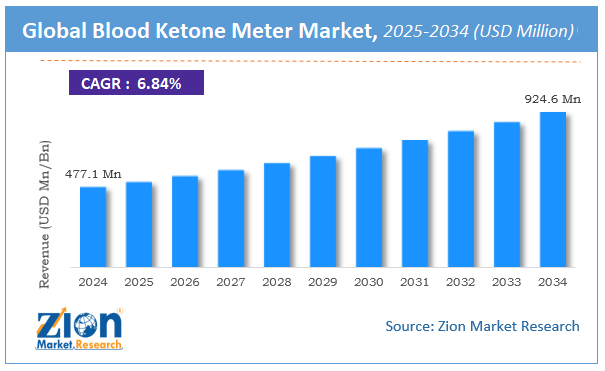
The global Blood Ketone Meter Market Size was worth around USD 477.1 million in 2024 and is predicted to grow to around USD 924.6 million by 2034 with a compound annual growth rate (CAGR) of roughly 6.84% between 2025 and 2034. The Blood Ketone Meter Market is driven by rising prevalence of diabetes and obesity, increasing adoption of ketogenic diets, growing demand for home-based diabetes management, and advancements in portable monitoring technology.
The report analyzes the global blood ketone meter market's drivers, restraints/challenges, and the effect they have on demand during the projection period. In addition, the report explores emerging opportunities in the blood ketone meter industry.
Blood Ketone Meter Market: Overview
Ketones are manufactured by the human body through the breakdown of fats, and this process is referred to as ketosis. The human body manufactures ketones when there is a lack of sugar supply in cells owing to reduced insulin levels. Apparently, the human body system starts breaking down fats to provide ketones as an alternative energy source over sugar. Reportedly, ketosis results in loss of weight along with offering numerous benefits, including appetite control as well as improvement in heart health through cholesterol reduction.
Key Insights
- As per the analysis shared by our research analyst, the global blood ketone meter market is estimated to grow annually at a CAGR of around 6.84% over the forecast period (2025-2034).
- Regarding revenue, the global blood ketone meter market size was valued at around USD 477.1 Million in 2024 and is projected to reach USD 924.6 Million by 2034.
- The blood ketone meter market is projected to grow at a significant rate due to rising prevalence of diabetes and obesity, increasing adoption of ketogenic diets, growing demand for home-based diabetes management, and advancements in portable monitoring technology.
- Based on Product, the Blood Ketone Monitoring segment is expected to lead the global market.
- On the basis of Application, the Human segment is growing at a high rate and will continue to dominate the global market.
- Based on the End-use, the Hospitals segment is projected to swipe the largest market share.
- Based on region, North America is predicted to dominate the global market during the forecast period.
Blood Ketone Meter Market: Growth Drivers
What factors are primarily accelerating the expansion of the Blood Ketone Meter market?
Growth of blood ketone meter market over forecast time span can be attributed to a surge in diabetes-related awareness, leading to the launch of new products for identifying glucose and ketones. A prominent increment in research activities by major players for designing multi-functional blood ketone meters will accentuate expansion of blood ketone meter industry. The rise in the number of diabetics across the globe will culminate into humungous demand for blood ketone meter industry over forecast timeline. As per CDC, nearly 27 million of U.S. population in 2020 were diagnosed with diabetes. Reportedly, in 2018, more than 2 lakh Americans falling below 20 years age were diagnosed with diabetes.
Furthermore, industry players are collaborating with other major players to manufacture blood ketone meters with new features. Manufacturers are introducing new products as per requirements of individuals. This, in turn, will create new growth avenues for blood ketone meter market. Nonetheless, evolving landscapes will upswing market trends.
Restraints
What challenges are limiting the growth potential of the Blood Ketone Meter market?
The ongoing cost of consumables such as test strips can create a financial burden for long-term users, particularly in price-sensitive markets. Competition from alternative ketone testing methods and the need for regular calibration or quality control may also limit broader adoption in some settings.
Limited awareness in certain regions and variability in reimbursement coverage for home monitoring devices can further restrain market penetration.
Blood Ketone Meter Market: Segmentation Analysis
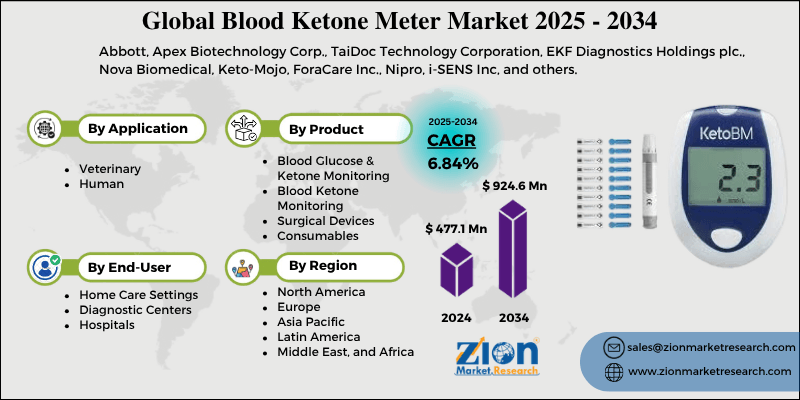
The global blood ketone meter market is segmented based on product, application, end-use, and region.
Based on Product, the global blood ketone meter market is divided into blood glucose monitoring, blood ketone monitoring, surgical devices, and consumables. The Blood Ketone Monitoring segment is expected to lead the market because dedicated ketone meters provide precise measurements required by diabetic patients at risk of ketoacidosis and by individuals strictly following ketogenic diets. This focused functionality supports strong clinical and consumer demand and drives overall market growth. The Blood Glucose and Ketone Monitoring segment ranks as the second major category, gaining traction through the convenience of dual-parameter devices that allow simultaneous tracking of glucose and ketone levels in a single unit.
On the basis of Application, the global blood ketone meter market is bifurcated into human and veterinary. The Human segment dominates and continues to grow at a robust rate due to the large and expanding population of people living with diabetes, as well as the rising number of individuals using ketone monitoring for weight management and metabolic optimization. High clinical and home-use volumes in this segment underpin the majority of market revenue and innovation activity. The Veterinary segment holds secondary importance and is expanding as awareness of metabolic monitoring in companion animals increases among pet owners and veterinary clinics.
By End-use, the global blood ketone meter market is split into hospitals, diagnostic centers, homecare settings, and other end-uses. The Hospitals segment is projected to capture the largest market share because of the high frequency of ketone testing in emergency departments, intensive care units, and inpatient diabetes management for detecting and treating diabetic ketoacidosis. Institutional purchasing and standardized protocols support substantial device and consumable volumes. The Homecare Settings segment ranks second and is growing rapidly, driven by the shift toward self-monitoring, patient empowerment, and the convenience of portable meters for daily diabetes and ketogenic diet management.
Blood Ketone Meter Market: Report Scope
| Report Attributes | Report Details |
|---|---|
| Report Name | Blood Ketone Meter Market |
| Market Size in 2024 | USD 477.1 Million |
| Market Forecast in 2034 | USD 924.6 Million |
| Growth Rate | CAGR of 6.84% |
| Number of Pages | 195 |
| Key Companies Covered | Abbott, Apex Biotechnology Corp., TaiDoc Technology Corporation, EKF Diagnostics Holdings plc., Nova Biomedical, Keto-Mojo, ForaCare Inc., Nipro, i-SENS Inc, and others. |
| Segments Covered | By Product, By Application, By End-Use, and By Region |
| Regions Covered | North America, Europe, Asia Pacific (APAC), Latin America, The Middle East and Africa (MEA) |
| Base Year | 2024 |
| Historical Year | 2020 to 2023 |
| Forecast Year | 2025 - 2034 |
| Customization Scope | Avail customized purchase options to meet your exact research needs. Request For Customization |
Blood Ketone Meter Market: Regional Analysis
Why will North America continue to dominate the global market during the projection period?
North America is expected to maintain its leading position due to its advanced healthcare infrastructure, high prevalence of diabetes, strong awareness of metabolic monitoring, and widespread adoption of both clinical and home-based blood ketone meters.
In North America, the United States serves as the primary market driver, supported by a large diabetic population, extensive hospital and diagnostic networks, favorable reimbursement environments in many settings, and the presence of leading device manufacturers. Canada contributes through progressive diabetes management programs and growing consumer interest in ketogenic lifestyles. The region’s early adoption of multi-functional meters, strong clinical research activity, and established distribution channels enable it to set global standards for product performance, user education, and digital health integration that influence market development worldwide.
Blood Ketone Meter Market: Competitive Analysis
- Abbott
- Apex Biotechnology Corp.
- TaiDoc Technology Corporation
- EKF Diagnostics Holdings plc.
- Nova Biomedical
- Keto-Mojo
- ForaCare Inc.
- Nipro
- i-SENS Inc
The global blood ketone Meter market is segmented as follows:
By Product
- Blood Glucose Monitoring
- Blood Ketone Monitoring
- Surgical Devices
- Consumables
By Application
- Human
- Veterinary
By End-User
- Hospitals
- Diagnostic Centers
- Home Care Settings
- Other End Use
By Region
- North America
- The U.S.
- Canada
- Europe
- France
- The UK
- Spain
- Germany
- Italy
- Rest of Europe
- Asia Pacific
- China
- Japan
- India
- South Korea
- Southeast Asia
- Rest of Asia Pacific
- Latin America
- Brazil
- Mexico
- Rest of Latin America
- Middle East & Africa
- GCC
- South Africa
- Rest of Middle East & Africa
Table Of Content
Methodology
FrequentlyAsked Questions
A blood ketone meter is a portable diagnostic device that measures the concentration of ketones in the blood. It is used to monitor ketosis for diabetes management, detection of diabetic ketoacidosis, adherence to ketogenic diets, and assessment of metabolic health in both human and veterinary applications.
The global blood ketone meter market is expected to grow due to increasing prevalence of diabetes and metabolic disorders, the rising popularity of ketogenic and low-carbohydrate diets for weight management and metabolic health.
The global blood ketone meter market is expected to grow at a CAGR of 6.84% during the forecast period.
North America is expected to dominate the blood ketone meter market over the forecast period.
Leading players in the global blood ketone meter market include Abbott, Apex Biotechnology Corp., TaiDoc Technology Corporation, EKF Diagnostics Holdings plc., Nova Biomedical, Keto-Mojo, ForaCare Inc., Nipro, i-SENS Inc, among others.
The report explores crucial aspects of the blood ketone meter market, including a detailed discussion of existing growth factors and restraints, while also examining future growth opportunities and challenges that impact the market.
Major challenges include the recurring cost of consumables such as test strips, competition from alternative testing methods, limited awareness in some regions, and variability in reimbursement coverage for home monitoring devices.

HappyClients

