
Ballistic Missile Market Size, Share, Growth, Opportunities 2034

Ballistic Missile Market By Missile Type (Air-Launched (ALBM), Anti-Ship (AShBM), and Land-Attack (LABM), By Component (Missile Airframe, Propulsion Systems, Guidance Systems, Sensors & Seekers, Warheads, Communication Systems, and Others), By Missile Speed (Subsonic, Supersonic, and Hypersonic), By Launch Platform (Naval, Ground-Based, and Airborne), By Missile Range (Tactical Range, Short Range, Medium Range, Intermediate Range, and Intercontinental Range), By Propulsion System (Liquid Propellant and Solid Propellant), and By Region - Global and Regional Industry Overview, Market Intelligence, Comprehensive Analysis, Historical Data, and Forecasts 2026 - 2034
| Market Size in 2025 | Market Forecast in 2034 | CAGR (in %) | Base Year |
|---|---|---|---|
| USD 5.22 Billion | USD 7.23 Billion | 3.63% | 2025 |
Ballistic Missile Industry Perspective:
What is the anticipated size of the ballistic missile market during the projection period?
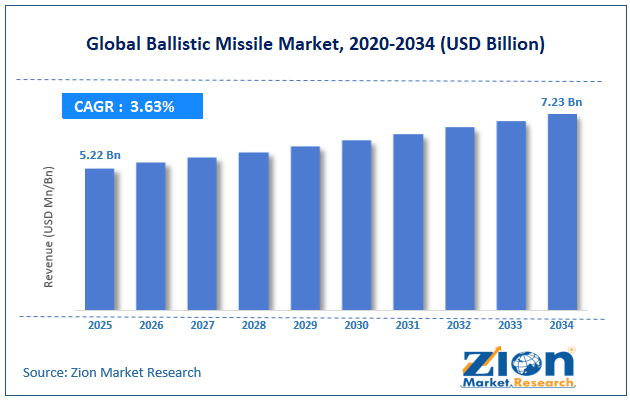
The global ballistic missile market size was worth around USD 5.22 billion in 2025 and is predicted to grow to around USD 7.23 billion by 2034, with a compound annual growth rate (CAGR) of roughly 3.63% between 2026 and 2034.
Key Insights:
- As per the analysis shared by our research analyst, the global ballistic missile market is estimated to grow annually at a CAGR of around 3.63% over the forecast period (2026-2034)
- In terms of revenue, the global ballistic missile market size was valued at around USD 5.22 billion in 2025 and is projected to reach USD 7.23 billion, by 2034.
- The ballistic missile market is projected to grow at a significant rate due to the rising defense expenditure worldwide, growing national security concerns, and escalating geopolitical conflicts.
- Based on the missile type, the land-attack (LABM) segment is growing at a high rate and will continue to dominate the global market as per industry projections.
- Based on the components, sensors & seekers are expected to generate the fastest growth during the forecast period.
- Based on the missile speed, the supersonic segment is expected to lead the market growth trends.
- Based on the launch platform, the ground-based missiles segment is projected to influence revenue in the market.
- Based on the missile range, the intercontinental range segment is anticipated to grow at the fastest CAGR during the forecast period.
- Based on the propulsion system, the solid propellant will emerge as the fastest-growing segment.
- Based on region, North America is projected to dominate the global market during the forecast period.
Ballistic Missile Market: Overview
A ballistic missile is a strategic military weapon. This self-guided defense equipment is propelled by a rocket mechanism and follows a ballistic trajectory to deliver a given payload to a predetermined target. Ballistic missiles can carry different payload types, including nuclear, chemical, and biological munitions. Depending on the type, ballistic missiles can be launched from land-based silos, submarines, ships, mobile surfaces, and aircraft. During the forecast period, the ballistic missile market is expected to be driven by rising defense expenditure worldwide, growing national security concerns, and escalating geopolitical conflicts. In addition, technological advancements may further help the market grow. However, high investment costs, trade barriers across regions, and strict arms-control legal frameworks may affect market revenue during the forecast period.
Impact of the USA-Israel and Iran war on the Ballistic Missile Market:
The USA-Israel and Iran war has emerged as one of the most prominent drivers for increased demand for ballistic missiles, especially between the US, Iran, and their respective allies. As per recent reports, the US military has spent over USD 37 billion on defense operations since the war with Iran began. In the coming years, this geopolitical conflict is expected to reshape the demand for next-generation ballistic missiles.
Ballistic Missile Market: Dynamics
Growth Drivers
How will growing military expenditure contribute to ballistic missile market growth?
The global ballistic missile market is expected to be driven by the surge in military expenditure worldwide. The arms race has played a critical role in shaping modern military infrastructure. Arms rivalry between the Western and Eastern blocs has amplified demand for modern ammunition, thus enabling revenue for ballistic missile manufacturers. According to recent reports, Russia has launched several new initiatives to boost domestic ballistic missile production, including the RS-28 Sarmat and Iskander-M systems. Rising threats to national security due to terrorist groups, territorial disputes, and geopolitical tensions will further encourage military investments, influencing market growth trends.
Nuclear ambitions to work in favor of the market players during the forecast period
Growing nuclear ambitions of countries across the globe are expected to emerge as a leading demand driver for ballistic missiles. Major nuclear powers such as the US, Russia, India, China, and the United Kingdom are actively modernizing their nuclear weapons systems, especially against the backdrop of changing geopolitical partnerships. In addition, North Korea and Iran have been reported to have invested heavily in nuclear ammunition. The global ballistic missile market witnessed the launch of around 10 short-range, tactical, nuclear-capable ballistic missiles by North America in August 2026.
Restraints
High cost of investment and concerns over negative implications of missile use to limit industry growth
The global ballistic missile industry is expected to be restricted due to high investment costs and the environmental & humanitarian impact of missile use. Modern and advanced guidance and propulsion systems require years of research & development. Procurement costs can be equally high, especially when dealing with next-generation systems. In addition, ballistic missile use has significant environmental and humanitarian impact, which questions the use of such ammunition technologies during geopolitical conflicts.
Opportunities
Why is demand for next-generation battlefield technologies expected to encourage growth in the ballistic missile market?
The global ballistic missile market is expected to grow as next-generation battlefield management systems continue to develop. AI-integrated, cutting-edge Command, Control, Communications, Computers, Cyber, Intelligence, Surveillance, and Reconnaissance (C5ISR) systems have highlighted the shortcomings of existing military systems, propelling demand for next-generation ammunition capable of navigating the evolving battlefield landscape. In August 2026, India announced the successful test firing of an ingenious Agni-4 ballistic missile. Part of the Agni series, it is a long-range, nuclear-capable surface-to-surface ballistic missile developed by the region. In August 2026, reports emerged suggesting that the US Navy is working on a long-range missile capable of downing aerial targets up to 250 nautical miles away. It is officially termed the AIM-242 long-range air-to-air missile and showcases the region’s commitment to upgrading its existing ammunition base.
Challenges
What are the leading challenges affecting growth in the ballistic missile industry?
The global ballistic missile industry is projected to be constrained by strict regulatory frameworks that control arms development, procurement, and cross-border trade. National and international regulations, such as non-proliferation measures and export controls, tightly regulate the arms industry. Trading partnerships are complex as they follow lengthy approval procedures, further affecting market revenue.
Ballistic Missile Market: Report Scope
| Report Attributes | Report Details |
|---|---|
| Report Name | Ballistic Missile Market |
| Market Size in 2025 | USD 5.22 Billion |
| Market Forecast in 2034 | USD 7.23 Billion |
| Growth Rate | CAGR of 3.63% |
| Number of Pages | 229 |
| Key Companies Covered | Northrop Grumman Corporation, Bharat Dynamics Limited, Roketsan, General Dynamics Corporation, China Aerospace Science and Technology Corporation (CASC), BAE Systems plc, Rafael Advanced Defense Systems Ltd., The Boeing Company, MBDA, Hanwha Aerospace, Lockheed Martin Corporation, BrahMos Aerospace, NPO Mashinostroyeniya, Korea Aerospace Industries (KAI), Israel Aerospace Industries Ltd. (IAI), and others. |
| Segments Covered | By Missile Type, By Component, By Missile Speed, By Launch Platform, By Missile Range, By Propulsion System, and By Region |
| Regions Covered | North America, Europe, Asia Pacific (APAC), Latin America, Middle East, and Africa (MEA) |
| Base Year | 2025 |
| Historical Year | 2020 - 2024 |
| Forecast Year | 2026 - 2034 |
| Customization Scope | Avail customized purchase options to meet your exact research needs. Request For Customization |
Ballistic Missile Market: Segmentation
The global ballistic missile market is segmented based on missile type, component, missile speed, launch platform, missile range, propulsion, and region.
Why will the land-attack (LABM) segment lead the ballistic missile industry revenue during the forecast period?
Based on the missile type, the global market segments are air-launched (ALBM), anti-ship (AshBM), and land-attack (LABM). In 2025, the highest growth was listed in the land-attack (LABM) segment. It accounted for 67% of the global revenue and will continue growing at a strong CAGR during the forecast period. Rising investments in nuclear modernization and growing demand for long-range missiles will drive segmental revenue during the forecast period.
Which will be the fastest-growing components segment during the forecast period in the ballistic missile market?
Based on components, the global market is fragmented into missile airframe, propulsion systems, guidance systems, sensors & seekers, warheads, communication systems, and others. In 2025, the guidance systems segment led the market growth rate, accounting for 35% of global revenue. During the forecast period, sensors & seekers are expected to grow the fastest due to rapid technological advancements and Artificial Intelligence (AI) integration directed to improving sensor performance.
Which factors drive demand in the supersonic segment in the ballistic missile industry?
Based on missile speed, the global ballistic missile industry is divided into subsonic, supersonic, and hypersonic. In 2025, the supersonic segment was the leading revenue generator, accounting for over 55% of total market share. It will continue to lead the market with a high CAGR. The presence of robust supportive infrastructure, operational readiness, and cost efficiency will drive segmental growth in the coming years.
What will be the influence of the ground-based segment on the ballistic missile market?
Based on the launch platform, the global market segments are naval, ground-based, and airborne. According to market revenue, ground-based missiles were the leading revenue generators in 2025, contributing 72% of total market share. They will continue to lead the market growth trends due to lower operational costs, strategic deterrence, and established architecture.
How will the intercontinental range segment encourage expansion of the ballistic missile market?
Based on missile range, the global market is divided into tactical range, short range, medium range, intermediate range, and intercontinental range. In 2025, the tactical range segment was listed as having the highest growth. The intercontinental range segment is anticipated to grow at the fastest CAGR during the forecast period, influenced by higher demand for high-performance ballistic missiles with superior range and penetration.
What will be the impact of the solid propellant segment on the ballistic missile market?
Based on propulsion system, the global market divisions are liquid propellant and solid propellant. In 2025, the solid propellant segment showed the highest growth and will continue to lead the market with a significant CAGR. Solid propellants facilitate rapid propulsion. They are easy to store and safer to use than liquid counterparts.
Ballistic Missile Market: Regional Analysis
Why will North America lead the ballistic missile market in the coming years?
The global ballistic missile market is currently led by North America. In 2025, it accounted for 33% of the global revenue and will grow at a strong CAGR during the forecast period. The US defense unit is one of the world’s largest military spenders. Growing geopolitical conflict involving the US, its allies, and other nations has intensified the use of ballistic missiles. During the forecast period, the regional market will continue to benefit from ongoing research & development of next-generation missiles.
Why will Asia-Pacific generate the fastest CAGR in the ballistic missile market during the forecast period?
Asia-Pacific is expected to emerge as the fastest-growing region in the ballistic missile market during the forecast period. In 2025, it accounted for 20% of the global revenue. China will lead regional growth trends as the country amplifies its military expenditure. Rising technological innovation and strategic partnerships between regional players will shape growth across Asia-Pacific. India is working extensively to develop indigenous missiles, further boosting regional market revenue.
Ballistic Missile Market: Competitive Analysis
The global ballistic missile market is led by players like:
- Northrop Grumman Corporation
- Bharat Dynamics Limited
- Roketsan
- General Dynamics Corporation
- China Aerospace Science and Technology Corporation (CASC)
- BAE Systems plc
- Rafael Advanced Defense Systems Ltd.
- The Boeing Company
- MBDA
- Hanwha Aerospace
- Lockheed Martin Corporation
- BrahMos Aerospace
- NPO Mashinostroyeniya
- Korea Aerospace Industries (KAI)
- Israel Aerospace Industries Ltd. (IAI)
What are the latest key trends in the ballistic missile market?
Shift toward maneuverable missile technologies
The ongoing development of maneuverable missile technologies (MaRVs) is a leading market trend. These missiles are expected to deliver superior performance and excellent maneuverability for better impact.
Advancements in counter-missile systems
Next-generation ballistic missiles have encouraged more investments in advanced counter-missile systems. This, in turn, will drive more investment in developing more effective ballistic missiles, creating a two-way trade.
The global ballistic missile market is segmented as follows:
By Missile Type
- Air-Launched (ALBM)
- Anti-Ship (AShBM)
- Land-Attack (LABM)
By Component
- Missile Airframe
- Propulsion Systems
- Guidance Systems
- Sensors & Seekers
- Warheads
- Communication Systems
- Others
By Missile Speed
- Subsonic
- Supersonic
- Hypersonic
By Launch Platform
- Naval
- Ground-Based
- Airborne
By Missile Range
- Tactical Range
- Short Range
- Medium Range
- Intermediate Range
- Intercontinental Range
By Propulsion System
- Liquid Propellant
- Solid Propellant
By Region
- North America
- The U.S.
- Canada
- Mexico
- Europe
- France
- The UK
- Spain
- Germany
- Italy
- Rest of Europe
- Asia Pacific
- China
- Japan
- India
- Australia
- South Korea
- Rest of Asia Pacific
- The Middle East & Africa
- Saudi Arabia
- UAE
- Egypt
- Kuwait
- South Africa
- Rest of the Middle East & Africa
- Latin America
- Brazil
- Argentina
- Rest of Latin America
Table Of Content
Methodology
FrequentlyAsked Questions
A ballistic missile is a strategic military weapon. This self-guided defense equipment is propelled by a rocket mechanism and follows a ballistic trajectory to deliver a payload to a predetermined target.
The global ballistic missile market is expected to be driven by the surge in military expenditure worldwide.
According to study, the global ballistic missile market size was worth around USD 5.22 billion in 2025 and is predicted to grow to around USD 7.23 billion by 2034.
The CAGR value of the ballistic missile market is expected to be around 3.63% during 2026-2034.
The global ballistic missile industry is projected to be restricted due to strict regulatory frameworks controlling arms development, procurement, and trade across geographic borders.
Shift toward maneuverable missile technologies and advancements in counter-missile systems are the emerging trends and innovations impacting the ballistic missile market.
The global ballistic missile market has performed well so far and will offer similar trends in the coming years.
North America will contribute notably towards the ballistic missile market value.
The global ballistic missile market is led by players like Northrop Grumman Corporation, Bharat Dynamics Limited, Roketsan, General Dynamics Corporation, China Aerospace Science and Technology Corporation (CASC), BAE Systems plc, Rafael Advanced Defense Systems Ltd., The Boeing Company, MBDA, Hanwha Aerospace, Lockheed Martin Corporation, BrahMos Aerospace, NPO Mashinostroyeniya, Korea Aerospace Industries (KAI), and Israel Aerospace Industries Ltd. (IAI).
The report explores crucial aspects of the ballistic missile market, including a detailed discussion of existing growth factors and restraints, while also browsing future growth opportunities and challenges that impact the market.

HappyClients

