
Autonomous Marine Vehicles Market Size, Growth, Global Trends, Forecast 2034

Autonomous Marine Vehicles Market By Type (Unmanned Surface Vehicles, Autonomous Underwater Vehicles, and Remotely Operated Vehicles), By Application (Defense and Military, Commercial, Scientific Research, Oil and Gas, Environmental Monitoring, and Others), By Propulsion System (Electric, Hybrid, and Fuel Cell), By Operation Mode (Remotely Operated, Fully Autonomous, and Semi-Autonomous), By End-User (Naval Forces, Research Institutions, Oil and Gas Companies, Environmental Agencies, Port Authorities, and Others), and By Region - Global and Regional Industry Overview, Market Intelligence, Comprehensive Analysis, Historical Data, and Forecasts 2025 - 2034
| Market Size in 2024 | Market Forecast in 2034 | CAGR (in %) | Base Year |
|---|---|---|---|
| USD 3.40 Billion | USD 6.40 Billion | 6.8% | 2024 |
Autonomous Marine Vehicles Industry Perspective:
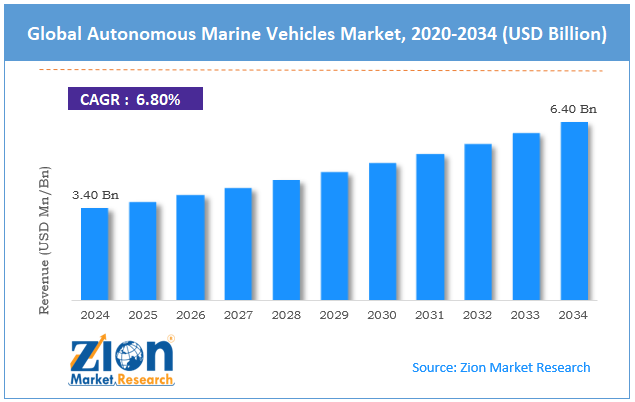
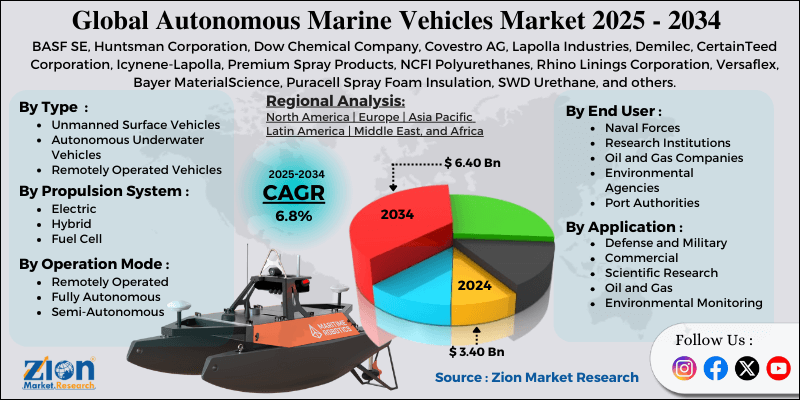
The global autonomous marine vehicles market size was worth approximately USD 3.40 billion in 2024 and is projected to grow to around USD 6.40 billion by 2034, with a compound annual growth rate (CAGR) of roughly 6.8% between 2025 and 2034.
Key Insights:
- As per the analysis shared by our research analyst, the global autonomous marine vehicles market is estimated to grow annually at a CAGR of around 6.8% over the forecast period (2025-2034).
- In terms of revenue, the global autonomous marine vehicles market size was valued at approximately USD 3.40 billion in 2024 and is projected to reach USD 6.40 billion by 2034.
- The autonomous marine vehicles market is projected to grow significantly due to rising maritime security concerns, increasing offshore exploration activities, growing demand for oceanographic research, expanding applications in environmental monitoring, technological advancements in artificial intelligence and sensors, and rising investment in naval modernization programs.
- Based on type, the autonomous underwater vehicles segment is expected to lead the autonomous marine vehicles market, while the unmanned surface vehicles segment is anticipated to experience significant growth.
- Based on the application, the defense and military segment is expected to lead the market compared to the commercial segment.
- Based on the propulsion system, the electric segment is the dominating segment, while the hybrid segment is projected to witness sizeable revenue over the forecast period.
- Based on operation mode, the remotely operated segment is expected to lead the market during the forecast period.
- Based on the end-user, the naval forces segment is expected to lead compared to the research institutions segment.
- Based on region, North America is projected to dominate the global autonomous marine vehicles market during the estimated period, followed by Europe.
Autonomous Marine Vehicles Market: Overview
Autonomous marine vehicles are unmanned watercraft designed to work on or below the water surface without direct human control. These vehicles use artificial intelligence, sensors, navigation systems, and communication technology to complete tasks independently or with minimal supervision. They exist in different forms, including unmanned surface vehicles that move across the water, autonomous underwater vehicles that travel below the surface, and remotely operated vehicles controlled from a distance. They carry tools such as cameras, sonar systems, environmental sensors, and other data collection devices to perform different activities. Their navigation depends on GPS, inertial measurement units, depth sensors, and obstacle detection systems, which help them to avoid collisions and follow planned routes.
They communicate using radio frequencies, satellite connections, or acoustic signals based on their depth and surroundings. Their power sources include rechargeable batteries, solar panels, diesel generators, or hybrid systems that increase their operational duration. The information gathered during missions is either stored on board or sent in real-time for immediate use. These vehicles operate in difficult environments where human presence is unsafe, costly, or impractical, and they are useful for ocean exploration, security monitoring, infrastructure inspection, and environmental research.
The increasing need for maritime security and the growing focus on ocean research are expected to drive growth in the autonomous marine vehicles market throughout the forecast period.
Autonomous Marine Vehicles Market Dynamics
Growth Drivers
Maritime security threats and border surveillance needs
The autonomous marine vehicles market is growing quickly as countries face rising security issues in their coastal waters and exclusive economic zones. Piracy, smuggling, illegal fishing, and maritime terrorism require constant monitoring across wide ocean areas, which is difficult and expensive using manned vessels. Autonomous vehicles offer cost-effective surveillance by working continuously without crew fatigue or safety risks. They detect suspicious movements, track unauthorized vessels, and collect intelligence in sensitive regions without risking human lives. Border security teams use surface vehicles equipped with radar and cameras to monitor coastlines and identify illegal crossings. Naval forces use underwater vehicles to detect mines, submarines, and hidden threats that endanger shipping lanes and military operations. The ability to work in disputed waters without putting personnel in danger makes these vehicles highly valuable.
Rising geopolitical tensions in regions such as the South China Sea, the Persian Gulf, and Arctic waters increase the demand for robust maritime awareness. Port authorities use autonomous vehicles to inspect ship hulls, scan underwater structures, and improve harbor security. Anti-terrorism units benefit from vehicles able to investigate suspicious objects or vessels from a safe distance.
How are offshore energy growth and underwater infrastructure development boosting the autonomous marine vehicles market expansion?
The global autonomous marine vehicles industry is growing steadily as offshore oil, gas, and renewable energy projects expand into deeper waters and distant regions. Traditional inspection methods, which use divers and manned submersibles, are costly, risky, and restricted by depth and weather limits. Autonomous vehicles complete regular inspections of pipelines, drilling platforms, subsea wellheads, and production equipment more safely and efficiently. They capture high-resolution video and sonar images to identify corrosion, leaks, structural damage, and marine growth needing attention. Wind farm operators use surface and underwater vehicles to inspect turbine foundations, cables, and anchoring systems without pausing power generation.
The vehicles study environmental impacts, monitor sediment movement, and observe marine life around installations. Decommissioning old platforms requires detailed surveys to be completed faster by autonomous vehicles. Pipeline route surveys for new projects benefit from rapid, autonomous mapping that covers wide areas efficiently. Deep-water exploration depends on vehicles able to work at depths beyond human reach while collecting geological and environmental data.
Restraints
How are high initial costs and technical complexity creating key restraints for the autonomous marine vehicles market?
The autonomous marine vehicles market faces major challenges due to the high investment required to develop, purchase, and operate these advanced systems. Sophisticated sensors, navigation tools, communication units, and artificial intelligence software increase vehicle costs far more than traditional marine equipment. Small and medium organizations often struggle to justify such expenses without assured returns or steady project demand. Custom vehicle development for specialized missions creates additional financial barriers that slow market expansion. Training teams to operate, maintain, and repair complex autonomous systems requires significant time and resources that many groups cannot provide.
Technical skills in robotics, software programming, sensor integration, and marine engineering are in high demand and can be expensive to acquire. Software updates, hardware upgrades, and system improvements require continuous investment to keep vehicles aligned with advancing technology. Insurance costs remain high due to unclear liability rules and limited operational records. Battery replacement, sensor calibration, and routine maintenance create ongoing costs that strain operational budgets.
Opportunities
How are the expanding oceanographic research and climate change monitoring creating opportunities in the global autonomous marine vehicles market?
The autonomous marine vehicles industry is gaining strong opportunities as scientific institutions and environmental agencies expand efforts to study ocean dynamics and climate change effects. Research vessels are costly to operate and limited in their ability to maintain long-term presence in remote ocean regions. They measure water temperature, salinity, current patterns, and chemical composition to support the development of detailed ocean models. Climate scientists use vehicles to monitor melting ice shelves, track ocean acidification, and study carbon absorption in different water layers.
Coral reef monitoring programs use autonomous vehicles to record bleaching events, track recovery, and evaluate conservation progress. Deep-sea exploration benefits from vehicles that reach ocean trenches and hydrothermal vents, allowing researchers to discover new species and geological features. Weather prediction models are continually improving with data from vehicles that capture atmospheric and oceanic conditions in previously inaccessible areas. Tsunami warning systems utilize underwater vehicles to monitor seismic activity and pressure changes that indicate the development of potential threats.
Challenges
Regulatory frameworks and legal uncertainties
The autonomous marine vehicles market faces complex challenges due to unclear regulations and changing legal frameworks covering unmanned maritime operations. International maritime law was created for manned vessels and does not fully address autonomous operations, THEREBY creating uncertainty for compliance efforts. Different countries enforce varying rules for autonomous vehicle use in territorial waters, making cross-border missions difficult to manage.
Liability issues arise when accidents involving unmanned vehicles OCCUR, with unclear responsibility between manufacturers, operators, and software developers. Navigation rules designed for human judgment do not always align with the behavior of autonomous systems, potentially creating conflicts with manned vessel traffic. Communication protocols and collision avoidance systems must meet standards that are not yet fully defined for autonomous platforms.
Military and dual-use technology limits restrict international sales and technology transfers for certain vehicle types. Environmental regulations require impact assessments for new technologies; however, consistent evaluation methods for autonomous vehicles are still in the process of evolving. Data ownership and privacy concerns appear when vehicles collect information in international waters or near sensitive locations.
Autonomous Marine Vehicles Market: Report Scope
| Report Attributes | Report Details |
|---|---|
| Report Name | Autonomous Marine Vehicles Market |
| Market Size in 2024 | USD 3.40 Billion |
| Market Forecast in 2034 | USD 6.40 Billion |
| Growth Rate | CAGR of 6.8% |
| Number of Pages | 217 |
| Key Companies Covered | BASF SE, Huntsman Corporation, Dow Chemical Company, Covestro AG, Lapolla Industries, Demilec, CertainTeed Corporation, Icynene-Lapolla, Premium Spray Products, NCFI Polyurethanes, Rhino Linings Corporation, Versaflex, Bayer MaterialScience, Puracell Spray Foam Insulation, SWD Urethane, and others. |
| Segments Covered | By Type, By Application, By Propulsion System, By Operation Mode, By End User, and By Region |
| Regions Covered | North America, Europe, Asia Pacific (APAC), Latin America, Middle East, and Africa (MEA) |
| Base Year | 2024 |
| Historical Year | 2019 to 2023 |
| Forecast Year | 2025 - 2034 |
| Customization Scope | Avail customized purchase options to meet your exact research needs. Request For Customization |
Autonomous Marine Vehicles Market: Segmentation
The global autonomous marine vehicles market is segmented based on type, application, propulsion system, operation mode, end-user, range, and region.
Based on type, the global autonomous marine vehicles industry is segregated into unmanned surface vehicles, autonomous underwater vehicles, and remotely operated vehicles. Autonomous underwater vehicles lead the market due to their extensive use in deep-water exploration, offshore infrastructure inspection, and naval operations where surface presence is undesirable or impractical.
Based on application, the industry is classified into defense and military, commercial, scientific research, oil and gas, environmental monitoring, and others. Defense and military applications hold the largest market share due to substantial government investment in maritime security, mine countermeasures, anti-submarine warfare, and intelligence gathering capabilities.
Based on propulsion system, the global autonomous marine vehicles market is divided into electric, hybrid, and fuel cell. Electric propulsion is expected to lead the market during the forecast period due to its reliability, low maintenance requirements, quiet operation, which is suitable for stealth missions, and compatibility with rechargeable battery technology.
Based on operation mode, the global market is categorized into remotely operated, fully autonomous, and semi-autonomous. Remotely operated systems hold the largest market share due to regulatory preferences for human oversight, established operational procedures, and comfort levels with proven control methods in critical applications.
Based on end-user, the global market is segmented into naval forces, research institutions, oil and gas companies, environmental agencies, port authorities, and others. Naval forces hold the largest market share due to defense budgets prioritizing unmanned systems for force multiplication, risk reduction, and operational flexibility in contested environments.
Autonomous Marine Vehicles Market: Regional Analysis
How is North America emerging as the leading region in the autonomous marine vehicles market?
North America holds a leading role in the autonomous marine vehicles market due to its strong defense spending, advanced technology development, and extensive coastline that requires continuous protection and monitoring. The United States Navy invests heavily in unmanned maritime systems as part of fleet modernization and distributed operations planning. Defense contractors in the region create advanced autonomous technologies, supported by research funding and cooperation with military programs. The country’s large exclusive economic zone and global maritime responsibilities increase demand for dependable surveillance abilities. Oil and gas operations in the Gulf of Mexico create steady commercial demand for underwater inspection vehicles. Research institutions on both coasts conduct major oceanographic studies using autonomous platforms.
Technology companies in Silicon Valley contribute artificial intelligence and sensor innovations that improve vehicle performance. The Great Lakes and inland waterways offer testing areas and real operating environments for many vehicle types. Coast Guard teams use autonomous vehicles for search and rescue assistance, environmental monitoring, and law enforcement tasks. Arctic waters opening due to ice loss create new opportunities for exploration and resource surveys. Port security needs influenced by terrorism concerns support the continued demand for harbor surveillance systems. Academic partnerships between universities and industry help accelerate technology progress. Strong intellectual property rules encourage investment in innovation, and established supply chains support production and maintenance across the region.
The Asia Pacific is rapidly growing in the global market.
Asia Pacific is seeing strong growth in the autonomous marine vehicles market as regional nations modernize their naval forces, expand maritime industries, and strengthen control over disputed waters. China leads regional investment with major programs developing local autonomous capabilities for both naval and commercial applications. Island nations, including Japan and Australia, face significant maritime awareness challenges across wide ocean regions due to their vast coastlines and strategic responsibilities.
Rising tensions in the South China Sea are driving increased demand for military surveillance and mine countermeasure systems, which support safer operations in contested zones. India is expanding its blue-water navy with unmanned systems that assist aircraft carriers and submarine missions across distant waters. Southeast Asian countries buy autonomous vehicles for anti-piracy activities and fisheries protection to improve security and sustainability.
The region’s large shipping industry uses vehicles for port management, hull inspections, and navigational safety tasks that enhance operational efficiency. Offshore energy growth increases demand for pipeline inspection and subsea equipment monitoring as projects move into deeper waters. Aquaculture operations, highly important in the region, use vehicles for environmental monitoring and farm management to support healthier production. Scientific studies on coral reefs, fisheries, and climate effects rely heavily on autonomous platforms for extensive data collection. Government programs supporting ocean technology development provide long-term funding and strong policy support.
Recent Market Developments:
- In July 2025, Hyundai Glovis, in partnership with Avikus (a division of HD Hyundai), announced the plan to retrofit seven large Pure Car and Truck Carriers (PCTCs) with a Level-2 Maritime Autonomous Surface Ship (MASS) system branded “HiNAS”, making them among the largest AI-driven vessels ever.
- In September 2025, Teledyne Marine was awarded a long-term contract by the UK Ministry of Defense covering support for the REPMUS exercises (2025-2028), including deployment and integration of autonomous marine vehicles.
Autonomous Marine Vehicles Market: Competitive Analysis
The leading players in the global autonomous marine vehicles market are:
- Kongsberg Maritime
- Teledyne Technologies
- L3Harris Technologies
- Saab AB
- General Dynamics Mission Systems
- Boeing
- Lockheed Martin
- BAE Systems
- Thales Group
- Atlas Elektronik
- ECA Group
- Oceaneering International
- Fugro
- Ocean Infinity
- and Subsea 7
The global autonomous marine vehicles market is segmented as follows:
By Type
- Unmanned Surface Vehicles
- Autonomous Underwater Vehicles
- Remotely Operated Vehicles
By Application
- Defense and Military
- Commercial
- Scientific Research
- Oil and Gas
- Environmental Monitoring
- Others
By Propulsion System
- Electric
- Hybrid
- Fuel Cell
By Operation Mode
- Remotely Operated
- Fully Autonomous
- Semi-Autonomous
By End User
- Naval Forces
- Research Institutions
- Oil and Gas Companies
- Environmental Agencies
- Port Authorities
- Others
By Region
- North America
- The U.S.
- Canada
- Europe
- France
- The UK
- Spain
- Germany
- Italy
- Rest of Europe
- Asia Pacific
- China
- Japan
- India
- South Korea
- Southeast Asia
- Rest of Asia Pacific
- Latin America
- Brazil
- Mexico
- Rest of Latin America
- Middle East & Africa
- GCC
- South Africa
- Rest of Middle East & Africa
Table Of Content
Methodology
FrequentlyAsked Questions

HappyClients

