
Automotive HVAC Market Size, Share, Analysis, Trends, Growth, Forecasts, 2032

Automotive HVAC Market By Technology (Manual, Automatic), Component (Evaporator, Compressor, Condenser, Receiver/Drier, and Expansion Device), By Vehicle Type (Passenger Cars, Light Commercial Vehicle (LCV), and Heavy Commercial Vehicle (HCV)): Global Industry Perspective, Comprehensive Analysis and Forecast, 2024 - 2032
| Market Size in 2023 | Market Forecast in 2032 | CAGR (in %) | Base Year |
|---|---|---|---|
| USD 52.02 Billion | USD 94.2 Billion | 6.82% | 2023 |
Automotive HVAC Industry Perspective
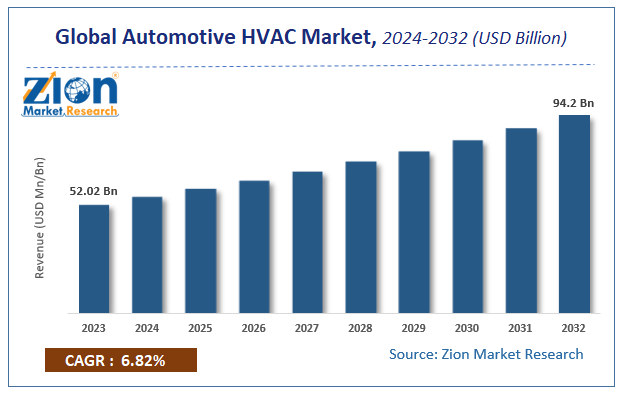
According to a report from Zion Market Research, the global Automotive HVAC Market was valued at USD 52.02 Billion in 2023 and is projected to hit USD 94.2 Billion by 2032, with a compound annual growth rate (CAGR) of 6.82% during the forecast period 2024-2032. This report explores market strengths, weakness, opportunities, and threats. It also provides valuable insights into the market's growth drivers, challenges, and the future prospects that may emerge in the Automotive HVAC industry over the next decade.
Global Automotive HVAC Market: Overview
HVAC is a heating, ventilation, and air conditioning technology that is used to maintain a pleasant environmental temperature inside the vehicle. The process of exchange and circulation of fresh air within a space is known as ventilation. Air conditioning is a process of shifting air in order to make indoor air more comfortable. The major advantage of an automotive HVAC system is that it provides a high level of comfort inside the vehicle for a longer duration. Previously, the use of HVAC automotive systems was a luxury, and not all cars were equipped with HVAC. However, it has now a mandatory feature in most vehicles because of the fundamental automotive safety and comfort requirements that are internationally recognized.
Global Automotive HVAC Market: Growth Factors
Factors such as increasing income levels and a rising middle-class population are expected to boost market growth in the future. Also, growing demand in the automotive sector is stimulating the market size of automotive HVAC. In addition, the automotive HVAC market is witnessing high demand owing to automatic temperature control features. Automotive HVAC system utilizes refrigerants which reduce concerns regarding safety; this, in turn, is anticipated to increase demand in the forthcoming years. The use of polluting refrigerants, to some extent, in the automatic HVAC market poses challenges to the thermal system. Furthermore, the implementation of geothermal pumps is expected to boost the global market growth in the coming years.
Global Automotive HVAC Market: Segmentation
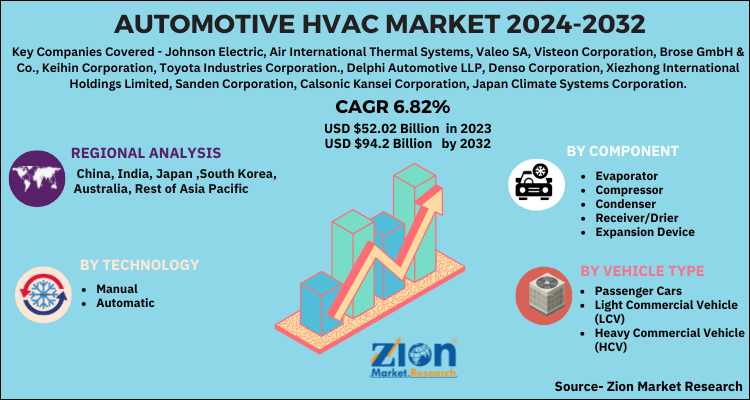
On the basis of technology, the global automotive HVAC market is segmented into manual HVAC systems and automatic HVAC systems. The automatic HVAC system dominates the market owing to the increasing adoption of technology by customers.
Based on the components, the global market is segmented as a receiver, compressor, and expansion device. The compressor market is estimated to be the fastest-growing segment over the next six years.
The compressors generate the flow of refrigerants and remove latent heat. Manufacturers are focusing on upgrading their product offerings to meet the rising energy standards and low GWP coolant requirements, expanding the market size of the industry.
Further, the global automatic HVAC market is segmented on the basis of vehicle types as passenger vehicles, commercial vehicles, and heavy commercial vehicles. The passenger vehicle segment is influencing the market owing to an increase in the production of passenger vehicles.
Region-wise, the global market is segregated into North America, Europe, Asia Pacific, Latin America, and Middle East & Africa.
Automotive HVAC Market: Report Scope
| Report Attributes | Report Details |
|---|---|
| Report Name | Automotive HVAC Market |
| Market Size in 2023 | USD 52.02 Billion |
| Market Forecast in 2032 | USD 94.2 Billion |
| Growth Rate | CAGR of 6.82% |
| Number of Pages | 110 |
| Key Companies Covered | Johnson Electric, Air International Thermal Systems, Valeo SA, Visteon Corporation, Brose GmbH & Co., Keihin Corporation, Toyota Industries Corporation., Delphi Automotive LLP, Denso Corporation, Xiezhong International Holdings Limited, Sanden Corporation, Calsonic Kansei Corporation, Japan Climate Systems Corporation, and Gentherm Inc. among others |
| Segments Covered | By Technology, By Components, By Vehicle Types And By Region |
| Regions Covered | North America, Europe, Asia Pacific (APAC), Latin America, Middle East, and Africa (MEA) |
| Base Year | 2023 |
| Historical Year | 2018 - 2022 |
| Forecast Year | 2024 - 2032 |
| Customization Scope | Avail customized purchase options to meet your exact research needs. Request For Customization |
Global Automotive HVAC Market: Regional Analysis
Asia Pacific has accounted for the major hunk of the global market share of the automotive HVAC industry. It is due to an increase in the number of vehicle production in developing countries such as India, and China. In addition, growing government support for the auto industry impacts the global market in a positive way. Moreover, North America and Europe are expected to grow at the fastest pace owing to the improving macroeconomic and production capacity.
Global Automotive HVAC Market: Competitive Players
Some main participants of the global automotive HVAC market are
- Johnson Electric
- Air International Thermal Systems
- Valeo SA
- Visteon Corporation
- Brose GmbH & Co.
- Keihin Corporation
- Toyota Industries Corporation.
- Delphi Automotive LLP
- Denso Corporation
- Xiezhong International Holdings Limited
- Sanden Corporation
- Calsonic Kansei Corporation
- Japan Climate Systems Corporation
- Gentherm Inc.
- among others.
This report segments the global automotive HVAC market into:
By Technology
- Manual
- Automatic
By Component
- Evaporator
- Compressor
- Condenser
- Receiver/Drier
- Expansion Device
By Vehicle Type
- Passenger Cars
- Light Commercial Vehicle (LCV)
- Heavy Commercial Vehicle (HCV)
By Region
- North America
- The U.S.
- Canada
- Mexico
- Europe
- France
- The UK
- Spain
- Germany
- Italy
- Rest of Europe
- Asia Pacific
- China
- Japan
- India
- Australia
- South Korea
- Rest of Asia Pacific
- The Middle East & Africa
- Saudi Arabia
- UAE
- Egypt
- Kuwait
- South Africa
- Rest of the Middle East & Africa
- Latin America
- Brazil
- Argentina
- Rest of Latin America
Table Of Content
Methodology
FrequentlyAsked Questions
Automotive HVAC systems control heating, ventilation, and air conditioning in vehicles. They maintain passenger comfort and cabin air quality.
The global Automotive HVAC market is expected to be driven by the rising vehicle production, demand for passenger comfort, and increasing adoption of electric vehicles. Climate control efficiency and innovation drive market expansion.
According to study, the global Automotive HVAC market size was worth around USD 52.02 Billion in 2023 and is predicted to grow to around USD 94.2 Billion By 2032.
The global Automotive HVAC market is expected to grow at a Compound Annual Growth Rate (CAGR) of around CAGR 6.82% during the forecast period from 2024-2032.
The global Automotive HVAC industry is projected to be challenged by Challenges include integration complexity with EV platforms and cost pressures from OEMs.
The Opportunities include rising vehicle production, EV thermal management demand, comfort feature upgrades, and innovation in energy-efficient HVAC systems will offer significant growth opportunities in the Automotive HVAC market.
Smart climate control with AI-driven efficiency; integration with EV thermal management; compact and energy-efficient system designs are the emerging trends and innovations impacting the Automotive HVAC market.
The global Automotive HVAC market is expected to be led by APAC during the forecast period.
Some of the prominent players operating in the global Automotive HVAC market are; Johnson Electric, Air International Thermal Systems, Valeo SA, Visteon Corporation, Brose GmbH & Co., Keihin Corporation, Toyota Industries Corporation., Delphi Automotive LLP, Denso Corporation, Xiezhong International Holdings Limited, Sanden Corporation, Calsonic Kansei Corporation, Japan Climate Systems Corporation, and Gentherm Inc. among others and others.
The report explores crucial aspects of the Automotive HVAC market, including a detailed discussion of existing growth factors and restraints, while also browsing future growth opportunities and challenges that impact the market.

HappyClients

