
Automotive Ball Joint Market Size, Share, Trends, Growth & Forecast 2034

Automotive Ball Joint Market By Product Type (Upper Ball Joints and Lower Ball Joints), By Vehicle Type (Electric Vehicles (EVs), Heavy Commercial Vehicles (HCVs), Light Commercial Vehicles (LCVs), and Passenger Vehicles), By Material (Aluminum, Steel, and Plastic/Composite), By Sales Channel (Aftermarket and Original Equipment Manufacturer (OEM), and By Region - Global and Regional Industry Overview, Market Intelligence, Comprehensive Analysis, Historical Data, and Forecasts 2025 - 2034
| Market Size in 2024 | Market Forecast in 2034 | CAGR (in %) | Base Year |
|---|---|---|---|
| USD 5.42 Billion | USD 8.09 Billion | 4.73% | 2024 |
Automotive Ball Joint Industry Perspective:
What will be the size of the global automotive ball joint market during the forecast period?
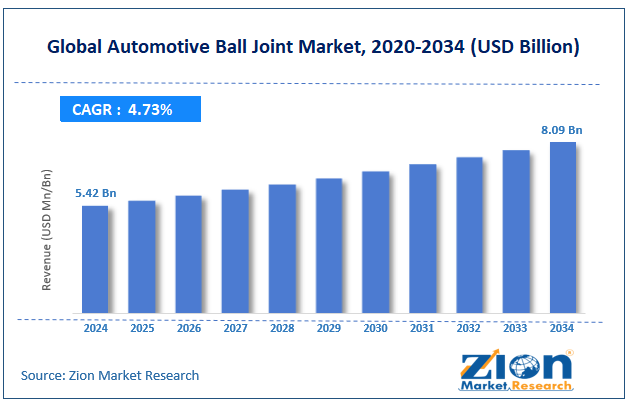
The global automotive ball joint market size was worth around USD 5.42 billion in 2024 and is predicted to grow to around USD 8.09 billion by 2034, with a compound annual growth rate (CAGR) of roughly 4.73% between 2025 and 2034.
Key Insights:
- As per the analysis shared by our research analyst, the global automotive ball joint market is estimated to grow annually at a CAGR of around 4.73% over the forecast period (2025-2034)
- In terms of revenue, the global automotive ball joint market size was valued at around USD 5.42 billion in 2024 and is projected to reach USD 8.09 billion by 2034.
- The automotive ball joint market is projected to grow at a significant rate due to the rising vehicle ownership rate across the globe.
- Based on the product type, the lower ball joints market segment is growing at a high rate and will continue to dominate the global market, as per industry projections
- Based on the material, the steel segment is anticipated to command the largest market share
- Based on region, the Asia-Pacific is projected to dominate the global market during the forecast period
Automotive Ball Joint Market: Overview
Automotive ball joints are essential elements of automobile vehicles. They are a part of a vehicle’s front suspension along with other components such as joints, links, and bushings. Automotive ball joints allow the front wheels of a vehicle to move up and down independently. Furthermore, they also play a crucial role in turning the wheels left or right together. Ball joints optimize suspension movement, improve tire wear, and enhance vehicle control. Ball joints have two structural elements: a metal housing and a stud. Ball joints are provided by original equipment manufacturers (OEMs) and by aftermarket service providers. During the forecast period, demand for automotive ball joints is expected to continue growing, driven by multiple factors.
For instance, growing vehicle ownership across the globe, along with increased demand for electric and hybrid vehicles, will work in favor of the industry players. Additionally, government policies promoting automobile safety will encourage higher investments in more effective automotive ball joints. The industry may face growth constraints due to high production costs and price competition.
Automotive Ball Joint Market: Dynamics
Growth Drivers
Why will the rising vehicle ownership rate influence the automotive ball joint market growth rate?
The global automotive ball joint market is expected to be influenced by the rising vehicle ownership rate across the globe. Automotive ball joints are critical components of a vehicle that ensure passenger safety and overall improved automobile performance. Ball joints are divided into two categories: upper ball joints and lower ball joints. The former assists in maintaining vehicle alignment and absorbing radial loads. On the other hand, lower ball joints are essential for a vehicle’s steering movement. In recent years, demand for passenger and commercial vehicles has grown at an unprecedented rate.
The rising disposable income of the general population, along with access to financial assistance such as low down payment and availability of Equated Monthly Installment (EMI) schemes, has helped fuel demand for all types of vehicles. This, in turn, has influenced the application of automotive ball joints. The reduction in production cost of vehicles and the increasing launch of affordable automobiles are expected to work in favor of the industry during the projection period.
Government initiatives to promote road safety to instill improved revenue in the industry
According to industry research, government initiatives and strict protocols concerning road safety will promote demand for automotive ball joints in the coming years. Automobile manufacturers are increasingly working on meeting strict safety standards and guidelines. Automotive ball joints are critical safety components in both heavy and light vehicles and therefore demand greater attention from companies operating in the automotive sector.
As per recent reports, the European Union is working on implementing stricter tests and initiatives to curb road accidents across the region. Similar initiatives can be witnessed worldwide, fueling revenue in the global automotive joint market during the projection period.
Restraints
Why will high manufacturing costs emerge as a major growth-limiting factor in the automotive ball joint market?
The global automotive ball joint industry is expected to be restricted due to the high production costs of ball joints. Steel and specialty alloys are the essential raw materials required for producing ball joints. However, fluctuating prices of these essential starting materials, along with the use of precision manufacturing techniques, will impact business decisions in the long run. Smaller and medium-sized companies may face significant barriers to global or regional expansion during the forecast period.
Opportunities
Expansion of the electric vehicles (EVs) sector to create growth opportunities for the industry players
The global automotive ball joint market is projected to generate growth opportunities due to the rapid expansion of the electric vehicle segment. EVs have witnessed tremendous acceptance among end users. The rising adoption of electric and hybrid vehicles is a result of fluctuating fuel prices, growing consumer awareness, and government subsidies offered on eco-friendly vehicles. In addition, electric and hybrid vehicle makers are adopting intense strategies aimed at global expansion, which can further curate demand for automotive ball joints during the projection period.
In December 2025, Highland Electric Fleets, a leading US-based provider of Electrification as a Service (EaaS), announced it had secured funding of USD 150 million from Aiga Capital Partners. The company is expected to use the funds to expand its services in new markets and also support additional deployments beginning in 2026. Government support in the expansion of the EV sector and infrastructure development will emerge as critical drivers for automotive ball joints in the coming years.
Challenges
What challenges will counterfeit products create for automotive ball joint market players?
The global automotive ball joint industry is projected to be challenged by the rising concerns over the sale of counterfeit and low-cost products in the automotive industry. These products can pose serious safety risks and also impact brand reputation. Additionally, since counterfeit products are available at low prices, they also lead to unfair price competition for the original makers of ball joints.
Automotive Ball Joint Market: Report Scope
| Report Attributes | Report Details |
|---|---|
| Report Name | Automotive Ball Joint Market |
| Market Size in 2024 | USD 5.42 Billion |
| Market Forecast in 2034 | USD 8.09 Billion |
| Growth Rate | CAGR of 4.73% |
| Number of Pages | 213 |
| Key Companies Covered | PPG Industries, Sika, 3M, Arkema, LORD Corporation, Avery Dennison, Dow, Wacker Chemie, Jowat, Henkel, Illinois Tool Works (ITW), H.B. Fuller, BASF, Permabond, Huntsman., and others. |
| Segments Covered | By Product Type, By Vehicle Type, By Material, By Sales Channel, and By Region |
| Regions Covered | North America, Europe, Asia Pacific (APAC), Latin America, Middle East, and Africa (MEA) |
| Base Year | 2024 |
| Historical Year | 2019 to 2023 |
| Forecast Year | 2025 - 2034 |
| Customization Scope | Avail customized purchase options to meet your exact research needs. Request For Customization |
Automotive Ball Joint Market: Segmentation
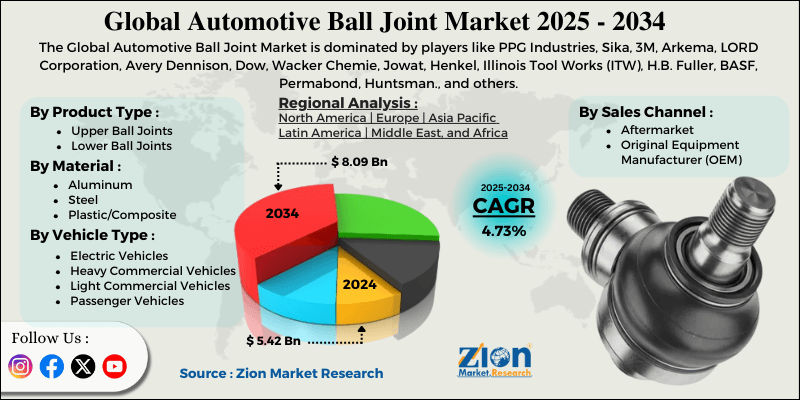
The global automotive ball joint market is segmented based on product type, vehicle type, material, sales channel, and region.
Based on product type, the global market segments are upper ball joints and lower ball joints. In 2024, the highest growth was listed in the lower ball joints market, dominating nearly 59% of the total segmental revenue. The pivotal role played by the lower ball joint in managing vehicle weight and ensuring optimal steering output is the major segmental growth propeller. Similar growth trends are expected to emerge during the forecast period.
Based on vehicle type, the global market divisions are electric vehicles (EVs), heavy commercial vehicles (HCVs), light commercial vehicles (LCVs), and passenger vehicles.
Based on material, the global automotive ball joint industry is divided into aluminum, steel, and plastic/composite. The steel segment was the highest revenue generator in 2024 and will continue to dominate the market over the forecast period. Steel offers excellent performance and structural integrity when used for producing automotive ball joints. Additionally, it is also more cost-efficient and resistant to wear & tear.
Based on the sales channel, the global market segments are aftermarket and original equipment manufacturer (OEM).
Automotive Ball Joint Market: Regional Analysis
Why will Asia-Pacific remain the highest revenue generator in the automotive ball joint market?
The global automotive ball joint market is projected to be led by Asia-Pacific during the projection period. In 2024, Asia-Pacific accounted for nearly 35% of the global revenue, and it is anticipated to deliver a CAGR of around 5.5% over the forecast duration. The regional prominence is driven by increasing production of automobile vehicles, with China emerging as the highest producer and exporter of automotives.
In addition, the regional EV sector has registered unprecedented sales over the last few years, dominating the global landscape. The rising global expansion of Chinese and Indian automakers into other regions will aid improved revenue in the Asia-Pacific automotive ball joint industry.
North America is expected to emerge as the second-highest revenue generator during the projection period. In 2024, it held control over 30.02% of total revenue, and it is expected to grow at a CAGR of 4.78% over the coming years. The presence of high safety standards in the automotive sector, along with the rising electrification of automobiles, will promote regional expansion. The US will generate the highest revenue in the regional market, driven by surging adoption of electric vehicles and rising production of automotive ball joints in the domestic market.
Automotive Ball Joint Market: Competitive Analysis
The global automotive ball joint market is led by players like:
- PPG Industries
- Sika
- 3M
- Arkema
- LORD Corporation
- Avery Dennison
- Dow
- Wacker Chemie
- Jowat
- Henkel
- Illinois Tool Works (ITW)
- H.B. Fuller
- BASF
- Permabond
- Huntsman.
Automotive Ball Joint Market: Key Market Trends
Increased sales in the aftermarket segment
A promising trend in the automotive ball joint industry is the rising sales of ball joints through aftermarket channels. Third-party providers offer higher customization options and are more cost-effective than OEM sellers.
Expansion of fleet vehicles
The rapid expansion of the logistics industry and the e-commerce sector has fueled increased momentum for commercial vehicles. This offers excellent growth opportunities to automotive ball joint makers as companies continue to invest in fleet expansion to meet global demands.
The global automotive ball joint market is segmented as follows:
By Product Type
- Upper Ball Joints
- Lower Ball Joints
By Vehicle Type
- Electric Vehicles (EVs)
- Heavy Commercial Vehicles (HCVs)
- Light Commercial Vehicles (LCVs)
- Passenger Vehicles
By Material
- Aluminum
- Steel
- Plastic/Composite
By Sales Channel
- Aftermarket
- Original Equipment Manufacturer (OEM)
By Region
- North America
- The U.S.
- Canada
- Mexico
- Europe
- France
- The UK
- Spain
- Germany
- Italy
- Rest of Europe
- Asia Pacific
- China
- Japan
- India
- Australia
- South Korea
- Rest of Asia Pacific
- The Middle East & Africa
- Saudi Arabia
- UAE
- Egypt
- Kuwait
- South Africa
- Rest of the Middle East & Africa
- Latin America
- Brazil
- Argentina
- Rest of Latin America
Table Of Content
Methodology
FrequentlyAsked Questions

HappyClients

