
Automated Fluorescence Microscope Market Size, Share, Trends, Growth 2034

Automated Fluorescence Microscope Market By Technology (Widefield Automated Fluorescence Microscopes, Confocal Automated Fluorescence Microscopes), By Application (Biomedical Research, Drug Discovery and Development), By End-User (Hospitals and Clinics, Pharmaceutical and Biotechnology Companies), and By Region - Global and Regional Industry Overview, Market Intelligence, Comprehensive Analysis, Historical Data, and Forecasts 2025 - 2034
| Market Size in 2024 | Market Forecast in 2034 | CAGR (in %) | Base Year |
|---|---|---|---|
| USD 556.99 Million | USD 722.19 Million | 3.30% | 2024 |
Automated Fluorescence Microscope Industry Perspective:
What will be the size of the automated fluorescence microscope market from 2025 to 2034?
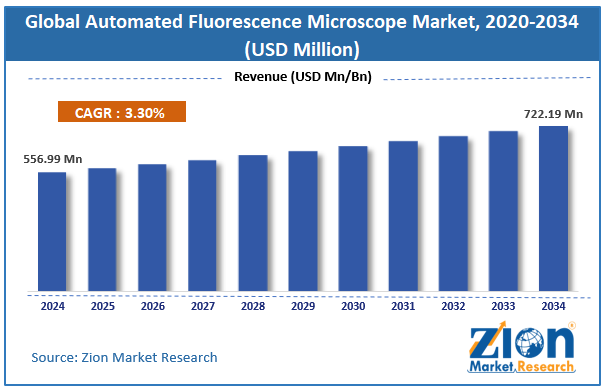
The global automated fluorescence microscope market size was approximately USD 556.99 million in 2024 and is projected to reach USD 722.19 million by 2034, with a compound annual growth rate (CAGR) of approximately 3.30% between 2025 and 2034.
Key Insights:
- As per the analysis shared by our research analyst, the global automated fluorescence microscope market is estimated to grow annually at a CAGR of around 3.30% over the forecast period (2025-2034)
- In terms of revenue, the global automated fluorescence microscope market size was valued at around USD 556.99 million in 2024 and is projected to reach USD 722.19 million by 2034.
- The automated fluorescence microscope market is projected to grow significantly, driven by the rising prevalence of chronic diseases, technological advancements in imaging systems, and government funding for life sciences research.
- Based on technology, the widefield automated fluorescence microscopes segment is expected to lead the market, while the confocal automated fluorescence microscopes segment is expected to grow considerably.
- Based on application, the biomedical research segment is the largest, while the drug discovery and development segment is projected to record sizeable revenue over the forecast period.
- Based on end-user, the pharmaceutical and biotechnology companies segment is expected to lead the market, followed by the hospitals and clinics segment.
- By region, North America is projected to dominate the global market during the forecast period, followed by Europe.
Automated Fluorescence Microscope Market: Overview
An automated fluorescence microscope is an improved imaging system that uses fluorescent proteins or dyes to visualize specific molecules or structures within tissues and cells. Automation enables the microscope to control focusing, image acquisition, analysis, and stage movement with minimal human intervention, thereby improving accuracy, speed, and reproducibility. The global automated fluorescence microscope market is poised for notable growth, driven by advances in life sciences and biomedical research, the surging adoption of high-content screening, and improvements in fluorescent probes and labels. Expanding research in cell biology, neuroscience, and genetics augments the need for improved imaging tools. Automated fluorescence microscopes enable high-resolution, faster analysis. This supports complex experiments and large-scale studies. Pharmaceutical companies rely on high-content screening for toxicity testing and drug discovery. Automated fluorescence microscopes help with parallel imaging of thousands of samples. This majorly reduces time and manual effort. Moreover, improved fluorescent dyes offer high stability and brightness. This improves image clarity and reduces sensitivity. As probe technology advances, the demand for automated systems rises.
Nevertheless, the global market faces limitations due to factors such as high equipment and maintenance costs, operational complexity, and availability of low-cost alternatives. Automated fluorescence microscopes need a large upfront investment. Maintenance and upgrades further increase prices, thus restricting adoption among small laboratories. Improved systems need skilled personnel for troubleshooting and operation. Training requirements may slow adoption. Hence, smaller institutions may lack specialization. Likewise, basic fluorescence or brightfield microscopes are comparatively low-priced. Some labs use simpler systems for routine tasks. This lowers the demand for automation.
Still, the global automated fluorescence microscope industry benefits from several favorable factors, such as integration with multi-omics platforms, cloud-based image analysis, and modular, customizable systems. Combining microscopy with proteomics and genomics improves data insights. Integrated platforms offer higher research value. This creates strong growth potential. Cloud solutions lower local data storage needs. They enable remote access and collaboration, thereby increasing system adoption and flexibility. Additionally, modular designs allow laboratories to upgrade steadily. This reduces initial investment hindrances. It appeals to budget-conscious users.
Automated Fluorescence Microscope Market Dynamics
Growth Drivers
How is the automated fluorescence microscope market driven by the rising chronic diseases & diagnostic needs?
The worldwide growth in chronic diseases like infectious conditions, neurological disorders, and cancer is driving healthcare providers to adopt more improved diagnostic tools. Automated fluorescence microscopes provide high-quality imaging, enabling earlier and more precise diagnoses. Clinical laboratories are upgrading to automated systems to manage large patient samples effectively. Enhanced diagnostic capabilities lead to better patient outcomes. This clinical demand drives growth in the automated fluorescence microscope market.
How is the expansion of high-throughput screening in Pharma fueling the automated fluorescence microscope industry?
Biotechnology and pharmaceutical companies increasingly rely on high-throughput screening for drug discovery and development. Automated fluorescence microscopes enable rapid, large-scale imaging, essential for screening thousands of compounds. This helps accelerate research schedules and decrease barriers. The need for efficient, scalable workflows drives the adoption of automated imaging platforms. As drug pipelines expand, the demand for these systems grows accordingly.
Restraints
Limited standardization across instruments adversely impacts the market progress
Different manufacturers offer varying optics, software, and imaging protocols, resulting in a lack of standardization. Incompatibility between instruments can challenge multi-center studies. Data sharing and comparison in laboratories are hampered. This fragmentation slows adoption, mainly in regulated or collaborative environments. Users may hesitate to invest in systems that may not integrate easily with current workflows.
Opportunities
How is the escalation of global research funding creating promising avenues for the growth of the automated fluorescence microscope industry?
Private organizations and governments are steadily investing in biomedical research and life sciences. This funding enables institutions to acquire advanced imaging systems for molecular and cellular research. Research and grants programs motivate the adoption of high-throughput automated microscopes. Elevated investment stimulates growth in the emerging nations and developed regions. This global funding trend supports long-term expansion of the automated fluorescence microscope industry.
Challenges
Integration with existing laboratory workflows restricts the market growth
Several laboratories face challenges in integrating new automated systems with existing equipment and software. Compatibility problems may reduce efficiency and delay implementation. Workflow adjustments need additional planning and training. Laboratories may experience temporary downtime during integration. Smooth interoperability is vital for maximizing system utility and adoption.
Automated Fluorescence Microscope Market: Report Scope
| Report Attributes | Report Details |
|---|---|
| Report Name | Automated Fluorescence Microscope Market |
| Market Size in 2024 | USD 556.99 Million |
| Market Forecast in 2034 | USD 722.19 Million |
| Growth Rate | CAGR of 3.30% |
| Number of Pages | 212 |
| Key Companies Covered | Thermo Fisher Scientific, Carl Zeiss AG, Leica Microsystems, Nikon Corporation, Olympus Corporation, Keyence Corporation, Hamamatsu Photonics, BioTek Instruments, Bruker Corporation, Agilent Technologies, Molecular Devices, Zaber Technologies, PicoQuant, Andor Technology, Opto GmbH., and others. |
| Segments Covered | By Technology, By Application, By End-User, and By Region |
| Regions Covered | North America, Europe, Asia Pacific (APAC), Latin America, Middle East, and Africa (MEA) |
| Base Year | 2024 |
| Historical Year | 2019 to 2023 |
| Forecast Year | 2025 - 2034 |
| Customization Scope | Avail customized purchase options to meet your exact research needs. Request For Customization |
Automated Fluorescence Microscope Market: Segmentation
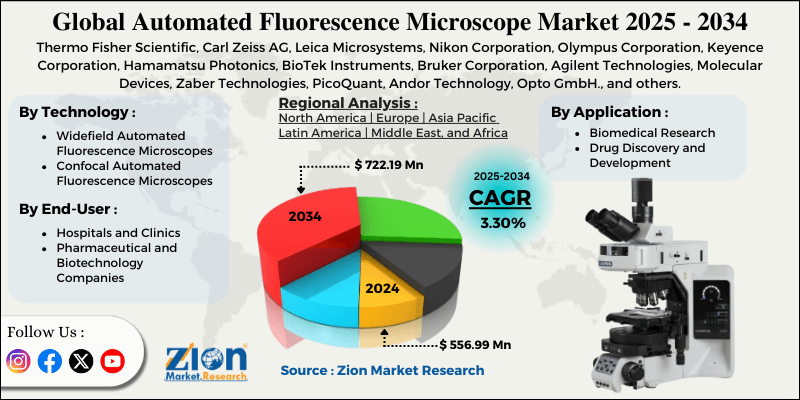
The global automated fluorescence microscope market is segmented based on technology, application, end-user, and region.
Based on technology, the global automated fluorescence microscope industry is divided into widefield automated fluorescence microscopes and confocal automated fluorescence microscopes. The wide-field automated fluorescence microscopy segment accounts for 45% of the market, driven by its cost-effectiveness and rapid imaging speed. They are broadly used in high-throughput screening and general cell biology applications. Their wide automation and illumination make them ideal for several routine research workflows.
On the other hand, the confocal automated fluorescence microscopes segment captures nearly 35% of the market, as they offer high resolution and optical sectioning for detailed 3D imaging in advanced research. Although more high-priced and slower than wide-field systems, their accuracy fuels adoption in complex biological studies and drug discovery.
Based on application, the global automated fluorescence microscope market is segmented into biomedical research and drug discovery and development. The biomedical research segment holds 50% market share, as automated fluorescence microscopes are widely used in clinical and academic labs to study disease biology and cellular mechanisms. Their broad utility and high demand in research institutions make this a dominating application segment.
Conversely, the drug discovery and development segment holds second place with 30% market share, driven by high-content screening, toxicity studies in biotech and pharma, and target validation. Automated fluorescence imaging amplifies compound profiling through high-throughput workflows. Its specialized use in preclinical pipelines places it second in overall share.
Based on end-user, the global market is segmented into hospitals and clinics, and pharmaceutical and biotechnology companies. The pharmaceutical and biotechnology companies segment dominates the market with 45% market share. This ranking is backed by the extensive use of automated fluorescence microscopes for high-content screening, target validation, and drug discovery. The demand is fueled by the need for accurate, high-throughput, and reproducible cellular analysis in preclinical research.
The hospitals and clinics segment ranks second with 30% market share. They primarily use automated fluorescence microscopes for diagnostic applications, clinical research, and pathology. Despite the growing adoption, it is lower than in biotech and pharmaceutical companies due to specialized training requirements and costs.
Automated Fluorescence Microscope Market: Regional Analysis
Why does North America hold a dominant position in the global Automated Fluorescence Microscope Market?
North America is projected to maintain its dominant position in the global automated fluorescence microscope market, with a 6.9% CAGR, owing to strong market share and research investment, the presence of major players and innovation hubs, and a robust biomedical and healthcare R&D ecosystem. North America holds a substantial market share, underscoring its leadership in advanced imaging technologies. High investments in research infrastructure and high-precision laboratories fuel strong demand. Leading academic and biotechnology institutions further boost the industry adoption.
Moreover, North America is home to several leading microscope manufacturers and biotech companies that drive adoption and innovation. Collaborations between research institutions and industry accelerate product development and application diversity. This concentration of expertise aids the region’s industry leadership worldwide. The region’s well-developed healthcare system and substantial biomedical R&D spending support the broader adoption of automated fluorescence microscopes. Clinics, hospitals, and research labs depend on these systems for cellular and diagnostic analysis. This promises continuous growth and technological upgrades in the market.
Europe maintains its position as the second-largest region, with an approximately 6.6%-7.9% CAGR in the global automated fluorescence microscope industry, driven by its major industry share, research funding, the advanced healthcare and life sciences sector, and collaborative innovation and manufacturing. Europe holds a second-leading share of the market due to strong investment in scientific research and infrastructure. Well-funded public research institutions and universities fuel demand for advanced imaging tools. This stable funding landscape supports current adoption and upgrades of automated microscopy systems.
Moreover, the region’s mature healthcare system and active life sciences industry drive the adoption of automated fluorescence microscopes for translational studies and clinical research. Research hospitals and biotech clusters apply these systems for cellular analysis and disease modeling. This wide application base sustains industry growth in the region.
Additionally, several European countries house major microscopy manufacturers and technology developers, fostering local production and innovation. Cross-border collaborations among industry, research consortia, and academia accelerate the development of new imaging applications. This cooperative ecosystem enhances Europe’s competitive standing as the second-leading region.
Automated Fluorescence Microscope Market: Competitive Analysis
The leading players in the global automated fluorescence microscope market are:
- Thermo Fisher Scientific
- Carl Zeiss AG
- Leica Microsystems
- Nikon Corporation
- Olympus Corporation
- Keyence Corporation
- Hamamatsu Photonics
- BioTek Instruments
- Bruker Corporation
- Agilent Technologies
- Molecular Devices
- Zaber Technologies
- PicoQuant
- Andor Technology
- Opto GmbH
Automated Fluorescence Microscope Market: Key Market Trends
Cloud connectivity & digital collaboration:
Cloud-based solutions and digital data platforms are being integrated with automated fluorescence microscopes to streamline remote data access, collaborative analysis, and storage. This allows geographically dispersed research teams to share and process large image datasets in real-time. This trend improves flexibility and boosts multicenter projects.
High‑throughput & automated workflows:
Demand for high-throughput imaging continues to grow as pharmaceutical and research laboratories seek to analyze thousands of specimens quickly. Automation of stage movement, multi-well plate handling, and autofocus is becoming standard, reducing manual workload and increasing experimental throughput. These capabilities are mainly crucial in phenotypic assays and drug screening.
The global automated fluorescence microscope market is segmented as follows:
By Technology
- Widefield Automated Fluorescence Microscopes
- Confocal Automated Fluorescence Microscopes
By Application
- Biomedical Research
- Drug Discovery and Development
By End-User
- Hospitals and Clinics
- Pharmaceutical and Biotechnology Companies
By Region
- North America
- The U.S.
- Canada
- Mexico
- Europe
- France
- The UK
- Spain
- Germany
- Italy
- Rest of Europe
- Asia Pacific
- China
- Japan
- India
- Australia
- South Korea
- Rest of Asia Pacific
- The Middle East & Africa
- Saudi Arabia
- UAE
- Egypt
- Kuwait
- South Africa
- Rest of the Middle East & Africa
- Latin America
- Brazil
- Argentina
- Rest of Latin America
Table Of Content
Methodology
FrequentlyAsked Questions
Which key factors will influence the automated fluorescence microscope market growth over 2025-2034?
What are the emerging trends and innovations impacting the automated fluorescence microscope market?

HappyClients

