
Global ATSC 3.0 Devices Market Size, Share, Growth Analysis Report - Forecast 2034

ATSC 3.0 Devices Market By Device Type (Televisions, Set-top Boxes, USB Receivers, Gateways, Others), By End-user (Residential, Commercial, Broadcasting Stations), By Connectivity (Wired, Wireless), By Distribution Channel (Online, Retail, OEMs), and By Region: Global and Regional Industry Overview, Market Intelligence, Comprehensive Analysis, Historical Data, and Forecasts 2025 - 2034
| Market Size in 2024 | Market Forecast in 2034 | CAGR (in %) | Base Year |
|---|---|---|---|
| USD 6.19 Billion | USD 37.08 Billion | 17.8% | 2024 |
ATSC 3.0 Devices Market: Industry Perspective
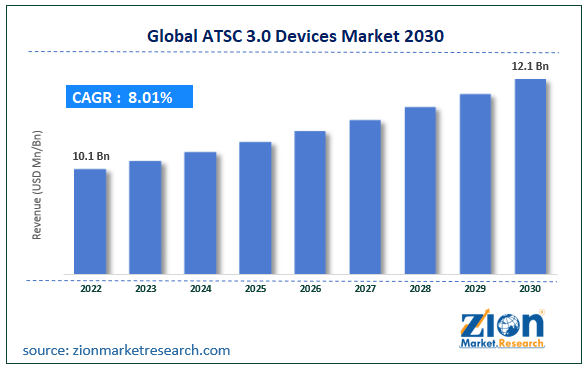
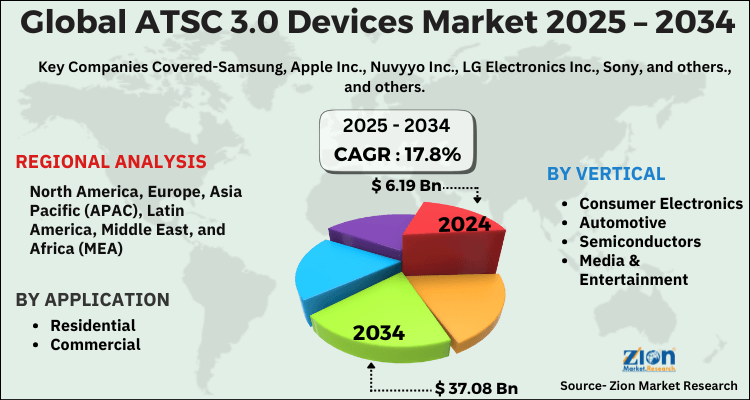
The global ATSC 3.0 devices market size was worth around USD 6.19 Billion in 2024 and is predicted to grow to around USD 37.08 Billion by 2034 with a compound annual growth rate (CAGR) of roughly 17.8% between 2025 and 2034. The report analyzes the global ATSC 3.0 devices market's drivers, restraints/challenges, and the effect they have on the demands during the projection period. In addition, the report explores emerging opportunities in the ATSC 3.0 devices industry.
ATSC 3.0 Devices Market: Overview
ATSC 3.0 referred to as the advanced television systems committee is a main version of the ATSC protocols for television broadcasting. Reportedly, it includes nearly 20 standards encompassing various aspects of the system and has more than 1,000 pages of documentation. These protocols are planned for providing support to advanced technologies such as HEVC for video channels having Dolby AC-4 & MPEG-H 3D Audio, 2160p 4K resolution, various color gamut, dynamic range, data casting abilities, and effective television support. Moreover, ATSC 3.0 helps in promotional activities and advertising to targeted audiences.
Key Insights
- As per the analysis shared by our research analyst, the global ATSC 3.0 devices market is estimated to grow annually at a CAGR of around 17.8% over the forecast period (2025-2034).
- Regarding revenue, the global ATSC 3.0 devices market size was valued at around USD 6.19 Billion in 2024 and is projected to reach USD 37.08 Billion by 2034.
- The ATSC 3.0 devices market is projected to grow at a significant rate due to Next-gen broadcasting features like 4K, HDR, and enhanced audio drive consumer and broadcaster interest. Growing rollout of ATSC 3.0 infrastructure in North America supports device demand.
- Based on Device Type, the Televisions segment is expected to lead the global market.
- On the basis of End-user, the Residential segment is growing at a high rate and will continue to dominate the global market.
- Based on the Connectivity, the Wired segment is projected to swipe the largest market share.
- By Distribution Channel, the Online segment is expected to dominate the global market.
- Based on region, North America is predicted to dominate the global market during the forecast period.
ATSC 3.0 Devices Market: Dynamics
Key Growth Drivers:
The ATSC 3.0 devices market is primarily driven by the rapid adoption of next-generation broadcasting standards that offer enhanced picture quality, interactive content, and improved audio experiences. The growing demand for ultra-high-definition (UHD) and 4K televisions is fueling the need for compatible ATSC 3.0-enabled devices. Broadcasters’ increasing investments in upgrading transmission infrastructure and consumers’ preference for immersive viewing experiences are further propelling market growth. Additionally, the integration of ATSC 3.0 technology in smart TVs and set-top boxes is enhancing content accessibility and enabling targeted advertising, which supports the expansion of the overall market.
Restraints:
The high initial cost of ATSC 3.0-compatible devices and the need for significant infrastructure upgrades act as key restraints for market growth. Many consumers are hesitant to replace their existing devices due to affordability concerns, especially in regions where ATSC 3.0 broadcasts are still in the early stages of rollout. Moreover, limited consumer awareness about the benefits of the new standard and inconsistent adoption rates across different countries further hinder market penetration. The complexity of transitioning from existing broadcasting technologies to ATSC 3.0 also poses challenges for broadcasters and manufacturers alike.
Opportunities:
The growing shift toward smart broadcasting and hybrid TV experiences presents strong opportunities for the ATSC 3.0 devices market. The technology’s ability to combine over-the-air (OTA) broadcast with broadband internet allows for personalized and interactive viewing experiences, creating new avenues for content providers and advertisers. Emerging markets are also expected to offer lucrative opportunities as governments and broadcasters invest in digital infrastructure. Furthermore, the integration of ATSC 3.0 into automotive infotainment systems and mobile devices opens new prospects for real-time content delivery and location-based services.
Challenges:
One of the key challenges facing the ATSC 3.0 devices market is the uneven pace of regulatory approvals and broadcast network deployment across regions, which leads to fragmented adoption. Compatibility issues between existing broadcasting systems and the new standard can also delay widespread implementation. Additionally, cybersecurity concerns related to connected broadcasting systems pose risks for both consumers and service providers. The need for ongoing consumer education and industry collaboration remains critical to overcoming adoption barriers and ensuring the long-term success of ATSC 3.0 technology.
ATSC 3.0 Devices Market: Segmentation
The global ATSC 3.0 devices market is sectored into vertical, application, and region. All the segments have been analyzed based on present and future trends and the market is estimated from 2025 to 2034.
In terms of vertical, the global ATSC 3.0 devices market is segregated into consumer electronics, automotive, semiconductors, and media & entertainment segments. Furthermore, the consumer electronics segment, which gathered nearly one-fourth of the global market revenue share in 2022, is projected to register the highest CAGR in the next couple of years. The growth of the segment in the forecasting timeline can be owing to the growing purchase of new electronics products owing to the latter’s ability in offering high content display quality to end-users.
Based on the application, the global ATSC 3.0 devices industry is sectored into residential and commercial segments. Furthermore, the residential segment, which garnered a huge chunk of the global industry share in 2022, is forecast to dominate the global industry over the analysis timespan. The segmental expansion over the assessment timespan can be subject to massive content usage by households.
The Regional, this segment includes the current and forecast demand for North America, Europe, Asia Pacific, Latin America,and the Middle East and Africa.
ATSC 3.0 Devices Market: Report Scope
| Report Attributes | Report Details |
|---|---|
| Report Name | ATSC 3.0 Devices Market |
| Market Size in 2024 | USD 6.19 Billion |
| Market Forecast in 2034 | USD 37.08 Billion |
| Growth Rate | CAGR of 17.8% |
| Number of Pages | 218 |
| Key Companies Covered | Samsung, Apple Inc., Nuvyyo Inc., LG Electronics Inc., Sony, and others., and others. |
| Segments Covered | By Device Type, By End-user, By Connectivity, By Distribution Channel, and By Region |
| Regions Covered | North America, Europe, Asia Pacific (APAC), Latin America, The Middle East and Africa (MEA) |
| Base Year | 2024 |
| Historical Year | 2020 to 2023 |
| Forecast Year | 2025 - 2034 |
| Customization Scope | Avail customized purchase options to meet your exact research needs. Request For Customization |
ATSC 3.0 Devices Market: Regional Insights
The ATSC 3.0 devices market from 2025 to 2034 is expected to witness significant regional variation driven by advancements in broadcasting infrastructure and consumer demand for next-generation television experiences. North America dominates the market due to the widespread rollout of ATSC 3.0 broadcasting in the United States, supported by strong consumer adoption of 4K and smart TVs. Europe is gradually embracing ATSC 3.0 technology, focusing on enhancing digital broadcasting capabilities and improving spectrum efficiency across major countries such as Germany, the United Kingdom, and France. The Asia-Pacific region is projected to experience rapid growth, driven by technological innovation, the expansion of smart television manufacturing in countries like South Korea, Japan, and China, and increasing investment in advanced transmission systems. Meanwhile, regions such as the Middle East, Africa, and Latin America are expected to show steady adoption as governments and broadcasters invest in upgrading broadcast standards to improve picture quality and viewing experiences. Overall, global adoption trends indicate a steady rise in demand for ATSC 3.0-compatible devices, supported by enhanced broadcast quality, interactive features, and growing consumer preference for high-definition content delivery.
ATSC 3.0 Devices Market: Competitive Analysis
The report provides a company market share analysis to give a broader overview of the key market players. In addition, the report also covers key strategic developments of the market, including acquisitions & mergers, new product launches, agreements, partnerships, collaborations & joint ventures, research & development, and regional expansion of major participants involved in the ATSC 3.0 devices market on a global and regional basis.
The global ATSC 3.0 devices market profiles key players such as:
- Samsung
- Apple Inc.
- Nuvyyo Inc.
- LG Electronics Inc.
- Sony
The global ATSC 3.0 devices market is segmented as follows:
By Application
- Residential
- Commercial
By Vertical
- Consumer Electronics
- Automotive
- Semiconductors
- Media & Entertainment
By Region
- North America
- The U.S.
- Canada
- Europe
- France
- The UK
- Spain
- Germany
- Italy
- Rest of Europe
- Asia Pacific
- China
- Japan
- India
- South Korea
- Southeast Asia
- Rest of Asia Pacific
- Latin America
- Brazil
- Mexico
- Rest of Latin America
- Middle East & Africa
- GCC
- South Africa
- Rest of Middle East & Africa
Table Of Content
Methodology
FrequentlyAsked Questions
ATSC 3.0 referred to as the advanced television systems committee is a main version of the ATSC protocols for television broadcasting.
The global ATSC 3.0 devices market is expected to grow due to Next-gen broadcasting features like 4K, HDR, and enhanced audio drive consumer and broadcaster interest. Growing rollout of ATSC 3.0 infrastructure in North America supports device demand.
According to a study, the global ATSC 3.0 devices market size was worth around USD 6.19 Billion in 2024 and is expected to reach USD 37.08 Billion by 2034.
The global ATSC 3.0 devices market is expected to grow at a CAGR of 17.8% during the forecast period.
North America is expected to dominate the ATSC 3.0 devices market over the forecast period.
Leading players in the global ATSC 3.0 devices market include Samsung, Apple Inc., Nuvyyo Inc., LG Electronics Inc., Sony, and others., among others.
The report explores crucial aspects of the ATSC 3.0 devices market, including a detailed discussion of existing growth factors and restraints, while also examining future growth opportunities and challenges that impact the market.

HappyClients

