
Global Artificial Intelligence In Fintech Market Size, Share, Trends, Growth and Forecast 2034

Artificial Intelligence In Fintech Market By Component (Solution and Services), By Deployment (On-premise and Cloud), By End Use (Customer Behavioral Analytics, Virtual Assistants (Chatbots), Business Analytics & Reporting, and Others), and By Region - Global and Regional Industry Overview, Market Intelligence, Comprehensive Analysis, Historical Data, and Forecasts 2025 - 2034
| Market Size in 2024 | Market Forecast in 2034 | CAGR (in %) | Base Year |
|---|---|---|---|
| USD 14.94 Billion | USD 50.70 Billion | 16.50% | 2024 |
Artificial Intelligence In Fintech Market: Industry Perspective
What will be the size of the global Artificial Intelligence In Fintech market during the forecast period?
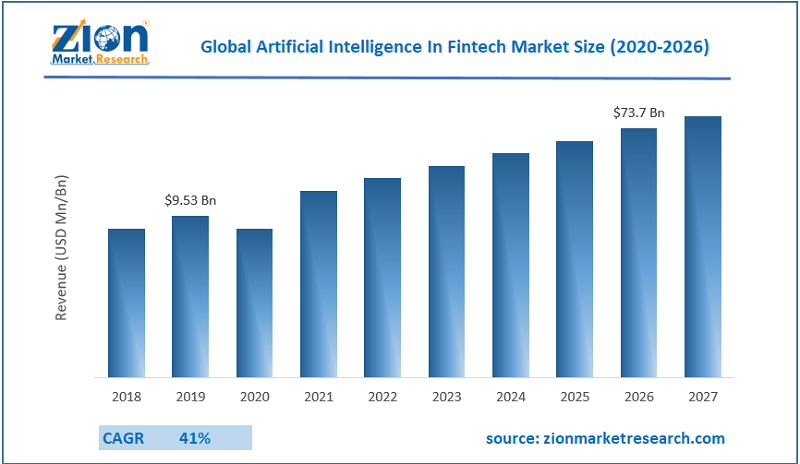
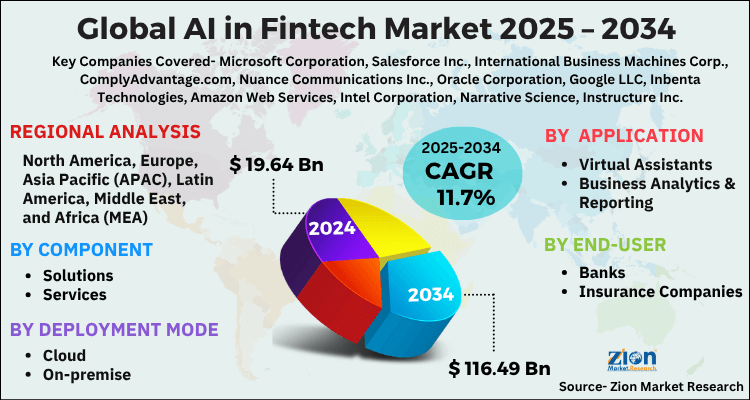
The global artificial intelligence in fintech market size was around USD 14.94 billion in 2024 and is projected to reach USD 50.70 billion by 2034, with a compound annual growth rate (CAGR) of roughly 16.50% between 2025 and 2034. The report examines the primary drivers, challenges, and restraints shaping global demand for the artificial intelligence in fintech market throughout the forecast period and identifies high-growth opportunities across the industry.
Key Insights:
- As per the analysis shared by our research analyst, the global artificial intelligence in fintech market is estimated to grow annually at a CAGR of around 16.50% over the forecast period (2025-2034)
- In terms of revenue, the global artificial intelligence in fintech market size was valued at around USD 14.94 billion in 2024 and is projected to reach USD 50.70 billion by 2034.
- The artificial intelligence in fintech market is projected to grow significantly owing to rising demand for fraud detection solutions, increasing use of machine learning for risk assessment, and adoption of chatbots for customer service.
- Based on the component, the solution segment is expected to lead the market, while the services segment is expected to grow considerably.
- Based on deployment, the cloud segment is the dominant segment, while the on-premises segment is projected to generate sizeable revenue over the forecast period.
- Based on application, the business analytics and reporting segment is expected to lead the market, followed by the virtual assistants (chatbots) segment.
- By region, North America is projected to dominate the global market during the forecast period, followed by Europe.
Artificial Intelligence In Fintech Market: Overview
Artificial intelligence in fintech utilizes data analysis and advanced algorithms to automate financial services, enhance customer experiences, and improve decision-making. It powers applications such as credit scoring, fraud detection, and algorithmic trading with greater accuracy and speed, as well as personalized banking. The global artificial intelligence in fintech market is projected to witness substantial growth, driven by rising demand for predictive analytics, surging fraud detection needs, and the rise of FinTech platforms and digital banking. Financial institutions are relying on AI and predictive analytics to assess risks, forecast market trends, and understand customer behavior. This enables data-driven decision-making and enhances the accuracy of investment and lending strategies. The rising volume of financial data boosts this demand.
Moreover, AI helps detect fraudulent transactions in real-time by identifying anomalies in large datasets. This lowers financial loss and strengthens trust in digital financial platforms. Growing cyber threats are driving institutions to adopt AI-based security systems. Furthermore, the growth of digital payment platforms and mobile banking is fueling AI adoption. AI improves user experience through personalization, automation, and faster processing. This shift towards digital finance drives industry growth remarkably.
Although drivers exist, the global market is challenged by factors such as security and data privacy concerns and the complexity of regulatory compliance. Fintech companies handle highly sensitive personal and financial data. AI systems increase the risk of data breaches if not properly secured. This creates regulatory challenges and trust issues for adoption. Similarly, financial services operate under stringent, evolving regulations in different regions. Integrating AI while promising compliance could be costly and complex. Non-compliance may result in penalties and reputational damage. Even so, the global artificial intelligence in fintech industry is well-positioned due to the growth of Robo-Advisory services, the development of AI-powered risk management, and the emergence of RegTech solutions.
AI-powered robo-advisors offer automated investment advice at a low price. They make wealth management accessible to a wider audience. This segment is projected to grow rapidly. AI enhances risk assessment through real-time predictive modeling and data analytics. Financial institutions can better manage credit, operational, and market risks. This improves decision-making and stability. Additionally, AI-driven regulatory technology (RegTech) streamlines the reporting and compliance process. It reduces manual effort and ensures regulatory compliance. This creates fresh business opportunities in compliance automation.
Impact of the USA-Israel war on Iran on the Artificial Intelligence In Fintech Market
The USA-Israel conflict over Iran is heightening global financial uncertainty, eroding investor confidence in AI-driven fintech solutions. Growing supply chain disturbances and energy prices are increasing operational costs for artificial intelligence infrastructure. These factors may slow short-term industry growth and funding activities. Nonetheless, demand for AI in risk management, cybersecurity, and fraud detection is projected to grow, aiding selective growth.
Artificial Intelligence In Fintech Market: Dynamics
Growth Drivers
How is the expansion of personalized financial services fueling the worldwide Artificial Intelligence In Fintech market?
Consumers are now expecting highly personalized financial experiences, which AI allows through data-driven insights. AI-powered recommendation engines alter investment, loan, and insurance product recommendations based on individual behavior. According to reports, over 70% of fintech users prefer platforms that offer personalized services. AI chatbots and robo-advisors are becoming mainstream, managing billions in assets worldwide. Recent developments show that fintech companies are integrating generative AI to improve advisory services and customer interactions.
How is the global Artificial Intelligence In Fintech market driven by increased investment and venture capital funding in AI Fintech?
Investment in AI-driven fintech startups has increased, with billions of dollars flowing into the industry every year. In 2025, venture capital funding remains strong despite broader market volatility. Investors are especially interested in AI solutions for insurance tech, lending, and wealth management. Several AI fintech unicorns have progressed, signaling strong industry confidence. Recent news indicates that large financial institutions are making strategic acquisitions to integrate artificial intelligence capabilities swiftly, thereby impacting the global progress of the artificial intelligence in fintech market.
Restraints
Regulatory uncertainty and compliance barriers negatively impact the market progress
AI in fintech operates in a highly regulated environment with changing legal frameworks. Uncertainty regarding AI governance, accountability, and ethical use creates hesitation among companies. Different nations have diverse regulatory standards, complicating worldwide expansion. Compliance risks can lead to heavy penalties if AI systems fail to meet the needs. Governments are still working to define clear AI-specific financial regulations.
Opportunities
How is the integration of Generative AI and conversational banking offering advantageous conditions for the growth of the Artificial Intelligence In Fintech market?
Generative AI is creating fresh opportunities in the artificial intelligence in fintech industry in service automation and customer engagement domains. Virtual assistants and AI chatbots are becoming more human-like and advanced. Financial institutions are using these tools to enhance customer experience and reduce operational costs. By 2025, conversational AI will handle a notable share of customer interactions. News trends indicate that banks are introducing AI-powered assistants for personalized financial guidance.
Challenges
Cybersecurity threats targeting AI systems restrict market growth
AI systems themselves are becoming targets for sophisticated cyberattacks. Adversarial attacks can manipulate AI models and compromise financial operations. Ensuring the security of AI algorithms adds another layer of complexity. Fintech companies should invest heavily in protecting their AI infrastructure. Recent incidents highlight rising concerns over SI-specific cybersecurity risks.
Artificial Intelligence In Fintech Market: Report Scope
| Report Attributes | Report Details |
|---|---|
| Report Name | Artificial Intelligence In Fintech Market |
| Market Size in 2024 | USD 14.94 Billion |
| Market Forecast in 2034 | USD 50.70 Billion |
| Growth Rate | CAGR of 16.50 |
| Number of Pages | 227 |
| Key Companies Covered | IBM Corporation, Microsoft Corporation, Google LLC (Alphabet Inc.), Amazon Web Services Inc., Salesforce Inc., Intel Corporation, SAP SE, Oracle Corporation, Accenture plc, Infosys Limited, Cognizant Technology Solutions Corporation, Fiserv Inc., PayPal Holdings Inc., Stripe Inc., Square Inc. (Block), and others. |
| Segments Covered | By Component, By Deployment, By Application, and By Region |
| Regions Covered | North America, Europe, Asia Pacific (APAC), Latin America, Middle East, and Africa (MEA) |
| Base Year | 2024 |
| Historical Year | 2019 to 2023 |
| Forecast Year | 2025 - 2034 |
| Customization Scope | Avail customized purchase options to meet your exact research needs. Request For Customization |
Artificial Intelligence In Fintech Market: Segmentation
The global artificial intelligence in fintech market is segmented based on component, deployment, application, and region.
Why is the Solution segment projected to dominate the artificial intelligence in fintech market?
Based on the component, the global artificial intelligence in fintech industry is divided into solutions and services. The solution segment holds a leading market share of nearly 77.6%. Financial institutions largely invest in AI-driven software for fraud detection, customer engagement, automated decision-making, and risk analytics. This reflects the wide adoption of applications and platforms that improve core fintech operations.
Conversely, the services segment ranks second in the market with a 22.5% share. Demand is growing for integration, implementation, managed services, and consulting to deploy AI efficiently. These services allow customization, optimization, and adoption of advanced AI without extensive in-house proficiency.
What factors help the Cloud segment lead the artificial intelligence in fintech market?
Based on deployment, the global artificial intelligence in fintech market is segmented into on-premises and cloud. The cloud segment held leadership with 77% of the total market share. Its flexibility, scalability, ease of implementation, and lower costs enable fintech companies to rapidly expand their AI capabilities and integrate analytics, customer-focused tools, and fraud detection. Cloud solutions reduce infrastructure burdens while allowing faster innovation.
Nevertheless, the on-premises segment ranks second in the market, with nearly a 25% share. Large financial institutions prefer it for full control over sensitive and confidential data, internal governance, and strict compliance. While growth is steadier, on-premises remains critical for regulatory compliance and data sovereignty.
What are the key reasons for the leadership of the Business Analytics and Reporting segment in the artificial intelligence in fintech market?
Based on application, the global market is segmented into customer behavioral analytics, virtual assistants (chatbots), business analytics & reporting, and others. The business analytics and reporting segment holds dominance with 32% of the total market. Businesses use these AI tools to enhance decision-making, gain insights, and ensure regulatory compliance in large financial datasets. Its leadership underscores the importance of analytics for strategy, operational efficiency, and risk management.
However, the virtual assistants (chatbots) segment holds a 22% share, second only to the 36% share of the search segment. High demand for 24/7 customer and automated engagement fuels adoption, allowing fintechs and banks to answer queries, facilitate transactions, and manage accounts. These tools enhance user experience and lower operational support costs.
Artificial Intelligence In Fintech Market: Regional Analysis
What enables North America's strong foothold in the global Artificial Intelligence In Fintech Market?
North America is likely to sustain its leadership in the artificial intelligence in fintech market, with a 20.5% CAGR, driven by an advanced fintech ecosystem, strong technological infrastructure, and a supportive regulatory and investment environment. North America hosts a dense network of fintech startups and major financial institutions that are heavily investing in AI. These companies adopt machine learning for credit scoring, fraud detection, and personalized services. This innovation-driven ecosystem accelerates AI integration in financial operations.
Moreover, the region benefits from scalable cloud platforms, reliable connectivity, and high-performance computing. These technologies support advanced AI analytics and real-time data processing. Efficient infrastructure allows seamless deployment of AI fintech solutions at scale. Furthermore, flexible regulations and strong venture capital funding encourage AI innovation in fintech. Established and startup firms can quickly develop and commercialize AI-driven solutions. This supportive ecosystem fosters experimentation and fuels sustained industry growth.
Why does Europe rank second in the global Artificial Intelligence In Fintech Market?
Europe continues to hold the second-highest share, with a 22% CAGR in the artificial intelligence in fintech industry, owing to a strong regulatory framework and data protection, growing fintech adoption and collaboration, and a focus on transparent and ethical AI. Europe’s strong regulatory environment, including clear AI and GDPR guidelines, encourages responsible AI use and helps build trust in digital finance. Fintechs can innovate with confidence knowing compliance standards are established. This balance of innovation and protection appeals to investment and adoption of AI technologies. Additionally, European banks and fintech startup firms actively collaborate on AI initiatives, creating integrated solutions for lending, risk analytics, and payments.
Cross-border fintech hubs like Amsterdam, Berlin, and London fuel shared innovation. This cooperative ecosystem enables the deployment of AI across various financial services. Europe prioritizes explainable, ethical AI practices that align with customer expectations for accountability and fairness. This focus reassures users and regulators, reducing barriers to adoption. Such trust-centric development drives long-term investment and wider implementation of AI in fintech.
Artificial Intelligence In Fintech Market: Competitive Analysis
The leading players in the global artificial intelligence in fintech market are:
- IBM Corporation
- Microsoft Corporation
- Google LLC (Alphabet Inc.)
- Amazon Web Services Inc.
- Salesforce Inc.
- Intel Corporation
- SAP SE
- Oracle Corporation
- Accenture plc
- Infosys Limited
- Cognizant Technology Solutions Corporation
- Fiserv Inc.
- PayPal Holdings Inc.
- Stripe Inc.
- Square Inc. (Block)
What are the key trends in the global Artificial Intelligence In Fintech Market?
Proliferation of AI‑Driven personalization
AI is powering ultra-personalized financial services, from tailored investment recommendations to customized banking interfaces. By analyzing user preferences and behavior, fintechs deliver context-aware experiences that raise engagement and satisfaction. Personalization differentiates brands in competitive markets.
Integration of AI with Blockchain and DeFi
Convergence between blockchain technologies and AI is improving automation, security, and transparency in smart contracts and transactions. AI helps optimize decentralized finance (DeFi) rules, predict network risks, and detect anomalies. This trend is expanding innovative, trustless financial ecosystems.
The global artificial intelligence in fintech market is segmented as follows:
By Component
- Solution
- Services
By Deployment
- On-premise
- Cloud
By Application
- Customer Behavioral Analytics
- Virtual Assistants (Chatbots)
- Business Analytics & Reporting
- Others
By Region
- North America
- The U.S.
- Canada
- Mexico
- Europe
- France
- The UK
- Spain
- Germany
- Italy
- Rest of Europe
- Asia Pacific
- China
- Japan
- India
- Australia
- South Korea
- Rest of Asia Pacific
- The Middle East & Africa
- Saudi Arabia
- UAE
- Egypt
- Kuwait
- South Africa
- Rest of the Middle East & Africa
- Latin America
- Brazil
- Argentina
- Rest of Latin America
Table Of Content
Methodology
FrequentlyAsked Questions
Artificial intelligence in fintech utilizes data analysis and advanced algorithms to automate financial services, enhance customer experiences, and improve decision-making. It powers applications such as credit scoring, fraud detection, and algorithmic trading with greater accuracy and speed, as well as personalized banking.
The global artificial intelligence in fintech market is projected to grow due to the expansion of AI adoption in financial services, the growth of big data analytics capabilities, and demand for personalized financial services enabled by predictive analytics.
According to study, the global artificial intelligence in fintech market size was around USD 14.94 billion in 2024 and is expected to grow to around USD 50.70 billion by 2034.
The CAGR for artificial intelligence in fintech market is expected to be around 16.50% during 2025-2034.
Evolving financial regulations, strict data privacy laws, and cybersecurity requirements are shaping AI adoption and growth in the fintech market.
Applications like fraud detection, personalized financial services, credit scoring, and robo-advisory offer major growth opportunities in AI-driven fintech.
North America is expected to lead the global artificial intelligence in fintech market during the forecast period.
The key players profiled in the global artificial intelligence in fintech market include IBM Corporation, Microsoft Corporation, Google LLC (Alphabet Inc.), Amazon Web Services, Inc., Salesforce, Inc., Intel Corporation, SAP SE, Oracle Corporation, Accenture plc, Infosys Limited, Cognizant Technology Solutions Corporation, Fiserv, Inc., PayPal Holdings, Inc., Stripe, Inc., and Square, Inc. (Block).
The competitive landscape in AI fintech is fragmented, with fintech startups, established banks, and technology vendors competing through partnerships, innovation, and AI-driven solutions.
The report examines key aspects of artificial intelligence in fintech market, including a detailed analysis of existing growth factors and restraints, as well as an examination of future growth opportunities and challenges that will impact the market.

HappyClients

