
Global Antiemetics Market Size, Share, Growth, Sales, and Forecasts 2034

Antiemetics Market By Indication (Motion Sickness, Chemotherapy-Induced Nausea, Pregnancy-related Nausea, Postoperative Nausea & Vomiting, and Radiation-Infused Nausea), By Route of Administration (Rectal, Transdermal, Oral, Intravenous, and Subcutaneous), and By Region - Global and Regional Industry Overview, Market Intelligence, Comprehensive Analysis, Historical Data, and Forecasts 2025 - 2034
| Market Size in 2024 | Market Forecast in 2034 | CAGR (in %) | Base Year |
|---|---|---|---|
| USD 37.54 Billion | USD 59.27 Billion | 4.24% | 2024 |
Antiemetics Market: Industry Perspective
What will be the size of the global antiemetics market during the projected period?
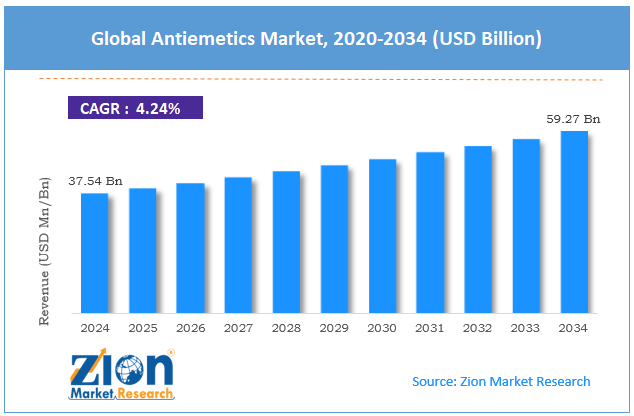
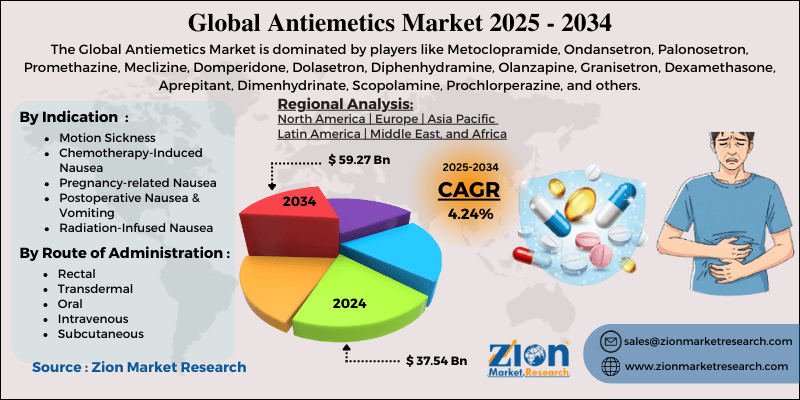
The global antiemetics market size was worth around USD 37.54 billion in 2024 and is predicted to grow to around USD 59.27 billion by 2034, with a compound annual growth rate (CAGR) of roughly 4.24% between 2025 and 2034.
Key Insights:
- As per the analysis shared by our research analyst, the global antiemetics market is estimated to grow annually at a CAGR of around 4.24% over the forecast period (2025-2034)
- In terms of revenue, the global antiemetics market size was valued at around USD 37.54 billion in 2024 and is projected to reach USD 59.27 billion by 2034.
- The antiemetics market is projected to grow at a significant rate due to the rising geriatric population across the globe.
- Based on the indication, the chemotherapy-induced segment is growing at a high rate and will continue to dominate the global market, as per industry projections
- Based on the route of administration, the oral segment is anticipated to command the largest market share
- Based on region, North America is projected to dominate the global market during the forecast period
Antiemetics Market: Overview
Antiemetics are medical drugs used to treat vomiting and nausea. Antiemetics are divided into 7 main subgroups, including cannabinoids, antihistamines, and serotonin antagonists. According to market research, antiemetics are generally recommended for predictable or chronic cases of vomiting and nausea. Cleveland Clinic has listed certain side effects associated with the drugs, including drowsiness, constipation, insomnia, and vertigo, among several others. During the forecast period, demand for antiemetics is expected to continue growing, driven by multiple factors. The rising prevalence of motion sickness among people of all age groups is one of the primary reasons for increased demand for antiemetics.
Additionally, advancements in antiemetics, including new formulations and standardization, will help provide novel expansion opportunities for industry players. However, concerns over the drugs' negative health impact and regulatory issues may lead to growth challenges in the market during the projection period.
Antiemetics Market: Dynamics
Growth Drivers
What will be the impact of the rising geriatric population on the antiemetics market growth rate?
The global antiemetic market is expected to be driven by the rising geriatric population across the globe. The elderly population is prone to different types of chronic and age-related illnesses requiring regular medication. The most common nausea-causing diseases in the older population include ulcers, chronic illnesses, gastritis, and neurological conditions, among others. The surge in the number of senior citizens and older adults is driving demand in the healthcare sector. According to the World Health Organization (WHO), the elderly population across the globe is expected to increase from 12% to 22% by 2050.
Surging cases of cancer worldwide to propel market expansion during the projection period
One of the most dominant growth propellers for antiemetics is the increasing demand for the drug to treat chemotherapy-induced nausea. According to industry research, most people undergoing chemotherapy experience frequent vomiting and nausea. Exposure of the gastrointestinal tract, liver, and brain to radiation leads to patients experiencing these side effects. Medical practitioners prescribe antiemetics to cancer patients to relieve them of these side effects. The rising prevalence of cancer worldwide will accelerate demand for antiemetics in the coming years. In addition, expanding access to effective cancer-related medical care can benefit the global antiemetics industry during the projection period.
Restraints
How will drug side effects restrict antiemetics market growth trends in the coming years
The global antiemetics market is expected to be restricted due to the growing concerns over side effects associated with the drug. According to the Cleveland Clinic, each antiemetic drug is linked to specific side effects. For instance, antihistamines can cause drowsiness, and serotonin antagonists are associated with constipation, dizziness, and headache. NK-1 receptor antagonists can cause allergic reactions in some patients, while cannabinoids are known to cause dysphoria, low blood pressure, and vertigo. In some cases, the side effects of antiemetics can be more severe, leading to restricted growth in the industry.
Opportunities
Ongoing advancements in antiemetics create growth opportunities in the future
The global antiemetics industry is projected to offer growth opportunities driven by advancements in the market. These advancements are linked to new formulations and improved combinations. For instance, the industry witnessed the launch of Granisetron extended-release subcutaneous (GERSC), which is the most recent 5-HT3RA. The novel formulation is recommended to be used with other antiemetics to prevent delayed and acute vomiting and nausea associated with Moderately Emetogenic Chemotherapy (MEC) and anthracycline–cyclophosphamide combination chemotherapy regimens.
In April 2025, a recent study was conducted to assess the antiemetic efficacy of chewing gum compared with conventionally used intravenous ondansetron in female populations. Another study included the use of olanzapine as antiemetic prophylaxis during moderately emetogenic chemotherapy processes.
What are the growth possibilities offered to antiemetics industry by the increasing demand for ambulatory services?
The rapid expansion of ambulatory services worldwide has increased demand for medications that help patients recover quickly and smoothly after surgery. Antiemetic drugs are given to the patient to reduce the chances of nausea and vomiting post-operation and to shorten hospital stays. The increasing efforts to expand ambulatory surgical services worldwide may open new avenues for sustained growth for antiemetic drug-producing companies during the forecast period.
Challenges
Regulatory hurdles will continue to challenge market expansion trends in the coming years
The global antiemetics market is expected to be challenged by the regulatory hurdles that exist in the industry. The development and introduction of new drugs in the market are subject to regulatory hurdles that change from one region to another. Complying with a dynamic set of legal frameworks can be time-consuming and requires extensive investments. These factors will continue to impact business decisions in the long run.
Antiemetics Market: Report Scope
| Report Attributes | Report Details |
|---|---|
| Report Name | Antiemetics Market |
| Market Size in 2024 | USD 37.54 Billion |
| Market Forecast in 2034 | USD 59.27 Billion |
| Growth Rate | CAGR of 4.24% |
| Number of Pages | 214 |
| Key Companies Covered | Metoclopramide, Ondansetron, Palonosetron, Promethazine, Meclizine, Domperidone, Dolasetron, Diphenhydramine, Olanzapine, Granisetron, Dexamethasone, Aprepitant, Dimenhydrinate, Scopolamine, Prochlorperazine, and others. |
| Segments Covered | By Indication, By Route of Administration, and By Region |
| Regions Covered | North America, Europe, Asia Pacific (APAC), Latin America, Middle East, and Africa (MEA) |
| Base Year | 2024 |
| Historical Year | 2019 - 2023 |
| Forecast Year | 2025 - 2034 |
| Customization Scope | Avail customized purchase options to meet your exact research needs. Request For Customization |
Antiemetics Market: Segmentation
The global antiemetics market is segmented based on indication, route of administration, and region.
Based on the indication, the global market segments are motion sickness, chemotherapy-induced nausea, pregnancy-related nausea, postoperative nausea & vomiting, and radiation-induced nausea. In 2024, the highest growth was listed in chemotherapy-induced nausea, driven by the growing prevalence of cancer worldwide. According to WHO statistics, more than 20 million new cancer cases were registered globally in 2022. Chemotherapy induces frequent vomiting and nausea in cancer patients, driving demand for antiemetics.
Based on route of administration, the global market is divided into rectal, transdermal, oral, intravenous, and subcutaneous. In 2024, the oral segment was the leading revenue generator 2024. The correct route of administration is essential in the antiemetics market since it helps determine treatment effectiveness. The oral segment is led by the ease of use and convenience offered by the route of administration as compared to other counterparts.
Antiemetics Market: Regional Analysis
Why will North America dominate the antiemetics market during the forecast period?
The global antiemetics market is expected to be led by North America during the forecast period. The primary reason for higher regional revenue is the presence of a dominant and robust healthcare sector and higher access to preventive medicines. In addition, increased investments in healthcare research & development (R&D) and a surge in the number of clinical trials on antiemetics will fuel regional expansion in the future.
Europe is the second-highest revenue generator. The European market is driven by a higher number of the geriatric population and rising patient awareness. In addition, over the last few years, the European healthcare industry has witnessed increased investment to improve access to medical care in remote regions, influencing market growth trends. Asia-Pacific is a lucrative market with exceptional growth potential. The rising prevalence of cancer across Asian countries, along with higher demand for treating pregnancy-induced nausea, contributes to the region’s growth trends. Government initiatives and favorable drug development policies will drive increased revenue across the Asia-Pacific in the coming years.
Antiemetics Market: Competitive Analysis
The global antiemetics market is led by players like:
- Metoclopramide
- Ondansetron
- Palonosetron
- Promethazine
- Meclizine
- Domperidone
- Dolasetron
- Diphenhydramine
- Olanzapine
- Granisetron
- Dexamethasone
- Aprepitant
- Dimenhydrinate
- Scopolamine
- Prochlorperazine
What are the key trends in the global Antiemetics Market?
Increased demand for personalized medicines
A growing trend in the industry has emerged in the form of personalized medicines. Market players are working to deliver customized antiemetic solutions tailored to patients' medical needs.
Demand for preventive care
The antiemetics market is facing a notable shift toward preventive care. There are intensifying efforts toward preemptive antiemetic treatment, especially in nations with vulnerable demographics.
Technological integration in drug discovery
The Antiemetics industry is registering increased use of modern technologies in drug discovery. These solutions include smart pills and transdermal patches as modern modes of administration to improve results.
The global antiemetics market is segmented as follows:
By Indication
- Motion Sickness
- Chemotherapy-Induced Nausea
- Pregnancy-related Nausea
- Postoperative Nausea & Vomiting
- Radiation-Infused Nausea
By Route of Administration
- Rectal
- Transdermal
- Oral
- Intravenous
- Subcutaneous
By Region
- North America
- The U.S.
- Canada
- Mexico
- Europe
- France
- The UK
- Spain
- Germany
- Italy
- Rest of Europe
- Asia Pacific
- China
- Japan
- India
- Australia
- South Korea
- Rest of Asia Pacific
- The Middle East & Africa
- Saudi Arabia
- UAE
- Egypt
- Kuwait
- South Africa
- Rest of the Middle East & Africa
- Latin America
- Brazil
- Argentina
- Rest of Latin America
Table Of Content
Methodology
FrequentlyAsked Questions
Antiemetics are medical drugs used to treat vomiting and nausea. Antiemetics are divided into 7 main subgroups, including cannabinoids, antihistamines, and serotonin antagonists.
The global antiemetic market is expected to be driven by the rising geriatric population across the globe.
According to study, the global antiemetics market size was worth around USD 37.54 billion in 2024 and is predicted to grow to around USD 59.27 billion by 2034.
The CAGR value of the antiemetics market is expected to be around 4.24% during 2025-2034.
The global antiemetics market is expected to be challenged by the regulatory hurdles that exist in the industry.
Increased demand for personalized medicines, demand for preventive care, and technological integration in drug discovery are the emerging trends and innovations impacting the antiemetics market.
The global antiemetics market has shown steady growth in the current period and is expected to follow the same trends in the coming years.
The global antiemetics market is expected to be led by North America during the forecast period.
The global antiemetics market is led by players like Metoclopramide, Ondansetron, Palonosetron, Promethazine, Meclizine, Domperidone, Dolasetron, Diphenhydramine, Olanzapine, Granisetron, Dexamethasone, Aprepitant, Dimenhydrinate, Scopolamine, and Prochlorperazine.
The report explores crucial aspects of the antiemetics market, including a detailed discussion of existing growth factors and restraints, while also browsing future growth opportunities and challenges that impact the market.

HappyClients

