
Anesthesia Information Management Systems Market Size, Share, Trends, Growth 2034

Anesthesia Information Management Systems Market By Component (Software, Hardware, Services), By Application (Preoperative Assessment, Intraoperative Monitoring, Postoperative Care and Recovery), By End-User (Hospitals, Ambulatory Surgical Centers, Specialty Clinics, Academic and Research Institutions), By Distribution Channel (Direct Sales, Value-Added Resellers, Online Procurement Platforms, Government and Institutional Tender Procurement), and By Region - Global and Regional Industry Overview, Market Intelligence, Comprehensive Analysis, Historical Data, and Forecasts 2026 - 2034
| Market Size in 2025 | Market Forecast in 2034 | CAGR (in %) | Base Year |
|---|---|---|---|
| USD 567.84 Billion | USD 917.82 Billion | 5.48% | 2025 |
Anesthesia Information Management Systems Industry Perspective:
What will be the size of the Anesthesia Information Management Systems market during the forecast period?
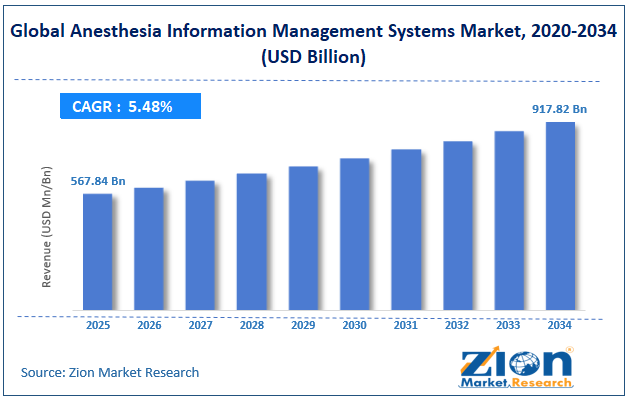
The global anesthesia information management systems market size was approximately USD 567.84 billion in 2025 and is projected to reach USD 917.82 billion by 2034, growing at a compound annual growth rate of approximately 5.48% between 2026 and 2034.
Key Insights
- According to our research team's analysis, the global anesthesia information management systems market is expected to grow at a compound annual growth rate of approximately 5.48% over the forecast period from 2026 to 2034.
- In terms of revenue, the global anesthesia information management systems market was valued at approximately USD 567.84 billion in 2025 and is projected to reach USD 917.82 billion by 2034.
- The anesthesia information management systems market is expected to grow steadily due to rising surgical procedures, increased hospital digitalization, stricter electronic recordkeeping requirements, and a growing focus on patient safety and efficient healthcare workflows.
- Based on component, software holds the largest market share, as it manages clinical records and workflows, while services are growing the fastest due to increasing demand for system implementation, training, and maintenance.
- Based on application, intraoperative monitoring leads the market as it supports real-time patient monitoring during surgery, while postoperative care is growing with increasing use of clinical data to improve patient outcomes.
- Based on end-user, hospitals hold the largest market share due to high surgical volumes, while ambulatory surgical centers are growing rapidly as more outpatient procedures are performed worldwide.
- Based on distribution channel, direct sales lead the market because hospitals prefer working directly with technology providers, while value-added resellers are expanding in regional and mid-sized healthcare markets.
- Based on region, North America leads the global anesthesia information management systems market due to advanced healthcare infrastructure and strong digital adoption, followed by Europe, where increasing investment in electronic health records and patient care is driving growth.
Anesthesia Information Management Systems Market: Overview
Anesthesia information management systems is a digital system that helps hospitals automatically record, organize, and manage all anesthesia-related patient information during surgeries and medical procedures. Instead of manually recording details, the system collects real-time data from patient monitoring devices, including vital signs, medications administered, fluid levels, and other important information. It stores it directly in electronic medical records. This helps anesthesiologists, nurse anesthetists, and surgical teams reduce paperwork, improve accuracy, and keep complete patient records throughout the procedure. These systems can also connect with hospital software, electronic health records, pharmacy systems, and billing platforms, making it easier to share information across departments. Growing efforts to replace paper records, increasing surgical procedures, and stricter healthcare regulations are driving the adoption of these systems worldwide. In addition, the use of artificial intelligence is helping doctors identify possible risks early, support better clinical decisions, improve patient safety, and make surgical care more efficient.
The anesthesia information management systems industry is growing steadily as hospitals and surgical facilities worldwide prioritize digital documentation, improved patient safety outcomes, and smarter use of clinical data across every stage of perioperative care.
Impact of the USA-Israel War on Iran on the Anesthesia Information Management Systems Market
Geopolitical tensions involving the United States, Israel, and Iran may temporarily increase the cost of electronic components and cause short-term supply chain delays for anesthesia information management systems. However, hospitals continue to invest in these systems because surgeries require accurate digital records, efficient workflows, and high standards of patient safety. As healthcare digitalization expands worldwide, the market is expected to remain resilient and continue growing despite temporary global uncertainties.
Anesthesia Information Management Systems Market: Technology Roadmap 2025–2034
What is the projected development roadmap of the anesthesia information management systems market over the forecast period?
The anesthesia information management systems market is advancing through accelerating cloud adoption, deeper integration with electronic health records, artificial intelligence-powered clinical decision support, and the emergence of fully automated perioperative documentation platforms. The market is expected to grow at a compound annual growth rate of approximately 5.48% during the forecast period, driven by hospital digitalization, growing adoption of data-driven tools, and increasing focus on patient safety and clinical efficiency.
The following roadmap outlines key development phases expected through 2034.
2025–2027: Cloud Connectivity and Integration Phase
- Cloud-based anesthesia information management systems are expected to see wider adoption as hospitals choose affordable, scalable, and easy-to-deploy digital solutions.
- Better integration with electronic health records, pharmacy systems, and hospital software is expected to improve data sharing and workflow efficiency.
- Mobile-friendly platforms are expected to enable healthcare staff to access and update patient records from portable devices securely.
2028–2031: AI and Predictive Patient Safety Phase
- AI-powered systems are expected to provide real-time alerts on patient risks, helping doctors respond more quickly and improve patient safety.
- Personalized drug dosing tools are expected to help anesthesiologists make more accurate medication decisions based on patient data.
- Voice recognition and speech-to-text features are expected to speed up clinical documentation and reduce manual work during surgeries.
2032–2034: Smart Documentation and Data Analytics Phase
- Automated anesthesia record generation is expected to reduce paperwork and improve the accuracy of clinical documentation.
- Advanced analytics tools are expected to help hospitals improve surgical outcomes by analyzing patient data across multiple facilities.
- Stronger cybersecurity and data protection technologies are expected to improve the security of cloud-based anesthesia information management systems.
Anesthesia Information Management Systems Market: Dynamics
Growth Drivers
Anesthesia information management systems market is growing with rising surgical volumes and hospital digitalization.
The anesthesia information management systems industry is growing as hospitals increasingly adopt digital systems to improve patient safety, reduce paperwork, and maintain accurate surgical records. Rising numbers of surgical procedures, driven by an aging population and the growing prevalence of chronic diseases such as cancer, heart disease, and orthopedic conditions, are increasing the need for efficient anesthesia data management. Governments and healthcare authorities in many countries are also encouraging the use of electronic medical records and digital healthcare systems through supportive policies and funding programs.
In addition, hospitals are investing in connected healthcare technologies that allow anesthesia information systems to work smoothly with electronic health records, pharmacy software, and other hospital applications. The expansion of large hospital networks and the growing focus on improving clinical efficiency, reducing documentation errors, and delivering better patient outcomes are further supporting the demand for anesthesia information management systems worldwide.
How is the growing demand for patient safety technology and error reduction driving the anesthesia information management systems market?
The anesthesia information management systems market is also growing as hospitals place greater focus on improving patient safety and reducing medical errors during surgery. These systems automatically record anesthesia details, medication use, and patient vital signs in real time, reducing manual documentation mistakes and improving record accuracy. They also provide alerts when patient conditions change, helping doctors and anesthesia providers respond quickly to potential risks. This is especially important during complex surgeries, when healthcare professionals manage multiple tasks simultaneously.
As hospitals and healthcare organizations continue to focus on better clinical outcomes, higher-quality care, and safer surgical procedures, demand for anesthesia information management systems worldwide is increasing. Growing awareness of the benefits of digital healthcare technologies is also encouraging more hospitals to replace paper-based records with automated systems. In addition, continuous advancements in healthcare software and increasing investment in hospital digitalization are creating new opportunities for market growth.
Restraints
How are high implementation costs and workflow integration complexity affecting the anesthesia information management systems market?
The anesthesia information management systems market faces several challenges that may slow its growth. One of the biggest restraints is the high cost of implementing these systems, including software, hardware, network upgrades, and staff training, which can be difficult for small hospitals and healthcare facilities with limited budgets. Another major challenge is integrating anesthesia information management systems with existing hospital software, electronic health records, and patient monitoring devices, as these systems may not always work together seamlessly. The transition from paper-based records to digital platforms can also take time because healthcare professionals need proper training and may be hesitant to change familiar workflows. In addition, hospitals must comply with strict regulations on patient data privacy, cybersecurity, and electronic health records, which can increase implementation time and costs. These factors continue to limit the faster adoption of anesthesia information management systems, particularly in developing regions and smaller healthcare organizations.
Opportunities
Cloud deployment, AI, and emerging markets are driving opportunities in the anesthesia information management systems market.
The anesthesia information management systems market offers strong growth opportunities as hospitals worldwide continue to invest in digital healthcare and modern surgical infrastructure. Developing countries across Asia Pacific, Latin America, the Middle East, and Africa are building new hospitals and upgrading existing healthcare facilities, creating demand for affordable, cloud-based Anesthesia Information Management Systems systems. The growing adoption of cloud technology enables hospitals to implement these systems without investing heavily in IT infrastructure. Another major opportunity is the use of artificial intelligence (AI), which can help analyze patient data, identify potential risks early, support better clinical decisions, and improve patient safety during surgeries. Hospitals are also seeking integrated healthcare solutions that connect anesthesia systems to electronic health records, pharmacy software, and other hospital applications to improve workflow and efficiency. In addition, increasing government support for healthcare digitalization, rising investments in smart hospitals, and growing partnerships between software providers and healthcare technology companies are expected to create new opportunities for market growth in the coming years.
Challenges
What challenges does the anesthesia information management systems market face in achieving broad adoption and delivering long-term system value?
The anesthesia information management systems market faces several challenges that can affect its growth. One of the biggest challenges is ensuring that these systems work seamlessly with diverse hospital software, electronic health record systems, pharmacy systems, and patient monitoring devices from multiple manufacturers. Protecting patient data is another major concern, as hospitals continue to face increasing cybersecurity threats and data breaches. Healthcare providers also need proper training to use these systems effectively without disrupting surgical workflows, a process that can take time and additional resources. Keeping up with changing regulations related to patient privacy, electronic records, and healthcare compliance also increases operational complexity for hospitals and software providers. In addition, growing competition among medical technology companies, healthcare IT providers, and digital health startups is putting pressure on prices and driving companies to improve their products with new features and better performance continuously.
Anesthesia Information Management Systems Market: Report Scope
| Report Attributes | Report Details |
|---|---|
| Report Name | Anesthesia Information Management Systems Market |
| Market Size in 2025 | USD 567.84 Billion |
| Market Forecast in 2034 | USD 917.82 Billion |
| Growth Rate | CAGR of 5.48% |
| Number of Pages | 227 |
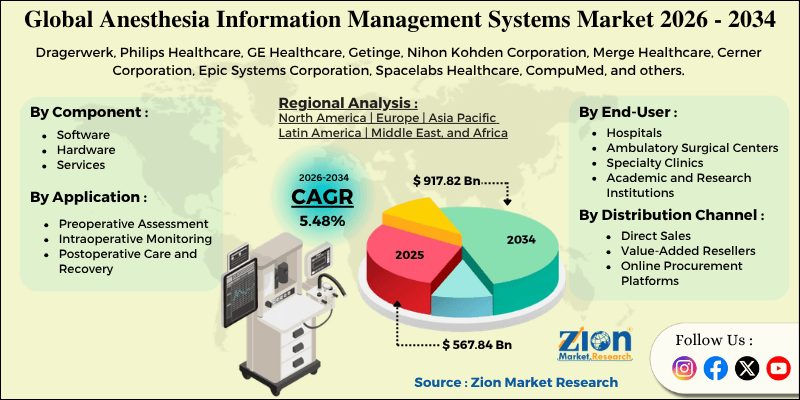
| Key Companies Covered | Dragerwerk, Philips Healthcare, GE Healthcare, Getinge, Nihon Kohden Corporation, Merge Healthcare, Cerner Corporation, Epic Systems Corporation, Spacelabs Healthcare, CompuMed, and others. |
| Segments Covered | By Component, By Application, By End-User, By Distribution Channel, and By Region |
| Regions Covered | North America, Europe, Asia Pacific (APAC), Latin America, Middle East, and Africa (MEA) |
| Base Year | 2025 |
| Historical Year | 2020 - 2024 |
| Forecast Year | 2026 - 2034 |
| Customization Scope | Avail customized purchase options to meet your exact research needs. Request For Customization |
Anesthesia Information Management Systems Market: Segmentation
The global anesthesia information management systems market is segmented by component, application, end-user, distribution channel, and region.
What makes software the dominant component in the anesthesia information management systems market?
Based on component, the global anesthesia information management systems market is segregated into software, hardware, and services. Software leads with about 55% share because it manages patient records, clinical documentation, analytics, and anesthesia workflows during surgeries. The services segment holds around 27% share. They are growing rapidly due to increasing demand for implementation support, software upgrades, staff training, and system maintenance.
How does intraoperative monitoring maintain its leading position in the anesthesia information management systems market?
Based on application, the anesthesia information management systems market is classified into preoperative assessment, intraoperative monitoring, and postoperative care and recovery. Intraoperative monitoring accounts for about 52% of the market share, as it enables real-time monitoring and documentation during surgeries, improving patient safety and clinical decision-making. The postoperative care and recovery segment accounts for around 29% of the share. It is growing steadily with increasing use of anesthesia data to improve patient outcomes and surgical quality.
What makes hospitals the dominant end-user group in the anesthesia information management systems market?
Based on end user, the market is segmented into hospitals, ambulatory surgical centers, specialty clinics, and academic and research institutions. Hospitals hold around a 60% share because they perform the most surgeries and require advanced anesthesia information management systems across multiple operating rooms. The ambulatory surgical centers segment accounts for about 23% of the market share. They are growing rapidly due to rising outpatient procedures and demand for efficient digital documentation.
How do direct sales lead the distribution landscape of the anesthesia information management systems market?
Based on distribution channel, the anesthesia information management systems market is divided into direct sales, value-added resellers, online procurement platforms, and government and institutional tender procurement. Direct sales account for about 45% of market share because hospitals prefer to purchase directly from technology providers for better support, customization, and long-term service. The value-added resellers segment holds around 31% of the market share. They are expanding steadily by supplying anesthesia information management systems solutions to regional hospitals and mid-sized healthcare facilities.
Anesthesia Information Management Systems Market: Regional Analysis
How is North America shaping global demand for anesthesia information management systems solutions?
North America is the largest anesthesia information management systems market and is expected to grow at a CAGR of around 5.4% during the forecast period. The region leads because hospitals have widely adopted digital healthcare technologies and perform a high number of surgical procedures every year. The United States holds the largest share due to strong investment in hospital digitalization, increasing use of electronic health records, and growing demand for accurate anesthesia documentation to improve patient safety.
Many hospitals are upgrading their operating rooms with advanced anesthesia information management systems to improve workflow and clinical efficiency. Canada also contributes to market growth through continued investment in modern healthcare infrastructure and electronic medical record systems. Mexico is emerging as a growing market as private hospitals increasingly adopt digital healthcare solutions. The presence of leading healthcare technology companies, well-developed hospital infrastructure, supportive government initiatives, and rising focus on improving surgical care continue to strengthen North America's position as the leading regional market for anesthesia information management systems.
How does Europe maintain strong momentum in the anesthesia information management systems market?
Europe is the second-largest anesthesia information management systems market and is expected to grow at a CAGR of around 6.2% during the forecast period. The region is growing as hospitals increasingly adopt digital healthcare systems and electronic health records to improve patient care and comply with regulatory requirements. Countries such as Germany, the United Kingdom, France, the Netherlands, and the Nordic countries are investing heavily in hospital digitalization and connected healthcare technologies. Germany and the United Kingdom are the largest contributors due to their advanced healthcare infrastructure, high number of surgical procedures, and strong government support for digital transformation. European initiatives to improve cross-border health data sharing are also encouraging hospitals to adopt standardized anesthesia information management systems. In addition, the presence of leading medical technology companies, continuous investment in healthcare innovation, and growing focus on improving surgical safety and clinical efficiency are supporting the steady growth of the anesthesia information management systems market across Europe.
Recent Market Developments
- In May 2026, iMDsoft advanced its clinical information management platform by expanding support for integrated anesthesia documentation and critical care workflows, helping hospitals improve digital record management and patient safety.
Anesthesia Information Management Systems Market: Competitive Analysis
The leading players in the global anesthesia information management systems market are:
- Dragerwerk
- Philips Healthcare
- GE Healthcare
- Getinge
- Nihon Kohden Corporation
- Merge Healthcare
- Cerner Corporation
- Epic Systems Corporation
- Spacelabs Healthcare
- CompuMed
The global anesthesia information management systems market is segmented as follows:
By Component
- Software
- Hardware
- Services
By Application
- Preoperative Assessment
- Intraoperative Monitoring
- Postoperative Care and Recovery
By End-User
- Hospitals
- Ambulatory Surgical Centers
- Specialty Clinics
- Academic and Research Institutions
By Distribution Channel
- Direct Sales
- Value-Added Resellers
- Online Procurement Platforms
- Government and Institutional Tender Procurement
By Region
- North America
- The U.S.
- Canada
- Mexico
- Europe
- France
- The UK
- Spain
- Germany
- Italy
- Rest of Europe
- Asia Pacific
- China
- Japan
- India
- Australia
- South Korea
- Rest of Asia Pacific
- The Middle East & Africa
- Saudi Arabia
- UAE
- Egypt
- Kuwait
- South Africa
- Rest of the Middle East & Africa
- Latin America
- Brazil
- Argentina
- Rest of Latin America
Table Of Content
Methodology
FrequentlyAsked Questions
Anesthesia information management systems is a digital system that helps hospitals automatically record, organize, and manage all anesthesia-related patient information during surgeries and medical procedures.
The global anesthesia information management systems market is expected to grow, driven by rising surgical volumes worldwide, strengthening regulatory requirements for electronic perioperative documentation, growing institutional investment in patient safety technology, broader hospital adoption of integrated clinical information systems, and progressive integration of artificial intelligence and predictive analytics capabilities into real-time anesthesia documentation platforms.
According to research, the global anesthesia information management systems market was valued at approximately USD 567.84 billion in 2025 and is projected to reach approximately USD 917.82 billion by 2034.
The compound annual growth rate of the anesthesia information management systems market is expected to be approximately 5.48% from 2026 to 2034.
North America is expected to lead the global anesthesia information management systems market throughout the forecast period, driven by high surgical volumes, strong health information technology investment, and regulatory requirements for electronic health records in perioperative care settings.
The major players in the global anesthesia information management systems market include Dragerwerk, Philips Healthcare, GE Healthcare, Getinge, Nihon Kohden Corporation, Merge Healthcare, Cerner Corporation, Epic Systems Corporation, Spacelabs Healthcare, and CompuMed.
The report examines key aspects of the anesthesia information management systems market, including growth drivers, adoption barriers, emerging opportunities, competitive dynamics, detailed regional performance, and a forward-looking outlook across all major components, deployment modes, applications, end-user segments, and geographic regions through 2034.
Advancements in cloud computing, artificial intelligence, real-time patient monitoring, and system integration are transforming the Anesthesia Information Management Systems market. These technologies help hospitals improve clinical documentation, reduce manual errors, enhance patient safety, support faster decision-making, and streamline operating room workflows.
The global anesthesia information management systems market value chain includes software development, hardware integration, system implementation, cloud and IT services, distribution, hospital deployment, staff training, ongoing maintenance, and end-user support to ensure efficient clinical operations.
The anesthesia information management systems market is expected to benefit from rising healthcare spending, growing hospital digitalization, and increasing government investment in healthcare infrastructure. However, inflation, budget limitations, and economic uncertainty may temporarily slow technology adoption, especially in developing healthcare markets.

List of Contents
Anesthesia Information Management SystemsIndustry Perspective:Key InsightsOverviewTechnology Roadmap 20252034DynamicsReport ScopeSegmentationRegional AnalysisRecent Market DevelopmentsCompetitive AnalysisThe global anesthesia information management systems market is segmented as follows:HappyClients

