
AI-Enabled Railway Market Size, Share, Value and Forecast 2034

AI-Enabled Railway Market By Component (Hardware Systems, Software Platforms, Cloud and Edge Computing Services, Consulting Services, and Maintenance Services), By Application (Predictive Maintenance and Asset Monitoring, Traffic and Network Management, Passenger Experience and Ticketing, and Safety and Security Systems), By Technology (Machine Learning and Deep Learning, Computer Vision and Image Recognition, Natural Language Processing, and Robotics and Automation), By End User (Passenger Rail Operators, Freight Rail Operators, Metro and Urban Transit Authorities, Railway Infrastructure Companies, and High-Speed Rail Operators), and By Region - Global and Regional Industry Overview, Market Intelligence, Comprehensive Analysis, Historical Data, and Forecasts 2026 - 2034
| Market Size in 2025 | Market Forecast in 2034 | CAGR (in %) | Base Year |
|---|---|---|---|
| USD 2.99 Billion | USD 10.89 Billion | 15.09% | 2025 |
AI-Enabled Railway Industry Perspective:
What will be the size of the AI-enabled railway market during the forecast period?
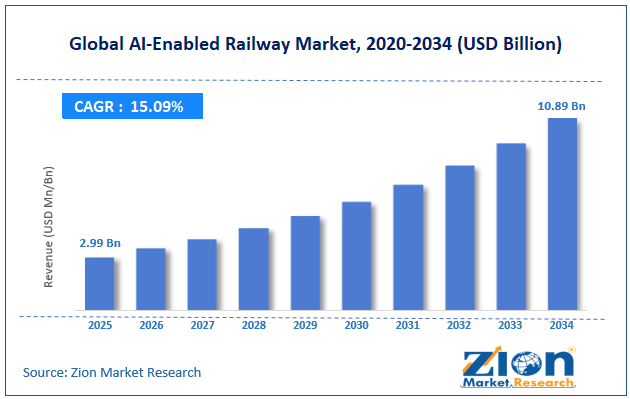
The global AI-enabled railway market size was valued at approximately USD 2.99 billion in 2025 and is projected to reach around USD 10.89 billion by 2034, growing at a compound annual growth rate of approximately 15.09% between 2026 and 2034.
Key Insights
- As per the analysis shared by our research team, the global AI-enabled railway market is estimated to grow at a compound annual growth rate of approximately 15.09% during the forecast period from 2026 to 2034.
- In terms of revenue, the global AI-enabled railway market was valued at approximately USD 2.99 billion in 2025 and is projected to reach USD 10.89 billion by 2034.
- The AI-enabled railway market is expected to grow strongly due to rising investment in smart rail infrastructure, a growing focus on passenger safety, the increasing need for predictive maintenance, and expanding urban metro networks worldwide.
- Based on component, software platforms lead the market because of their central role in data processing and decision-making. At the same time, cloud and edge computing services are the fastest-growing segment as operators shift toward real-time, distributed data processing.
- Based on application, predictive maintenance and asset monitoring lead the market since preventing equipment failure remains a top priority for operators. At the same time, passenger experience and ticketing are the fastest-growing segments as stations adopt smarter, more connected services.
- Based on technology, machine learning and deep learning lead the market because they are widely used across forecasting and automation tasks. At the same time, computer vision and image recognition are the fastest-growing technologies as visual inspection systems become more advanced and affordable.
- Based on end user, passenger rail operators lead the market given the scale of daily passenger operations. At the same time, metro and urban transit authorities are the fastest-growing segment as cities expand their rail-based public transport networks.
- Based on region, Asia Pacific leads the global AI-enabled railway market, driven by rapid rail network expansion. At the same time, Europe is the fastest-growing region, driven by strong policy support for rail modernization and sustainable transport initiatives.
AI-Enabled Railway Market: Overview
AI-enabled railways are railway systems that use artificial intelligence to improve train safety, operations, maintenance, and passenger services. These systems combine technologies such as machine learning, computer vision, sensors, and automation to help railway operators monitor and manage trains, tracks, stations, and networks more effectively. Artificial intelligence can detect track damage, worn components, signal problems, and other safety risks early, helping prevent unexpected breakdowns and service disruptions. Predictive maintenance is another important application, as AI can analyses equipment data and identify signs of failure before major repairs are required. Railway operators also use AI to optimize train schedules, manage traffic, select efficient routes, and improve network capacity, reducing delays and operating costs. At railway stations, AI-powered systems support smart ticketing, passenger counting, crowd management, security monitoring, and real-time travel information. In freight transportation, artificial intelligence helps operators plan routes, manage cargo loads, improve fuel efficiency, and reduce delivery times. As rail networks expand and passenger and freight demand grows, these technologies are becoming an important part of modern railway operations, maintenance, safety management, and service improvement.
Overall, these advancements are supporting growth in the AI-enabled railway industry as operators increasingly adopt intelligent solutions to improve safety, efficiency, reliability, and passenger services.
AI-Enabled Railway Market: Strategic Perspective
Where is the AI-enabled railway market heading?
The AI-enabled railway market is moving toward smarter and more connected rail networks, where real-time monitoring, predictive maintenance, and automated systems work together to improve safety and reduce delays. Growing adoption of edge computing, smart sensors, and cloud-based analytics will help railway operators modernize older infrastructure while keeping daily services running smoothly.
Where should businesses invest in the AI-enabled railway market?
The AI-enabled railway market offers opportunities in predictive maintenance, intelligent traffic management, computer vision for railway inspection, and AI-powered passenger services. Businesses can focus on flexible, compatible solutions that work with existing railway systems and can expand as operators upgrade their infrastructure.
What will reshape competition in the AI-enabled railway market?
The AI-enabled railway market will be shaped by companies' ability to deliver clear improvements in railway safety, punctuality, operating costs, and system reliability. Strong AI capabilities, data security, easy integration with older railway infrastructure, and successful real-world implementation will become increasingly important as adoption grows.
AI-Enabled Railway Market: Technology Roadmap 2026–2034
What is the projected development roadmap of the AI-enabled railway market over the forecast period?
The AI-enabled railway market is progressing through more accurate predictive algorithms, wider deployment of sensor and camera networks, expanded automation of train operations, and growing use of data analytics to support real-time decision-making across rail networks. The market is expected to grow at a compound annual growth rate of approximately 15.09% over the forecast period, driven by rising safety standards, increasing rail passenger volumes, and continuous advancement in AI capabilities.
The following roadmap outlines key development phases expected through 2034.
2026–2028: Foundation and Monitoring Phase
- Sensor and data infrastructure buildout: Rail operators are expected to expand the installation of sensors, cameras, and monitoring devices across tracks, stations, and rolling stock to generate the data AI systems need.
- Early predictive maintenance adoption: Companies are likely to begin using AI models to flag potential equipment issues before they lead to breakdowns, reducing unplanned service disruptions.
- Pilot programs for traffic optimization: Railway authorities are expected to test AI-based scheduling and traffic management tools on select routes to measure improvements in punctuality and network efficiency.
2029–2031: Integration and Automation Expansion Phase
- Network-wide predictive systems: AI-based maintenance and monitoring tools are expected to move beyond pilot projects into full deployment across entire rail networks, covering both passenger and freight operations.
- Autonomous and semi-autonomous train trials: Companies are likely to expand trials of AI-assisted train operation, particularly in metro and urban transit systems with more controlled environments.
- Passenger experience platforms: Smart ticketing, AI-based crowd management, and personalized travel updates are expected to become standard features at major stations and busy transit hubs.
2032–2034: Intelligent and Autonomous Rail Phase
- Advanced autonomous operations: Broader adoption of AI-driven train control systems may extend beyond metro networks into select long-distance and freight rail corridors.
- Self-optimizing rail networks: Railways could increasingly rely on AI systems that continuously adjust scheduling, maintenance, and resource allocation based on real-time network conditions.
- Fully integrated passenger and safety ecosystems: AI-powered safety monitoring, predictive maintenance, and passenger services may become tightly interconnected, offering a seamless and highly responsive rail travel experience.
AI-Enabled Railway Market: Dynamics
Growth Drivers
What factors are driving changing operator priorities in the AI-enabled railway market?
Operator priorities in the AI-enabled railway market are changing as rail authorities focus more on safety, punctuality, reliability, and cost efficiency. Many operators are replacing fixed maintenance schedules with condition-based maintenance that uses real-time data to identify when equipment needs attention. This is increasing demand for accurate sensors, predictive algorithms, and automated inspection tools that can work across different railway systems. Passenger-focused AI is also gaining attention, helping stations reduce crowding, improve navigation, and provide timely travel information. Smaller rail networks are adopting affordable, scalable solutions, while major metro systems are investing in larger AI platforms. Before choosing technology providers, operators are considering data accuracy, system reliability, integration requirements, and long-term maintenance costs. Technology companies are responding with modular solutions, phased implementation, flexible pricing, and practical performance data. These changes are making AI adoption easier for railway operators while supporting safer, more reliable, and efficient rail services across growing networks and improving the overall passenger experience for daily travelers worldwide.
Specialized AI solutions are creating new opportunities in the AI-enabled railway market.
The AI-enabled railway industry is creating new growth opportunities through specialized technologies that solve specific challenges across rail networks. Companies are developing machine learning, computer vision, and data analytics solutions to improve railway safety, maintenance, scheduling, and asset management. Predictive maintenance is gaining strong attention because it can identify equipment problems early, reduce unexpected breakdowns, and extend the life of costly railway assets. Sustainability is also becoming important, with AI-based route and load optimization helping freight operators reduce fuel consumption and emissions. Metro networks, high-speed trains, and freight operators are adopting these technologies to improve reliability and manage rising passenger and cargo volumes. Cloud-based AI platforms are making advanced tools more accessible to smaller railway operators without requiring large investments in internal technology infrastructure. Local partnerships can further support faster implementation, training, and technical assistance. Scalable and affordable AI solutions are particularly useful for regional and short-line rail networks with limited budgets. Long-term contracts, software updates, and technical support also create additional business opportunities.
Restraints
High implementation cost is a key challenge limiting growth in the AI-enabled railway market.
The AI-enabled railway market faces challenges such as high initial costs, complex system integration, cybersecurity risks, and resistance to new technologies. Installing sensors, cameras, and computing systems across large railway networks can require significant investment, especially when operators use older infrastructure. Railway authorities are also concerned about data security, system reliability, maintenance expenses, and the long-term performance of AI solutions. Smaller operators may prefer traditional maintenance and scheduling methods because of limited budgets, technical resources, and concerns about adopting unfamiliar systems. AI equipment must also perform reliably under harsh conditions, including extreme weather, vibration, and continuous railway operations. Growing volumes of operational and passenger data are increasing concerns about privacy and cyber threats. A shortage of skilled AI and data professionals in some regions can further delay implementation. Technology providers can reduce these barriers by offering flexible payment options, simpler integration, stronger cybersecurity, durable hardware, employee training, and reliable technical support throughout system deployment and operation.
Opportunities
Will safety-focused innovation open new opportunities in the AI-enabled railway market?
Safety-focused innovation is creating new opportunities in the AI-enabled railway market as rail authorities seek faster and more reliable ways to protect passengers, cargo, and infrastructure. AI-based systems can detect faults early, continuously monitor railway assets, and send automated alerts when potential safety issues arise. Advanced computer vision and real-time data analytics are helping operators identify track damage, equipment defects, and other risks more accurately than traditional inspection methods. Modular monitoring systems and scalable sensor networks also let railway operators expand AI coverage gradually within their budgets. Smaller regional networks can begin with specific applications such as track inspection, while metro and high-speed rail systems can adopt wider safety solutions across their networks. Freight operators, urban transport authorities, and infrastructure companies are also investing in technologies that support aging railway assets. Cloud-based platforms allow smaller technology providers to reach operators in different regions without building extensive infrastructure. AI solutions for tunnels, bridges, stations, and extreme weather monitoring can further expand demand. Regular software updates and improved learning models can enhance accuracy over time, supporting continued innovation and revenue growth across the market.
Challenges
How are integration complexity and data concerns affecting the AI-enabled railway market?
The AI-enabled railway industry faces challenges related to complex integration, data security, system accuracy, and reliability. Connecting modern AI platforms with older signaling, control, and railway systems can be difficult and expensive, often requiring significant time and technical expertise. Operators are also closely evaluating AI tools based on accuracy, false alarms, and performance under different weather and operating conditions. This is pushing technology providers to improve algorithms and offer clearer performance information. Traditional inspection and maintenance methods remain widely used, especially among operators that are cautious about automated systems. Growing digitalization is also increasing concerns about passenger data privacy and cybersecurity across railway networks. In developing regions, limited digital infrastructure can further restrict large-scale AI adoption. Dependence on specialized sensors, cameras, and computing equipment may also create supply chain risks and increase costs. Technology providers can address these challenges with secure, flexible platforms, stronger local support, simpler integration, better training, and closer cooperation with railway authorities during implementation and system upgrades.
AI-Enabled Railway Market: Report Scope
| Report Attributes | Report Details |
|---|---|
| Report Name | AI-Enabled Railway Market |
| Market Size in 2025 | USD 2.99 Billion |
| Market Forecast in 2034 | USD 10.89 Billion |
| Growth Rate | CAGR of 15.09% |
| Number of Pages | 229 |
| Key Companies Covered | Siemens Mobility, Hitachi Rail, Alstom, Wabtec Corporation, Thales Group, Cisco Systems, IBM Corporation, Huawei Technologies, Nokia Corporation, Indra Sistemas, and others. |
| Segments Covered | By Component, By Application, By Technology, By End User, and By Region |
| Regions Covered | North America, Europe, Asia Pacific (APAC), Latin America, Middle East, and Africa (MEA) |
| Base Year | 2025 |
| Historical Year | 2020 - 2024 |
| Forecast Year | 2026 - 2034 |
| Customization Scope | Avail customized purchase options to meet your exact research needs. Request For Customization |
AI-Enabled Railway Market: Segmentation
The global AI-enabled railway market is segmented by component, application, technology, end user, and region.
Why does software lead the AI-enabled railway market by component?
Based on component, the market is classified into hardware systems, software platforms, cloud and edge computing services, consulting services, and maintenance services. Software platforms hold about 44% of the market share, leading because they form the core of data analysis, predictive modeling, and decision-making across rail operations. Cloud and edge computing services hold around 24% market share. This is the fastest-growing segment as operators increasingly shift toward distributed, real-time data processing.
How is predictive maintenance maintaining its lead in the AI-enabled railway market by application?
By application, the AI-enabled railway industry is divided into predictive maintenance and asset monitoring, traffic and network management, passenger experience and ticketing, and safety and security systems. Predictive maintenance and asset monitoring account for approximately 34% of the global market share, driven by the strong financial and safety benefits of catching equipment issues before they cause failures. Passenger experience and ticketing account for around 22% of market share. It is the fastest-growing segment as stations and operators invest more heavily in smart, connected passenger services.
Where does machine learning stand in the AI-enabled railway market by technology?
Based on technology, the market is categorized into machine learning and deep learning, computer vision and image recognition, natural language processing, and robotics and automation. Machine learning and deep learning lead with about a 41% share because of their broad use in forecasting, anomaly detection, and automated decision-making. Computer vision and image recognition hold around 25% market share. It is growing rapidly as camera-based inspection systems become more accurate, affordable, and widely deployed across rail networks.
Which end user accounts for the largest share in the AI-enabled railway market?
Based on end user, the global AI-enabled railway market is divided into passenger rail operators, freight rail operators, metro and urban transit authorities, railway infrastructure companies, and high-speed rail operators. Passenger rail operators account for about 37% of the market, leading due to the sheer scale of daily passenger operations and the strong focus on safety and punctuality. Metro and urban transit authorities hold around 26% market share. This segment is expanding quickly as growing cities invest heavily in expanding and modernizing their urban rail networks.
AI-Enabled Railway Market: Regional Analysis
What factors are strengthening Asia Pacific's position in the AI-enabled railway market?
Asia Pacific leads the global AI-enabled railway market and is expected to grow at a CAGR of around 7.2% during the forecast period. This strong position is supported by large investments in rail infrastructure and rapidly expanding metro networks, creating steady demand for AI-based monitoring, maintenance, and management systems. China, Japan, and India are major markets due to their extensive rail networks, high-speed rail projects, and large urban populations that depend heavily on rail transport. Railway authorities are increasingly using AI-powered predictive maintenance to monitor equipment, reduce failures, and keep networks operating efficiently. Government spending on smart cities and intelligent transportation is also helping operators adopt advanced railway technologies. Regional technology companies and system integrators are partnering with railway authorities to develop AI solutions for passenger and freight services. Rising urban populations and commuter numbers are increasing demand for AI-based crowd management, traffic control, and scheduling systems. The region also has strong technology manufacturing capabilities, helping companies produce AI hardware and software at competitive costs. Growing interest in autonomous train operations, particularly in metro networks, is encouraging further investment in research and development. Local providers are also developing solutions designed for regional railway conditions, infrastructure needs, and network complexity. These factors are helping railway operators improve safety, reliability, efficiency, and passenger experience while supporting wider AI adoption across the region.
How are national rail modernization efforts driving growth in the European AI-enabled railway market?
The European AI-enabled railway market is expected to grow at a volume CAGR of around 8.4% during the forecast period, supported by government policies focused on rail modernization, sustainable transport, and better cross-border connectivity. Germany, France, the UK, and other European countries are investing in modern railway infrastructure and AI-based systems to improve network performance. Sustainability targets are also encouraging railway operators to use artificial intelligence for better energy management, efficient train operations, and lower environmental impact. AI solutions are being adopted across passenger rail, freight transportation, and international rail networks, creating opportunities for both public and private operators. Growing demand for predictive maintenance and automated safety monitoring is helping operators manage aging infrastructure and reduce unexpected service disruptions. Technology providers are developing flexible solutions that can meet different national railway standards, regulations, and infrastructure requirements. Investments in high-speed rail and cross-border connections are further increasing demand for intelligent traffic management and monitoring systems. Interoperable platforms are gaining attention because they can connect different railway technologies and systems. Regional technology companies are also developing specialized AI solutions for local railway networks. Rising investment in sustainable rail infrastructure is expected further to support European market expansion throughout the forecast period.
Recent Market Developments
- In July 2026, Siemens Mobility showcased AI-enabled rail technologies at InnoTrans 2026, including AI-supported traffic management, predictive maintenance, infrastructure monitoring, and intelligent passenger information systems.
- In March 2026, Hitachi Rail launched its BV700 smart ticket validator, expanding its digital ticketing portfolio with contactless travel capabilities designed to improve passenger journeys and operational efficiency.
AI-Enabled Railway Market: Competitive Analysis
The leading players in the global AI-enabled railway market are:
- Siemens Mobility
- Hitachi Rail
- Alstom
- Wabtec Corporation
- Thales Group
- Cisco Systems
- IBM Corporation
- Huawei Technologies
- Nokia Corporation
- Indra Sistemas
The global AI-enabled railway market is segmented as follows:
By Component
- Hardware Systems
- Software Platforms
- Cloud and Edge Computing Services
- Consulting Services
- Maintenance Services
By Application
- Predictive Maintenance and Asset Monitoring
- Traffic and Network Management
- Passenger Experience and Ticketing
- Safety and Security Systems
By Technology
- Machine Learning and Deep Learning
- Computer Vision and Image Recognition
- Natural Language Processing
- Robotics and Automation
By End User
- Passenger Rail Operators
- Freight Rail Operators
- Metro and Urban Transit Authorities
- Railway Infrastructure Companies
- High-Speed Rail Operators
By Region
- North America
- The U.S.
- Canada
- Mexico
- Europe
- France
- The UK
- Spain
- Germany
- Italy
- Rest of Europe
- Asia Pacific
- China
- Japan
- India
- Australia
- South Korea
- Rest of Asia Pacific
- The Middle East & Africa
- Saudi Arabia
- UAE
- Egypt
- Kuwait
- South Africa
- Rest of the Middle East & Africa
- Latin America
- Brazil
- Argentina
- Rest of Latin America
Table Of Content
Methodology
FrequentlyAsked Questions
An AI-enabled railway is a system that uses artificial intelligence to improve train safety, operations, maintenance, and passenger services. This system combines technologies such as machine learning, computer vision, sensors, and automation to help railway operators monitor and manage trains, tracks, stations, and networks more effectively.
The global AI-enabled railway market is expected to grow due to rising investment in smart rail infrastructure, a growing focus on passenger safety, the increasing need for predictive maintenance, and expanding urban metro networks worldwide.
According to research, the global AI-enabled railway market was valued at approximately USD 2.99 billion in 2025 and is projected to reach approximately USD 10.89 billion by 2034.
The AI-enabled railway market is expected to grow at a compound annual growth rate of approximately 15.09% from 2026 to 2034.
Asia Pacific is expected to lead the global AI-enabled railway market throughout the forecast period, driven by massive rail infrastructure investment, expanding metro networks, and strong government support for smart transport initiatives.
The major players in the global AI-enabled railway market include Siemens Mobility, Hitachi Rail, Alstom, Wabtec Corporation, Thales Group, Cisco Systems, IBM Corporation, Huawei Technologies, Nokia Corporation, and Indra Sistemas.
The report examines key aspects of the AI-enabled railway market, including research and development drivers, adoption barriers, application opportunities, competitive landscape dynamics, detailed regional market performance analysis, and a comprehensive forward-looking outlook across all major components, applications, technologies, end users, and geographic regions through 2034.
Rising government spending on infrastructure modernization and public transport is supporting demand in the AI-enabled railway market, especially for advanced predictive maintenance and safety solutions. However, inflation and rising costs for specialized hardware, skilled labor, and system integration may slow adoption among smaller or budget-constrained rail operators.
The AI-enabled railway market offers opportunities in predictive maintenance software development, computer vision-based inspection tools, cybersecurity solutions, partnerships with national rail authorities, and expansion into emerging rail markets.
Prices in the AI-enabled railway market vary by system complexity and scale, with large-scale predictive maintenance and traffic management platforms costing more because of advanced hardware and specialized software. Smaller, modular AI solutions remain more accessible for regional operators and smaller rail networks working with limited technology budgets.

HappyClients