
Global AI Based Weather Modeling Market Size, Share, Trends, Growth Report, 2034

AI Based Weather Modeling Market By Component (Software and Services), By Technology (Machine Learning, Computer Vision, Deep Learning and Others), By End Use (National Meteorological Agencies & Governments, Energy & Utilities, Aviation & Maritime, Agriculture & Agritech and Others) and By Region - Global and Regional Industry Overview, Market Intelligence, Comprehensive Analysis, Historical Data, and Forecasts 2026 - 2034
| Market Size in 2025 | Market Forecast in 2034 | CAGR (in %) | Base Year |
|---|---|---|---|
| USD 172.7 Million | USD 1210.7 Million | 21.5% | 2025 |
AI Based Weather Modeling Industry Perspective:
What will be the size of the global AI based weather modeling market during the forecast period?
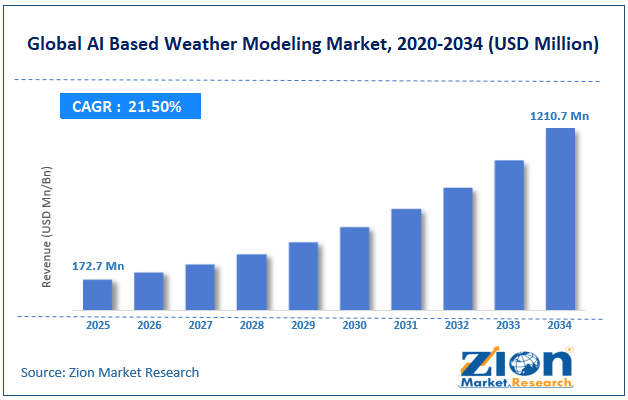
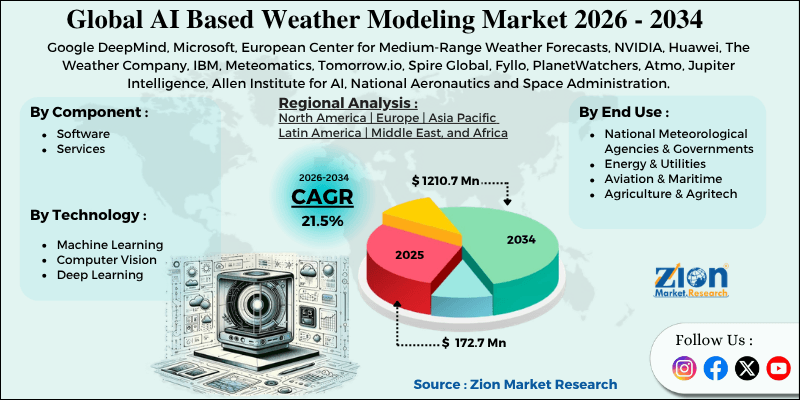
The global AI based weather modeling market size was worth around USD 172.7 million in 2025 and is predicted to grow to around USD 1210.7 million by 2034 with a compound annual growth rate (CAGR) of roughly 21.5% between 2026 and 2034.
 Request Free SampleRequest Free Sample
AI Based Weather Modeling Market: Overview
The application of AI, ML, DL, neural networks, and foundation models for processing and interpreting big data sets associated with the atmosphere, satellites, radar, oceans, and historical weather data in order to predict future weather conditions is known as AI weather modeling. Unlike traditional numerical weather prediction (NWP), which uses complex physical equations, AI weather modeling relies solely on patterns discovered in data and can make quick, detailed, and accurate weather predictions. Such predictions include temperature, precipitation, wind speed, humidity, air pressure, and extreme weather. There are many applications of AI weather modeling that include meteorology, agriculture, aviation, renewable energy, transportation, disaster management, insurance, and many others.
Key Insights
- As per the analysis shared by our research analyst, the global AI based weather modeling market is estimated to grow annually at a CAGR of around 21.5% over the forecast period (2026-2034).
- In terms of revenue, the global AI based weather modeling market size was valued at around USD 172.7 million in 2025 and is projected to reach USD 1210.7 million by 2034.
- Expansion of earth observation and satellite data is expected to propel the AI based weather modeling market over the projected period.
- Based on the component, the software segment held the largest market share in 2025 of over 72%.
- Based on the technology, the machine learning segment held a prominent market share in 2025.
- Based on the end use, the national meteorological agencies & governments segment dominates the market.
- Based on region, North America led the market with a revenue share of over 40% in 2025.
Impact of the USA-Israel War on Iran on the AI Based Weather Modeling Market
The USA-Israel conflict against Iran has resulted in a neutral to a little bit positive impact on the artificial intelligence (AI) weather modeling industry. While it has enhanced the necessity of weather knowledge for defense purposes, aviation, shipping, and disaster management, the conflict has also brought some logistical challenges, higher energy prices, and uncertain investments into AI-based systems. Nevertheless, rising tensions between countries have highlighted the importance of having an accurate and up-to-date weather modeling system associated with military and disaster management systems.
AI Based Weather Modeling Market: Dynamics
Growth Drivers
Why does the growing frequency of extreme weather events drive the AI based weather modeling market?
The growing frequency and intensity of such extreme weather events worldwide are key drivers of the rising demand for AI-based weather modeling technology. Climate change has increased the frequency of hurricanes, floods, heatwaves, droughts, wildfires, thunderstorms, and tropical cyclones, underscoring the need for more advanced, faster, and more accurate weather forecasting. While traditional numerical weather prediction (NWP) methods have proven quite reliable, in some cases, they may require substantial computing power and take a long time to process. Governmental bodies, meteorological services, disaster management agencies, and humanitarian organizations are increasingly allocating funding to AI-based forecasting tools to enhance their early warning systems and improve readiness for emergency situations. With improved prediction, relevant bodies will be able to issue evacuation warnings and prepare for disasters much more quickly, helping prevent casualties and damage during weather-related events.
Restraints
High initial investment and infrastructure costs hamper the growth of the AI based weather modeling industry
The fact that AI-driven weather model development, deployment, and maintenance are expensive activities remains a serious market constraint. To build advanced weather prediction models, companies need significant spending on HPC equipment, GPUs, cloud computing, data storage, and high-speed networking. Also, enterprises should invest heavily in building and maintaining weather satellites, Doppler radars, IoT-based weather stations, remote sensing systems, and data-acquisition systems to collect the vast amounts of meteorological data needed for machine learning.
However, the costs associated with constructing such facilities are only one side of the coin. AI models used for weather prediction need regular retraining on new datasets from the atmosphere, ocean, and satellite observations to account for changes in weather conditions and climate. It requires significant computing power, energy, cloud computing capacity, software maintenance, and so on. Also, there is a need for a multidisciplinary team of experts in artificial intelligence, data science, meteorology, and climatology.
Opportunities
How does the growing product launch offer a lucrative opportunity for the AI based weather modeling market?
The growing product launch is expected to offer a potential opportunity to the AI based weather modeling market. For instance, in December 2025, the National Oceanic and Atmospheric Administration (NOAA) introduced a revolutionary set of operational, AI-powered models for global weather forecasting, which have brought about a breakthrough in the speed, effectiveness, and precision of forecasts. The models will ensure fast, precise guidance for forecasters, requiring only minimal computational power. “It represents a huge step forward for America in terms of weather model development.” They [the AI models] represent a shift in paradigm for NOAA with respect to increasing accuracy of weather and tropical track forecasting, and rapid delivery of forecast information to meteorologists and the general public at a much lower cost by reducing computational costs."
Challenges
How does the shortage of skilled AI and atmospheric science professionals pose a significant challenge to the AI based weather modeling market?
The lack of experts skilled in artificial intelligence as well as atmospheric sciences remains the key problem hindering the development of the AI weather modeling market. The creation and implementation of intelligent and complex weather forecasting systems are possible through the application of interdisciplinary competencies related to machine learning, deep learning, meteorology, climatology, NWP, geospatial analysis, remote sensing, and high-performance computing. Nevertheless, the available pool of specialists is relatively narrow across the globe due to the combination of necessary qualifications.
AI-based weather modeling involves specialists who are able to work with meteorological data, develop and train deep learning models, integrate satellite and radar measurements, and analyze forecast results based on the principles of atmospheric physics. It is increasingly difficult to attract and retain such highly skilled employees due to intense competition from other industries, including generative AI, self-driving cars, financial services, healthcare, and cybersecurity.
 Request Free SampleRequest Free Sample
AI Based Weather Modeling Market: Report Scope
| Report Attributes | Report Details |
|---|---|
| Report Name | AI Based Weather Modeling Market |
| Market Size in 2025 | USD 172.7 Million |
| Market Forecast in 2034 | USD 1210.7 Million |
| Growth Rate | CAGR of 21.5% |
| Number of Pages | 227 |
| Key Companies Covered | Google DeepMind, Microsoft, European Center for Medium-Range Weather Forecasts, NVIDIA, Huawei, The Weather Company, IBM, Meteomatics, Tomorrow.io, Spire Global, Fyllo, PlanetWatchers, Atmo, Jupiter Intelligence, Allen Institute for AI, National Aeronautics and Space Administration, China Meteorological Administration, AccuWeather, Met Office, DTN, and others. |
| Segments Covered | By Component, By Technology, By End Use, and By Region |
| Regions Covered | North America, Europe, Asia Pacific (APAC), Latin America, Middle East, and Africa (MEA) |
| Base Year | 2025 |
| Historical Year | 2020 - 2024 |
| Forecast Year | 2026 - 2034 |
| Customization Scope | Avail customized purchase options to meet your exact research needs. Request For Customization |
AI Based Weather Modeling Market: Segmentation
Component Insights
Why does the software segment hold a prominent position in the AI based weather modeling market?
The software segment held the largest market share in 2025 of over 72%. Demand for sophisticated analytics platforms capable of analyzing large volumes of climate data in real time drives the software segment of the AI-based weather modeling market. Widespread acceptance of cloud computing enables the cost-effective implementation of AI algorithms for weather prediction. The use of machine learning and deep learning models improves forecasting, an important requirement for industries such as aviation, energy, and agriculture. Investment in user interfaces and API integration technologies also contributes to market growth. In addition, government disaster management measures and business needs for risk mitigation support software-led growth in the market.
Technology Insights
How does the machine learning segment capture the largest market share in the AI based weather modeling market?
The machine learning segment held a prominent market share in 2025. The reason for this growth is that it can process climate data faster and more accurately than traditional models. Machine learning algorithms excel at discovering patterns in satellite, radar, and historical weather data, enabling accurate short- and long-term predictions. The rising demand for warning systems for extreme weather, along with increased use across the agricultural, energy, aviation, and disaster management sectors, is driving growth in machine learning for weather forecasting.
End Use Insights
Does the national meteorological agencies & governments segment capture the largest market share in the AI based weather modeling market?
The national meteorological agencies & governments segment dominates the market. The growth is being fueled by the need to increase resilience, preparedness, and safety in response to climatic conditions. Governments are increasingly turning to AI-based forecasting to ensure the accuracy and precision of early warnings for various climatic events, such as flooding and cyclones. AI helps efficiently process large volumes of climate data from satellites, sensors, and radars, which support the implementation of national and sustainable development policies. Moreover, the growing need to upgrade outdated forecasting systems also drives this market's growth.
Regional Insights
Why does North America lead the AI based weather modeling market?
North America led the market with a revenue share of over 40% in 2025. The growth is attributed to the presence of major players and continuous product innovation, & launch drives the regional market. For instance, in January 2026, as part of its annual meeting at the American Meteorological Society, NVIDIA announced an entire family of NVIDIA Earth-2 open models, libraries, and frameworks for weather and climate AI, which provide the world’s first fully open and accelerated weather AI software stack. These open technologies, such as pretrained models, frameworks, customizations, and inference libraries, accelerate each step of the forecasting process, from observation data processing through 15-day global forecasts and local storm forecasts.
AI Based Weather Modeling Market: Competitive Analysis
The global AI based weather modeling market is dominated by players like:
- Google DeepMind
- Microsoft
- European Center for Medium-Range Weather Forecasts
- NVIDIA
- Huawei
- The Weather Company
- IBM
- Meteomatics
- Tomorrow.io
- Spire Global
- Fyllo
- PlanetWatchers
- Atmo
- Jupiter Intelligence
- Allen Institute for AI
- National Aeronautics and Space Administration
- China Meteorological Administration
- AccuWeather
- Met Office
- DTN
The global AI based weather modeling market is segmented as follows:
By Component
- Software
- Services
By Technology
- Machine Learning
- Computer Vision
- Deep Learning
- Others
By End Use
- National Meteorological Agencies & Governments
- Energy & Utilities
- Aviation & Maritime
- Agriculture & Agritech
- Others
By Region
- North America
- The U.S.
- Canada
- Mexico
- Europe
- France
- The UK
- Spain
- Germany
- Italy
- Rest of Europe
- Asia Pacific
- China
- Japan
- India
- Australia
- South Korea
- Rest of Asia Pacific
- The Middle East & Africa
- Saudi Arabia
- UAE
- Egypt
- Kuwait
- South Africa
- Rest of the Middle East & Africa
- Latin America
- Brazil
- Argentina
- Rest of Latin America
Table Of Content
Methodology
FrequentlyAsked Questions
The application of AI, ML, DL, neural networks, and foundation models for processing and interpreting big data sets associated with the atmosphere, satellites, radar, oceans, and historical weather data in order to predict future weather conditions is known as AI weather modeling.
The AI-based weather modeling market is primarily driven by the growing frequency of extreme weather events, increasing demand for faster and more accurate weather forecasting, and rapid advancements in artificial intelligence, deep learning, and foundation models.
The growth of the AI-based weather modeling market is restrained by several challenges, including high initial investment in high-performance computing (HPC), cloud infrastructure, GPUs, and weather observation systems, as well as the shortage of professionals with expertise in both artificial intelligence and atmospheric sciences.
Based on the technology, the machine learning segment is expected to dominate the AI based weather modeling market growth during the projected period.
Emerging trends in the AI-based weather modeling market include the rapid adoption of foundation AI models, transformer-based architectures, and graph neural networks that deliver faster and more accurate forecasts than traditional numerical weather prediction (NWP) methods.
According to the report, the global AI based weather modeling market size was worth around USD 172.7 million in 2025 and is predicted to grow to around USD 1210.7 million by 2034.
The global AI based weather modeling market is expected to grow at a CAGR of 21.5% during the forecast period.
The global AI based weather modeling industry growth is expected to be led by North America over the forecast period.
The global AI based weather modeling market is dominated by players like Google DeepMind, Microsoft, European Center for Medium-Range Weather Forecasts, NVIDIA, Huawei, The Weather Company, IBM, Meteomatics, Tomorrow.io, Spire Global, Fyllo, PlanetWatchers, Atmo, Jupiter Intelligence, Allen Institute for AI, National Aeronautics and Space Administration, China Meteorological Administration, AccuWeather, Met Office, and DTN, among others.
The AI based weather modeling market report covers the geographical market along with a comprehensive competitive landscape analysis. It also includes cash flow analysis, profit ratio analysis, market basket analysis, market attractiveness analysis, sentiment analysis, PESTLE analysis, trend analysis, SWOT analysis, trade area analysis, demand & supply analysis, Porter’s five forces analysis, and value chain analysis.

HappyClients

