
Global Advanced Planning and Scheduling (APS) Software Market Size 2034

Advanced Planning and Scheduling (APS) Software Market By Component (Software and Services), By Deployment Mode (On-Premises and Cloud-Based), By Organization Size (Small and Medium Enterprises and Large Enterprises), By Application (Production Planning, Demand Planning and Forecasting, Inventory Management, Scheduling, and Others), By End-User Industry (Manufacturing, Automotive, Aerospace and Defense, Food and Beverage, Pharmaceuticals, Chemicals, Electronics, and Others), and Region - Global and Regional Industry Overview, Market Intelligence, Comprehensive Analysis, Historical Data, and Forecasts 2026 - 2034
| Market Size in 2025 | Market Forecast in 2034 | CAGR (in %) | Base Year |
|---|---|---|---|
| USD 4.6 Billion | USD 10.4 Billion | 9.5% | 2025 |
Advanced Planning and Scheduling (APS) Software Industry Perspective:
What will be the size of the global Advanced Planning and Scheduling (APS) Software market during the forecast period?
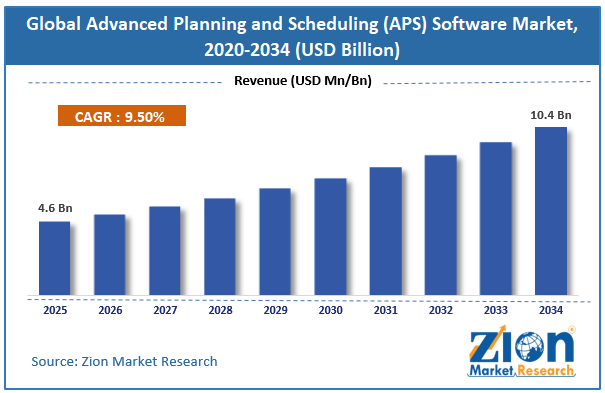
The global advanced planning and scheduling (APS) software market size was worth around USD 4.6 billion in 2025 and is predicted to grow to around USD 10.4 billion by 2034, with a compound annual growth rate (CAGR) of roughly 9.5% between 2026 and 2034.
 Request Free SampleRequest Free Sample
Key Insights
- As per the analysis shared by our research analyst, the global Advanced Planning and Scheduling (APS) Software market is estimated to grow annually at a CAGR of around 9.5% over the forecast period (2026-2034).
- In terms of revenue, the global Advanced Planning and Scheduling (APS) Software market size was valued at around USD 4.6 billion in 2025 and is projected to reach USD 10.4 billion by 2034.
- Growing integration of AI and machine learning is expected to drive the Advanced Planning and Scheduling (APS) Software market.
- Based on the component, the software segment dominates with a revenue share of 64% in 2025.
- Based on the deployment mode, the on-premises segment holds a majority of market share in 2025 of 58%.
- Based on the organization size, the large enterprises capture a majority of market share of 72% in 2025.
- Based on the application, production planning dominates the industry with a revenue share of 26% in 2025.
- Based on the end-user industry, manufacturing holds a prominent revenue share of 27% in 2025.
- Based on region, North America dominates the Advanced Planning and Scheduling (APS) Software market with a revenue share of 36.5% in 2025.
Advanced Planning and Scheduling (APS) Software Market: Overview
Advanced Planning and Scheduling (APS) software helps organizations plan, optimize, and schedule production and operational activities. APS software accounts for constraints such as demand, production capacity, labor availability, raw materials, equipment, inventory levels, and delivery deadlines. These applications use innovative algorithms, optimization techniques, artificial intelligence (AI), machine learning (ML), and real-time data analysis to create efficient production schedules and optimize resource utilization. APS software can also connect with enterprise resource planning (ERP), manufacturing execution systems (MES), and supply chain management platforms to increase visibility and coordination across operations. It enables companies to respond quickly to changes such as demand shifts, material shortages, machine breakdowns, and urgent customer orders while reducing production costs, inventory, delays, and idle capacity. This software allows organizations to make data-driven planning decisions, improve operational efficiency, optimize supply-chain performance, and meet customer delivery requirements.
Impact of the USA-Israel War on Iran on the Advanced Planning and Scheduling (APS) Software Market
The USA-Israel war on Iran is expected to have a moderately positive effect on the Advanced Planning and Scheduling (APS) Software Market, as prolonged disruptions to energy supplies, shipping routes, raw materials, and manufacturing operations are likely to increase the need for real-time planning and schedule optimization. The war has disrupted traffic through the Strait of Hormuz and added uncertainty to supply chains, driving manufacturers and logistics-dependent businesses to adopt APS solutions to plan for scenarios, optimize capacity, manage inventory, and reschedule quickly. Meanwhile, higher energy, transportation, and operating costs could cause some companies to hold off on software investments in the short term. The conflict is expected to boost demand for APS software in the long term, as companies look for greater resilience and flexibility in their supply chains.
Advanced Planning and Scheduling (APS) Software Market: Dynamics
Growth Drivers
How does the rising demand for real-time decision-making drive the Advanced Planning and Scheduling (APS) Software market?
The demand for real-time decision-making is driving the Advanced Planning and Scheduling (APS) Software Market, as manufacturers and supply-chain organizations are increasingly asked to respond quickly to changes in customer demand, material availability, production capacity, machine status, and delivery requirements. APS solutions deliver real-time visibility, allowing companies to quickly alter production schedules, identify bottlenecks, optimize resource allocation, and evaluate alternative scenarios when disruptions happen. The growing availability of data from ERP, MES, IoT, and connected manufacturing systems feeds into APS platforms with current operational information, further enhancing these capabilities. As a result, companies are increasingly adopting APS software to improve operational agility, reduce production delays and costs, optimize resource use, and make faster, data-driven decisions to enable market growth.
Restraints
High implementation and deployment costs act as a major restraint on the growth of the Advanced Planning and Scheduling (APS) Software industry
High deployment costs constrain the Advanced Planning and Scheduling (APS) Software Market. There are software license costs, system integration costs, consultancy costs, customization costs, data migration costs, training costs, and ongoing maintenance costs. Costs also apply to connecting to an Enterprise Resource Planning (ERP) system, Manufacturing Execution System (MES), and other legacy systems. High initial costs may make it difficult for small and medium-sized enterprises (SMEs) to adopt APS solutions, especially when the return on investment is unclear. Some companies may delay adoption, use simpler alternatives, and/or adopt APS software in a staged or phased manner. This would limit market expansion and slow down industry expansion.
Opportunities
How does the expansion of digital manufacturing offer a lucrative opportunity for the Advanced Planning and Scheduling (APS) Software market?
The boom in digital manufacturing will accelerate APS software adoption as manufacturers build smart factories that integrate automated equipment, the Internet of Things (IoT), and other technologies. In digital manufacturing, APS systems can gather real-time data to create flexible production schedules based on machine status, available labor and materials, open production orders, and on-floor production conditions. To meet Industry 4.0 manufacturing demands, companies will need APS solutions to coordinate planning activities with ongoing shop-floor operations. APS software vendors will build more AI solutions and add features such as predictive planning, automated rescheduling, and what-if analysis to their software offerings. Continued innovation in digital manufacturing and factory automation will positively impact the Advanced Planning and Scheduling (APS) Software Market.
Challenges
Why do the ongoing maintenance and training requirements pose a significant challenge to the growth of the Advanced Planning and Scheduling (APS) Software industry?
The Advanced Planning and Scheduling (APS) software market is expected to face challenges related to ongoing maintenance and training as APS systems become increasingly advanced. APS systems are designed to be flexible and adaptable to changes in business and production processes. However, the flexibility comes with a cost. Businesses must constantly maintain and update system configurations and data and provide user training. For processes with many moving parts, employees must be trained to use the different functionalities of APS systems. This also increases total cost of ownership and resource commitment for small and medium organizations. In response, many firms may wait to implement an APS system or, in some cases, underutilize it, restricting both market growth and the industry's overall growth.
Advanced Planning and Scheduling (APS) Software Market: Report Scope
| Report Attributes | Report Details |
|---|---|
| Report Name | Advanced Planning and Scheduling (APS) Software Market |
| Market Size in 2025 | USD 4.6 Billion |
| Market Forecast in 2034 | USD 10.4 Billion |
| Growth Rate | CAGR of 9.5% |
| Number of Pages | 227 |
| Key Companies Covered | Siemens AG, Oracle Corporation, SAP SE, Dassault Systèmes, Kinaxis Inc., Aspen Technology Inc., Blue Yonder (formerly JDA Software), Plex Systems, Infor, Quintiq (Dassault Systèmes), Adexa Inc., The AnyLogic Company, Cybertec, Opcenter (Siemens), PlanetTogether, QAD Inc., Flexis AG, Demand Solutions, WITRON Logistik, Logility Inc., and others. |
| Segments Covered | By Component, By Deployment Mode, By Organization Size, By Application, By End-User Industry, and By Region |
| Regions Covered | North America, Europe, Asia Pacific (APAC), Latin America, Middle East, and Africa (MEA) |
| Base Year | 2025 |
| Historical Year | 2020 - 2024 |
| Forecast Year | 2026 - 2034 |
| Customization Scope | Avail customized purchase options to meet your exact research needs. Request For Customization |
Advanced Planning and Scheduling (APS) Software Market: Segmentation
Component Insights
Why does the software segment hold a prominent position in the Advanced Planning and Scheduling (APS) Software market?
The software segment dominates with a revenue share of 64% in 2025. The market is mainly growing due to the adoption of cloud-based APS, AI and ML scheduling, real-time decision-making, smart manufacturing, and supply chain digitalization. Of these, the cloud is key because it provides scalability, easier access, reduced back-end resources, and improved software deployment and upgrades. This is driving companies to switch from old-generation planning tools to state-of-the-art APS. The increasing complexity of manufacturing and the need to respond more quickly to changes in demand, capacity, supply, materials, and supply-chain disruptions are also driving corporations to invest more in advanced software, creating more market opportunities for APS software.
Deployment Mode Insights
How does the on-premises segment capture the largest share in the Advanced Planning and Scheduling (APS) Software market?
The on-premises segment holds 58% of the advanced planning and scheduling (APS) software industry share in 2025. The on-premises APS market is driven by large manufacturers and enterprises that need strong ownership of security and regulatory requirements for sensitive production data. This solution has wide application, especially in areas that produce highly sensitive data, such as automotive, aerospace, and defense; these industries already have deep integration into complex and costly ERP/Manufacturing processes. Existing in-house IT infrastructure and capacity also drive demand for on-premises systems from organizations that want more control over their infrastructure. However, the segment is under considerable influence from the proliferation of cloud-based APS that provide enhanced scalability, efficiency, and lower initial setup costs.
Organization Size Insights
What factor drives the large enterprises segment in the Advanced Planning and Scheduling (APS) Software market?
Large enterprises capture 72% of the advanced planning and scheduling (APS) software market share in 2025. Most large enterprises consist of large, multi-site production systems with highly coupled supply chains and large-scale production processes that require planning and scheduling capabilities. These businesses typically have larger IT expenditures and resource pools. They are willing to invest in APS to improve production execution, capacity utilization, inventory levels, visibility, and supply chain resilience.
Also, as more and more enterprise APS are integrated with ERP, MES, AI, IoT, and advanced analytics to offer higher performance and fast decision-making, which is of great interest for large enterprises, they tend to invest further investment on APS platforms during growing their revenue, thus enhancing revenue for the segment and industry.
Application Insights
Why does the production planning segment capture the prominent share in the Advanced Planning and Scheduling (APS) Software market?
The production planning segment dominates the advanced planning and scheduling (APS) software industry with a revenue share of 26% in 2025. Manufacturers try to optimize every aspect of the production process, manage supply and demand as effectively as possible, and increase utilization of material, labor, and machinery. APS tools support achievable plan generation by accounting for realistic production constraints in machine capacity, materials, labor, inventory, and customer delivery commitments. In a manufacturing environment that demands better production performance and increasingly sophisticated smart manufacturing, shorter lead times and lower operating costs are driving the shift from manual, spreadsheet-based planning to an automatic, data-driven approach. Integration with ERP, MES, IoT, and AI, along with real-time production data, helps generate more realistic plans and adapt quickly to changing demand.
End-User Industry Insights
What factor drives the manufacturing segment in the Advanced Planning and Scheduling (APS) Software market?
The manufacturing segment held a prominent revenue share of 27% in 2025. As Manufacturers find a need to optimize production environments, machine usage and utilization, lead time reduction, and rapidly adapt to changes in demand and availability of material, manufacturing represents the largest business segment in the use of APS as a solution capable of coordinating capacity, schedule production, material availability, human resources, inventory, and delivery to the point by addressing actual production conditions.
In addition, the adoption of Industry 4.0, smart factories, AI, IoT, ERP/MES’S convergence, and real-time production data is raising awareness and demand for decision-support planning/scheduling tools. Therefore, to reduce operational constraints and gaps such as machine/labor blockage and waiting times, and to improve reliability across the company's supply chain, investment in APS solutions in manufacturing is expected to grow, increasing revenue for this segment.
Regional Insights
What factors drive the North America region in the Advanced Planning and Scheduling (APS) Software market?
North America dominates the Advanced Planning and Scheduling (APS) Software market with a revenue share of 36.5% in 2025. The rollout and new development of AI APS & planning products across the region in 2025 are key drivers of market growth. Among them are Siemens’ May 2025 release of Opcenter APS 2504 with improved features like a new validation dashboard, enhanced data integration, and better security and usability to assist manufacturers to discover potential scheduling conflicts before occurring and; Kinaxis' October 2025 release of Maestro Agents with the addition of AI-based digital agents that allow supply-chain planners to move from the detection of a disruption to remediation of it faster than before.
Additionally, the October 2025 launch of enriched AI agents and self-learning applications in o9 assist with supply chain & enterprise plan and execution. These developments indicate a shift toward real-time, automated planning using AI, encouraging manufacturers in the region to migrate from legacy planning systems.
Advanced Planning and Scheduling (APS) Software Market: Competitive Analysis
The global Advanced Planning and Scheduling (APS) Software market is dominated by players like:
- Siemens AG
- Oracle Corporation
- SAP SE
- Dassault Systèmes
- Kinaxis Inc.
- Aspen Technology Inc.
- Blue Yonder (formerly JDA Software)
- Plex Systems
- Infor
- Quintiq (Dassault Systèmes)
- Adexa Inc.
- The AnyLogic Company
- Cybertec
- Opcenter (Siemens)
- PlanetTogether
- QAD Inc.
- Flexis AG
- Demand Solutions
- WITRON Logistik
- Logility Inc.
The global Advanced Planning and Scheduling (APS) Software market is segmented as follows:
By Component
- Software
- Services
By Deployment Mode
- On-Premises
- Cloud-Based
By Organization Size
- Small and Medium Enterprises
- Large Enterprises
By Application
- Production Planning
- Demand Planning and Forecasting
- Inventory Management
- Scheduling
- Others
By End-User Industry
- Manufacturing
- Automotive
- Aerospace and Defense
- Food and Beverage
- Pharmaceuticals
- Chemicals
- Electronics
- Others
By Region
- North America
- The U.S.
- Canada
- Mexico
- Europe
- France
- The UK
- Spain
- Germany
- Italy
- Rest of Europe
- Asia Pacific
- China
- Japan
- India
- Australia
- South Korea
- Rest of Asia Pacific
- The Middle East & Africa
- Saudi Arabia
- UAE
- Egypt
- Kuwait
- South Africa
- Rest of the Middle East & Africa
- Latin America
- Brazil
- Argentina
- Rest of Latin America
Table Of Content
Methodology
FrequentlyAsked Questions
Advanced Planning and Scheduling (APS) software is a type of solution that helps organizations plan, optimize, and schedule production and operational activities. APS software accounts for a range of constraints, including demand, production capacity, labor availability, raw materials, equipment, inventory levels, and delivery deadlines.
The key growth drivers for the Advanced Planning and Scheduling (APS) Software Market include the increasing adoption of Industry 4.0, AI, machine learning, IoT, and cloud-based technologies, which enable real-time production planning and intelligent scheduling. Growing supply-chain complexity, demand fluctuations, and the need to optimize production capacity, inventory, labor, and machinery are also encouraging organizations to adopt APS solutions.
The major challenges restraining the Advanced Planning and Scheduling (APS) Software Market include high implementation and integration costs, complexity in integrating with legacy ERP and MES systems, poor data quality, shortage of skilled professionals, and resistance to organizational change. APS platforms depend on accurate and standardized operational data, while fragmented or outdated data can reduce the accuracy of scheduling recommendations.
Based on the application, the production planning segment is expected to dominate the Advanced Planning and Scheduling (APS) Software market growth during the projected period.
Emerging trends and innovations impacting the Advanced Planning and Scheduling (APS) Software Market include the integration of AI and machine learning, generative AI, autonomous planning, cloud-native platforms, digital twins, IoT, and real-time scheduling. AI is increasingly being used to automate planning decisions, improve forecasting, identify disruptions, and optimize production schedules. At the same time, digital twins enable manufacturers to simulate capacity, inventory, and production scenarios before implementing changes.
According to the report, the global Advanced Planning and Scheduling (APS) Software market size was worth around USD 4.6 billion in 2025 and is predicted to grow to around USD 10.4 billion by 2034.
The global Advanced Planning and Scheduling (APS) Software market is expected to grow at a CAGR of 9.5% during the forecast period.
The global Advanced Planning and Scheduling (APS) Software industry growth is expected to be led by North America over the forecast period.
The global Advanced Planning and Scheduling (APS) Software market is dominated by players like Siemens AG, Oracle Corporation, SAP SE, Dassault Systèmes, Kinaxis Inc., Aspen Technology Inc., Blue Yonder (formerly JDA Software), Plex Systems, Infor, Quintiq (Dassault Systèmes), Adexa Inc., The AnyLogic Company, Cybertec, Opcenter (Siemens), PlanetTogether, QAD Inc., Flexis AG, Demand Solutions, WITRON Logistik, and Logility Inc., among others.
The advanced planning and scheduling (APS) software market report covers the geographical market along with a comprehensive competitive landscape analysis. It also includes cash flow analysis, profit ratio analysis, market basket analysis, market attractiveness analysis, sentiment analysis, PESTLE analysis, trend analysis, SWOT analysis, trade area analysis, demand & supply analysis, Porter’s five forces analysis, and value chain analysis.

HappyClients

