
4K Television Market Size, Share, Trends, Growth and Forecast 2032

4K Television Market by display technology (LCD, OLED), By Application (Residential, commercial, industrial), and by Region: Global Industry Perspective, Comprehensive Analysis and Forecast, 2024 - 2032
| Market Size in 2023 | Market Forecast in 2032 | CAGR (in %) | Base Year |
|---|---|---|---|
| USD 79.28 Billion | USD 703.59 Billion | 24.4% | 2023 |
4K Television Market Insights
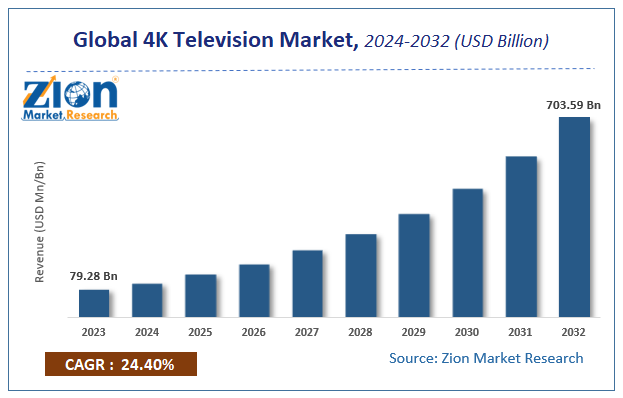
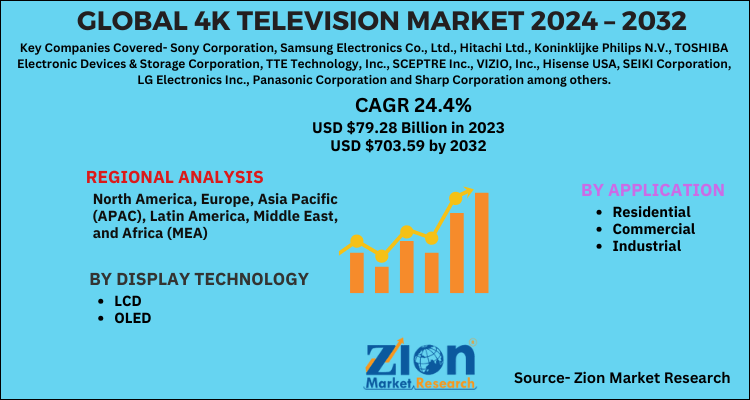
According to a report from Zion Market Research, the global 4K Television Market was valued at USD 79.28 Billion in 2023 and is projected to hit USD 703.59 Billion by 2032, with a compound annual growth rate (CAGR) of 24.4% during the forecast period 2024-2032.
This report explores market strengths, weakness, opportunities, and threats. It also provides valuable insights into the market's growth drivers, challenges, and the future prospects that may emerge in the 4K Television industry over the next decade.
Global 4K TV Market Definition
4K television is an ultra-high-definition (UHD) tv. It is a set with 4K resolution. The 4K resolution is fourfold the resolution of full HD. 4K televisions have a resolution of 3,840 horizontal pixels and a couple of 160 vertical pixels, for a complete of regarding 8.3 million pixels. Primarily the “K” in 4K stands for kg (1000), which suggests a TV that has achieved a horizontal resolution of regarding 4000 pixels. The 4K tv provides a wider variety of colors and the footage seems to be more vibrant. Resolution is a term that tells you simply how densely these little dots, the pixels, are placed along with the show. Individual pixels collect along to create the image you see on the screen, the higher the pel count the upper the resolution.
Amongst the 2 show technologies utilized in the 4K televisions, the display consists of a grid of active and passive matrix displays. The passive matrix digital display encompasses a grid of conductors with pixels situated at every intersection within the grid. Moreover, the active matrix display consists of transistors situated at every pel intersection and is eliminated by the causation of an electrical current through the grid. Whereas, a light-emitting diode TV may be a form of TV that uses light-emitting diodes to backlight the display, instead of the cold cathode fluorescent lights (CCFLs) utilized in most digital display televisions. The distinctive issue between the 2 technologies is the power demand for show illumination.
Light-emitting diode displays consume less power as compared to it digital displays and so are being adopted on a significant scale. Advanced LEDs like OLED (Organic lightweight Emitting Diode), and 4K televisions deliver wonderful quality and less energy consumption. this often contributes to the adoption of light-emitting diode 4K televisions as a replacement for ancient digital display televisions. The use of an outsized screen tv in public areas has become progressively common in recent years. the flexibility to deliver a transparent, high-resolution image has created them widespread in airports, train stations, and different locations wherever the show may be seen by many of us right away. Additionally, digital assemblage victimization giant screens are commonly wont to offer info or advertise.
The report includes in-depth analysis of the strategies adopted by utmost competitors in the 4K television market analysis. The research study contains of market attractiveness analysis, wherein segment display technology, applications, and regional segments are benchmarked on the basis of their market size and growth rate.
Global 4K TV Market Overview
The growing quality of 4K technology and its benefits, rising income, and inclination towards shopper physical science are the main factors bolstering the expansion of the worldwide 4K TV Market. Moreover, technological advancements, increasing investments in 4K technology to supply ultra-high definition (UHD) content, and increasing adoption of those TVs for house amusement, gaming, and 4K set-up boxes are expected to propel the market growth. However, factors like the high value of tv sets and high electricity consumption would possibly prohibit the expansion of the market. The rise in income of shoppers can increase the demand for 4K tv that is predicted to spice up the worldwide 4K TV Market growth. The continuous developments in industry makers have reduced costs. It is expected to propel the expansion of the global 4K TV Market growth.
Moreover, an increase in technological advancements can have a positive impact on international 4K TV Market growth. With the increasing adoption of streaming services for streaming amusement information like movies, videos, and different contents, the service suppliers are acting to up the standard of the streaming information. Extremist HD streaming services suppliers like Amazon, Netflix, Vudu, and Sony are up to their services. this is often expected to contribute to the expansion of the 4K TV Market in returning years. Moreover, 4K televisions are replacements for ancient digital display televisions in applications like defense, sports, and part industries. Moreover, the provision of high-definition content players like Blu-ray players might upmarket the quality 1080 panel video into 4K video format, serving the expansion of the 4K TV Market.
Except for the improved video quality offered by 4K televisions, the other value of 4K televisions is anticipated to restrain the expansion of the market. However, with advancements in technology, the value issue is predicted to be paid in returning years. The recognition of large-screen UHD TV within the Asia Pacific region has been hyperbolic considerably throughout past broadcast tv programs to be watched over a number of years, particularly due to the rise in demand for electronic merchandise and web services by individuals. Moreover, government initiatives like Digital India also are providing new opportunities for corporations operating in this market.
4K Television Market: Regional Analysis
The research study provides a decisive view on the 4K television market analysis based on display technology, applications, and region. All the segments of 4K television market analysis have been analyzed based on the past, present, and future trends. The market is estimated from 2024 to 2032. The regional segmentation consists of the past, present, and forecasted demand for Middle East & Africa, North America, Asia Pacific, Latin America and Europe. The regional segment is further divided into the U.S., UK, France, Germany, China, Japan, India, and Brazil among others.
4K Television Market: Competitive Players
Detailed analysis of the major players in the 4K television market analysis includes their financial overview, business strategies, new developments, and the product offered by them in the market. This will help in analyzing the market competition.
Key competitors included in this report are -
- Sony Corporation
- Samsung Electronics Co.
- Hitachi Ltd.
- Koninklijke Philips N.V.
- TOSHIBA Electronic Devices & Storage Corporation
- TTE Technology
- SCEPTRE Inc.
- VIZIO
- Hisense USA
- SEIKI Corporation
- LG Electronics Inc.
- Panasonic Corporation
- Sharp Corporation among others.
4K Television Market: Report Scope
| Report Attributes | Report Details |
|---|---|
| Report Name | 4K Television Market |
| Market Size in 2023 | USD 79.28 Billion |
| Market Forecast in 2032 | USD 703.59 Billion |
| Growth Rate | CAGR of 24.4% |
| Number of Pages | 150 |
| Key Companies Covered | Sony Corporation, Samsung Electronics Co., Ltd., Hitachi Ltd., Koninklijke Philips N.V., TOSHIBA Electronic Devices & Storage Corporation, TTE Technology, Inc., SCEPTRE Inc., VIZIO, Inc., Hisense USA, SEIKI Corporation, LG Electronics Inc., Panasonic Corporation and Sharp Corporation among others |
| Segments Covered | By Display Technology, By Application And By Region |
| Regions Covered | North America, Europe, Asia Pacific (APAC), Latin America, Middle East, and Africa (MEA) |
| Base Year | 2023 |
| Historical Year | 2018 - 2022 |
| Forecast Year | 2024 - 2032 |
| Customization Scope | Avail customized purchase options to meet your exact research needs. Request For Customization |
The report segments the 4K television market as follows:
Global 4K Television Market: Display Technology Segment Analysis
- LCD
- OLED
Global 4K Television Market: Application Segment Analysis
- Residential
- Commercial
- Industrial
By Region
- North America
- The U.S.
- Canada
- Mexico
- Europe
- France
- The UK
- Spain
- Germany
- Italy
- Rest of Europe
- Asia Pacific
- China
- Japan
- India
- Australia
- South Korea
- Rest of Asia Pacific
- The Middle East & Africa
- Saudi Arabia
- UAE
- Egypt
- Kuwait
- South Africa
- Rest of the Middle East & Africa
- Latin America
- Brazil
- Argentina
- Rest of Latin America
Table Of Content
Methodology
FrequentlyAsked Questions
A 4K television offers ultra-high-definition resolution. It delivers sharper and clearer images
The global 4K Television market is expected to be driven by the rising consumer demand for high-resolution content and smart entertainment systems. Expansion of OTT platforms and broadband supports adoption.
According to study, the global 4K Television market size was worth around USD 79.28 Billion in 2023 and is predicted to grow to around USD 703.59 Billion By 2032.
The global 4K Television market is expected to grow at a Compound Annual Growth Rate (CAGR) of around CAGR 24.4% during the forecast period from 2024-2032.
The global 4K Television industry is projected to be challenged by Challenges include market saturation, price competition, and OTT substitution effects.
The Opportunities include premium display demand, sports and gaming content, smart TV integration, and emerging market adoption will offer significant growth opportunities in the 4K Television market.
Enhanced HDR and AI upscaling; smart TV ecosystem integration; demand for immersive home entertainment are the emerging trends and innovations impacting the 4K Television market.
The global 4K Television market is expected to be led by APAC during the forecast period.
Some of the prominent players operating in the global 4K Television market are; Sony Corporation, Samsung Electronics Co., Ltd., Hitachi Ltd., Koninklijke Philips N.V., TOSHIBA Electronic Devices & Storage Corporation, TTE Technology, Inc., SCEPTRE Inc., VIZIO, Inc., Hisense USA, SEIKI Corporation, LG Electronics Inc., Panasonic Corporation and Sharp Corporation among others and others.
The report explores crucial aspects of the 4K Television market, including a detailed discussion of existing growth factors and restraints, while also browsing future growth opportunities and challenges that impact the market.

HappyClients