
Wireless Health Market Size, Share, Trends, Growth and Forecast 2034

Wireless Health Market By Technology (Wireless Personal Area Network (WPAN), Wi-Fi, Worldwide Interoperability for Microwave Access (WiMAX), and Wireless Wide Area Network (WWAN)), By Component (Hardware, Software, and Services), By Application (Hospitals & Nursing Homes, Home Care, Pharmaceuticals, and Others), and By Region - Global and Regional Industry Overview, Market Intelligence, Comprehensive Analysis, Historical Data, and Forecasts 2025 - 2034
| Market Size in 2024 | Market Forecast in 2034 | CAGR (in %) | Base Year |
|---|---|---|---|
| USD 238.76 Billion | USD 1270.99 Billion | 18.2% | 2024 |
Wireless Health Market Industry Perspective:
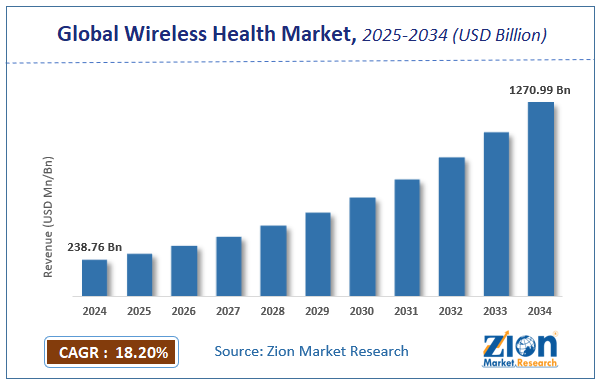
The global wireless health market was worth around USD 238.76 billion in 2024 and is estimated to grow to about USD 1270.99 billion by 2034, with a compound annual growth rate (CAGR) of approximately 18.2% between 2025 and 2034. The Wireless Health Market is driven by increasing adoption of remote patient monitoring, connected medical devices, and the expansion of IoT in healthcare.
The report analyzes the wireless health market’s drivers, restraints/challenges, and the effect they have on demand during the projection period. In addition, the report explores emerging opportunities in the wireless health market.
Wireless Health Market: Overview
Wireless health is a cutting-edge practice that combines conventional health with wireless technology to treat, diagnose, and monitor patients, as well as to improve their overall well-being. It is mostly used for telemedicine, which is utilized to treat patients who are digitally linked to a doctor via video conferencing and who live in places where healthcare services are not readily available. Medical care is connected to suppliers of a sensor, wireless network service providers, hardware systems, enterprise data management groups, and technology developers through wireless health. Wearable gadgets, for example, are applications of wireless health that focus on rehab, early illness identification, and personal health status.
Key Insights
- As per the analysis shared by our research analyst, the global Wireless Health market is estimated to grow annually at a CAGR of around 18.2% over the forecast period (2025-2034).
- In terms of revenue, the global Wireless Health market size was valued at around USD 238.76 billion in 2024 and is projected to reach USD 1270.99 billion by 2034.
- The market is driven by increasing adoption of remote patient monitoring, connected medical devices, and the expansion of IoT in healthcare.
- Based on the Technology, the Wireless Personal Area Network (WPAN) segment dominated the market with a share of approximately 37% in 2024, owing to its cost-effective connectivity, user-friendly technologies such as Bluetooth and RFID, and suitability for short-range wearable and personal health devices.
- Based on the Component, the Hardware segment held the largest share of around 40% in 2024, driven by the essential role of sensors, wearable devices, and connected medical equipment that form the physical foundation of wireless health systems.
- Based on the Application, the Hospitals & Nursing Homes segment is projected to capture the largest market share of nearly 45% in 2024, because these settings require robust wireless infrastructure for real-time patient monitoring, efficient data access, and coordinated care delivery.
- Based on region, North America dominated the global market with a share of approximately 40% in 2024, primarily due to well-established healthcare infrastructure, high smartphone penetration, strong adoption of remote and telehealth solutions, and supportive government initiatives.
Wireless Health Market: Growth Drivers
Penetration of internet and wireless communication technology is driving the market growth
Increased use of the smartphone has changed the perspective of healthcare professionals. Instead of being distracted by time-consuming administrative procedures, healthcare providers in a connected hospital employ wireless medical devices to offer the highest quality of care to patients. Doctors and nurses can readily access up-to-date patient information, allowing them to make treatment decisions based on real-time medical data, resulting in better patient outcomes. The market is also driven by wearable devices for continuous monitoring. Medical equipment and diagnostic centers are experimenting with body-worn sensors that can monitor vital signs and send them in real-time to an internet platform that can be accessed remotely, thanks to the spread of smartphones and the acceptance of wearable gadgets.
Wireless Health Market: Restraints
Concerns about data privacy and cybersecurity may limit the market expansion
Millions of patients are using wireless health to obtain rapid results remotely. However, such vast data, including patient history, treatment, and outcomes, are vulnerable to data piracy. Because large volumes of healthcare data are collected over the course of treatment in medical institutions such as hospitals and clinics, data theft might jeopardize patients' privacy. Cyberattacks are the biggest threat for any wireless applications, as they can be hacked and used by unauthorized firms or groups, which is also contributing to the slow growth of the market.
Wireless Health Market: Opportunities
IoT in the healthcare sector to increase usage of wireless health
Internet of Things has the potential to transform the sector significantly, as its applications are easy to adopt and understand. Like many other industries, the Internet of Things (IoT) has aided the expansion of healthcare IT, which has necessitated the creation of a connected medical environment. In the event of unavailability, wireless network solutions aid the healthcare business by allowing physicians to access data offsite to direct diagnostics.
Wireless Health Market: Challenges
24/7 operational medical sector, with no downtime for network maintenance, poses the biggest challenge for the market
Continuous patient flow and emergency treatments push the medical sector to function 24/7. The wireless functions must remain operative during critical care. However, this could cause less attention to network maintenance and result in a shutdown of wireless operations.
Wireless Health Market: Segmentation
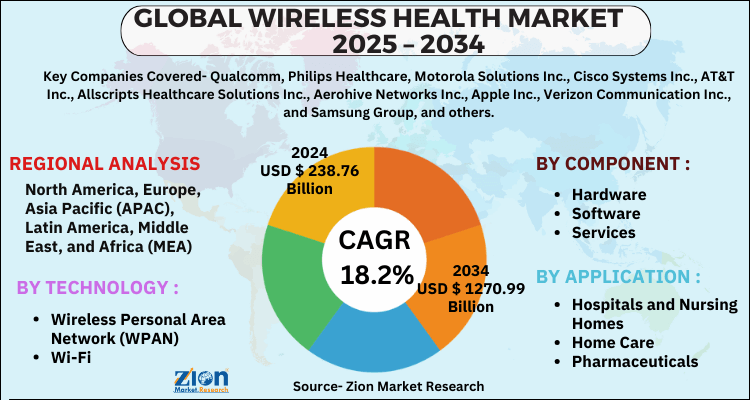
The Wireless Health market is segmented by technology, component, application, and region.
Based on Technology Segment, the Wireless Health market is divided into Wireless Personal Area Network (WPAN), Wi-Fi, Worldwide Interoperability for Microwave Access (WiMAX), and Wireless Wide Area Network (WWAN). The WPAN segment currently dominates because it offers cost-effective, short-range connectivity ideal for wearable sensors, personal monitoring devices, and body-area networks using technologies such as Bluetooth and RFID. Its ease of integration and low power consumption support widespread adoption in consumer and clinical wearable applications, driving overall market growth. The Wi-Fi segment holds the second-largest position, valued for its higher bandwidth and ability to support data-intensive applications such as image transfer and real-time video within hospital and home environments.
Based on Component Segment, the Wireless Health market is divided into hardware, software, and services. The hardware segment leads the market as sensors, wearable devices, gateways, and connected medical equipment form the essential physical layer required for data collection and transmission. Continuous innovation in compact, accurate, and energy-efficient devices sustains demand and underpins market expansion. The software segment ranks second, contributing significantly through platforms for data management, analytics, remote monitoring dashboards, and interoperability that convert raw device data into actionable clinical insights.
Based on Application Segment, the Wireless Health market is divided into hospitals & nursing homes, home care, pharmaceuticals, and others. The hospitals & nursing homes segment dominates because these facilities require reliable wireless infrastructure for continuous patient monitoring, real-time access to records, coordinated care teams, and efficient workflow management. High patient volumes and the need for rapid clinical decision-making drive substantial investment in wireless solutions and support overall market growth. The home care segment is the second-most prominent and is expected to register strong growth, fueled by the shift toward remote monitoring, aging populations, and the desire to reduce hospital readmissions through continuous oversight in residential settings.
Wireless Health Market: Report Scope
| Report Attributes | Report Details |
|---|---|
| Report Name | Wireless Health Market |
| Market Size in 2024 | USD 238.76 Billion |
| Market Forecast in 2034 | USD 1270.99 Billion |
| Growth Rate | CAGR of 18.2% |
| Number of Pages | 210 |
| Key Companies Covered | Qualcomm, Philips Healthcare, Motorola Solutions Inc., Cisco Systems Inc., AT&T Inc., Allscripts Healthcare Solutions Inc., Aerohive Networks Inc., Apple Inc., Verizon Communication Inc., and Samsung Group, and others. |
| Segments Covered | By Technology, By Component, By Application, and By Region |
| Regions Covered | North America, Europe, Asia Pacific (APAC), Latin America, The Middle East and Africa (MEA) |
| Base Year | 2024 |
| Historical Year | 2020 to 2023 |
| Forecast Year | 2025 - 2034 |
| Customization Scope | Avail customized purchase options to meet your exact research needs. Request For Customization |
Wireless Health Market: Regional Analysis
Why will North America continue to dominate the global market during the projection period?
North America holds the dominant share of 40 % in the global wireless health market. This is attributed to a well-established healthcare infrastructure, a large number of smartphone users, and increasing adoption of remote healthcare. Increased awareness and adoption of remote/telehealth in the United States contribute to the largest share of the country in the regional market. The Healthcare sector in Canada is one of the best in the world; also, it is rapidly adopting newer technologies. Due to this, the country is expected to grow at a rapid rate in the regional market. The Asia Pacific is one of the largest healthcare markets in the world and is expected to offer excellent growth opportunities for the wireless health market.
The regional segmentation includes the present and forecast demand for North America, Europe, Asia Pacific, Latin America and the Middle East and Africa, with its further bifurcation into major countries including China, Japan, India, U.S., Germany, France, UK, and Brazil. North America accounted for the largest share of this market in 2016 and is expected to witness the fastest growth in global wireless health market in the coming five years. Major driving factors of this market in this region are government initiatives such as the Affordable Care Act.
Europe is expected to account for the second-largest position in this market within the forecast period due to the more inclination towards developing new innovative healthcare technologies. Asia Pacific is expected to be one of the attractive markets for wireless health within the forecast period owing to the increasing awareness about wireless devices and improving healthcare infrastructure. Latin America and the Middle East and Africa are expected to show positive growth in this market in the coming five years.
Recent Developments
- In December 2021, AT&T, Qure4u, and Samsung formed an alliance to provide remote patient monitoring for high-risk patients using FirstNet®.
- In March 2021, General Electric announced the release of Vscan Air, a new wireless, hand-held ultrasound gadget designed to help the corporation gain a competitive edge in the booming market.
Wireless Health Market: Competitive Analysis
The report provides a company market share analysis to give a broader overview of the key market players. In addition, the report also covers key strategic developments of the market, including acquisitions & mergers, new product launches, agreements, partnerships, collaborations & joint ventures, research & development, and regional expansion of major participants involved in the wireless health market on a global and regional basis.
- Qualcomm
- Philips Healthcare
- Motorola Solutions Inc.
- Cisco Systems Inc.
- AT&T Inc.
- Allscripts Healthcare Solutions Inc.
- Aerohive Networks Inc.
- Apple Inc.
- Verizon Communications Inc.
- Samsung Group
The global wireless health market is segmented as follows:
By Technology
- Wireless Personal Area Network (WPAN)
- Wi-Fi
- Worldwide Interoperability for Microwave Access (WiMAX)
- Wireless Wide Area Network (WWAN)
By Component
- Hardware
- Software
- Services
By Application
- Hospitals and Nursing Homes
- Home Care
- Pharmaceuticals
- Other
By Region
- North America
- The U.S.
- Canada
- Mexico
- Europe
- France
- The UK
- Spain
- Germany
- Italy
- Rest of Europe
- Asia Pacific
- China
- Japan
- India
- Australia
- South Korea
- Rest of Asia Pacific
- The Middle East & Africa
- Saudi Arabia
- UAE
- Egypt
- Kuwait
- South Africa
- Rest of the Middle East & Africa
- Latin America
- Brazil
- Argentina
- Rest of Latin America
Table Of Content
Methodology
FrequentlyAsked Questions
Wireless health combines conventional healthcare practices with wireless technologies to diagnose, treat, monitor patients, and improve overall well-being. It supports telemedicine, wearable devices, remote monitoring, and connected care systems that extend medical services beyond traditional clinical settings.
The global wireless health market is expected to grow due to increasing adoption of remote patient monitoring, growing use of mobile health applications, and advancements in wearable health devices.
According to a study, the global wireless health market size was worth around USD 238.76 Billion in 2024 and is expected to reach USD 1270.99 Billion by 2034.
The global wireless health market is expected to grow at a CAGR of 18.2% during the forecast period.
North America is expected to dominate the wireless health market over the forecast period.
Leading players in the global wireless health market include Qualcomm, Philips Healthcare, Motorola Solutions Inc., Cisco Systems Inc., AT&T Inc., Allscripts Healthcare Solutions Inc., Aerohive Networks Inc., Apple Inc., Verizon Communication Inc., and Samsung Group, among others.
The report explores crucial aspects of the wireless health market, including a detailed discussion of existing growth factors and restraints, while also examining future growth opportunities and challenges that impact the market.

HappyClients

