Vending Machine Market Size, Trend, Growth, Industry Analysis 2034

Vending Machine Market By Type (Tobacco Vending Machines, Beverage Vending Machines, Food Vending Machines, and Other Vending Machines), By Applications (Public Places, Corporate Offices, Hotels & Restaurants, and Others), By Technology (Semi-automatic Machine, Automatic Machine, and Smart Machine), and By Region - Global and Regional Industry Overview, Market Intelligence, Comprehensive Analysis, Historical Data, and Forecasts 2026 - 2034
| Market Size in 2025 | Market Forecast in 2034 | CAGR (in %) | Base Year |
|---|---|---|---|
| USD 22.30 Billion | USD 31.90 Billion | 4.07% | 2025 |
Vending Machine Industry Perspective:
What is the anticipated size of the vending machine market during the projection period?
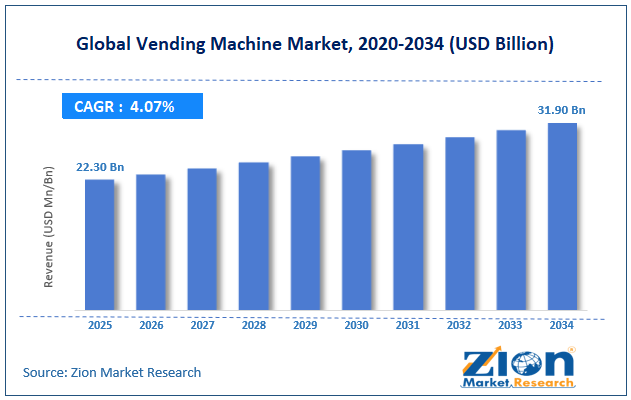
The global vending machine market size was worth around USD 22.30 billion in 2025 and is predicted to grow to around USD 31.90 billion by 2034, with a compound annual growth rate (CAGR) of roughly 4.07% between 2026 and 2034.
Key Insights:
- As per the analysis shared by our research analyst, the global vending machine market is estimated to grow annually at a CAGR of around 4.07% over the forecast period (2026-2034)
- In terms of revenue, the global vending machine market size was valued at around USD 22.30 billion in 2025 and is projected to reach USD 31.90 billion, by 2034.
- The vending machine market is projected to grow at a significant rate due to the rapid expansion of airports, bus stops, & other transit spots, rising demand for cashless payments, and growing consumption of healthy food & beverages.
- Based on the type, the beverage vending machines segment is growing at a high rate and will continue to dominate the global market as per industry projection.
- Based on the applications, the hotels & restaurants segment is anticipated to command the largest market share.
- Based on the technology, smart machines are expected to grow at a higher CAGR of 9.8%.
- Based on region, North America is projected to dominate the global market during the forecast period.
Vending Machine Market: Overview
A vending machine is an automatic dispenser for drinks and snacks. It requires no human intervention to dispense a product in exchange for money. According to market analysis, vending machines are among the most accessible forms of modern retail architecture because they operate continuously. The most common forms of vending machines include coffee vending machines, beverage vending machines, smart vending machines, healthy food vending machines, hygiene vending machines, and industrial vending machines. Additionally, major sectors using different forms of vending machines include corporate houses, healthcare facilities, educational institutes, transportation hubs, and retail spaces. During the forecast period, demand for vending machines is projected to grow due to rapid expansion of airports, bus stops, & other transit spots, rising demand for cashless payments, and growing consumption of healthy food & beverages. However, the high cost of initial investment, concerns over inventory loss, and competition from traditional retail infrastructure may affect market revenue in the coming years.
Impact of the USA-Israel and Iran war on the Vending Machine Market:
The USA-Israel and Iran war is expected to affect the production, transportation, and distribution costs of vending machines. The impact of the war will be indirect but significant. This conflict has affected global economies as business operating costs and living expenses have increased in the last few months. In the coming years, the war may influence supply chain diversification and localized production to limit the impact of geopolitical conflict.
Vending Machine Market: Dynamics
Growth Drivers
Why will a surge in transportation hubs influence growth in the vending machine market?
The global vending machine market is anticipated to be led by increasing construction of new transportation hubs and the expansion of existing facilities. Airports, bus stops, railway stations, and other transport infrastructure are some of the prominent public places where vending machines are installed. This machinery provides travelers with access to food, beverages, and other items at their convenience. Vending machines do not require manual assistance, and consumers can access stored products at any time. This is one of the major benefits of installing automatic vending machines at transport hubs since they operate around the clock.
In September 2026, India’s Chennai International Airport announced its plan to introduce 36 sanitary pad vending machines across the facility.
Smart vending machines to aid higher growth in the vending machine market during the forecast period
Smart vending machines with improved user interface, touchscreen panels, and Internet of Things (IoT) connectivity, among other features, are becoming increasingly popular worldwide. They offer several benefits, including improved user experience, superior inventory management, personalized product recommendations, and cashless payment capabilities. In March 2026, BuyBuyCart, a leading player in India's organized retail infrastructure, launched smart vending machines with improved operational efficiency.
In September 2026, ZHILAI, a leading provider of smart storage and delivery solutions, launched the Multi-Pickup Hot Food Vending Machine. With this launch, the company expanded its smart retail portfolio, allowing food service operators to deliver convenient hot meals.
Restraints
High investment and repair costs limit expansion in the vending machine industry.
The global vending machine industry is expected to face restrictions due to high initial investment costs and significant ongoing repair & maintenance expenses. These costs are considerably higher for advanced and smart vending machines. For instance, the average price of a touchscreen model can range between USD 4500 and USD 9000. Additionally, a lack of skilled experts offering repair and maintenance services may further affect industry revenue in the long run.
Opportunities
How will the growing cashless payment trend create opportunities in the vending machine market?
The global vending machine market is expected to grow as cashless payments become more common. Increasing use of digital payments, online wallets, Quick Response (QR) codes, and other cashless payments is promoting demand for vending machines. Growing government investments in upgrading digital payment infrastructure will further encourage deployment of vending machines. In September 2026, Indonesia announced the expansion of its cross-border digital payment infrastructure as the country witnesses an increase in tourism. Furthermore, the region aims to create growth opportunities for small businesses with this move.
In September 2026, AsiaPay, a leading provider of digital payment technology and services, launched the All-in-One Card Tokenization Solution service. The novel technology is designed to secure, streamline, and standardize digital card payments. The introduction of more robust, secure, and reliable digital payment solutions may further benefit market players.
Challenges
What are the leading challenges in the vending machine industry?
The global vending machine industry will be challenged by its dependence on deployment locations. For instance, vending machines are more effective in areas that are frequently crowded. They may fail to perform as per expectation in low-traffic locations. Additionally, high competition from traditional retail experience may further affect industry revenue in the coming years.
Vending Machine Market: Report Scope
| Report Attributes | Report Details |
|---|---|
| Report Name | Vending Machine Market |
| Market Size in 2025 | USD 22.30 Billion |
| Market Forecast in 2034 | USD 31.90 Billion |
| Growth Rate | CAGR of 4.07% |
| Number of Pages | 227 |
| Key Companies Covered | Glory Ltd., Seaga Manufacturing Inc., Fuji Electric Co. Ltd., Automated Merchandising Systems Inc., Rhea Vendors Group, Evoca Group, Jofemar Corporation, Bianchi Industry S.p.A., SandenVendo America Inc., U-Select-It Inc., Azkoyen Group, Crane Payment Innovations, Sielaff GmbH & Co. KG, Royal Vendors Inc., Wittern Group, and others. |
| Segments Covered | By Type, By Application, By Technology, and By Region |
| Regions Covered | North America, Europe, Asia Pacific (APAC), Latin America, Middle East, and Africa (MEA) |
| Base Year | 2025 |
| Historical Year | 2020 - 2024 |
| Forecast Year | 2026 - 2034 |
| Customization Scope | Avail customized purchase options to meet your exact research needs. Request For Customization |
Vending Machine Market: Segmentation
The global vending machine market is segmented based on type, application, technology, and region.
Why will the beverages segment lead the vending machine industry revenue during the forecast period?
Based on type, the global market segments are tobacco vending machines, beverage vending machines, food vending machines, and other vending machines. In 2025, 45% of total revenue was listed in the beverage vending machines segment. It will continue to deliver the highest CAGR during the forecast period. These machines are designed to deliver different beverage formats such as coffee, tea, and ready-to-drink items.
Which will be the fastest-growing application during the forecast period in the vending machine market?
Based on applications, the global vending machine industry is fragmented into public places, corporate offices, hotels & restaurants, and others. The hotels & restaurants segment showed the highest growth in 2025. They contributed up to 39.1% of the total revenue. During the forecast period, hotels & restaurants will deliver significant revenue driven by rapid expansion of accommodating facilities & food service units, growing global tourism, and adoption of cashless payment methods.
Which factors drive demand in the smart machine segment in the vending machine industry?
Based on technology, the global market divisions are semi-automatic machine, automatic machine, and smart machine. In 2025, automatic machines accounted for 55.61% of total revenue. During the forecast period, smart machines are expected to grow at a higher CAGR of 9.8%. Rising demand for user-friendly, high-performance machines will fuel segmental revenue.
Vending Machine Market: Regional Analysis
Why will North America lead the vending machine market in the coming years?
The global vending machine market is currently led by North America. In 2025, it accounted for 36.1% of the global revenue and will grow at a CAGR of 3.67% during the forecast period. Retail facilities across North America are highly automated, driving regional market revenue. Moreover, an existing infrastructure supporting the deployment and use of vending machines across public and corporate spaces has further intensified regional growth.
Why will Asia-Pacific generate the fastest CAGR in the vending machine market during the forecast period?
Asia-Pacific is expected to emerge as the fastest-growing region in the vending machine market with a CAGR of 9.9% during the forecast period. In 2025, it accounted for 31.2% of the global revenue. Growth in Asia-Pacific will be led by rapid digitalization of retail space, presence of prominent players offering next-generation vending machines, and supportive digital payment infrastructure. Moreover, increasing customer knowledge and awareness and product diversification strategies adopted by vending machine companies will propel regional revenue.
Vending Machine Market: Competitive Analysis
The global vending machine market is led by players like:
- Glory Ltd.
- Seaga Manufacturing Inc.
- Fuji Electric Co. Ltd.
- Automated Merchandising Systems Inc.
- Rhea Vendors Group
- Evoca Group
- Jofemar Corporation
- Bianchi Industry S.p.A.
- SandenVendo America Inc.
- U-Select-It Inc.
- Azkoyen Group
- Crane Payment Innovations
- Sielaff GmbH & Co. KG
- Royal Vendors Inc.
- Wittern Group
What are the latest key trends in the vending machine market?
Use of Artificial Intelligence (AI)
Integrating AI with smart vending machines is a prominent market trend. It will allow enhanced product assortment, predictive maintenance, and better inventory management for optimal results.
Focus on energy efficiency
Sustainability initiatives are driving demand for energy-efficient vending machines. This includes the introduction of renewable energy-powered machines and tools with reverse-vending capabilities.
The global vending machine market is segmented as follows:
By Type
- Tobacco Vending Machines
- Beverage Vending Machines
- Food Vending Machines
- Other Vending Machines
By Applications
- Public Places
- Corporate Offices
- Hotels & Restaurants
- Others
By Technology
- Semi-automatic Machine
- Automatic Machine
- Smart Machine
By Region
- North America
- The U.S.
- Canada
- Mexico
- Europe
- France
- The UK
- Spain
- Germany
- Italy
- Rest of Europe
- Asia Pacific
- China
- Japan
- India
- Australia
- South Korea
- Rest of Asia Pacific
- The Middle East & Africa
- Saudi Arabia
- UAE
- Egypt
- Kuwait
- South Africa
- Rest of the Middle East & Africa
- Latin America
- Brazil
- Argentina
- Rest of Latin America
Table Of Content
Methodology
FrequentlyAsked Questions
A vending machine is an automatic drink and snack dispenser. It dispenses a product automatically in exchange for money.
The global vending machine market is anticipated to be led by the increasing construction of new transportation hubs and expansion of existing facilities.
According to study, the global vending machine market size was worth around USD 22.30 billion in 2025 and is predicted to grow to around USD 31.90 billion by 2034.
The CAGR value of the vending machine market is expected to be around 4.07% during 2026-2034.
The global vending machine industry will be challenged by dependence on deployment locations.
Use of Artificial Intelligence (AI) and a focus on energy efficiency are the emerging trends and innovations impacting the vending machine market.
The global vending machine market has performed well so far and will offer similar trends in the coming years.
North America will contribute notably to the vending machine market value.
The global vending machine market is led by players like Glory Ltd., Seaga Manufacturing Inc., Fuji Electric Co. Ltd., Automated Merchandising Systems Inc., Rhea Vendors Group, Evoca Group, Jofemar Corporation, Bianchi Industry S.p.A., SandenVendo America Inc., U-Select-It Inc., Azkoyen Group, Crane Payment Innovations, Sielaff GmbH & Co. KG, Royal Vendors Inc., and Wittern Group.
The report explores crucial aspects of the vending machine market, including a detailed discussion of existing growth factors and restraints, while also browsing future growth opportunities and challenges that impact the market.

HappyClients