
Vegan Footwear Market Size, Share, Trends, Growth and Forecast 2032

Vegan Footwear Market By Products (loafers, heels, sandals, boots, sneakers, shoes, and others), By Sales (indirect and direct), By Materials (microfiber, hemp, natural rubber, cotton, recycled polyester, recycled plastics, polyurethane, and others), By End-user (women, men, kids, and transgender), By Price ranges (premium and mass) And By Region: - Global And Regional Industry Overview, Market Intelligence, Comprehensive Analysis, Historical Data, And Forecasts, 2024-2032
| Market Size in 2023 | Market Forecast in 2032 | CAGR (in %) | Base Year |
|---|---|---|---|
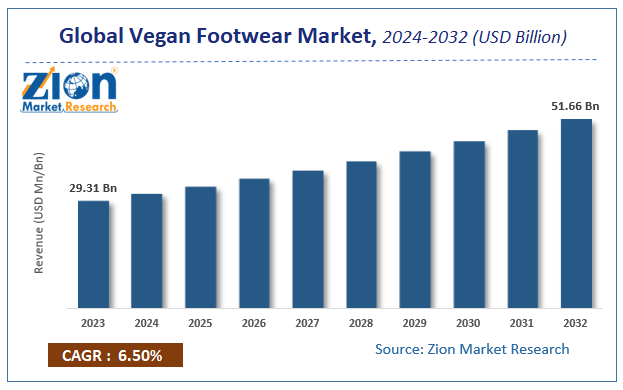
| USD 29.31 Billion | USD 51.66 Billion | 6.5% | 2023 |
Description
What is the Vegan Footwear Market Size?
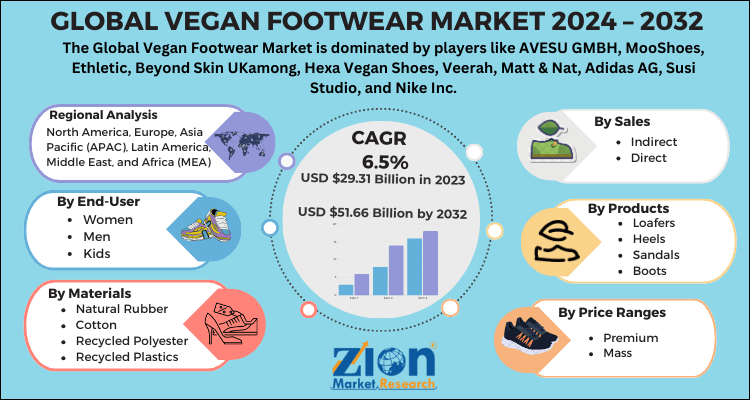
According to the report published by Zion Market Research, the global Vegan Footwear Market size was valued at USD 29.31 Billion in 2023 and is predicted to reach USD 51.66 Billion by the end of 2032. The market is expected to grow with a CAGR of 6.5% during the forecast period. The report analyzes the global Vegan Footwear Market's growth drivers, restraints, and impact on demand during the forecast period. It will also help navigate and explore the arising opportunities in the egan Footwear industry.
 Request Free SampleRequest Free Sample
Global Vegan Footwear Market: Overview
Vegan footwear is made without animal products or ingredients like leather, wool, silk, and many more. These are cruelty-free. With the growing trends of sustainable shopping, vegan footwear is much in demand. The global vegan footwear market is expected to grow exponentially with a high CAGR during the forecast period.
Global Vegan Footwear Market: Growth Factors
The emerging veganism trends are no longer restricted to kitchens; they have reached widespread areas encompassing the footwear and apparel industry. The growing consumer interest in eco-friendly products is the chief driver of the global vegan footwear market growth. The trend is anticipated to grow vigorously in the coming years. The emergence of leading shoemakers has further added momentum to the ongoing trends.
The source of ethical fashion trends is mostly traced in fashion hubs like the US and Europe. They are growing much faster than expected and hence inspiring developing nations to move on with the trend. The rising focus on cruelty-free fashion has induced the manufacturers to push the production and supply of vegan footwear to cater to the demand.
Consumers are better informed about the usage of different materials in the manufacturing of footwear that poses hazardous threats to human health like triggering allergic reactions and many others. Leather is one of the known materials, used in the sole making of the shoes is steered away due to the changing consumer buying paradigm towards the eco-friendly alternatives.
The growing production and adoption of vegan footwear are contributing significantly to reduce the carbon footprint. Moreover, vegan footwear has a wide scope with regards to their fashion quotient.
Further, the manufacturers are paying attention to the fashion buzz regarding vegan footwear and leading brands are increasing their investment to make the design more appealing and attractive. Besides the crisp and attractive physical appearance, these are touted to be comparatively more comfortable and offer efficient resistance against the different climatic conditions.
 Request Free SampleRequest Free Sample
Global Vegan Footwear Market: Segmentation
The global vegan footwear market can be segmented into products, sales, materials, end-user, price ranges, and regions.
By product, the market can be segmented into loafers, heels, sandals, boots, sneakers, shoes, and others. The shoe segment holds hegemony over others due to the surging trends among both men and women. They are gradually emerging as a sustainable and popular choice for myriad reasons. The shoes certified by the international organization provide a guarantee of not contributing towards the creating of carbon footprint.
By sales, the market can be segmented into indirect and direct. The indirect sales segment holds hegemony as hypermarket and supermarket remain preferred options for shopping.
By material, the market can be segmented into microfiber, hemp, natural rubber, cotton, recycled polyester, recycled plastics, polyurethane, and others. Among the classified segments, the microfiber holds the largest share in the global vegan footwear market. The hemp segment is anticipated to grow significantly during the forecast period due to the surging demand for innovative designs in footwear.
By price range, the market can be segmented into premium and mass. The mass segment dominates the market significantly and is expected to grow with a high CAGR during the forecast period.
By end-use, the market can be segmented into women, men, kids, and transgender. Among these, the men segment holds the largest market share.
Vegan Footwear Market: Report Scope
| Report Attributes | Report Details |
|---|---|
| Report Name | Vegan Footwear Market |
| Market Size in 2023 | USD 29.31 Billion |
| Market Forecast in 2032 | USD 51.66 Billion |
| Growth Rate | CAGR of 6.5% |
| Number of Pages | 220 |
| Key Companies Covered | AVESU GMBH, MooShoes, Ethletic, Beyond Skin UKamong, Hexa Vegan Shoes, Veerah, Matt & Nat, Adidas AG, Susi Studio, and Nike Inc |
| Segments Covered | By products, By sales, By materials, By end-user, By price ranges and By Region |
| Regions Covered | North America, Europe, Asia Pacific (APAC), Latin America, Middle East, and Africa (MEA) |
| Base Year | 2023 |
| Historical Year | 2018 - 2022 |
| Forecast Year | 2024 - 2032 |
| Customization Scope | Avail customized purchase options to meet your exact research needs. Request For Customization |
Global Vegan Footwear Market: Regional analysis
North America holds the largest share in the global vegan footwear market due to the presence of key market players and the rising demand for vegan products. The region has witnessed a significant rise in the vegan population in recent years. Moreover, the growing awareness of people toward environmental health has further propelled regional growth.
Europe is expected to emerge as a prominent region in the global vegan footwear market owing to the growing interest of the people in eco-friendly products.
Asia Pacific is anticipated to grow significantly during the forecast period due to the growing popularity of ethical fashion.
Global Vegan Footwear Market: Competitive Players
Some of the significant players in the global vegan footwear market are
- AVESU GMBH
- MooShoes
- Ethletic
- Beyond Skin UKamong
- Hexa Vegan Shoes
- Veerah
- Matt & Nat
- Adidas AG
- Susi Studio
- Nike Inc
The Global Vegan Footwear Market is segmented as follows:
By Products
- loafers
- heels
- sandals
- boots
- sneakers
- shoes
- and others
By Sales
- indirect
- direct
By Materials
- microfiber
- hemp
- natural rubber
- cotton
- recycled polyester
- recycled plastics
- polyurethane
- and others
By End-user
- women
- men
- kids
- transgender
By Price ranges
- premium
- mass
By Region
- North America
- The U.S.
- Canada
- Mexico
- Europe
- France
- The UK
- Spain
- Germany
- Italy
- Rest of Europe
- Asia Pacific
- China
- Japan
- India
- Australia
- South Korea
- Rest of Asia Pacific
- The Middle East & Africa
- Saudi Arabia
- UAE
- Egypt
- Kuwait
- South Africa
- Rest of the Middle East & Africa
- Latin America
- Brazil
- Argentina
- Rest of Latin America
What Reports Provides
- Full in-depth analysis of the parent market
- Important changes in market dynamics
- Segmentation details of the market
- Former, on-going, and projected market analysis in terms of volume and value
- Assessment of niche industry developments
- Market share analysis
- Key strategies of major players
- Emerging segments and regional markets
- Testimonials to companies in order to fortify their foothold in the market.
Table Of Content

FrequentlyAsked Questions
Vegan footwear is made without animal-derived materials such as leather or wool. It uses synthetic or plant-based alternatives.
The global Vegan Footwear market is expected to be driven by the Growth is fueled by rising ethical and sustainable fashion demand, increasing vegan consumer base, and brand innovation in plant-based/leather-alternative materials. E-commerce and premium lifestyle trends further support sales.
According to study, the global Vegan Footwear market size was worth around USD 29.31 Billion in 2023 and is predicted to grow to around USD 51.66 Billion By 2032.
The global Vegan Footwear market is expected to grow at a Compound Annual Growth Rate (CAGR) of around CAGR 6.5% during the forecast period from 2024-2032.
The global Vegan Footwear industry is projected to be challenged by Material performance/durability gaps vs leather; greenwashing scrutiny and certification needs; higher costs and limited scale for novel materials.
The Growing ethical and sustainability-driven consumers; innovation in bio-based and recycled materials; expansion via DTC, premium lifestyle, and sports collaborations will offer significant growth opportunities in the Vegan Footwear market.
Bio-based leathers (mycelium, cactus, pineapple) scaling; circular design and take-back programs; improved durability/comfort through advanced polymers are the emerging trends and innovations impacting the Vegan Footwear market.
The global Vegan Footwear market is expected to be led by Europe during the forecast period.
Some of the prominent players operating in the global Vegan Footwear market are; AVESU GMBH, MooShoes, Ethletic, Beyond Skin UKamong, Hexa Vegan Shoes, Veerah, Matt & Nat, Adidas AG, Susi Studio, and Nike Inc and others.
The report explores crucial aspects of the Vegan Footwear market, including a detailed discussion of existing growth factors and restraints, while also browsing future growth opportunities and challenges that impact the market.
HappyClients

