
Valve Positioners Market Size, Share, Trends, Growth 2032

Valve Positioners Market By Type (Electro-Pneumatic, Pneumatic, and Digital), By Actuation (Single-Acting and Double-Acting), By End-Use Industry (Oil & Gas, Power, Water & Wastewater, Chemicals, and Food & Beverages), and By Region - Global and Regional Industry Overview, Market Intelligence, Comprehensive Analysis, Historical Data, and Forecasts 2024 - 2032
| Market Size in 2023 | Market Forecast in 2032 | CAGR (in %) | Base Year |
|---|---|---|---|
| USD 1969.4 Million | USD 3243.47 Million | 5.7% | 2023 |
Valve Positioners Industry Perspective
What will be the global Valve Positioners market size during the forecast period?
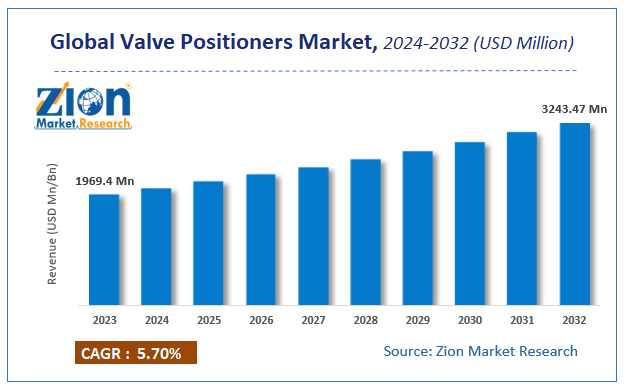
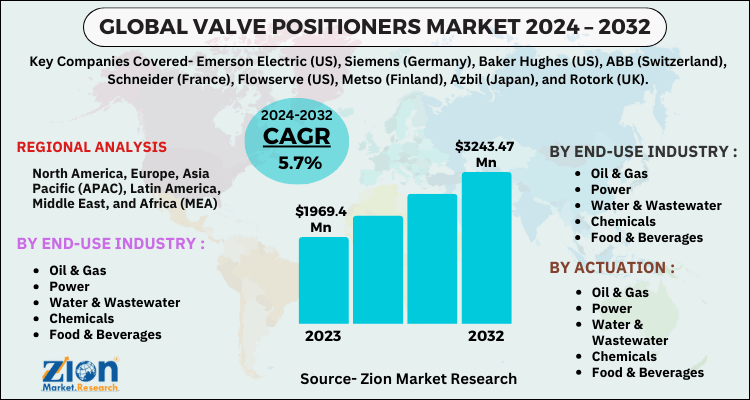
The global valve positioners market size was worth around USD 1969.4 million in 2023 and is predicted to grow to around USD 3243.47 million by 2032 with a compound annual growth rate (CAGR) of roughly 5.7% between 2024 and 2032. The report examines the primary drivers, challenges, and restraints shaping global demand for the valve positioners market throughout the forecast period and identifies high-growth opportunities across the industry.
Valve Positioners Market: Overview
Valve positioners are critical devices used in industrial control systems to ensure that a control valve accurately reaches and maintains a specified position in response to a control signal. They compensate for factors such as valve stem packing friction, hysteresis, and process pressure variations, enabling fine control over fluid flow, pressure, temperature, and level in process industries. Available in electro-pneumatic, pneumatic, and digital configurations, and designed for single-acting or double-acting actuation, these devices enhance the reliability, precision, and diagnostic capabilities of valve assemblies across demanding operating environments.
Key Insights
- As per the analysis shared by our research analyst, the global Valve Positioners market is estimated to grow annually at a CAGR of around 5.7% over the forecast period (2024-2032).
- In terms of revenue, the global Valve Positioners market size was valued at around USD 1969.4 Million in 2023 and is projected to reach USD 3243.47 Million by 2032.
- The market is driven by technological advancements, the need for fine process control, minimization of valve stem packing friction, rising demand in the oil & gas industry for efficiency and cost reduction, and increased focus on process monitoring and control.
- Based on the Type, the Pneumatic segment held a significant share due to its suitability for harsh environments in oil & gas, mining, and chemical industries
- Based on Actuation, the Single-Acting segment is growing at a high rate and is projected to dominate the global market.
- Based on the End-Use Industry, the Oil & Gas segment dominated the market because of high demand for efficient plant operation
- Based on region, Asia Pacific holds substantial shares due to benefits from rapid industrialization and infrastructure expansion
Valve Positioners Market Growth Drivers
There is a huge scope in the valve positioners market owing to technological advancement, a variety of Actuations, and growing demand in the market. The ability to have fine control over the process, minimize valve stem packing friction effects, and allow the use of characteristic cams in rotary valves are the attributes of valve positioners that are creating demand in several industries.
The rise in the demand for valve positioners in the oil & gas industry, owing to the demand and consumption for oil has become the major driver that is uplifting the market at a faster pace. Most of the oil & gas industries are looking forward to cutting down the operating cost and improving the level of efficiency and effectiveness of the plant. This has led to the installation of valve positioners in control valve assemblies, which support efficient plant operation in the oil & gas industry.
The rise in the demand for valve positioners owing to the enhanced importance of controlling and monitoring the process in industry so as to gain maximum output efficiency is one of the major drivers for the market to upsurge. The secondary factor that is boosting the demand for valve positioners is the rise in demand and consumption of power and fuel. Some of the factors that might hamper the growth of the valve positioners market are the lack of standardized norms and governing policies.
Valve Positioners Market: Segmentation
The Valve Positioners market is segmented by type, actuation, end-use industry, and region.
Based on Type Segment, the Valve Positioners market is divided into Electro-Pneumatic, Pneumatic, and Digital. Pneumatic positioners hold a strong position because they provide accurate air pressure to the valve actuator and are particularly well-suited to oil & gas, mining, and chemical environments due to anti-corrosion coatings and robust performance. This dominance helps drive market growth by meeting the reliability requirements of critical process industries. Electro-Pneumatic positioners convert current control signals into equivalent pneumatic signals and serve as a versatile bridge between electronic control systems and pneumatic actuators, while Digital positioners, equipped with microprocessors, offer superior diagnostic capabilities and are gaining traction for advanced monitoring and predictive maintenance applications.
Based on Actuation Segment, the Valve Positioners market is divided into single-acting and double-acting. Double-Acting actuation is widely used in applications requiring precise bidirectional control and higher force output, supporting complex process requirements in oil & gas and chemical plants. Single-Acting designs remain important for simpler, spring-return applications where fail-safe positioning is critical. Both subsegments contribute to market expansion by addressing diverse safety, reliability, and performance needs across industrial control valve assemblies.
Based on End-Use Industry Segment, the Valve Positioners market is divided into Oil & Gas, Power, Water & Wastewater, Chemicals, and Food & Beverages. Oil & Gas is the most dominant end-use industry due to the high volume of control valve installations, the continuous drive to improve plant efficiency, and the need to reduce operating costs through precise flow and pressure control. This leadership anchors overall market demand and encourages suppliers to develop specialized, corrosion-resistant solutions. Power generation, including conventional and renewable applications such as solar and wind, represents a significant secondary segment, where positioners regulate steam flow and withstand fluctuating conditions. Water & Wastewater, Chemicals, and Food & Beverages further support steady growth through process optimization and regulatory compliance requirements.
Valve Positioners Market: Report Scope
| Report Attributes | Report Details |
|---|---|
| Report Name | Valve Positioners Market |
| Market Size in 2023 | USD 1969.4 Million |
| Market Forecast in 2032 | USD 3243.47 Million |
| Growth Rate | CAGR of 5.7% |
| Number of Pages | 230 |
| Key Companies Covered | Emerson Electric (US), Siemens (Germany), Baker Hughes (US), ABB (Switzerland), Schneider (France), Flowserve (US), Metso (Finland), Azbil (Japan), and Rotork (UK) |
| Segments Covered | By Type, By Actuation, By End Use Industry, and By Region |
| Regions Covered | North America, Europe, Asia Pacific (APAC), Latin America, Middle East, and Africa (MEA) |
| Base Year | 2023 |
| Historical Year | 2018 - 2022 |
| Forecast Year | 2024 - 2032 |
| Customization Scope | Avail customized purchase options to meet your exact research needs. Request For Customization |
Valve Positioners Market: Regional Analysis
Why will Asia Pacific continue to dominate the global market during the projection period?
Asia Pacific is expected to contribute strongly to the global Valve Positioners market, driven by rapid industrialization, expanding process industries, and significant investments in oil & gas, power, chemicals, and water infrastructure. Countries such as China, India, Japan, and South Korea lead regional demand through large-scale manufacturing and energy projects that require precise process control. Continuous modernization of industrial facilities and growing adoption of automation technologies further reinforce the region’s importance and support overall global market expansion through high-volume installations and technology upgrades.
North America maintains a substantial share supported by a mature oil & gas sector, advanced process industries, and ongoing plant modernization initiatives. The United States remains the primary contributor, with strong demand for reliable and diagnostically advanced positioners in energy, chemicals, and water treatment applications.
Valve Positioners Market: Key Players & Competitive Landscape
The key players in the global valve positioners market are:
- Emerson Electric (US)
- Siemens (Germany)
- Baker Hughes (US)
- ABB (Switzerland)
- Schneider (France)
- Flowserve (US)
- Metso (Finland)
- Azbil (Japan)
- Rotork (UK)
The global Valve Positioners market is segmented as follows:
By Type
- Electro-Pneumatic
- Pneumatic
- Digital
By Actuation
- Single-Acting
- Double-Acting
By End-Use Industry
- Oil & Gas
- Power
- Water & Wastewater
- Chemicals
- Food & Beverages
By Region
- North America
- The U.S.
- Canada
- Mexico
- Europe
- France
- The UK
- Spain
- Germany
- Italy
- Rest of Europe
- Asia Pacific
- China
- Japan
- India
- Australia
- South Korea
- Rest of Asia Pacific
- The Middle East & Africa
- Saudi Arabia
- UAE
- Egypt
- Kuwait
- South Africa
- Rest of the Middle East & Africa
- Latin America
- Brazil
- Argentina
- Rest of Latin America
Table Of Content
Methodology
FrequentlyAsked Questions
A valve positioner is a device that is employed in industrial control systems to guarantee that a valve reaches and maintains the specified position in response to a control signal. Valve positioners are indispensable for the precise and dependable regulation of fluid flow in a variety of processes.
The demand for valve positioners has increased as industries such as oil & gas, chemicals, power generation, and water treatment strive to optimise processes. This has resulted in a greater need for precise valve control.
The global valve positioners market size was worth around USD 1969.4 million in 2023 and is predicted to grow to around USD 3243.47 million by 2032.
The global valve positioners market a compound annual growth rate (CAGR) of roughly 5.7% between 2024 and 2032.
Asia Pacific is expected to contribute notably, supported by industrial expansion, oil & gas activity, power generation investments, and continuous modernization of process control systems.
Emerson Electric (US), Siemens (Germany), Baker Hughes (US), ABB (Switzerland), Schneider (France), Flowserve (US), Metso (Finland), Azbil (Japan), Rotork (UK), and others.
Major challenges include the lack of standardized norms and governing policies in certain regions, integration complexities with existing systems, cost considerations for advanced digital solutions, and the need to ensure reliable performance in harsh industrial environments.
Emerging trends include the adoption of digital positioners with advanced diagnostic capabilities, improved materials and coatings for corrosion and temperature resistance, greater integration with modern control and automation systems, and a continued focus on process efficiency and predictive maintenance.
The value chain typically includes design and engineering of positioner technology, component manufacturing (sensors, electronics, pneumatic elements), assembly and testing, distribution and system integration with control valves and actuators, installation and commissioning, and ongoing service, diagnostics, and maintenance support.

HappyClients

