
U.S. Essential Oil Market Size, Growth,Trends, Forecast Report 2034

U.S. Essential Oil Market By Product (Acorus Calamus, Black Pepper, Basil, Ajowan, Carrot Seed, Cardamom, Clove, Cassia, Citronella, Celery, Cedarwood, Cinnamon, Orange Oil, and Others), By Application (Food & Beverages, Medical, Spa & Relaxation, and Cleaning & Home), By Sales Channel (Direct Selling and Indirect Selling)- Country Specific Industry Overview, Market Intelligence, Comprehensive Analysis, Historical Data, and Forecasts 2025 - 2034
| Market Size in 2024 | Market Forecast in 2034 | CAGR (in %) | Base Year |
|---|---|---|---|
| USD 9.8 Billion | USD 24.5 Billion | 9.5% | 2024 |
U.S. Essential Oil Industry Perspective:
What will be the size of the U.S. essential oil market during the forecast period?
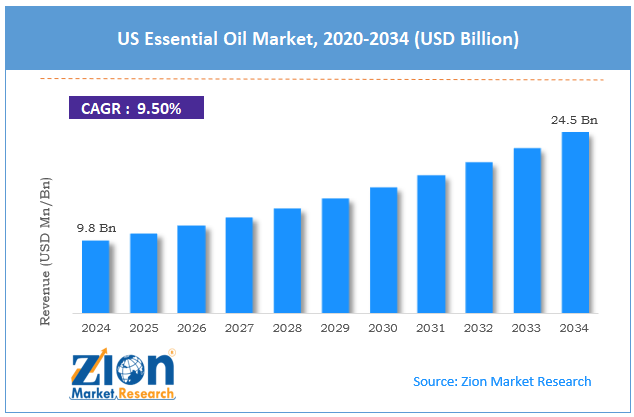
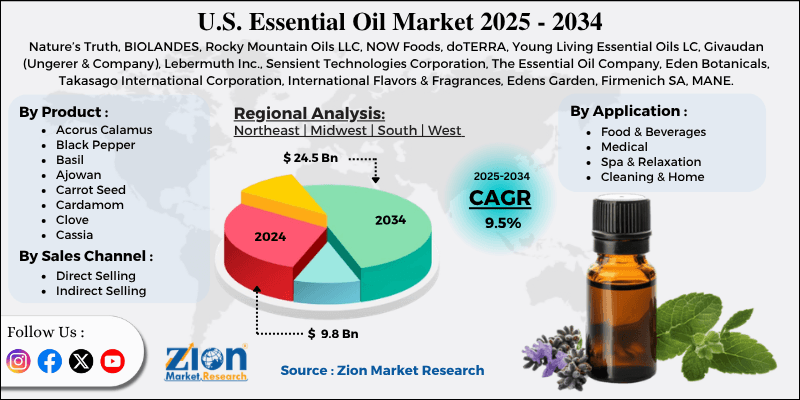
The U.S. essential oil market size was worth around USD 9.8 billion in 2024 and is predicted to grow to around USD 24.5 billion by 2034, with a compound annual growth rate (CAGR) of roughly 9.5% between 2025 and 2034.
U.S. Essential Oil Market: Overview
An essential oil is a concentrated hydrophobic liquid that contains odorous (aromatic) compounds derived from plants by distillation with water or steam, by mechanical processing such as cold pressing (common with citrus fruit peels), or other methods of extraction such as solvent extraction. The oils capture the plant's scent and its unique chemical makeup. They are then used in a wide variety of ways, from fragrance in cosmetics and skin and hair care to flavoring in food and beverages, and for therapeutic reasons in aromatherapy. Because essential oils are highly concentrated, they are generally diluted in a carrier oil before being applied topically to prevent skin irritation or sensitization.
Key Insights
- As per the analysis shared by our research analyst, the U.S. Essential Oil market is estimated to grow annually at a CAGR of around 9.5% over the forecast period (2025-2034).
- In terms of revenue, the U.S. essential oil market size was valued at around USD 9.8 billion in 2024 and is projected to reach USD 24.5 billion by 2034.
- The growing demand from the end-use sector is expected to drive the U.S. essential oil market over the forecast period.
- Based on the product, the orange oil segment holds the largest market share over the forecast period.
- Based on the application, the food & beverage segment held the largest revenue share at 40% in 2024.
- Based on the sales channel, the indirect selling segment dominates the market, accounting 68% of the market share.
U.S. Essential Oil Market: Dynamics
Growth Drivers
Does increased awareness of the health benefits of essential oils drive the U.S. essential oil market growth?
Enhanced consumer awareness of the health benefits and aromatherapy applications of essential oils has been a major growth driver in the U.S. Essential Oils Market. Customers are seeking more natural, plant-based options for lowering stress, better sleep, respiratory relief, and managing pain. Wellness social media channels, wellness influencers, holistic health professionals, and online learning portals have all contributed to disseminating aromatherapy and therapeutic oil uses to the masses.
Alongside the increased interest in preventive health care and self-care rituals, consumers are adopting essential oils into massage, meditation, skin care, and home diffusing routines. During and since the pandemic, heightened consumer interest in immune health and mental clarity sped up existing demand for these oils. Greater consumer education and acceptance of health naturals continue to grow essential oil use in homes, spas, and wellness brands bordering on healthcare.
Restraints
How does the limited and volatile raw material supply hamper the U.S. essential oil market growth?
The growth of the U.S. essential oils market is adversely affected by raw material supply issues; scarcity and instability in raw material supply add to overall instability in production and pricing. Essential oils require a lot of fresh raw material; they are derived from crops that are sensitive to climatic conditions, soil qualities, and seasonality.
Any disruption, such as droughts, floods, plant diseases, or weather variations, can affect the output of crops, thereby influencing the raw material supply for oils. Given the fact that small quantities of oil are obtained from large quantities of raw material, any minor fluctuations in supply will always lead to high output costs for inputs. This translates to high shelf prices as price-conscious consumers turn to synthetics. Similarly, raw material supply issues hinder the company’s diversification efforts.
Opportunities
Does the introduction of a new product offer a potential opportunity for the U.S. essential oil industry growth?
The introduction of a new product is expected to offer a potential opportunity for the expansion of the U.S. essential oil industry. For instance, in December 2025, Natural Grocers(R), the largest family-operated organic and natural grocery store in the country, is now offering a new line of organic essential oils to its all-natural, private-label Body Care section. Natural Grocers(R) Brand Organic Essential Oils are responsibly sourced, cruelty-free, and made without any additives, residual solvents, fillers, or preservatives. Every scent is created for premium quality and potency at an Always Affordable PriceSM.
Challenges
High production & price sensitivity pose a major challenge to the market growth
The high manufacturing costs and price sensitivity could present a barrier to the growth of the U.S. essential oil market, as the production process is time-consuming, scale-intensive, and an expenditure-heavy operation in terms of processing. The extraction operations (steam distillation or cold pressing) are characterized as high-energy, labor-intensive, and equipment-intensive processes. The yield fluctuation and raw material prices increase the production costs. The high markup on sales prices is pushed up by premium retail prices, and consumers tend to cut their purchase volume or turn to inferior substitutes, such as cheaper synthesized aromas or blends. The result limits immediate acceptance and penetration in the mass markets, capping revenue growth during the economic downturn.
U.S. Essential Oil Market: Report Scope
| Report Attributes | Report Details |
|---|---|
| Report Name | U.S. Essential Oil Market |
| Market Size in 2024 | 9.8 Billion |
| Market Forecast in 2034 | 24.5 Billion |
| Growth Rate | CAGR of 9.5% |
| Number of Pages | 223 |
| Key Companies Covered | Nature’s Truth, BIOLANDES, Rocky Mountain Oils LLC, NOW Foods, doTERRA, Young Living Essential Oils LC, Givaudan (Ungerer & Company), Lebermuth Inc., Sensient Technologies Corporation, The Essential Oil Company, Eden Botanicals, Takasago International Corporation, International Flavors & Fragrances, Edens Garden, Firmenich SA, MANE, Robertet, Symrise, and others. |
| Segments Covered | By Product, By Application, By Sales Channel, and By Region |
| Regions Covered in U.S. | Northeast, Midwest, South, and West |
| Base Year | 2024 |
| Historical Year | 2019 - 2023 |
| Forecast Year | 2025 - 2034 |
| Customization Scope | Avail customized purchase options to meet your exact research needs. Request For Customization |
U.S. Essential Oil Market: Segmentation
By Product Insights
Why does orange oil hold the dominant position in the U.S. essential oil market?
The orange oil segment holds the largest market share over the forecast period. The demand for orange oil is driven by its widespread availability, competitive pricing, and multiple beneficial applications across various end-user industries. Orange oil is used in various end-user applications such as food & beverages, personal care & cosmetics, aromatherapy, and household cleaning products, which help it enjoy a broad-based adoption in both branded and private-label products.
Other derivative products, such as lavender, peppermint, eucalyptus, tea tree, and lemon oils, are also gaining importance because of their therapeutic and aromatic benefits and a growing array of applications, which are examined in the study. The increasing consumer request for natural ingredients, clean-label formulations, and plant-based wellness products is also expanding the demand for essential oils in the U.S. market.
By Application Insights
Is the food & beverage application growing substantially in the U.S. essential oil industry?
The food & beverage segment held the largest revenue share at 40% in 2024. The market is witnessing good growth owing to the increasing application of essential oils as natural flavoring agents in various food and beverage products, such as bakery, confectionery, beverages, dairy, and savory preparations. Essential oils are used as flavoring, aromatic, nutritional, and sensory-appealing ingredients due to their clean-label and natural composition. Growing consumer inclination towards natural flavors, rising demand for processed & lightly processed food, & increasing consumption of plant-derived ingredients are fueling demand for the essential oils in this segment.
By Sales Channel Insights
Does the indirect selling segment dominate the U.S. essential oil market?
The indirect selling segment dominates the market, accounting 68% of market share. The channel is experiencing strong growth as the third-party suppliers, wholesalers, and distributors link the manufacturers of essential oils and various end-use industries such as food & beverages, personal care, aromatherapy, wellness, and home care products. The intermediaries help make the commodity available with assured supply and bulk procurement, and allow manufacturers/brands to be innovative and work on growth initiatives. The increasing demand for natural and organic ingredients, higher penetration of distribution channels, and the growth of private-label/branded products are expected to drive strong growth through indirect channels.
U.S. Essential Oil Market: Competitive Analysis
The U.S. essential oil market is dominated by players like:
- Nature’s Truth
- BIOLANDES
- Rocky Mountain Oils LLC
- NOW Foods
- doTERRA
- Young Living Essential Oils LC
- Givaudan (Ungerer & Company)
- Lebermuth Inc.
- Sensient Technologies Corporation
- The Essential Oil Company
- Eden Botanicals
- Takasago International Corporation
- International Flavors & Fragrances
- Edens Garden
- Firmenich SA
- MANE
- Robertet
- Symrise
The U.S. essential oil market is segmented as follows:
By Product
- Acorus Calamus
- Black Pepper
- Basil
- Ajowan
- Carrot Seed
- Cardamom
- Clove
- Cassia
- Citronella
- Celery
- Cedarwood
- Cinnamon
- Orange Oil
- Others
By Application
- Food & Beverages
- Medical
- Spa & Relaxation
- Cleaning & Home
By Sales Channel
- Direct Selling
- Indirect Selling
By Region
Table Of Content
Methodology
FrequentlyAsked Questions
An essential oil is a concentrated hydrophobic liquid, which contains odorous (aromatic) compounds derived from plants by distillation with water or steam, or by mechanical processing such as cold pressing (common with citrus fruit peels), or other methods of extraction such as solvent extraction.
The pace of expansion of the United States in the essential oils market over the forecast period (2025 to 2034) will be driven by increasing consumer preferences for clean labels and natural products, growing trends in aromatherapy and wellness applications, a strengthening presence in cosmetics and personal care segments, as well as the proliferation of e-commerce and direct-to-consumer channels. Conversely, growth will be constrained by issues such as fluctuations in the supply of raw materials, pricing pressures, concerns over product claims by regulatory authorities, and quality assurance requirements.
The U.S. essential oil market is not growing as fast as it could because of a number of factors, including the availability and price of raw materials, the high cost of making the oils, the fact that consumers are sensitive to price changes, safety and adulteration issues, and regulatory pressures over health and quality label claims. The market is also very divided. Heavy reliance on climate-dependent crops leads to fluctuating yields and prices; resource-intensive extraction techniques are costly; high prices may reduce uptake of some applications among mass-market consumers during recessionary periods.
According to the report, the U.S. essential oil market size was worth around USD 9.8 billion in 2024 and is predicted to grow to around USD 24.5 billion by 2034.
The U.S. essential oil market is expected to grow at a CAGR of 9.5% during the forecast period.
Based on the product, the orange oil segment is expected to dominate the U.S. essential oil market growth during the projected period.
In the coming years, the U.S. essential oils market will see new trends and innovations, such as more organic, sustainable, and ethically sourced oils that customers will expect; better or more specialized therapeutic grade products designed for specific health and wellness needs (like sleep, stress, immunity, and respiratory issues) as people learn more about the health challenges they want to tackle with essential oils.
The U.S. essential oil market is dominated by players like Nature’s Truth, BIOLANDES, Rocky Mountain Oils LLC, NOW Foods, doTERRA, Young Living Essential Oils LC, Givaudan (Ungerer & Company), Lebermuth Inc., Sensient Technologies Corporation, The Essential Oil Company, Eden Botanicals, Takasago International Corporation, International Flavors & Fragrances, Edens Garden, Firmenich SA, MANE, Robertet, and Symrise, among others.
The U.S. essential oil market report covers the geographical market along with a comprehensive competitive landscape analysis. It also includes cash flow analysis, profit ratio analysis, market basket analysis, market attractiveness analysis, sentiment analysis, PESTLE analysis, trend analysis, SWOT analysis, trade area analysis, demand & supply analysis, Porter’s five forces analysis, and value chain analysis.

HappyClients

