
Global Transcutaneous Monitors Market Size, Share, Trends, Growth 2032

Transcutaneous Monitors Market By Type (Adult Wound Healing, Neonatal Care), By Application (Wound Healing, Blood Gas Monitoring, Sleep Diagnostics, Respiratory Care, Plastic Surgery, Diagnostic in Vascular Ischemia, Others), By End- User (Hospitals, Ambulatory Surgical Centers, Specialty Clinics, Neonatal Intensive Care, Diagnostic Centers), By Channel Type (Single Channel Transcutaneous Monitors, Multi-Channel Transcutaneous Monitors), By Product (Baby Monitor, Wound Healing Monitor, Other): Global Industry Analysis, Size, Share, Growth, Trends, and Forecast, 2024-2032
| Market Size in 2023 | Market Forecast in 2032 | CAGR (in %) | Base Year |
|---|---|---|---|
| USD 419.19 million | USD 596.35 million | 3.95% | 2023 |
Description
How big is the Transcutaneous Monitors Market?
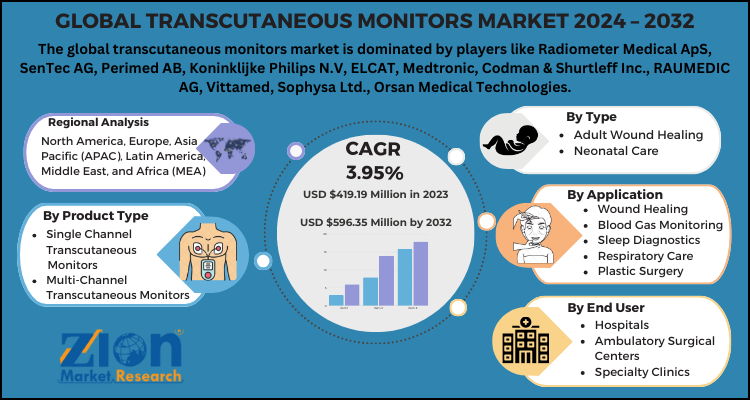
The global Transcutaneous Monitors market size accrued earnings worth approximately USD 419.19 Million in 2023 and is predicted to gain revenue of about USD 596.35 Million by 2032, is set to record a CAGR of nearly 3.95% over the period from 2024 to 2032
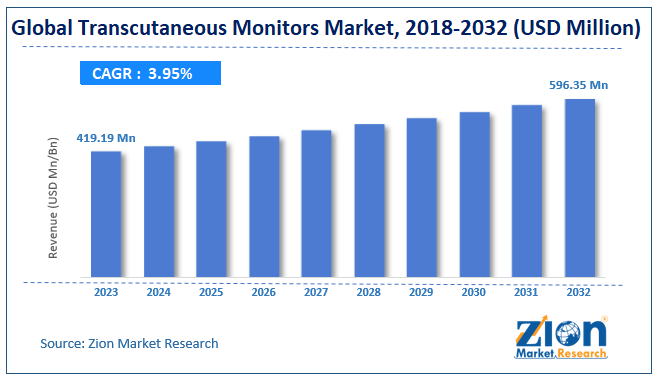
North America Transcutaneous Monitors Market Sales and Revenue: North America was valued at USD 161.35 million in 2023 and is projected to reach USD 229.69 million by 2032, growing at a CAGR of 3.99% during the forecast period. The region maintains its dominance due to advanced healthcare infrastructure and high adoption of neonatal monitoring technologies.
Europe Transcutaneous Monitors Market Sales and Revenue: Europe accounted for USD 119.94 million in 2023 and is expected to reach USD 160.06 million by 2032, registering a CAGR of 3.20% from 2024 to 2032. Growth is supported by increasing NICU admissions and expanding healthcare investments.
Asia Pacific Transcutaneous Monitors Market Sales and Revenue: Asia Pacific was valued at USD 102.06 million in 2023 and is projected to reach USD 163.38 million by 2032, expanding at the fastest CAGR of 5.36%. Rising birth rates, improving healthcare infrastructure, and growing awareness are key growth drivers.
Latin America Transcutaneous Monitors Market Sales and Revenue: Latin America reached USD 17.20 million in 2023 and is forecasted to grow to USD 21.29 million by 2032, at a CAGR of 2.15%. Market growth remains steady, supported by gradual improvements in neonatal care facilities.
Middle East Transcutaneous Monitors Market Sales and Revenue: The Middle East market stood at USD 11.35 million in 2023 and is projected to reach USD 12.99 million by 2032, growing at a CAGR of 1.55%. Growth is moderate due to selective adoption across advanced healthcare centers.
Africa Transcutaneous Monitors Market Sales and Revenue: Africa was valued at USD 7.28 million in 2023 and is expected to reach USD 8.93 million by 2032, registering a CAGR of 1.35%. The market is developing gradually, supported by improving healthcare access in selected countries.
Transcutaneous Monitors Market: Overview
The transcutaneous monitors are devices that are small, portable, and compact in size. These devices are used for supporting the patient monitoring during the traveling time which is possible owing to the built-in batteries thus being helpful to be utilized anywhere. There is the integration of data memory in the transcutaneous monitors which enables the user to download and monitor the patient’s measurement of uptake oxygen and the washout carbon dioxide on the computer.
Key Insights:
- As per the analysis shared by our research analyst, the transcutaneous monitors market is anticipated to grow at a CAGR of 3.95% during the forecast period (2024-2032)
- The global transcutaneous monitors market was estimated to be worth approximately USD 419.19 million in 2023 and is projected to reach a value of USD 596.35 million by 2032.
- The growth of the transcutaneous monitors market is being driven by increasing demand for non-invasive, continuous monitoring solutions in critical care and neonatal care settings.
- Based on the type, the adult wound healing segment is growing at a high rate and is projected to dominate the market.
- On the basis of application, the wound healing segment is projected to swipe the largest market share.
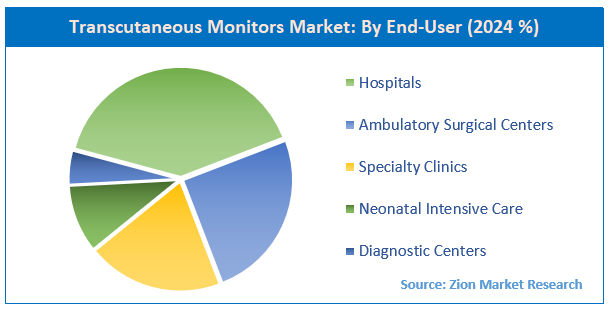
- In terms of end- user, the hospitals segment is expected to dominate the market.
- Based on the channel type, the single channel transcutaneous monitors segment is expected to dominate the market.
- On the basis of product, the baby monitor segment is projected to swipe the largest market share.
- By region, North America is expected to dominate the global market during the forecast period.
Transcutaneous Monitors Market: Facts
Radiometer has launched the new CE marked TCM5 transcutaneous monitor so that the vital needs of the pediatric, neonatal, and the adult patients are addressed. Using this device the non-invasive monitoring of tcpCO2, tcpO2 along with Masimo SET® SpO2, pulse rate, and perfusion index in real time can be done.
Transcutaneous Monitors Market Dynamics
Key Growth Drivers
The Transcutaneous Monitors Market is primarily driven by the increasing global prevalence of respiratory disorders such as Chronic Obstructive Pulmonary Disease (COPD), asthma, and sleep apnea. These conditions necessitate continuous, real-time monitoring of blood gas levels to ensure patient safety and guide treatment. The demand for non-invasive monitoring is a significant catalyst, as transcutaneous monitors offer a less painful and less risky alternative to traditional arterial blood gas sampling. Additionally, technological advancements have led to the development of more accurate, portable, and user-friendly devices, including wearable sensors and those with wireless connectivity, which are expanding their use beyond hospital settings into homecare and ambulatory monitoring. The rising demand for neonatal care, especially for premature infants, is another key driver as these monitors are crucial for the continuous and gentle assessment of a newborn's respiratory status.
Restraints
Despite the clear benefits, the transcutaneous monitors market faces several significant restraints. One of the main challenges is the high initial cost of the devices and their consumables, such as sensors and electrodes. This can be a major financial barrier for healthcare facilities with limited budgets, particularly in developing regions. Another key restraint is the reliance on proper skin preparation, sensor fixation, and calibration for accurate readings. Any deviation from these protocols can lead to unreliable data, which can compromise patient care. Additionally, concerns about the potential for skin burns, redness, and tissue damage from the heat generated by the sensor, especially in fragile patients like neonates, can limit widespread adoption and require specific clinical protocols to mitigate risk.
Opportunities
The Transcutaneous Monitors Market is presented with numerous opportunities for innovation and expansion. The increasing integration of these devices with digital health solutions, such as mobile apps, cloud-based analytics platforms, and telemedicine, is a major growth avenue. This enables healthcare providers to remotely monitor patients, leading to more timely interventions and improved patient outcomes. The growing emphasis on ambulatory monitoring and home healthcare is creating a strong demand for wearable, lightweight, and portable transcutaneous monitors, which can be used for continuous monitoring outside of a traditional hospital setting. Furthermore, the expansion of the technology's application beyond its traditional use in blood gas monitoring to include wound healing, sleep diagnostics, and vascular ischemia assessment offers new and lucrative market segments for manufacturers.
Challenges
The transcutaneous monitors market faces a number of complex challenges. A major technical challenge is ensuring data accuracy across different skin tones and during patient movement, which has historically been an issue with some monitoring technologies. The market is also challenged by the lack of a skilled and well-trained workforce with the expertise to properly operate and interpret the data from these sophisticated devices. This can lead to underutilization and potential misdiagnosis. Additionally, intense competition from alternative monitoring technologies, such as pulse oximetry and end-tidal capnography, poses a threat to market share. The industry must constantly innovate to demonstrate the superior clinical value and cost-effectiveness of transcutaneous monitoring to remain competitive.
Recent Development
- In July 2025, Philips expands its partnership with Masimo to enhance remote patient monitoring, integrating Masimo’s W1 health-tracking watch with Philips’ monitoring systems for continuous tracking of key health metrics.
- In July 2024, GE HealthCare announced an agreement to acquire Intelligent Ultrasound Group PLC’s clinical AI software business for around USD 51 million. The acquisition adds AI-driven image analysis tools designed to enhance ultrasound efficiency, streamline workflows, and improve usability for clinicians and patients.
- In February 2024, GE HealthCare and Biofourmis announced a strategic collaboration to enhance care continuity by delivering safe and effective home-based healthcare solutions, leveraging their combined expertise to support patients beyond the hospital.
- In May 2021, Medtronic plc launched the SonarMed™ airway monitoring system in the U.S. The first device of its kind, it utilizes acoustic technology to detect endotracheal tube obstructions and verify placement in real-time, providing clinicians with critical information for the safer care of pediatric patients.
Transcutaneous Monitors Market: Report Scope
| Report Attributes | Report Details |
|---|---|
| Report Name | Transcutaneous Monitors Market |
| Market Size in 2023 | USD 419.19 Million |
| Market Forecast in 2032 | USD 596.35 Million |
| Growth Rate | CAGR of 3.95% |
| Number of Pages | 201 |
| Key Companies Covered |
Radiometer Medical ApS, SenTec AG, Perimed AB, Koninklijke Philips N.V, ELCAT, Medtronic, Codman & Shurtleff Inc., RAUMEDIC AG, Vittamed, Sophysa Ltd., Orsan Medical Technologies, Integra LifeSciences Holdings Corporation, Spiegelberg GmbH & Co. KG, DiabetikFoot Care, Humares GmbH among others. |
| Segments Covered | By Type, By Application, By End-User, By Channel Type, By Product, and By Region |
| Regions Covered | North America, Europe, Asia Pacific (APAC), Latin America, Middle East, and Africa (MEA) |
| Base Year | 2023 |
| Historical Year | 2018 - 2022 |
| Forecast Year | 2024 - 2032 |
| Customization Scope | Avail customized purchase options to meet your exact research needs. Request For Customization |
Transcutaneous Monitors Market: Segmentation
The global market for the transcutaneous monitors is fragmented into the product type, application, and the end-user industry.
On the basis of the type of Product, the market is segregated into baby monitor, wound healing monitor, and others.
On the basis of the Application, the market is categorized into respiratory care, blood gas monitoring, plastic surgery, diagnostics in vascular ischemia, sleep diagnostics, wound healing, diabetes, and measurement of amputation level.
On the basis of the End-User Industry, the market is divided into specialty clinics, diagnostic centers, adult & pediatric intensive care units, hospitals, ambulatory surgical centers, and neonatal intensive care units.
Transcutaneous Monitors Market: Regional Analysis
The regions that are holding the major shares in the transcutaneous monitors market are Europe and the North America owing to the growing cases of people suffering from diabetes and chronic diseases. Other factors that support the growth of the market are the availability of the advanced healthcare facilities and the growing spending power of the people. In Asia Pacific region, the market is anticipated to grow at a rapid rate owing to the increasing presence of the local manufacturers of the transcutaneous monitors.
Transcutaneous Monitors Market: Competitive Players
The key market players that are involved in the transcutaneous monitors market include
- Radiometer Medical ApS
- SenTec AG
- Perimed AB
- Koninklijke Philips N.V
- ELCAT
- Medtronic
- Codman & Shurtleff Inc.
- RAUMEDIC AG
- Vittamed
- Sophysa Ltd.
- Orsan Medical Technologies
- Integra LifeSciences Holdings Corporation
- Spiegelberg GmbH & Co. KG
- DiabetikFoot Care
- Humares GmbH, among other
Transcutaneous Monitors Market: Segment Analysis
By Type
- Adult Wound Healing
- Neonatal Care
By Application
- Wound Healing
- Blood Gas Monitoring
- Sleep Diagnostics
- Respiratory Care
- Plastic Surgery
- Diagnostic in Vascular Ischemia
- Others
By End- User
- Hospitals
- Ambulatory Surgical Centers
- Specialty Clinics
- Neonatal Intensive Care
- Diagnostic Centers
By Channel Type
- Single Channel Transcutaneous Monitors
- Multi-Channel Transcutaneous Monitors
By Product
- Baby Monitor
- Wound Healing Monitor
- Other
By Region
- North America
- The U.S.
- Canada
- Mexico
- Europe
- France
- The UK
- Spain
- Germany
- Italy
- Rest of Europe
- Asia Pacific
- China
- Japan
- India
- Australia
- South Korea
- Rest of Asia Pacific
- The Middle East & Africa
- Saudi Arabia
- UAE
- Egypt
- Kuwait
- South Africa
- Rest of the Middle East & Africa
- Latin America
- Brazil
- Argentina
- Rest of Latin America
What Reports Provides
- Full in-depth analysis of the parent market
- Important changes in market dynamics
- Segmentation details of the market
- Former, on-going, and projected market analysis in terms of volume and value
- Assessment of niche industry developments
- Market share analysis
- Key strategies of major players
- Emerging segments and regional markets
- Testimonials to companies in order to fortify their foothold in the market.
Table Of Content

FrequentlyAsked Questions
Transcutaneous monitors are medical devices that measure blood gases through the skin. They are mainly used for neonatal and critical care monitoring.
The global Transcutaneous Monitors market is expected to be driven by the Market growth is driven by rising demand for non-invasive monitoring, increasing prevalence of chronic diseases, and technological advancements in sensor accuracy. Home healthcare adoption supports demand.
According to study, the global Transcutaneous Monitors market size was worth around USD 419.19 Million in 2023 and is predicted to grow to around USD 596.35 Million By 2032.
The global Transcutaneous Monitors market is expected to grow at a Compound Annual Growth Rate (CAGR) of around CAGR 3.95% during the forecast period from 2024-2032.
The global Transcutaneous Monitors industry is projected to be challenged by Challenges include accuracy concerns versus invasive methods, calibration and skin-sensor variability, and regulatory hurdles for clinical-grade performance.
The Opportunities include demand for continuous, non-invasive monitoring, growth in home healthcare and remote patient monitoring, and sensor innovation improving reliability and comfort will offer significant growth opportunities in the Transcutaneous Monitors market.
Non-invasive continuous monitoring with improved sensor accuracy; wearable form factors and mobile connectivity; AI trend detection and remote clinician dashboards are the emerging trends and innovations impacting the Transcutaneous Monitors market.
The global Transcutaneous Monitors market is expected to be led by North America during the forecast period.
Some of the prominent players operating in the global Transcutaneous Monitors market are; Radiometer Medical ApS, SenTec AG, Perimed AB, Koninklijke Philips N.V, ELCAT, Medtronic, Codman & Shurtleff Inc., RAUMEDIC AG, Vittamed, Sophysa Ltd., Orsan Medical Technologies, Integra LifeSciences Holdings Corporation, Spiegelberg GmbH & Co. KG, DiabetikFoot Care, Humares GmbH among others. and others.
The report explores crucial aspects of the Transcutaneous Monitors market, including a detailed discussion of existing growth factors and restraints, while also browsing future growth opportunities and challenges that impact the market.
HappyClients

