
Stretcher Chairs Market Size, Trend, Growth, Industry Analysis 2034

Stretcher Chairs Market By Type (Manual Stretcher Chairs, Electric Stretcher Chairs, Foldable Stretcher Chairs, Multi Position Stretcher Chairs), By Application (Hospitals and Clinics, Ambulance and Emergency Services, Nursing Homes and Elderly Care, Home Healthcare Settings), By Material (Steel Frame Stretcher Chairs, Aluminum Frame Stretcher Chairs, Composite Frame Stretcher Chairs, Reinforced Plastic Stretcher Chairs), By End User (Government Hospitals, Private Healthcare Facilities, Emergency Medical Service Providers, Home Care Agencies), and By Region - Global and Regional Industry Overview, Market Intelligence, Comprehensive Analysis, Historical Data, and Forecasts 2026 - 2034
| Market Size in 2025 | Market Forecast in 2034 | CAGR (in %) | Base Year |
|---|---|---|---|
| USD 377.8 Million | USD 567.76 Million | 4.63% | 2025 |
Stretcher Chairs Industry Perspective:
What will be the size of the stretcher chairs market during the forecast period?
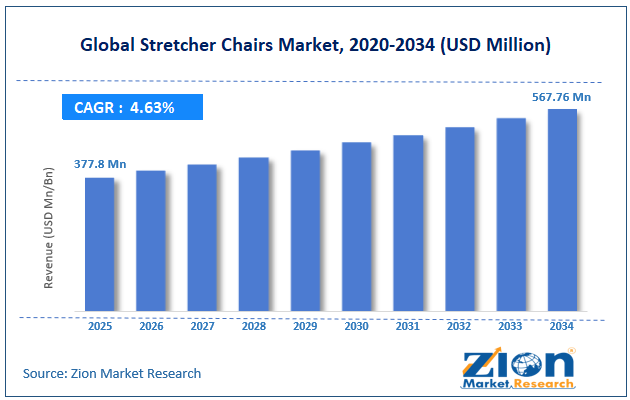
The global stretcher chairs market size was valued at approximately USD 377.8 million in 2025 and is projected to reach around USD 567.76 million by 2034, growing at a compound annual growth rate of approximately 4.63% between 2026 and 2034.
Key Insights
- As per the analysis shared by our research team, the global stretcher chairs market is estimated to grow at a compound annual growth rate of approximately 4.63% during the forecast period from 2026 to 2034.
- In terms of revenue, the global stretcher chairs market was valued at approximately USD 377.8 million in 2025 and is projected to reach USD 567.76 million by 2034.
- The stretcher chairs market is expected to grow strongly due to a rising elderly population, increasing investment in emergency medical services, growing demand for compact patient transport equipment, and expanding home healthcare adoption.
- Based on type, manual stretcher chairs lead the market because of their lower cost and reliable performance in everyday hospital settings, while electric stretcher chairs are gaining strong momentum as one of the fastest-growing types for reducing caregiver physical strain.
- Based on application, hospitals and clinics lead the market due to consistent daily demand for patient transport equipment. At the same time, home healthcare settings are the fastest-growing segment as more long-term care shifts to private residences.
- Based on material, steel-frame stretcher chairs lead the market because of their strength and affordability, while aluminum-frame stretcher chairs are seeing rapid adoption because of their lightweight construction and ease of handling.
- Based on end user, government hospitals lead the market due to high patient volumes and public healthcare budgets, while home care agencies are steadily growing as more families choose in-home medical support for aging relatives.
- Based on region, North America leads the global stretcher chairs market, while Asia Pacific is the fastest-growing region due to expanding hospital infrastructure and rising healthcare spending.
Stretcher Chairs Market: Overview
A stretcher chair is medical transport equipment that combines the features of a wheelchair and a stretcher, allowing patients to be moved safely in a seated or reclined position. Its adjustable design makes patient movement easier in narrow corridors, elevators, staircases, and other areas where traditional stretchers may be difficult to use. The stretcher chair market is growing as hospitals and healthcare providers seek safer, more practical patient transport solutions. These chairs are widely used in hospitals, ambulances, emergency services, nursing homes, and home healthcare. Folding frames, adjustable backrests, lightweight construction, and improved wheels allow caregivers to move patients more efficiently while reducing physical strain. Growing elderly populations and increasing numbers of people with limited mobility are further increasing demand for reliable transport equipment.
Healthcare facilities are also replacing bulky equipment with lighter and easier-to-store solutions. Manufacturers are improving frame strength, brakes, locking systems, and folding mechanisms to enhance safety, durability, cleaning, and storage. Demand is also rising for specialized models designed for bariatric patients, children, and emergency evacuation situations, expanding their use across different care environments. Growing awareness of caregiver safety is encouraging facilities to invest in equipment that reduces lifting injuries and improves patient handling.
The stretcher chairs industry continues to grow as hospitals, emergency service providers, and equipment manufacturers work together to create safer, more practical patient transport solutions worldwide.
Stretcher Chairs Market: Strategic Perspective
Where is the stretcher chairs market heading?
The stretcher chairs market is likely to shift toward more specialized equipment designed for emergency response, elderly care, home healthcare, and difficult patient transfers. Future products may emphasize powered movement, improved patient positioning, compact storage, infection-control materials, and designs that reduce physical effort for caregivers.
Where should businesses invest in the stretcher chairs market?
Investment opportunities in the stretcher chairs market are likely to emerge in powered stair-climbing models, bariatric equipment, pediatric designs, and lightweight products for home healthcare. Manufacturers that develop practical solutions for different patient groups and provide dependable maintenance and replacement-part services can access a wider healthcare customer base.
What will reshape competition in the stretcher chairs market?
Competition in the stretcher chairs market will increasingly depend on product comfort, maneuverability, durability, and ease of operation rather than basic transport functionality alone. Companies offering specialized designs, efficient after-sales service, responsive distribution, and equipment suited to different healthcare environments are likely to strengthen their market position.
Stretcher Chairs Market: Technology Roadmap 2026–2034
What is the projected development roadmap of the stretcher chairs market over the forecast period?
The stretcher chairs market is advancing through improved folding mechanisms, more reliable battery-powered lift systems, expanded use of lightweight materials, and growing integration of safety monitoring features, making patient transport safer and more comfortable for both patients and caregivers. The market is expected to grow at a compound annual growth rate of approximately 4.63% over the forecast period, driven by accelerating healthcare investment, developing safety standards, and continuous refinement of stretcher chair technology.
The following roadmap outlines key development phases expected through 2034.
2026–2028: Ergonomic Design and Patient Safety Improvement Phase
- Better caregiver ergonomics: Manufacturers are expected to redesign handles, seating positions, brakes, and lifting points to reduce physical strain during patient transfers.
- Improved infection control: Healthcare providers are likely to favor stretcher chairs with smooth, easy-to-clean surfaces and materials that withstand frequent disinfection.
- Greater patient customization: Product development is expected to focus on adjustable seating, stronger restraints, and models designed specifically for bariatric, pediatric, and mobility-limited patients.
2029–2031: Specialized Equipment and Healthcare Expansion Phase
- Powered transport solutions: Battery-assisted stair chairs and other powered models are expected to gain wider use as emergency teams look for ways to reduce manual lifting.
- Ambulance optimization: Compact stretcher chairs designed specifically for emergency vehicles are likely to become more important as ambulance operators seek equipment that saves space without reducing functionality.
- Home healthcare growth: Demand is expected to increase for lightweight models that caregivers and families can operate more easily in residential settings, particularly as elderly care moves beyond hospitals.
2032–2034: Smart Patient Mobility Phase
- Sensor-supported operation: Future stretcher chairs may use sensors to monitor weight distribution, chair position, and stability during movement.
- Connected healthcare integration: Smart models could connect with hospital equipment systems to share basic transport information and support better coordination between emergency and clinical teams.
- Greater mobility automation: Manufacturers are expected to explore assisted movement technologies that help caregivers navigate stairs, uneven surfaces, and confined spaces with less physical effort.
Stretcher Chairs Market: Dynamics
Growth Drivers
Growing patient mobility needs are strengthening the stretcher chairs market.
The stretcher chairs market is benefiting from growing demand for equipment that makes patient transfers safer and less physically demanding. Emergency teams use these chairs when patients need to be moved through staircases, narrow buildings, or crowded areas where standard stretchers are difficult to operate. Hospitals are also adopting them for movement between treatment rooms, diagnostic areas, and patient wards. Rising numbers of elderly patients and people with mobility limitations are increasing the need for equipment that supports controlled transfers. Improvements in wheel design, braking systems, seat adjustment, and frame construction are making newer models easier for caregivers to handle.
Ambulance operators are especially interested in equipment that stores efficiently while remaining ready for rapid deployment. Expanding home healthcare and nursing care services are creating further applications outside hospitals. Growing awareness of caregiver safety is also pushing healthcare facilities to replace bulky transport equipment with lighter, more ergonomic stretcher chairs. These changes are increasing the role of stretcher chairs in emergency response, routine healthcare transport, elderly care, and home-based medical services.
How are product innovations opening new opportunities in the stretcher chairs market?
The stretcher chairs industry is gaining new opportunities through product designs tailored to specific patient and healthcare needs. Bariatric models are being developed to safely transport heavier patients, while pediatric versions provide better support for children during medical transfers. Powered stair-climbing features can reduce the physical effort required from emergency teams, particularly when moving patients between floors. Manufacturers are also introducing lighter frames and improved folding mechanisms that make equipment easier to store inside ambulances and healthcare facilities. Adjustable seating positions can provide greater comfort for patients who cannot remain fully upright or lie flat. Infection-control requirements are encouraging the use of surfaces that are easier to clean and disinfect between patients.
Rental companies and home healthcare providers are creating additional demand by making specialized transport equipment available without requiring healthcare facilities or families to purchase it outright. These innovations are expanding the use of stretcher chairs across emergency care, hospitals, nursing facilities, and home healthcare.
Restraints
Budget constraints and operational challenges limit growth in the stretcher chairs market.
The stretcher chairs market faces barriers related to product affordability, user training, and differences in healthcare facility requirements. Hospitals and emergency services may hesitate to replace existing wheelchairs or stretchers when budgets are limited, particularly if current equipment remains functional. Staff also need proper training to operate folding systems, brakes, restraints, and adjustable features safely, especially during emergency transfers. Product selection can become difficult because facilities have different patient sizes, building layouts, ambulance designs, and transport needs.
Regular cleaning and disinfection are essential in healthcare environments and can place additional demands on materials and product maintenance. In some regions, limited access to replacement parts and servicing can increase downtime and ownership costs. Smaller healthcare facilities may also lack suitable storage space for specialized transport equipment. Manufacturers can address these barriers through durable designs, easier operation, local servicing, and training programs, helping expand adoption across hospitals, ambulances, nursing homes, and home healthcare settings.
Opportunities
How will specialized patient transport needs create opportunities in the stretcher chairs market?
The stretcher chairs industry is growing as healthcare providers seek equipment suited to different patient needs and transport conditions. Emergency medical teams can use compact stretcher chairs when moving patients through staircases, narrow buildings, accident sites, and other difficult locations. Nursing homes and home healthcare providers are also adopting these products as more elderly and mobility-limited patients receive care outside hospitals. Manufacturers are developing bariatric models for heavier patients, pediatric versions for children, and powered designs that reduce the physical effort required from caregivers. Fire and rescue services are another potential application because specialized stretcher chairs can support patient evacuation from challenging environments. Growing healthcare investment in emerging countries is also encouraging hospitals to modernize patient transport equipment. Improvements in frame strength, wheel design, brakes, restraints, and folding mechanisms are making products better suited to different care environments.
Rental and leasing services are also making specialized stretcher chairs more accessible to smaller healthcare facilities and home care providers. Demand is further increasing for compact models that can be stored easily in ambulances and residential spaces. Manufacturers are also focusing on easier cleaning and maintenance to meet the needs of busy healthcare environments. Rising elderly populations, expanding emergency medical services, and increasing home-based care are expected to create further opportunities across hospitals, nursing facilities, ambulances, and home healthcare during the forecast period.
Challenges
What challenges does the stretcher chairs market face in sustaining growth and achieving adoption?
The stretcher chairs market faces challenges as healthcare facilities often work with limited equipment budgets and may continue using traditional wheelchairs or stretchers because they have lower replacement costs. Choosing suitable equipment can also be difficult because hospitals, ambulances, nursing homes, and home healthcare settings have different patient capacity, storage, and mobility requirements. Staff need proper training to safely operate brakes, restraints, folding mechanisms, and adjustable seating features during patient transfers. Frequent cleaning and disinfection can also place pressure on product materials, particularly in busy hospitals and emergency vehicles.
Limited access to replacement parts and technical servicing may increase maintenance costs in smaller cities and developing regions. Some facilities may also lack enough storage space for specialized transport equipment. Manufacturers can address these barriers by offering different product sizes and price ranges, simplifying operation, improving durability, and providing training and servicing support. Better access to reliable equipment can help healthcare providers adopt stretcher chairs more widely across emergency care, hospitals, nursing homes, and home healthcare.
Stretcher Chairs Market: Report Scope
| Report Attributes | Report Details |
|---|---|
| Report Name | Stretcher Chairs Market |
| Market Size in 2025 | USD 377.8 Million |
| Market Forecast in 2034 | USD 567.76 Million |
| Growth Rate | CAGR of 4.63% |
| Number of Pages | 229 |
| Key Companies Covered | Stryker Corporation, Ferno-Washington, Stollenwerk Medical, Invacare Corporation, Hill-Rom Holdings, Getinge Group, Paramount Bed Holdings, Span-America Medical Systems, Gendron Inc, Joerns Healthcare, and others. |
| Segments Covered | By Type, By Application, By Material, By End User, and By Region |
| Regions Covered | North America, Europe, Asia Pacific (APAC), Latin America, Middle East, and Africa (MEA) |
| Base Year | 2025 |
| Historical Year | 2020 - 2024 |
| Forecast Year | 2026 - 2034 |
| Customization Scope | Avail customized purchase options to meet your exact research needs. Request For Customization |
Stretcher Chairs Market: Segmentation
The global stretcher chairs market is segmented by type, application, material, end user, and region.
What makes manual stretcher chairs the dominant type in the stretcher chairs market?
Based on type, the global stretcher chairs industry is categorized into manual, electric, foldable, and multi-position stretcher chairs. Manual stretcher chairs hold about 42% of the market share, leading due to their lower cost, straightforward operation, and widespread use across standard hospital departments. Electric stretcher chairs hold around 25% market share. They are the fastest-growing segment because demand is increasing for equipment that reduces physical strain on caregivers during patient transfers.
How do hospitals and clinics maintain their leading position in the stretcher chairs market?
Based on application, the stretcher chairs market is divided into hospitals and clinics, ambulance and emergency services, nursing homes and elderly care, and home healthcare settings. Hospitals and clinics account for about 40% of the global market share, driven by consistent daily needs for patient transport across departments. Home healthcare settings account for around 19% of the market share. It is the fastest-growing segment due to expanding preference for long-term care in private residences rather than institutional facilities.
Where do steel frame stretcher chairs stand out in the stretcher chairs market?
By material, the market is segmented into steel frame, aluminum frame, composite frame, and reinforced plastic stretcher chairs. Steel frame stretcher chairs lead with about a 37% share because of their strength, affordability, and proven durability in demanding hospital environments. Aluminum frame stretcher chairs hold around 28% market share. They are seeing rapid adoption because their lightweight construction makes transport easier for caregivers and reduces strain during daily use.
Which end user is driving demand for stretcher chairs in the global market?
Based on end user, the stretcher chairs market is classified into government hospitals, private healthcare facilities, emergency medical service providers, and home care agencies. Government hospitals account for about 39% of the market, leading because of high patient volumes and consistent public healthcare budget allocations for equipment. Home care agencies hold around 22% market share. This segment is expanding quickly as more families choose professional in-home care for elderly or mobility-limited relatives.
Stretcher Chairs Market: Regional Analysis
Why is North America leading the global stretcher chairs market?
North America holds a 40.73% market share globally in the stretcher chairs market and is expected to maintain its leading position during the forecast period. North America leads the market because hospitals and emergency medical teams emphasize efficient patient movement and reducing physical strain on caregivers. The United States has a well-developed ambulance network and many hospitals that regularly require specialized transport equipment. Healthcare facilities are upgrading patient-handling systems to improve movement through emergency rooms, stairways, corridors, and other difficult areas. Occupational safety concerns are also encouraging providers to use equipment that reduces lifting and carrying injuries among medical staff. The region’s growing elderly population is increasing the need for mobility assistance in hospitals, nursing homes, and home healthcare.
Ambulance services are also adopting more compact equipment that stores easily while remaining ready for emergency use. Manufacturers are responding with lighter frames, improved braking systems, powered features, and easier folding mechanisms. The growing adoption of home-based medical care is creating another demand area, particularly among elderly patients who require regular mobility assistance. Healthcare providers are also prioritizing equipment that can be cleaned quickly and withstand frequent use. Rising demand for specialized emergency equipment is also pushing healthcare facilities to modernize transport systems and improve patient-handling practices. Strong healthcare spending, established emergency services, and growing demand for safer patient handling are expected to keep North America in a leading position in the global stretcher chairs market.
What makes Asia Pacific the fastest-growing region in the stretcher chairs market?
The Asia Pacific stretcher chairs market holds a 23.61% market share globally and is expected to witness the fastest growth during the forecast period. Asia Pacific is expanding rapidly as healthcare systems develop to serve larger and increasingly elderly populations. China and India are adding hospitals and emergency facilities, while Japan and South Korea are dealing with rapidly aging populations that require more mobility support. Healthcare providers are becoming more aware of the risks caregivers face when lifting or moving patients manually, increasing interest in equipment that makes transfers easier. Ambulance services are also expanding in developing countries, creating demand for compact patient transport products that work in crowded urban environments.
Nursing homes and assisted-living facilities are becoming more important as families seek professional support for elderly relatives. Local manufacturers are improving product quality while keeping prices accessible, helping hospitals with limited budgets consider modern transport equipment. Growing home healthcare services are creating additional demand for lightweight stretcher chairs that can be used safely in residential settings. Rising construction of smaller hospitals and community care centers is also increasing the need for compact patient transport equipment. Improvements in medical infrastructure, rising healthcare expenditure, expanding elderly care services, and growing attention to staff safety are expected to create strong opportunities for the Asia Pacific stretcher chairs market throughout the forecast period.
Recent Market Developments
- In March 2026, Stryker continued offering advanced Stair-PRO and powered patient-transport solutions, including systems designed to reduce lifting during stair transport and improve maneuverability in challenging emergency environments.
Stretcher Chairs Market: Competitive Analysis
The leading players in the global stretcher chairs market are:
- Stryker Corporation
- Ferno-Washington
- Stollenwerk Medical
- Invacare Corporation
- Hill-Rom Holdings
- Getinge Group
- Paramount Bed Holdings
- Span-America Medical Systems
- Gendron Inc
- Joerns Healthcare
The global stretcher chairs market is segmented as follows:
By Type
- Manual Stretcher Chairs
- Electric Stretcher Chairs
- Foldable Stretcher Chairs
- Multi-Position Stretcher Chairs
By Application
- Hospitals and Clinics
- Ambulance and Emergency Services
- Nursing Homes and Elderly Care
- Home Healthcare Settings
By Material
- Steel Frame Stretcher Chairs
- Aluminum Frame Stretcher Chairs
- Composite Frame Stretcher Chairs
- Reinforced Plastic Stretcher Chairs
By End User
- Government Hospitals
- Private Healthcare Facilities
- Emergency Medical Service Providers
- Home Care Agencies
By Region
- North America
- The U.S.
- Canada
- Mexico
- Europe
- France
- The UK
- Spain
- Germany
- Italy
- Rest of Europe
- Asia Pacific
- China
- Japan
- India
- Australia
- South Korea
- Rest of Asia Pacific
- The Middle East & Africa
- Saudi Arabia
- UAE
- Egypt
- Kuwait
- South Africa
- Rest of the Middle East & Africa
- Latin America
- Brazil
- Argentina
- Rest of Latin America
Table Of Content
Methodology
FrequentlyAsked Questions
A stretcher chair is medical transport equipment that combines the features of a wheelchair and a stretcher, allowing patients to be moved safely in a seated or reclined position. Its adjustable design makes patient movement easier in narrow corridors, elevators, staircases, and other areas where traditional stretchers may be difficult to use.
The global stretcher chairs market is expected to grow due to rising elderly populations, increasing investment in emergency medical services, growing demand for compact patient transport equipment, and expanding home healthcare adoption worldwide.
According to research, the global stretcher chairs market was valued at approximately USD 377.8 million in 2025 and is projected to reach approximately USD 567.76 million by 2034.
The compound annual growth rate of the stretcher chairs market is expected to be approximately 4.63% from 2026 to 2034.
North America is expected to lead the global stretcher chairs market throughout the forecast period, driven by well-established healthcare infrastructure, strong safety regulations, and continued equipment modernization.
The major players in the global stretcher chairs market include Stryker Corporation, Ferno-Washington, Stollenwerk Medical, Invacare Corporation, Hill-Rom Holdings, Getinge Group, Paramount Bed Holdings, Span-America Medical Systems, Gendron Inc, and Joerns Healthcare.
The report examines key aspects of the stretcher chairs market, including research and development drivers, adoption barriers, application opportunities, competitive landscape dynamics, detailed regional market performance analysis, and a comprehensive forward-looking outlook across all major types, applications, materials, end-user segments, and geographic regions through 2034.
Technological advancements are improving safety, mobility, and convenience in the stretcher chairs market. Lighter materials, smoother wheels, stronger braking systems, improved folding mechanisms, and powered features are helping caregivers move patients more easily while reducing physical effort during transport.
Leading companies in the stretcher chairs market are expanding product ranges, developing specialized models, improving distribution networks, entering emerging markets, and partnering with hospitals and emergency services to reach more customers. They are also investing in lightweight designs, powered transport features, and after-sales service to strengthen customer loyalty and improve product adoption.
The stretcher chairs market value chain includes raw material sourcing, component manufacturing, product design, assembly, quality testing, distribution, sales, installation, maintenance, and after-sales support for healthcare providers.

HappyClients

