
Speed Sensor Market Size, Share, Growth Report 2032

Speed Sensor Market By Type (Variable Reluctance, Magnetoresistive, Hall Effect, And Others), By Application (Telematics, Consumer Electronics, Aerospace & Defense, Aerospace & Defense, Industrial, Automotive, And Others), By Region - Global And Regional Industry Overview, market Intelligence, Comprehensive Analysis, Historical Data, And Forecasts 2024-2032
| Market Size in 2023 | Market Forecast in 2032 | CAGR (in %) | Base Year |
|---|---|---|---|
| USD 10.22 Billion | USD 15.58 Billion | 4.79% | 2023 |
Description
What is the projected value for the Speed Sensor Market during 2024 to 2032?
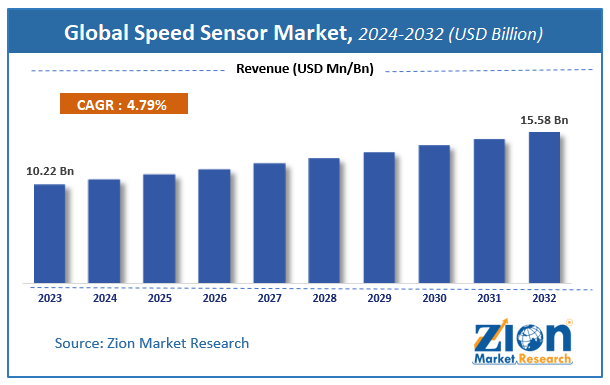
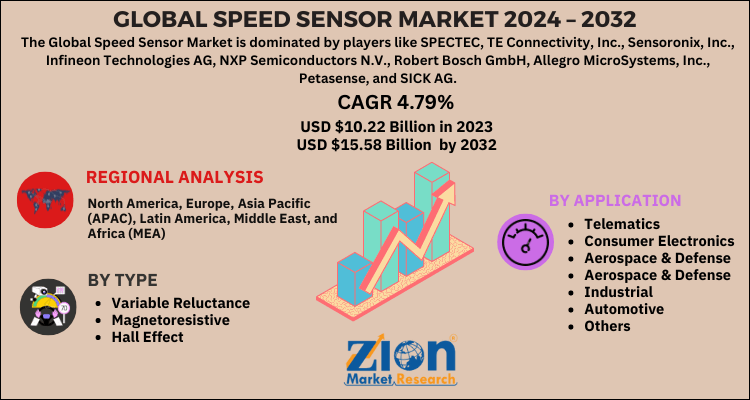
The global speed sensor market size was worth around USD 10.22billion in 2023 and is predicted to grow to around USD 15.58 billion by 2032 with a compound annual growth rate (CAGR) of roughly 4.79% between 2024 and 2032.
The study provides historical data from 2018 to 2022 along with a forecast from 2024 to 2032 based on revenue (USD Billion). The report covers a forecast and an analysis of the speed sensor market on a global and regional level.
 Request Free SampleRequest Free Sample
Global Speed Sensor Market: Overview
Speed sensor permits the magnetic rotation speed to be calculated with a view to facilitate the voltage corresponding to the rotational speed. It is a crucial element used in several onboard systems like bucket elevators, belt conveyors, screw conveyors, and many others. It detects the variations in speed by producing a magnetic pulse in the wave's form that is proportional to the vehicle speed. Speed sensors are proximity-type sensors that are non-contacting with both wide-range analog, digital outputs, and typically attached at the tail of rotating machines to compute the actual speed.
Global Speed Sensor Market: Growth Factors
The high penetration of surveillance drones and unmanned aerial vehicles across the globe are the major reasons driving the growth of the global speed sensor market. The unmanned aerial vehicles and drones are fitted with speed sensors to achieve a uniform speed of rotation propellers and brushless DC Motors. The growing application of speed sensors in logistics, e-commerce, and construction sectors is bolstering the growth of the market globally. Speed sensors are incorporated in commercial UAVs for surveying, mapping, inspection, and delivery application. Moreover, speed sensors also facilitate contactless and wear-free measurement of multiple mechanical quantities like the angle of rotation and angular speed of targets like a shaft, gear, and similar mechanisms. The launch of new products by prominent players with distinct safety features and algorithmic performance to make the product unique and boost the demand in the market is also expected to fuel the growth of the market significantly during the forecast period.
 Request Free SampleRequest Free Sample
Global Speed Sensor Market: Segmentation
The global speed sensor market can be segmented into type, sales channels, application, vehicle, and region.
By type, the market can be segmented into variable reluctance, magnetoresistive, hall effect, and others. The hall effect segment accounts for the largest share in the global speed sensor market due to the growing technological advancements in hall-based speed sensors like circular vertical hall technology. Moreover, it facilitates low insertion cases, a smaller sensor footprint, low cost, and improves sensor life cycle to the manufacturers. They also offer several inclusive features like contactless speed sensing with wide frequency bandwidth, precision accuracy, and high linearity. Further, the sensor possesses strong resistance against high-temperature environments and facilitates pre-programmability features that are a perfect fit for aeronautics and industrial application.
By application, the market can be segmented into telematics, consumer electronics, aerospace & defense, aerospace & defense, industrial, automotive, and others. The automotive segment holds the largest share in the global speed sensor market due to the growing demand for advanced vehicles all across the globe. Moreover, the rapidly growing automotive sector is likely to propel the growth of the segment vigorously during the forecast period. The emergence of an advanced driver assistance system further boosts the demand for speed sensors. Speed sensors are widely used in ADAS components like lane departure warning systems, forward collision warning, adaptive cruise control (ACC), automatic emergency braking (AEB), electronic stability control (ESC), and many others.
Speed Sensor Market: Report Scope
| Report Attributes | Report Details |
|---|---|
| Report Name | Speed Sensor Market |
| Market Size in 2023 | USD 10.22 Billion |
| Market Forecast in 2032 | USD 15.58 Billion |
| Growth Rate | CAGR of 4.79% |
| Number of Pages | 191 |
| Key Companies Covered | SPECTEC, TE Connectivity, Inc., Sensoronix, Inc., Infineon Technologies AG, NXP Semiconductors N.V., Robert Bosch GmbH, Allegro MicroSystems, Inc., Petasense, and SICK AG |
| Segments Covered | By type, By sales channels, By application, By vehicle and By Region |
| Regions Covered | North America, Europe, Asia Pacific (APAC), Latin America, Middle East, and Africa (MEA) |
| Base Year | 2023 |
| Historical Year | 2018 to 2022 |
| Forecast Year | 2024 - 2032 |
| Customization Scope | Avail customized purchase options to meet your exact research needs. Request For Customization |
Global Speed Sensor Market: Regional analysis
Asia Pacific accounts for the largest share in the global speed sensor market due to the favorable government initiatives along with the growing consumer electronics sector in the region. Moreover, the growing funding from the government for the development of the domestic consumer electronics sector is likely to boost the growth of the regional market during the forecast period.
North America is anticipated to grow significantly during the forecast period due to the growing demand for advanced driver assistance systems in the region. Moreover, the fast proliferating automatic sector in the region is also fuelling the growth of the regional market.
Global Speed Sensor Market: Competitive Player
Some of the significant players in the global speed sensor market are
- Sensor Solutions Corporation
- SPECTEC
- TE Connectivity Inc.
- Sensoronix Inc.
- Infineon Technologies AG
- NXP Semiconductors N.V.
- Robert Bosch GmbH
- Allegro MicroSystems Inc.
- Petasense
- SICK AG.
The Global Speed Sensor Market is segmented as follows:
By Type
- Variable Reluctance
- Magnetoresistive
- Hall Effect
- Others
By Application
- Telematics
- Consumer Electronics
- Aerospace & Defense
- Aerospace & Defense
- Industrial
- Automotive
- Others
By Region
- North America
- The U.S.
- Canada
- Mexico
- Europe
- France
- The UK
- Spain
- Germany
- Italy
- Rest of Europe
- Asia Pacific
- China
- Japan
- India
- Australia
- South Korea
- Rest of Asia Pacific
- The Middle East & Africa
- Saudi Arabia
- UAE
- Egypt
- Kuwait
- South Africa
- Rest of the Middle East & Africa
- Latin America
- Brazil
- Argentina
- Rest of Latin America
What Reports Provides
- Full in-depth analysis of the parent market
- Important changes in market dynamics
- Segmentation details of the market
- Former, on-going, and projected market analysis in terms of volume and value
- Assessment of niche industry developments
- Market share analysis
- Key strategies of major players
- Emerging segments and regional markets
- Testimonials to companies in order to fortify their foothold in the market.
Table Of Content

FrequentlyAsked Questions
A speed sensor measures the rotational or linear speed of a moving object. It is commonly used in vehicles and industrial machines.
The global Speed Sensor market is expected to be driven by the Growth is supported by increasing automation in automotive and industrial applications, rising adoption of electric vehicles, and demand for precision monitoring. Advancements in sensor accuracy and reliability drive expansion.
According to study, the global Speed Sensor market size was worth around USD 10.22 Billion in 2023 and is predicted to grow to around USD 15.58 Billion By 2032.
The global Speed Sensor market is expected to grow at a Compound Annual Growth Rate (CAGR) of around CAGR 4.79% during the forecast period from 2024-2032.
The global Speed Sensor industry is projected to be challenged by Challenges include performance reliability in harsh conditions, OEM pricing pressure, and complex integration with modern vehicle and industrial control systems.
The Opportunities include growth in EVs and ADAS, expanding industrial automation, and demand for high-precision sensing in robotics and smart manufacturing will offer significant growth opportunities in the Speed Sensor market.
Smarter sensors with higher accuracy and temperature robustness; integration into ADAS/EV powertrains; non-contact sensing (Hall/MR) for durability are the emerging trends and innovations impacting the Speed Sensor market.
The global Speed Sensor market is expected to be led by APAC during the forecast period.
Some of the prominent players operating in the global Speed Sensor market are; SPECTEC, TE Connectivity, Inc., Sensoronix, Inc., Infineon Technologies AG, NXP Semiconductors N.V., Robert Bosch GmbH, Allegro MicroSystems, Inc., Petasense, and SICK AG and others.
The report explores crucial aspects of the Speed Sensor market, including a detailed discussion of existing growth factors and restraints, while also browsing future growth opportunities and challenges that impact the market.
HappyClients

