
Global Smart Entry System Market Size, Share, Trends, Growth and Forecast 2030

Smart Entry System Market By Technology (sensor technology, capacitive sensor technology, automotive remote transmitter technology, and others), By Component (low-frequency power amplifier block, radio frequency receiver block, encrypting and decrypting data signals, and others)And By Region - Global And Regional Industry Overview, Market Intelligence, Comprehensive Analysis, Historical Data, And Forecasts 2023 - 2030
| Market Size in 2022 | Market Forecast in 2030 | CAGR (in %) | Base Year |
|---|---|---|---|
| USD 4.67 Billion | USD 15.40 Billion | 16.08% | 2022 |
Description
What is Smart Entry System Market Size?
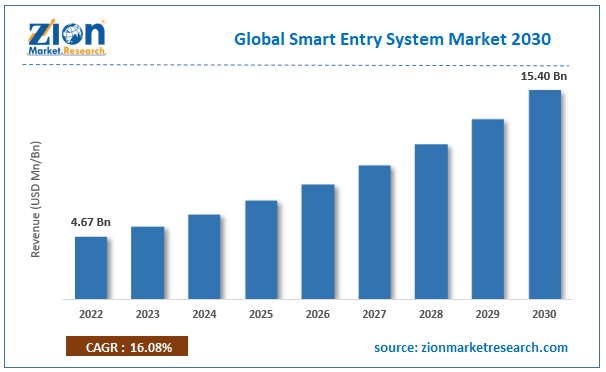
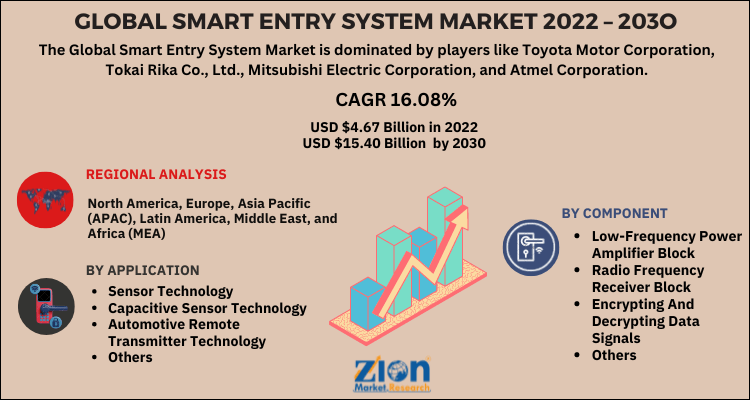
The global Smart Entry System Market size was worth around USD 4.67 Billion in 2022 and is predicted to grow to around USD 15.40 Billion by 2030 with a compound annual growth rate (CAGR) of roughly 16.08% between 2023 and 2030.
In the premium and the high-end cars, the new technology of the smart entry system is being used. With the help of this technology, the cars can be locked and unlocked without using keys. A digital key is used is coded with the help of the wireless communication technology.
Smart Entry System Market: Facts
The smart entry system that is developed by the Toyota provides the benefit of performing many of the normal functions of the car operations such as starting the engine and locking and unlocking of the doors just by having the key somewhere close to your body and not necessarily your hands.
Smart Entry System Market: Growth Factors
The major factor that is driving the smart entry system market is its increased usage in the automotive industry due to the advancements that are made in the technology that offers premium features for the vehicle. The manufacturers of the automobiles are constantly making efforts to simplify the locking and the unlocking operation which is increasing the demand for the smart entry system. The main application of the smart entry system in the vehicle is to eliminate the possibility of theft which has, in turn, lowered the requirement for the mechanical locking and unlocking system.
In the smart entry system, the remote transmitter senses the passive keyless system which allows the consumer to enter by just pulling the vehicle door handle. The smart entry system is undertaken by all the premium car manufacturers thus fuelling the growth of the smart entry system market. The factor that is restraining the growth of the market is the key requirement of the remote for the successful operation which can be misplaced easily which negatively affects the growth of the market.
Smart Entry System Market: Segmentation
The smart entry system market is fragmented into its technology and the system component. On the basis of the technology, the smart entry system market is segregated into infrared sensor technology, capacitive sensor technology, automotive remote transmitter technology, and others. On the basis of the system component, the market is categorized into low-frequency power amplifier block, radio frequency receiver block, encrypting and decrypting data signals, and others.
Smart Entry System Market: Report Scope
| Report Attributes | Report Details |
|---|---|
| Report Name | Smart Entry System Market Size Report |
| Market Size in 2022 | USD 4.67 Billion |
| Market Forecast in 2030 | USD 15.40 Billion |
| Growth Rate | CAGR of 16.08% |
| Number of Pages | 188 |
| Forecast Units | Value (USD Billion), and Volume (Units) |
| Key Companies Covered | Toyota Motor Corporation, Tokai Rika Co., Ltd., Mitsubishi Electric Corporation, and Atmel Corporation. |
| Segments Covered | By Component,By Technology,And By Region |
| Regions Covered | North America, Europe, Asia Pacific (APAC), Latin America, Middle East and Africa (MEA) |
| Countries Covered | North America: U.S and Canada Europe: Germany, Italy, Russia, U.K, Spain, France, Rest of Europe APAC: China, Australia, Japan, India, South Korea, South East Asia, Rest of Asia Pacific Latin America: Brazil, Argentina, Chile The Middle East And Africa: South Africa, GCC, Rest of MEA |
| Base Year | 2022 |
| Historical Year | 2017 - 2021 |
| Forecast Year | 2023 - 2030 |
| Customization Scope | Avail customized purchase options to meet your exact research needs. Request For Customization |
Smart Entry System Market: Regional Analysis
The region that is leading the smart entry system market is Western Europe owing to the presence of the popular car manufacturing units in the countries such as Germany and France. The second position in the smart entry system market is held by the North America owing to the growing demand for the premium cars. The market is growing in at a good pace in the Asia Pacific region. The presence of the major market players such as the Mitsubishi Electric Corporation in the country of Japan contribute to the development of the market. In Asia Pacific region, there is an increasing demand for the premium cars which is further fuelling the growth of the market.
Smart Entry System Market: Competitive Players
The key players that are involved in the smart entry system market include:
- Toyota Motor Corporation
- Tokai Rika Co., Ltd.
- Mitsubishi Electric Corporation
- Atmel Corporation.
Smart Entry System Market: Segmentation
By Technology
- Sensor technology
- Capacitive sensor technology
- Automotive remote transmitter technology
- others
By Component
- low-frequency power amplifier block
- Radio frequency receiver block
- Encrypting and decrypting data signals
- others
By Region
- North America
- The U.S.
- Canada
- Mexico
- Europe
- France
- The UK
- Spain
- Germany
- Italy
- Rest of Europe
- Asia Pacific
- China
- Japan
- India
- Australia
- South Korea
- Rest of Asia Pacific
- The Middle East & Africa
- Saudi Arabia
- UAE
- Egypt
- Kuwait
- South Africa
- Rest of the Middle East & Africa
- Latin America
- Brazil
- Argentina
- Rest of Latin America
What Reports Provides
- Full in-depth analysis of the parent market
- Important changes in market dynamics
- Segmentation details of the market
- Former, on-going, and projected market analysis in terms of volume and value
- Assessment of niche industry developments
- Market share analysis
- Key strategies of major players
- Emerging segments and regional markets
- Testimonials to companies in order to fortify their foothold in the market.
Table Of Content

FrequentlyAsked Questions
A smart entry system controls access using digital authentication. It improves security and convenience
The global Smart Entry System market is expected to be driven by the smart home adoption and security concerns. Integration with IoT and access control technologies supports expansion.
According to study, the global Smart Entry System market size was worth around USD 4.67 Billion in 2022 and is predicted to grow to around USD 15.40 Billion by 2030.
The global Smart Entry System market is expected to grow at a Compound Annual Growth Rate (CAGR) of around CAGR 16.08% during the forecast period from 2023-2030.
The global Smart Entry System industry is projected to be challenged by Challenges include cybersecurity risks and integration with building systems.
The Opportunities include smart homes, access control demand, commercial security, and IoT-enabled buildings will offer significant growth opportunities in the Smart Entry System market.
Biometric and mobile-based access; AI-powered security analytics; integration with smart buildings are the emerging trends and innovations impacting the Smart Entry System market.
The global Smart Entry System market is expected to be led by APAC during the forecast period.
Some of the prominent players operating in the global Smart Entry System market are; Toyota Motor Corporation, Tokai Rika Co., Ltd., Mitsubishi Electric Corporation, and Atmel Corporation. and others.
The report explores crucial aspects of the Smart Entry System market, including a detailed discussion of existing growth factors and restraints, while also browsing future growth opportunities and challenges that impact the market.
HappyClients

