
Global Restorative Material Market Size, Growth, Trends, and Forecast 2034

Restorative Material Market By Type (Composite Resins, Dental Amalgam, Glass Ionomer Cements, Ceramic Materials), By Application (Dental Fillings, Crowns and Bridges, Cavity Liners, Orthodontic Restorations), By End-User (Dental Hospitals, Dental Clinics, Academic and Research Institutes, Dental Laboratories), By Material Form (Powder Form, Paste Form, Liquid Form, Capsule Form), and By Region - Global and Regional Industry Overview, Market Intelligence, Comprehensive Analysis, Historical Data, and Forecasts 2026 - 2034
| Market Size in 2025 | Market Forecast in 2034 | CAGR (in %) | Base Year |
|---|---|---|---|
| USD 2.26 Billion | USD 3.42 Billion | 4.70% | 2025 |
Restorative Material Market: Industry Perspective
What will be the size of the restorative material market during the forecast period?
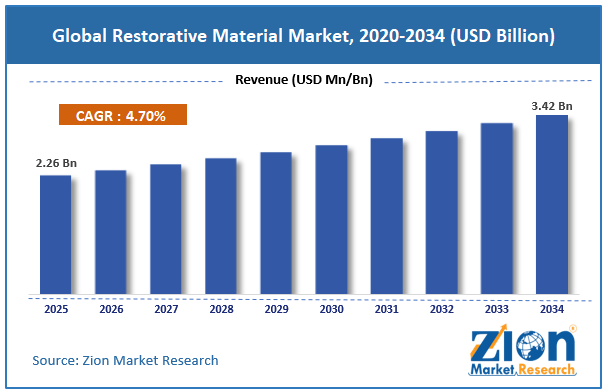
The global restorative material market size was valued at approximately USD 2.26 billion in 2026 and is projected to reach around USD 3.42 billion by 2034, growing at a compound annual growth rate of approximately 4.70% between 2026 and 2034.
Key Insights
- As per the analysis shared by our research team, the global restorative material market is estimated to grow at a compound annual growth rate of approximately 4.70% during the forecast period from 2026 to 2034.
- In terms of revenue, the global restorative material market was valued at approximately USD 2.26 billion in 2026 and is projected to reach USD 3.42 billion by 2034.
- The restorative material market is expected to grow strongly due to rising cases of tooth decay, increasing demand for aesthetic dental treatments, growing preference for long-lasting restorations, and expanding research into new dental materials.
- Based on type, composite resins lead the market because of their natural tooth-like appearance and wide clinical use, while ceramic materials are gaining strong momentum as one of the fastest-growing segments due to their strength and durability.
- Based on application, dental fillings lead the market due to the well-established and frequent use of restorative materials in treating cavities. At the same time, crowns and bridges are the fastest-growing segment as more patients seek long-term tooth replacement solutions.
- Based on end-user, dental clinics lead the market due to high patient volumes and widespread availability, while dental hospitals are steadily growing as more complex restorative procedures require specialized care.
- Based on material form, paste form leads the market because of its ease of use and quick application during dental procedures. In contrast, capsule form is the fastest-growing segment as more dentists prefer pre-measured and convenient material options.
- Based on region, North America leads the global restorative material market. At the same time, the Asia Pacific is the fastest-growing region due to rising dental care awareness and improving access to oral health services.
Restorative Material Market: Overview
Restorative materials are dental materials used to repair, rebuild, and restore teeth damaged by decay, injury, wear, or fractures. These materials help restore the natural shape, strength, function, and appearance of teeth, allowing people to eat, speak, and smile comfortably again. Dentists use restorative materials for common treatments such as fillings, crowns, bridges, inlays, and cavity repairs. The most widely used restorative materials include composite resins, dental amalgam, glass ionomer cements, ceramics, and other advanced dental materials. Each material is selected based on the type of tooth damage, its location, durability requirements, and the desired natural look. Continuous improvements in strength, longevity, and tooth-colored aesthetics are making modern restorative materials more popular than traditional options. The restorative materials market is growing steadily due to rising cases of dental cavities, increasing awareness of oral health, growing demand for cosmetic dentistry, and ongoing innovations in safe, durable, and high-performance dental restoration materials. Increasing access to dental care, growing disposable incomes, and expanding dental insurance coverage are encouraging more people to seek restorative treatments. Dental clinics and hospitals are also adopting advanced restorative materials to improve treatment outcomes, reduce procedure time, and provide longer-lasting dental restorations for patients worldwide.
The restorative material industry continues to expand as manufacturers and dental professionals work together to bring safer, stronger, and more natural-looking restorative solutions to patients around the world.
Impact of the USA-Israel War on Iran on the Restorative Material Market
The restorative material market may face short-term supply challenges because of ongoing geopolitical tensions between the United States, Israel, and Iran, which can affect the availability of certain raw materials used in manufacturing dental products. Dental material companies are strengthening their supply chains and expanding manufacturing to reduce these risks. Despite these temporary challenges, rising demand for dental care and growing investment in oral health infrastructure are expected to support the continued growth of the market.
Restorative Material Market: Technology Roadmap 2026–2034
What is the projected development roadmap of the restorative material market over the forecast period?
The restorative material market is advancing through improved material formulations, more precise application techniques, expanded product testing, and growing use of aesthetic and durable materials, making dental care safer and more effective for patients. The market is expected to grow at a compound annual growth rate of approximately 4.70% over the forecast period, driven by accelerating research investment, developing regulatory pathways, and continuous refinement of dental material technology.
The following roadmap outlines key development phases expected through 2034.
2026-2028: Material Development and Clinical Validation Phase
- Researchers are expected to develop new restorative material formulations that offer stronger bonding, better durability, and a more natural appearance for a wider range of dental repairs.
- Stricter global quality and safety standards are expected to encourage companies to improve testing processes, helping ensure new restorative materials are both safe and effective before reaching dental clinics.
- Growing collaboration between material manufacturers, dental hospitals, and research institutes is expected to speed up the development of new and improved restorative products.
2029-2031: Enhanced Durability and Broader Access Phase
- Advanced manufacturing methods are expected to become more widely used, helping produce restorative materials with greater consistency, fewer defects, and more manageable costs.
- The growing use of combination materials, where different restorative substances are layered together, is expected to improve durability and appearance for patients with more complex dental needs.
- Improved application tools and techniques are expected to help dentists complete restorative procedures more efficiently, reducing patient discomfort and treatment time.
2032-2034: Next Generation Restorative Solutions Phase
- Restorative materials are expected to become more refined, with products designed to bond more naturally with tooth structure while resisting wear and staining over time.
- Smaller and more precise material application systems are expected to support the growing demand for treatments that can be tailored closely to each patient's specific dental needs.
- New technologies combining restorative materials with digital scanning and design tools are expected to help dentists create more accurate and long-lasting restorations for patients.
Restorative Material Market: Dynamics
Growth Drivers
What is driving growth in the restorative material market as demand for dental repair rises?
The restorative material industry is growing steadily as dental clinics, hospitals, and manufacturers focus on providing durable, safe, and natural-looking tooth repair solutions. Rising cases of dental cavities, tooth decay, fractures, and tooth loss, along with increasing demand for cosmetic dentistry, are driving market growth worldwide. Restorative materials play an important role in repairing damaged teeth while restoring their strength, function, and appearance. They are widely used in treatments such as fillings, crowns, bridges, cavity liners, inlays, and onlays. Growing awareness of oral health, preventive dental care, and regular dental checkups is encouraging more people to seek timely treatment.
Manufacturers are continuously developing advanced restorative materials with better durability, aesthetics, and biocompatibility to improve patient outcomes. Dental professionals are increasingly adopting these innovative materials to deliver long-lasting restorations and greater patient satisfaction. Rising healthcare spending, improved access to dental services, and ongoing technological advancements are expected to continue driving strong growth in the market over the coming years.
The growing demand for aesthetic and natural-looking dental restorations is driving the restorative material market.
The restorative material market is creating strong growth opportunities as dentists increasingly focus on aesthetic, durable, and natural-looking dental treatments. Modern restorative materials are designed to closely match the color, shape, and texture of natural teeth, helping patients regain confident smiles after dental procedures. These advanced materials provide excellent strength, long-lasting performance, and improved comfort while restoring normal chewing and speaking functions. Dental clinics, hospitals, and laboratories are adopting innovative restorative materials to deliver better treatment outcomes and enhance patient satisfaction.
Manufacturers are investing in advanced bonding technologies, bioactive materials, and improved ceramic and composite formulations to expand treatment options. Continuous product innovation is making restorative procedures more reliable, efficient, and visually appealing. Growing awareness of oral health, cosmetic dentistry, and preventive dental care is encouraging more people to seek timely treatment. Rising healthcare investments, expanding dental infrastructure, supportive government initiatives, and increasing access to modern dental services are further driving demand. As technology continues to improve and patient expectations rise, the restorative material market is expected to experience steady growth and significant opportunities throughout the forecast period.
Restraints
Why are high material costs and technical sensitivity challenging the restorative material market?
The restorative material market faces several challenges that could limit its growth. Developing advanced restorative materials requires extensive research, high-quality raw materials, strict testing, and regulatory approvals, making the process costly and time-consuming for manufacturers. Smaller companies often find it difficult to compete with established brands because of limited funding and fewer research resources. Some restorative materials also require skilled handling and precise application, and incorrect use can reduce the strength, durability, and success of dental treatments. Manufacturers must continuously monitor product quality, safety, and performance, adding to long-term operational costs.
Another challenge is the shortage of trained dental professionals and technicians experienced in using the latest restorative materials and techniques. Limited access to modern dental care, especially in developing regions, further restricts market growth. Despite these challenges, ongoing technological advancements, increasing dental education, stronger industry partnerships, and expanding access to quality dental services are expected to support the long-term growth of the market.
Opportunities
Will expanding treatment applications and emerging markets drive growth opportunities in the restorative material market?
The restorative material market offers significant growth opportunities as manufacturers and dental professionals continue developing advanced, durable, and natural-looking dental repair solutions. These materials are widely used to treat cavities, repair chipped or broken teeth, replace damaged tooth structures, and restore normal function through fillings, crowns, bridges, inlays, and onlays. They help improve patient comfort, confidence, and oral health while delivering long-lasting and aesthetically pleasing results. Growing demand for cosmetic dentistry and minimally invasive procedures is encouraging dental clinics, hospitals, and laboratories to adopt high-performance restorative materials. Manufacturers are expanding the use of advanced ceramics, composite resins, and bioactive materials while improving production technologies to enhance safety, durability, and ease of application. Emerging economies such as China, India, Brazil, and countries across Southeast Asia are investing heavily in dental healthcare infrastructure, professional training, and public oral health awareness, creating new market opportunities. Continuous product innovation, increasing availability of affordable dental treatments, and rising healthcare spending are further supporting market expansion. As more people prioritize oral health and attractive smiles, the market is expected to witness steady demand and strong long-term growth throughout the forecast period.
Challenges
What challenges does the restorative material market face in sustaining growth and achieving widespread adoption?
The restorative material market faces several challenges that could affect its growth. Developing advanced restorative materials requires significant investment in research, high-quality raw materials, extensive product testing, and strict quality control, making it difficult for smaller companies to compete with established manufacturers. Regulatory approvals are often lengthy because companies must demonstrate the safety, durability, and effectiveness of new materials before they reach dental clinics. Different regulations across countries also increase development costs and delay product launches.
Another challenge is the shortage of trained dentists and dental technicians who can effectively use the latest restorative materials and techniques. Maintaining a reliable supply of quality raw materials and efficient manufacturing operations is also essential to avoid production delays. In addition, the market faces competition from preventive dentistry and advanced digital treatment technologies. Despite these challenges, continuous material innovation, growing research investments, stronger industry partnerships, and expanding access to modern dental care are expected to support the long-term growth of the market.
Restorative Material Market: Report Scope
| Report Attributes | Report Details |
|---|---|
| Report Name | Restorative Material Market |
| Market Size in 2025 | USD 2.26 Billion |
| Market Forecast in 2034 | USD 3.42 Billion |
| Growth Rate | CAGR of 4.70% |
| Number of Pages | 227 |
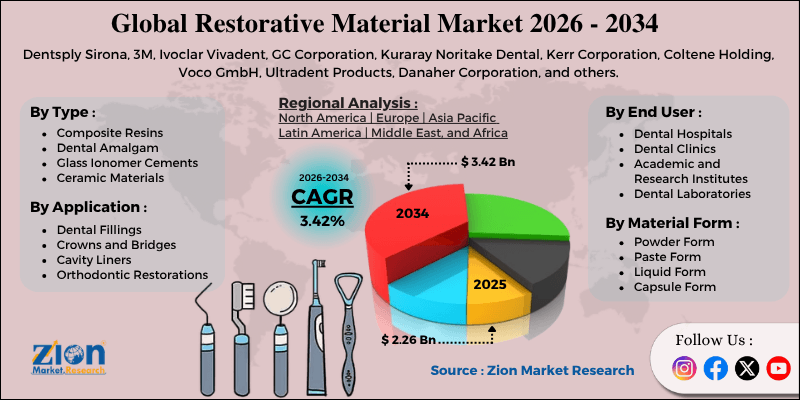
| Key Companies Covered | Dentsply Sirona, 3M, Ivoclar Vivadent, GC Corporation, Kuraray Noritake Dental, Kerr Corporation, Coltene Holding, Voco GmbH, Ultradent Products, Danaher Corporation, and others. |
| Segments Covered | By Type, By Application, By End User, By Material Form, and By Region |
| Regions Covered | North America, Europe, Asia Pacific (APAC), Latin America, Middle East, and Africa (MEA) |
| Base Year | 2025 |
| Historical Year | 2020 - 2024 |
| Forecast Year | 2026 - 2034 |
| Customization Scope | Avail customized purchase options to meet your exact research needs. Request For Customization |
Restorative Material Market: Segmentation
The global restorative material market is segmented by type, application, end-user, material form, and region.
What makes composite resins the dominant type in the restorative material market?
Based on type, the global restorative material market is classified into composite resins, dental amalgam, glass ionomer cements, and ceramic materials. Composite resins hold about 44% of the market share, leading due to their natural tooth-like appearance, strong bonding properties, and wide use across various dental restoration procedures. Ceramic materials hold around 23% market share. They are the fastest-growing segment because of their strength, durability, and excellent aesthetic qualities for visible tooth restorations.
How does dental filling treatment maintain its leading position in the restorative material market?
Based on application, the restorative material industry is segregated into dental fillings, crowns and bridges, cavity liners, and orthodontic restorations. Dental fillings account for approximately 41% of the global market share, driven by the frequent and widespread need to treat tooth decay and cavities. Crowns and bridges hold around 25% market share. It is the fastest-growing segment due to rising demand for long-term tooth replacement and restoration solutions.
What makes dental clinics the dominant end users in the restorative material market?
Based on end-user, the market is divided into dental hospitals, dental clinics, academic and research institutes, and dental laboratories. Dental clinics lead with about a 49% share because of their widespread availability and ability to handle routine restorative procedures efficiently. Dental hospitals hold around 22% market share. They are growing steadily as more complex and specialized restorative treatments require advanced facilities.
How does paste form shape the application landscape of the restorative material market?
Based on material form, the restorative material market is categorized into powder form, paste form, liquid form, and capsule form. Paste form accounts for about 37% of the market, leading because of its ease of handling and quick application during common restorative procedures. Capsule form holds around 26% market share. It is growing quickly as more dentists prefer pre-measured, convenient, and time-saving material options.
Restorative Material Market: Regional Analysis
Why is North America leading the global restorative material market?
The North America restorative material market dominates the global market and is expected to grow at a CAGR of around 7.3% during the forecast period. Advanced dental healthcare systems, high healthcare spending, strong research capabilities, and early adoption of innovative restorative materials drive this leadership. The United States accounts for the largest market share due to its well-developed dental care network, leading dental material manufacturers, and continuous investment in research and product innovation. Rising cases of tooth decay, increasing demand for cosmetic dentistry, and growing awareness of preventive oral care are further supporting market growth. Canada is also witnessing steady expansion through increased healthcare investments, advanced dental research, and greater adoption of modern restorative materials in clinics and hospitals.
Mexico is emerging as a promising market with improving dental infrastructure, better access to quality dental services, and rising awareness of advanced restorative treatments. Government initiatives supporting oral healthcare, continuous technological advancements, and growing investments in dental education are strengthening the regional market. Increasing demand for durable, natural-looking dental restorations and improved patient outcomes is expected to drive sustained growth in the North America restorative material market throughout the forecast period.
What makes Asia Pacific the fastest-growing region in the restorative material market?
The Asia Pacific restorative material market is one of the fastest-growing regional markets and is expected to grow at a CAGR of around 9.6% during the forecast period. Growth is driven by a large patient population, expanding dental healthcare services, rising disposable incomes, and increasing awareness of oral health across the region. China leads the market due to its rapidly growing dental industry, increasing cases of tooth decay, strong manufacturing base, and government support for oral healthcare and research. Japan remains a key market with its advanced dental care system, high-quality restorative materials, and continuous innovation in aesthetic dentistry. South Korea is experiencing strong growth as demand for cosmetic dental procedures and advanced restorative technologies continues to rise. India offers significant opportunities because of its expanding dental infrastructure, improving access to dental care, growing middle-class population, and increasing investments in healthcare.
Countries including Australia, Singapore, Thailand, and Malaysia are also contributing to regional growth through higher healthcare spending and greater adoption of modern restorative materials. Rising demand for cosmetic dentistry, continuous product innovation, expanding dental clinics, and supportive government initiatives are expected to drive sustained long-term growth in the Asia Pacific restorative material market throughout the forecast period.
Recent Market Developments
- In February 2026, GC Corporation launched G-ænial™ Universal Injectable Flow, a next-generation injectable composite restorative material designed to deliver high strength, improved polish retention, and natural aesthetics for direct dental restorations.
- In May 2026, Ivoclar expanded its Tetric® restorative materials portfolio with new shade and handling options, helping dental professionals achieve more efficient workflows and highly aesthetic direct restorations.
Restorative Material Market: Competitive Analysis
The leading players in the global restorative material market are:
- Dentsply Sirona
- 3M
- Ivoclar Vivadent
- GC Corporation
- Kuraray Noritake Dental
- Kerr Corporation
- Coltene Holding
- Voco GmbH
- Ultradent Products
- Danaher Corporation
The global restorative material market is segmented as follows:
By Type
- Composite Resins
- Dental Amalgam
- Glass Ionomer Cements
- Ceramic Materials
By Application
- Dental Fillings
- Crowns and Bridges
- Cavity Liners
- Orthodontic Restorations
By End User
- Dental Hospitals
- Dental Clinics
- Academic and Research Institutes
- Dental Laboratories
By Material Form
- Powder Form
- Paste Form
- Liquid Form
- Capsule Form
By Region
- North America
- The U.S.
- Canada
- Mexico
- Europe
- France
- The UK
- Spain
- Germany
- Italy
- Rest of Europe
- Asia Pacific
- China
- Japan
- India
- Australia
- South Korea
- Rest of Asia Pacific
- The Middle East & Africa
- Saudi Arabia
- UAE
- Egypt
- Kuwait
- South Africa
- Rest of the Middle East & Africa
- Latin America
- Brazil
- Argentina
- Rest of Latin America
Table Of Content
Methodology
FrequentlyAsked Questions
Restorative material is a substance used by dentists to repair and rebuild teeth damaged by decay, injury, or wear. These materials help restore the natural shape, strength, and appearance of teeth, allowing patients to chew, speak, and smile comfortably again.
The global restorative material market is expected to grow due to rising cases of tooth decay, increasing demand for aesthetic dental treatments, growing preference for long-lasting restorations, and expanding research into new dental materials worldwide.
According to research, the global restorative material market was valued at approximately USD 2.26 billion in 2026 and is projected to reach approximately USD 3.42 billion by 2034.
The compound annual growth rate of the restorative material market is expected to be approximately 4.70% from 2026 to 2034.
North America is expected to lead the global restorative material market throughout the forecast period, driven by its strong dental research base, advanced healthcare system, and significant investment in restorative material innovation.
The major players in the global restorative material market include Dentsply Sirona, 3M, Ivoclar Vivadent, GC Corporation, Kuraray Noritake Dental, Kerr Corporation, Coltene Holding, Voco GmbH, Ultradent Products, and Danaher Corporation.
The report examines key aspects of the restorative material market, including research and development drivers, adoption barriers, application opportunities, competitive landscape dynamics, detailed regional market performance analysis, and a comprehensive forward-looking outlook across all major types, applications, end-user segments, material forms, and geographic regions through 2034.
The restorative material market is witnessing trends such as bioactive restorative materials, tooth-colored composites, advanced ceramics, and minimally invasive dental solutions. Manufacturers are also developing stronger, longer-lasting, and more natural-looking materials that improve patient comfort, treatment outcomes, and overall aesthetic results.
Technological advancements are driving the restorative material market through improved composite resins, CAD/CAM-compatible materials, digital dentistry, and advanced bonding technologies. These innovations enable faster procedures, greater precision, enhanced durability, and better-looking dental restorations for both dentists and patients.
Leading companies in the restorative material market are expanding through new product launches, investments in research and development, strategic partnerships, acquisitions, and geographic expansion. They are also focusing on innovative materials and training programs to strengthen their global market presence.

HappyClients

