Reb M Market Size, Share, Trends, Growth & Forecast Report 2034
Reb M Market By Product Type (Powder, Liquid / Concentrate, Granules / Sachets), By Consumer Segment (Food & Beverage Manufacturers, Retail Consumers / End-users, Small & Medium Enterprises [SMEs]), By Distribution Channel (Online Sales, Retail Sales, Wholesale Distribution), and By Region - Global and Regional Industry Overview, Market Intelligence, Comprehensive Analysis, Historical Data, and Forecasts 2025 - 2034
| Market Size in 2024 | Market Forecast in 2034 | CAGR (in %) | Base Year |
|---|---|---|---|
| USD 73.42 Million | USD 132.41 Million | 7.65% | 2024 |
Reb M Industry Perspective:
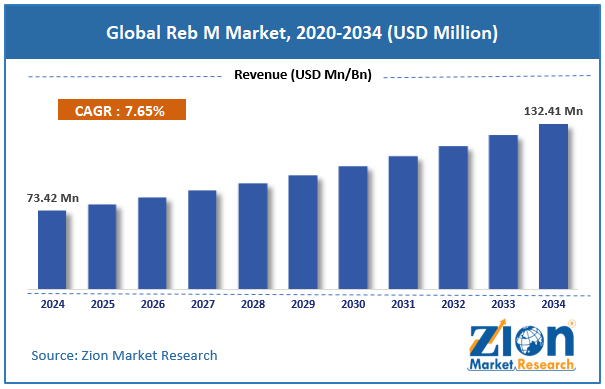
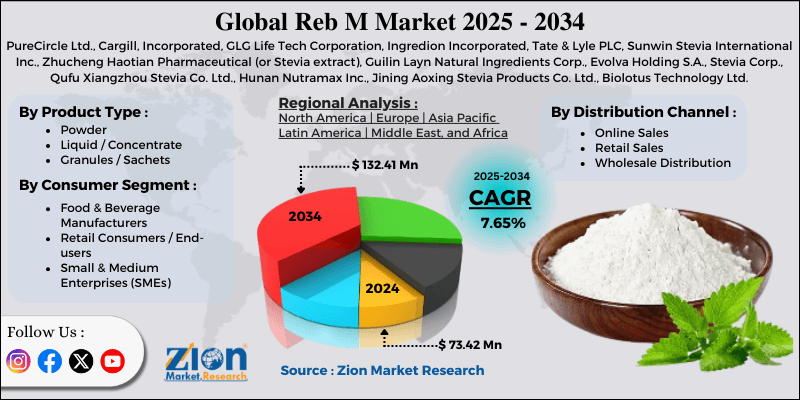
The global Reb M market size was approximately USD 73.42 million in 2024 and is projected to reach USD 132.41 million by 2034, with a compound annual growth rate (CAGR) of approximately 7.65% over 2025-2034.
Key Insights:
- As per the analysis shared by our research analyst, the global Reb M market is estimated to grow annually at a CAGR of around 7.65% over the forecast period (2025-2034)
- In terms of revenue, the global Reb M market size was valued at around USD 73.42 million in 2024 and is projected to reach USD 132.41 million by 2034.
- The Reb M market is projected to grow significantly, driven by rising preference for natural, zero-calorie sweeteners, favorable regulatory approvals, and improved taste profiles.
- Based on product type, the powder segment is expected to lead the market, while the liquid/concentrate segment is expected to grow considerably.
- Based on the consumer segment, the food & beverage manufacturers segment is the dominant segment. In contrast, the retail consumer/end-user segment is projected to generate significant revenue over the forecast period.
- Based on distribution channel, the wholesale distribution segment is expected to lead the market, followed by online sales.
- By region, North America is projected to dominate the global market during the forecast period, followed by the Asia Pacific.
Reb M Market: Overview
Reb M (Rebaudioside M) is a high-purity stevia sweetener obtained from the stevia plant, known for having a sugar-like and clean taste with the least bitterness. It is one of the most desirable steviol glycosides, as it closely mimics the sweetness profile of table sugar, thereby increasing its prominence in reduced-sugar foods and beverages. The global Reb M market is poised for notable growth, driven by rising health consciousness and sugar-reduction trends, demand for clean-label and natural ingredients, and advances in production technology. Consumers are highly aware of the health risks associated with high sugar consumption, such as diabetes and obesity. This results in surging demand for low-calorie, sugar-free alternatives. Reb M, a zero-calorie natural sweetener, fits well with this trend. Moreover, modern consumers choose products with recognizable, simple, and natural ingredients. Clean-label products are gaining traction worldwide in the food industry. Reb M, obtained from the stevia plant, supports this preference, increasing its appeal among manufacturers.
Furthermore, technologies such as enzymatic conversion, fermentation, and advanced purification have enhanced the production of highly pure 'Reb M'. These improvements allow consistent sweetness with minimal bitterness. Subsequently, quality control and scalability have become more achievable for manufacturers.
Nevertheless, the global market faces limitations due to factors such as high production and processing costs and the volatility of supply chains and raw materials. Producing high-purity Reb M involves expansive extraction, fermentation, and purification processes. These high costs are usually passed on to consumers, thereby reducing affordability. Price-sensitive markets may create hesitation about adoption worldwide. Likewise, the supply of stevia leaves, the primary source of Reb M, may vary due to differences in crop yields or climate conditions. This increases costs and impacts production stability. Manufacturers face challenges in ensuring a reliable, steady supply.
Still, the global Reb M industry benefits from several favorable factors, such as expansion into nutraceuticals and functional foods, and product innovation across multiple categories. Reb M can be incorporated into health-focused products such as functional foods and supplements. Demand is escalating among health-conscious and diabetic populations. This creates fresh revenue streams for manufacturers.
Additionally, improvements in formulation allow Reb M to be used in confectionery, snacks, beverages, bakery products, and tabletop sweeteners. Companies can develop a broader range of low-calorie products. Advancements help in differentiating brands in highly competitive markets.
Reb M Market Dynamics
Growth Drivers
How is infrastructure development and improved connectivity driving the Reb M market?
Major infrastructure projects like metro lines, highways, and smart-city developments are transforming previously remote areas into attractive commercial and residential hubs. Enhanced connectivity and access to amenities make peri-urban and suburban areas more desirable, with demand expected to extend beyond conventional city centers. Developers respond by creating integrated townships and mixed-use communities in these regions. Thus, property demand and values increase even in formerly less sought-after areas. These factors altogether fuel the worldwide Reb M market.
How is the Reb M market fueled by growing rental demand and a shift toward integrated living?
As affordability becomes challenging for most, rents continue to rise, particularly among working professionals, young families seeking flexibility, and migrants. High demand for rental homes makes investment in co-living properties and rentals attractive. Developers respond by building integrated townships that provide commercial, residential, and amenity spaces, as well as enhanced quality of life. This trend smooths demand variations: even when home buying slows, rental demand and integrated development keep the industry active. Subsequently, real estate remains a diversified asset class attractive to renters and buyers.
Restraints
The affordability crisis and the widening gap between incomes and property prices adversely impact the market progress
Property prices in several economies are rising faster than incomes, making homeownership unaffordable for large segments of the population, particularly first-time and younger buyers. With prices well above pre-pandemic levels, several households struggle to enter the market, limiting demand in affordable and middle-income segments. This shift in interest toward rentals or delays purchase decisions. Over time, the declining pool of buyers weakens industry liquidity and depth, slowing price growth and keeping affordability-driven demand low.
Opportunities
How does entry opportunity via rebased valuations create promising avenues for the Reb M industry growth?
After a few challenging years, many real estate markets have experienced downward corrections of 15-25% in property valuations. This repricing creates tactical entry points for investors seeking high-quality assets at reasonable or discounted prices. As interest rates steadily ease in a few regions, lower valuations, paired with stable or improving fundamentals, make acquisitions potentially appealing. For long-term investors, this may yield beneficial results when markets recover. Hence, today's volatility may represent a favorable window for selective investment, impacting the Reb M industry.
Challenges
Rising construction costs, labor shortages, increasing development risk, and supply chain disruptions restrict the market growth
Growing labor and construction material costs, along with frequent supply chain disruptions, are increasing the cost and time of new developments, squeezing developer margins and causing project cancellations or delays. Low land availability, especially in high-demand urban areas, constrains growth. These pressures increase the challenges of delivering affordable housing, limiting overall supply. Therefore, supply-demand imbalances persist, pushing buyers toward alternative or rental options and slowing new project launches.
Reb M Market: Report Scope
| Report Attributes | Report Details |
|---|---|
| Report Name | Reb M Market |
| Market Size in 2024 | USD 73.42 Million |
| Market Forecast in 2034 | USD 132.41 Million |
| Growth Rate | CAGR of 7.65% |
| Number of Pages | 212 |
| Key Companies Covered | PureCircle Ltd., Cargill, Incorporated, GLG Life Tech Corporation, Ingredion Incorporated, Tate & Lyle PLC, Sunwin Stevia International Inc., Zhucheng Haotian Pharmaceutical (or Stevia extract), Guilin Layn Natural Ingredients Corp., Evolva Holding S.A., Stevia Corp., Qufu Xiangzhou Stevia Co. Ltd., Hunan Nutramax Inc., Jining Aoxing Stevia Products Co. Ltd., Biolotus Technology Ltd., Jiangxi Jiahe Plant Technology Co. Ltd., and others. |
| Segments Covered | By Product Type, By Consumer Segment, By Distribution Channel, and By Region |
| Regions Covered | North America, Europe, Asia Pacific (APAC), Latin America, Middle East, and Africa (MEA) |
| Base Year | 2024 |
| Historical Year | 2019 to 2023 |
| Forecast Year | 2025 - 2034 |
| Customization Scope | Avail customized purchase options to meet your exact research needs. Request For Customization |
Reb M Market: Segmentation
The global Reb M market is segmented based on product type, consumer segment, distribution channel, and region.
Based on product type, the global Reb M industry is divided into powder, liquid/concentrate, and granules/sachets. The powder segment leads the market due to its stability and versatility. It can be easily stored, incorporated, and transported into a broad range of food and beverage formulations. Large-scale manufacturers favor it for dry mixes, confectionery, tabletop sweeteners, and bakery products. Its long shelf life, ease of formulation, and cost efficiency make it a preferred choice for industrial applications.
Based on consumer segment, the global Reb M market is segmented into food & beverage manufacturers, retail consumers/ end-users, and small & medium enterprises (SMEs). The food & beverage manufacturers segment holds a dominant share due to its wide application in confectionery, dairy alternatives, and beverages. They prioritize cost-effective, high-purity sweeteners that maintain taste and stability during large-scale production. Manufacturers are majorly reformulating products to reduce sugar while meeting consumer demand for clean-label ingredients. This domain accounts for the majority of worldwide consumption due to ongoing product innovation and volume requirements.
Based on distribution channel, the global market is segmented into online sales, retail sales, and wholesale distribution. The wholesale distribution segment captures a substantial share of the market. It serves large-scale food and beverage manufacturers. It allows bulk purchases at competitive prices, assuring a stable supply for industrial production. Manufacturers rely on wholesalers to offer large volumes and consistent quality for bakery, confectionery, beverage, and other food products.
Reb M Market: Regional Analysis
Why does North America hold a dominant position in the global Reb M Market?
North America is projected to maintain its dominant position in the global Reb M market, driven by health awareness, regulatory support, sugar reduction, a strong food and beverage industry with a reformulation trend, innovation, ingredient suppliers, and an efficient supply chain. High prevalence of obesity, lifestyle-related health issues, and diabetes inclines consumers towards natural and low-calorie sweeteners. Regulatory approvals of steviol glycosides, comprising Reb M, strengthen safety and market confidence.
Manufacturers can advance with reduced-sugar formulations without regulatory barriers. The adoption of supportive regulations and health awareness initiatives significantly drives regional demand. Moreover, North America is home to leading food and beverage manufacturers, including global brands in beverages, dairy alternatives, and confectionery. These companies actively reformulate products to reduce sugar while preserving texture and taste.
High-purity Reb M is extensively adopted in snacks, beverages, and dairy alternatives. This trend of reformulation creates consistent demand and strengthens the region's leadership. Furthermore, the area benefits from advanced R&D and formulation expertise in natural sweeteners. Leading ingredient manufacturers and suppliers promise a consistent, high-purity, high-quality supply and product innovation. Efficient logistics and supply chains support large-scale production and timely delivery. These factors jointly make North America a center for Reb M adoption and industry dominance.
Asia Pacific maintains its position as the second-largest region in the global Reb M industry, driven by growing health awareness and pressure to reduce sugar intake, strong agricultural and production infrastructure, and surging demand in food and beverage applications. Mounting rates of obesity, diabetes, and lifestyle-related health concerns are driving consumers toward low-calorie substitutes. Health-conscious behavior is driving the adoption of natural sweeteners like Reb M. Both households and manufacturers are favoring reduced sugar. This creates robust demand in snacks, beverages, and processed foods.
Economies in the Asia Pacific are key producers of stevia extracts and leaves. Low production costs and large-scale agricultural capabilities support cost-effective manufacturing of Reb M. The region effectively supplies both international and domestic markets. This supply benefit reinforces its rank in the worldwide market. The region's food and beverage market is speedily expanding, comprising soft drinks, snacks, dairy alternatives, and confectionery. Manufacturers are reformulating products to reduce sugar while maintaining taste. Both retail and industrial demand for Reb M is increasing progressively. This wide-ranging adoption strengthens the Asia Pacific's role as a vital global market.
Reb M Market: Competitive Analysis
The leading players in the global Reb M market are
- PureCircle Ltd.
- Cargill
- Incorporated
- GLG Life Tech Corporation
- Ingredion Incorporated
- Tate & Lyle PLC
- Sunwin Stevia International Inc.
- Zhucheng Haotian Pharmaceutical (or Stevia extract)
- Guilin Layn Natural Ingredients Corp.
- Evolva Holding S.A.
- Stevia Corp.
- Qufu Xiangzhou Stevia Co. Ltd.
- Hunan Nutramax Inc.
- Jining Aoxing Stevia Products Co. Ltd.
- Biolotus Technology Ltd.
- Jiangxi Jiahe Plant Technology Co. Ltd.
Reb M Market: Key Market Trends
Reformulation of existing products to reduce sugar:
Several established food and beverage brands are reformulating their recipes to reduce sugar while preserving taste. Reb M's sugar-like sweetness and high purity make it on-the-go for these reformulations. This trend is most evident in dairy alternatives, snacks, confectionery, and baked goods.
Expansion into new application categories beyond beverages:
While beverages remain a key application, Reb M is increasingly used in confectionery, dairy alternatives, nutraceuticals, bakery products, and sauces and dressings. The breadth of application is growing as formulators become more comfortable working with Reb M and as blending or taste-masking techniques advance.
The global Reb M market is segmented as follows:
By Product Type
- Powder
- Liquid / Concentrate
- Granules / Sachets
By Consumer Segment
- Food & Beverage Manufacturers
- Retail Consumers / End-users
- Small & Medium Enterprises (SMEs)
By Distribution Channel
- Online Sales
- Retail Sales
- Wholesale Distribution
By Region
- North America
- The U.S.
- Canada
- Europe
- France
- The UK
- Spain
- Germany
- Italy
- Rest of Europe
- Asia Pacific
- China
- Japan
- India
- South Korea
- Southeast Asia
- Rest of Asia Pacific
- Latin America
- Brazil
- Mexico
- Rest of Latin America
- Middle East & Africa
- GCC
- South Africa
- Rest of Middle East & Africa
Table Of Content
Methodology
FrequentlyAsked Questions

HappyClients