
Global Rapid Microbiology Testing Market Share, Size, Growth, Demand and Forecast 2032

Rapid Microbiology Testing Market By Product Type (Instruments, Reagents and Kits, and Consumables), By Method (Growth-Based, Viability-Based, Cellular Component-Based, Nucleic Acid-Based, and Others), By Application (Clinical Disease Diagnosis, Food and Beverage Testing, Pharmaceutical and Biological Drug Testing, Cosmetics and Personal Care Products Testing, Environmental Testing, Research Applications, and Others), and By Region - Global and Regional Industry Overview, Market Intelligence, Comprehensive Analysis, Historical Data, and Forecasts 2024 - 2032
| Market Size in 2023 | Market Forecast in 2032 | CAGR (in %) | Base Year |
|---|---|---|---|
| USD 4.94 Billion | USD 10.94 Billion | 9.24% | 2023 |
Rapid Microbiology Testing Industry Perspective
What will be the global rapid microbiology testing market size during the forecast period?
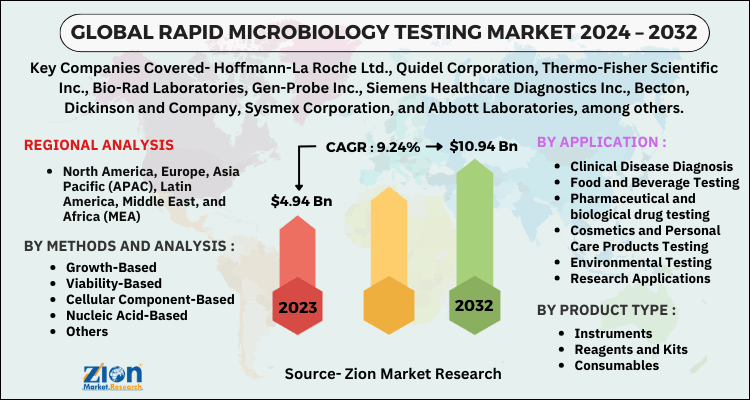
The global rapid microbiology testing market size was worth around USD 4.94 billion in 2023 and is predicted to reach around USD 10.94 billion by 2032, with a compound annual growth rate (CAGR) of roughly 9.24% between 2024 and 2032.
The report examines the primary drivers, challenges, and restraints shaping global demand for the rapid microbiology testing market throughout the forecast period and identifies high-growth opportunities across the industry.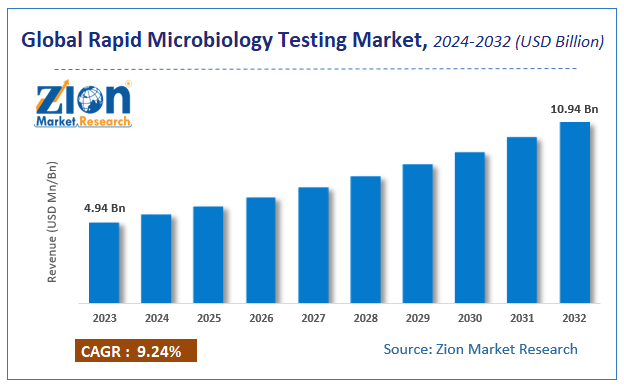 Request Free Sample
Key Insights
- As per the analysis shared by our research analyst, the rapid microbiology testing market is estimated to grow annually at a CAGR of roughly 9.24% over the forecast period from 2024 to 2032.
- In terms of revenue, the global rapid microbiology testing market size was valued at around USD 4.94 billion in 2023 and is projected to reach USD 10.94 billion by 2032.
- The rapid microbiology testing market is driven by the rising prevalence of infectious diseases, the increasing incidence of foodborne pathogen outbreaks, and the urgent need across industrial manufacturing sectors to reduce product release turnaround times.
- By product type, the instruments category accounted for the largest share of 48.5% in the global rapid microbiology testing market because high initial capital investments in automated detection systems, flow cytometers, and mass spectrometers remain central to laboratory modernization.
- By method, the growth-based category accounted for the leading share of 38.4% in the global rapid microbiology testing market because automated optical and biochemical tracking of microbial growth provides dependable colony quantification while maintaining regulatory familiarity across clinical and industrial testing protocols.
- By application, the clinical disease diagnosis category accounted for the largest share (41.2%) in the global rapid microbiology testing market because early, precise pathogen identification is vital to initiate targeted antibiotic therapies, reduce hospital mortality, and manage sepsis presentations.
- North America dominated the global rapid microbiology testing market with a share of over 42.1% in 2023 due to advanced healthcare infrastructure, stringent manufacturing quality-control regulations enforced by federal bodies, and rapid institutional adoption of automated diagnostic technologies.
Rapid Microbiology Testing Market: Overview
Microbiological testing involves various methods of detecting microorganisms in a given sample. It is an important process in the medical, healthcare, and food industries to prevent future product damage. The test is also considered a vital preventive method for industrial products. Rapid microbiology testing is an alternative to microbiological testing. Rapid microbiology testing takes less time than conventional microbiological testing.
Rapid Microbiology Testing Market: Growth Drivers
What factors are primarily accelerating demand in the rapid microbiology testing market?
Globally, the rapid microbiology testing market is likely to grow in the upcoming years due to the rising prevalence of chronic infectious diseases. Rapid methods that deliver results much faster than conventional culture-based approaches help clinicians and laboratories improve turnaround times and decision-making. Rapid technological advancements, including improvements in mass spectrometry, biosensors, and PCR-related approaches, are improving the accuracy, speed, and accessibility of rapid microbiology testing and are expected to drive the market in the coming years.
Rapid Microbiology Testing Market: Restraints
What factors are limiting the expansion of the rapid microbiology testing market?
The lack of proper reimbursement policies might hinder the rapid microbiology testing market. Emerging economies, such as India and China, might offer new growth opportunities for this microbiology testing market over the forecast timeframe.
Rapid Microbiology Testing Market: Opportunities
Where do significant growth opportunities lie for the rapid microbiology testing market?
Emerging economies such as India and China might offer new growth opportunities over the forecast timeframe. Significant population increase and expanding healthcare and industrial testing needs support higher demand for rapid detection methods.
Applications beyond clinical diagnosis—including food and beverage testing, pharmaceutical and biological drug testing, cosmetics and personal care testing, environmental testing, and research—create additional avenues for market expansion as quality and safety requirements tighten.
Rapid Microbiology Testing Market: Challenges
What key challenges confront participants in the rapid microbiology testing market?
Achieving consistent reimbursement and demonstrating clear clinical or operational value remain important challenges for broader adoption. Laboratories must balance the benefits of speed and accuracy against capital and consumable costs.
Integration of new methods into existing laboratory workflows and regulatory validation requirements can extend implementation timelines for both vendors and end users.
Rapid Microbiology Testing Market: Report Scope
| Report Attributes | Report Details |
|---|---|
| Report Name | Rapid Microbiology Testing Market |
| Market Size in 2023 | USD 4.94 Billion |
| Market Forecast in 2032 | USD 10.94 Billion |
| Growth Rate | CAGR of 9.24% |
| Number of Pages | 207 |
| Key Companies Covered | Hoffmann-La Roche Ltd., Quidel Corporation, Thermo-Fisher Scientific Inc., Bio-Rad Laboratories, Gen-Probe Inc., Siemens Healthcare Diagnostics Inc., Becton, Dickinson and Company, Sysmex Corporation, and Abbott Laboratories, among others |
| Segments Covered | By Product Type, By Method, By Application, and By Region |
| Regions Covered | North America, Europe, Asia Pacific (APAC), Latin America, Middle East, and Africa (MEA) |
| Base Year | 2023 |
| Historical Year | 2018 - 2022 |
| Forecast Year | 2024 - 2032 |
| Customization Scope | Avail customized purchase options to meet your exact research needs. Request For Customization |
Rapid Microbiology Testing Market: Segmentation
The rapid microbiology testing market is segmented by product type, method, application, and region. All the segments of the rapid microbiology testing market have been analyzed based on present and future trends and the market is estimated from 2024 to 2032.
By product type, the rapid microbiology testing market is divided into instruments, reagents and kits, and consumables. The instruments category is the dominant division in this sector, commanding the largest market share because advanced automated detection platforms, mass spectrometers, and automated incubators require substantial capital investment. Modern clinical and industrial quality control laboratories require robust analytical equipment engineered for high-throughput testing, walkaway automation, and compliance with data integrity regulations. Because laboratory modernizations and digital transformations prioritize automated screening infrastructure, hardware acquisition serves as the primary capital commitment driving overall market value. Meanwhile, the reagents and kits category is the second-largest division, generating strong recurring revenue as high daily testing volumes across clinical diagnostics and routine batch releases require a continuous supply of specialized molecular primers, fluorescent probes, and enzymatic assay mixes.
By method segment, the rapid microbiology testing market is divided into growth-based, viability-based, cellular component-based, nucleic acid-based, and others. The growth-based category represents the most dominant division, accounting for the highest market share because automated platforms that monitor early microbial metabolic activity and micro-colony formation align closely with traditional compendial culture methods. By detecting micro-colonies hours before they become visible to the human eye via digital imaging, impedance, or colorimetric changes, growth-based technologies significantly compress incubation times while retaining the regulatory acceptance and viability verification of standard culture methods. This compatibility ensures widespread deployment across pharmaceutical sterility testing and clinical microbiology labs. Concurrently, the nucleic acid-based category is the second-largest segment, driven by its unmatched analytical specificity, rapid processing times, and ability to detect fastidious pathogens and genetic antimicrobial resistance markers via PCR and isothermal amplification platforms.
By application segment, the rapid microbiology testing market is divided into clinical disease diagnosis, food and beverage testing, pharmaceutical and biological drug testing, cosmetics and personal care products testing, environmental testing, research applications, and others. The clinical disease diagnosis category is the largest division, accounting for the highest consumption of rapid testing solutions, driven by the life-saving need to diagnose infectious pathogens quickly and prevent fatal septic complications. Acute care hospitals, clinical pathology centers, and reference laboratories prioritize rapid diagnostics to quickly identify bacteremia, respiratory viruses, and multidrug-resistant hospital strains, enabling rapid implementation of targeted therapies that improve survival and prevent clinical complications. Food and beverage testing is the second-largest division, maintaining strong commercial value as global food processors implement rapid pathogen and spoilage screening to prevent cross-contamination, meet food safety oversight, and release perishable products safely to distribution channels.
Rapid Microbiology Testing Market: Regional Analysis
Why will North America continue to dominate the global market during the projection period?
North America is likely to dominate the rapid microbiology testing market in terms of market share, supported by established use of rapid testing methods in clinical and industrial laboratories. Strong healthcare infrastructure, high awareness of infectious disease burden, and presence of major diagnostic and life-science companies encourage continued investment in instruments, reagents, and kits. Regulatory and quality frameworks in pharmaceutical and food sectors further sustain demand for faster microbiological results. This leadership drives overall market growth by maintaining high adoption rates, supporting product innovation, and setting performance and compliance expectations that influence global laboratory practice.
Europe follows as a major regional market with mature diagnostic and quality-testing systems. Asia Pacific is expected to grow rapidly over the forecast timeline, with developing economies such as China and India anticipated to be major regional revenue generators due to significant population increase and expanding healthcare and industrial testing capacity. Latin America and the Middle East and Africa are progressing as laboratory infrastructure and awareness of rapid methods improve.
Rapid Microbiology Testing Market: Competitive Analysis
The global rapid microbiology testing market is dominated by players:
- Hoffmann-La Roche Ltd
- Quidel Corporation
- Thermo-Fisher Scientific Inc
- Bio-Rad Laboratories
- Gen-Probe Inc
- Siemens Healthcare Diagnostics Inc
- Becton
- Dickinson and Company
- Sysmex Corporation
- Abbott Laboratories
Segments Covered
This report segments the global rapid microbiology testing market into:
By Product Type
- Instruments
- Reagents and Kits
- Consumables
By Method
- Growth-Based
- Viability-Based
- Cellular Component-Based
- Nucleic Acid-Based
- Others
By Application
- Clinical Disease Diagnosis
- Food and Beverage Testing
- Pharmaceutical and Biological Drug Testing
- Cosmetics and Personal Care Products Testing
- Environmental Testing
- Research Applications
- Others
By Region
- North America
- The U.S.
- Canada
- Mexico
- Europe
- France
- The UK
- Spain
- Germany
- Italy
- Rest of Europe
- Asia Pacific
- China
- Japan
- India
- Australia
- South Korea
- Rest of Asia Pacific
- The Middle East & Africa
- Saudi Arabia
- UAE
- Egypt
- Kuwait
- South Africa
- Rest of the Middle East & Africa
- Latin America
- Brazil
- Argentina
- Rest of Latin America
Table Of Content
Methodology
FrequentlyAsked Questions
Infections or contamination are diagnosed through rapid microbiology testing, a diagnostic technique that quickly detects microorganisms (bacteria, viruses, fungi, etc.) in samples (e.g., blood, urine, sputum, or tissue). These tests aim to produce results much faster than conventional microbiology methods, which can take several days.
Continuous advancements in testing technologies, including mass spectrometry, biosensors, and PCR, are enhancing the accuracy, speed, and accessibility of rapid microbiology testing.
The global Rapid Microbiology Testing market size accrued earnings worth approximately USD 4.94 Billion in 2023 and is predicted to gain revenue of about USD 10.94 Billion by 2032.
The global Rapid Microbiology Testing market is set to record a CAGR of nearly 9.24% over the period from 2024 to 2032.
North America is likely to dominate in terms of market share, followed by Europe, while Asia Pacific is expected to grow rapidly, with China and India as major regional contributors.
Some key participants of the global rapid microbiology testing market are Hoffmann-La Roche Ltd., Quidel Corporation, Thermo-Fisher Scientific Inc., Bio-Rad Laboratories, Gen-Probe Inc., Siemens Healthcare Diagnostics Inc., Becton, Dickinson and Company, Sysmex Corporation, and Abbott Laboratories, among others.
The report provides comprehensive analysis of market size, growth drivers, restraints, opportunities, segmentation by product type, method, and application, regional dynamics, competitive landscape, and future outlook for the period 2024-2032.

HappyClients

