
Global Protein Shampoo Market Size Report, Industry Share, Analysis, Growth, 2032

Protein Shampoo Market By Product Type (Hydrolyzed Protein Shampoo, Keratin Protein Shampoo, Silk Protein Shampoo, Wheat Protein Shampoo, and Others), By Application (Hair Repair, Hair Growth, Anti-Dandruff, and Others), By End-User (Women, Men, and Unisex), By Distribution Channel (Supermarkets/Hypermarkets, Online Stores, Specialty Stores, and Others), and By Region - Global and Regional Industry Overview, Market Intelligence, Comprehensive Analysis, Historical Data, and Forecasts 2024 - 2032
| Market Size in 2023 | Market Forecast in 2032 | CAGR (in %) | Base Year |
|---|---|---|---|
| USD 2.26 Billion | USD 4.04 Billion | 6.68% | 2023 |
Protein Shampoo Industry Perspective
What will be the global protein shampoo market size during the forecast period?
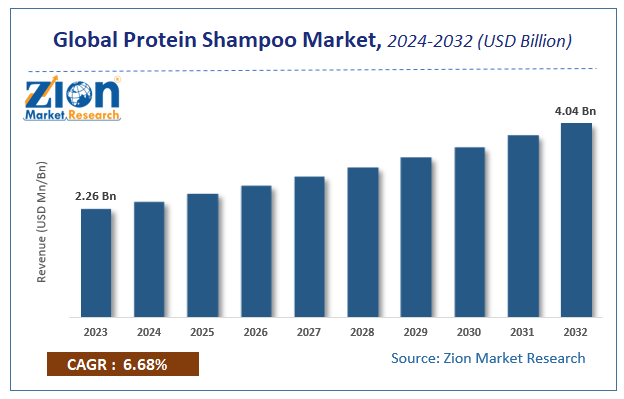
According to a report from Zion Market Research, the global protein shampoo market size was valued at USD 2.26 billion in 2023 and is projected to hit USD 4.04 billion by 2032, with a compound annual growth rate (CAGR) of 6.68% during the forecast period 2024-2032.
This report provides a comprehensive analysis of the growth drivers, restraints, and challenges shaping demand across the global protein shampoo market throughout the forecast period, while highlighting high-potential emerging opportunities within the industry.
Key Insights
- As per the analysis shared by our research analyst, the global protein shampoo market is estimated to grow annually at a CAGR of around 6.68% over the forecast period (2024-2032).
- In terms of revenue, the global protein shampoo market size was valued at around USD 2.26 billion in 2023 and is projected to reach USD 4.04 billion by 2032.
- The market is driven by rising consumer awareness of hair health, increasing demand for restorative and strengthening formulations, and growing preference for protein-enriched products that repair damage from styling and environmental stressors.
- Based on the product type, the keratin protein shampoo segment dominated the market due to its proven ability to rebuild hair structure and reduce breakage
- Based on the application, the hair repair segment held the leading position as consumers increasingly seek solutions for chemically treated hair
- Based on the end-user, the women segment dominated the market because of higher engagement with hair care routines and greater product experimentation
- Based on the distribution channel, the supermarkets/hypermarkets segment accounted for the largest share of over 35% owing to widespread retail presence
- By Region, North America dominated the global market due to high disposable incomes, strong consumer awareness of advanced hair care, and the presence of leading manufacturers
Protein Shampoo Market: Overview
Protein shampoo refers to hair cleansing formulations enriched with proteins such as keratin, hydrolyzed proteins, silk, or wheat derivatives designed to strengthen hair fibers, repair damage, improve elasticity, and enhance overall hair health. These products address common concerns including breakage, dryness, thinning, and loss of shine caused by chemical treatments, heat styling, and environmental exposure.
Protein Shampoo Market: Dynamics
Growth Drivers
What factors are accelerating demand for protein shampoo?
Increasing consumer focus on hair health and the damaging effects of frequent styling, chemical treatments, and pollution is driving strong demand for protein-enriched shampoos that restore strength and reduce breakage. Growing awareness of the protein composition of hair has encouraged shoppers to seek specialized formulations that deliver measurable repair and protective benefits.
Expanding distribution through modern retail and digital channels, combined with active marketing by major personal care brands, further supports market expansion. Recommendations from stylists and rising social media influence on beauty routines continue to elevate the visibility and adoption of protein-based hair care products across diverse consumer groups.
Restraints
What barriers are limiting market expansion?
Premium pricing associated with advanced protein formulations can restrict broader penetration, particularly among value-conscious consumers and in emerging markets where conventional shampoos remain dominant. The need for careful usage guidance to prevent protein overload also creates a learning curve that may slow trial among first-time users.
Competition from a wide range of alternative hair care solutions, including traditional moisturizing and sulfate-free shampoos, presents another constraint. Manufacturers must continuously demonstrate clear performance advantages to justify higher price points and maintain consumer loyalty.
Opportunities
Where do future growth prospects lie?
Innovation in hydrolyzed, plant-derived, and multi-protein technologies offers significant potential to attract clean-beauty and natural-ingredient seekers. Customization for specific hair types and textures, along with scalp-care integrated formulas, creates avenues for product differentiation and premiumization.
Rapid growth of online retail and expanding middle-class populations in emerging economies present additional opportunities for market expansion. Partnerships with professional salons and influencer-driven education campaigns can further accelerate awareness and trial of advanced protein shampoo offerings.
Challenges
What obstacles must the industry overcome?
Educating consumers on the correct frequency and complementary care required for protein treatments remains an ongoing challenge. Overuse can lead to stiffness or imbalance, potentially affecting satisfaction and repeat purchases.
Supply chain considerations related to high-quality protein sources and the pressure to maintain clean, sustainable formulations while controlling costs also require careful management. Balancing efficacy claims with regulatory compliance across different markets adds complexity for global brands.
Protein Shampoo Market: Report Scope
| Report Attributes | Report Details |
|---|---|
| Report Name | Protein Shampoo Market |
| Market Size in 2023 | USD 2.26 Billion |
| Market Forecast in 2032 | USD 4.04 Billion |
| Growth Rate | CAGR of 6.68% |
| Number of Pages | 250 |
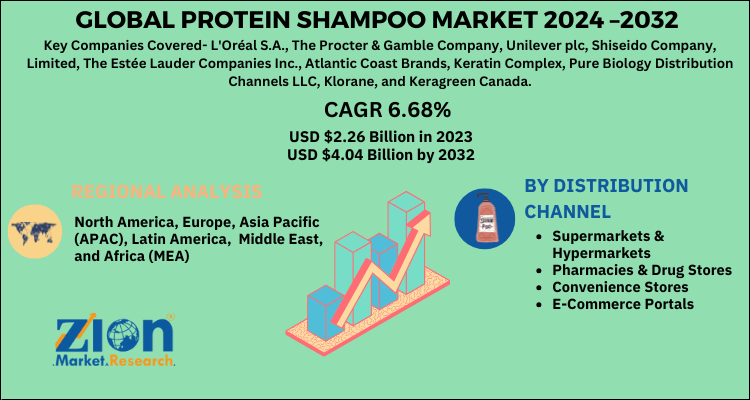
| Key Companies Covered | L'Oréal S.A., The Procter & Gamble Company, Unilever plc, Shiseido Company, Limited, The Estée Lauder Companies Inc., Atlantic Coast Brands, Keratin Complex, Pure Biology Distribution Channels LLC, Klorane, and Keragreen Canada |
| Segments Covered | By Product Type, By Application, By End-User, By Distribution Channel, and By Region |
| Regions Covered | North America, Europe, Asia Pacific (APAC), Latin America, Middle East, and Africa (MEA) |
| Base Year | 2023 |
| Historical Year | 2018 - 2022 |
| Forecast Year | 2024 - 2032 |
| Customization Scope | Avail customized purchase options to meet your exact research needs. Request For Customization |
Protein Shampoo Market: Segmentation
The protein shampoo market is segmented by product type, application, end-user, distribution channel, and region. All the segments of the protein shampoo market have been analyzed based on present and future trends and the market is estimated from 2024 to 2032.
Based on Product Type, the protein shampoo market is divided into hydrolyzed protein shampoo, keratin protein shampoo, silk protein shampoo, wheat protein shampoo, and others. The keratin protein shampoo segment leads the category because of its close structural similarity to human hair protein, enabling effective penetration, reconstruction of damaged bonds, and visible improvements in strength and smoothness. This dominance drives market growth by reinforcing consumer confidence in science-backed repair solutions and encouraging premium product development. Hydrolyzed protein shampoo ranks as the second major category due to its smaller molecular size that allows deeper absorption and versatility across hair types; its contribution supports broader accessibility and innovation in everyday strengthening formulas that expand overall category usage.
Based on Application, the protein shampoo market is divided into hair repair, hair growth, anti-dandruff, and others. The hair repair segment dominates as the primary application because of widespread hair damage from coloring, bleaching, heat tools, and environmental stressors, creating sustained demand for restorative protein treatments. This focus propels market expansion through continuous product launches centered on bond-building and anti-breakage claims. Hair growth forms the second leading application, supported by rising interest in volume, thickness, and scalp-nourishing benefits; its growth stimulates research into multi-benefit formulations that combine protein delivery with other active ingredients, further elevating category appeal.
Based on End-User, the protein shampoo market is divided into women, men, and unisex. The women segment represents the dominant end-user group owing to higher frequency of hair treatments, greater investment in specialized care, and stronger responsiveness to repair and strengthening messaging. This leadership drives overall market volume and encourages brands to prioritize female-focused innovation and marketing. Men constitute an important secondary group with rising grooming awareness and demand for simplified strengthening solutions; their increasing participation supports category diversification and the development of gender-neutral or male-specific protein formulas that broaden the total addressable market.
Based on Distribution Channel, the protein shampoo market is divided into supermarkets/hypermarkets, online stores, specialty stores, and others. Supermarkets/hypermarkets segment holds the largest share of over 35% because of extensive store networks, high consumer footfall, and the ability to offer a wide assortment of brands at accessible price points. This channel leadership fuels market growth by ensuring everyday availability and impulse purchases. Online stores rank as the second key channel, benefiting from convenience, detailed product information, subscription models, and rapid expansion of e-commerce platforms; their rise accelerates discovery of specialized protein formulas and supports direct-to-consumer brand strategies.
Protein Shampoo Market: Regional Analysis
Why will North America continue to dominate the global market during the projection period?
North America is expected to maintain its leading position throughout the forecast period. The region benefits from elevated consumer awareness of advanced hair care science, high disposable incomes that support premium product purchases, and a mature retail ecosystem spanning mass, specialty, and digital channels. The presence of major global manufacturers drives continuous innovation in keratin, hydrolyzed, and multi-protein technologies tailored to local preferences. Strong influence of professional stylists and social media further accelerates adoption of restorative formulas. These factors collectively enable North America to set product trends, elevate quality standards, and propel overall market growth through sustained demand for high-performance protein shampoo solutions.
Europe remains a significant market characterized by strong preference for natural, sustainable, and clean-label formulations. Consumers in key countries demonstrate high engagement with hair health and ethical beauty, encouraging brands to invest in plant-based proteins and transparent ingredient lists. Regulatory emphasis on product safety and environmental claims supports premiumization and innovation that contribute to regional expansion.
Asia Pacific is positioned for robust growth driven by expanding middle-class populations, rising beauty consciousness, and increasing disposable incomes in major economies. Growing exposure to global beauty trends and rapid digital retail development facilitate wider access to specialized protein shampoos. Climatic and hair-type diversity in the region further stimulates demand for customized repair and strengthening products.
Recent Developments
- In October 2026, Unilever advanced its Nexxus Keraphix range with Keratin Resistance Therapy technology, delivering measurable improvements in hair strength and softness based on extensive proteomic research and multiple pending patents.
- In 2025, Procter & Gamble highlighted strong stylist endorsement for Pantene Repair & Protect, with a majority of UK hairstylists recommending the system after trial use focused on protein-supported repair benefits.
Protein Shampoo Market: Competitive Analysis
The global protein shampoo market is dominated by players:
- L'Oréal S.A.
- The Procter & Gamble Company
- Unilever plc
- Shiseido Company Limited
- The Estée Lauder Companies Inc.
- Atlantic Coast Brands
- Keratin Complex
- Pure Biology Distribution Channels LLC
- Klorane
- Keragreen Canada.
Segments Covered
The global protein shampoo market is segmented as follows:
By Product Type
- Hydrolyzed Protein Shampoo
- Keratin Protein Shampoo
- Silk Protein Shampoo
- Wheat Protein Shampoo
- Others
By Application
- Hair Repair
- Hair Growth
- Anti-Dandruff
- Others
By End-User
- Women
- Men
- Unisex
By Distribution Channel
- Supermarkets/Hypermarkets
- Online Stores
- Specialty Stores
- Others
By Region
- North America
- The U.S.
- Canada
- Mexico
- Europe
- France
- The UK
- Spain
- Germany
- Italy
- Rest of Europe
- Asia Pacific
- China
- Japan
- India
- Australia
- South Korea
- Rest of Asia Pacific
- The Middle East & Africa
- Saudi Arabia
- UAE
- Egypt
- Kuwait
- South Africa
- Rest of the Middle East & Africa
- Latin America
- Brazil
- Argentina
- Rest of Latin America
Table Of Content
Methodology
FrequentlyAsked Questions
Protein shampoo is a specialized hair cleansing product enriched with proteins such as keratin, hydrolyzed proteins, silk, or wheat derivatives that strengthen hair fibers, repair damage, improve elasticity, and support overall hair health.
Key growth drivers include rising awareness of hair damage from styling and environmental factors, increasing demand for restorative and strengthening formulations, and expanding consumer preference for protein-enriched products that deliver visible repair benefits.
The global protein shampoo market size was valued at approximately USD 2.26 billion in 2023 and is projected to reach around USD 4.04 billion by 2032.
The global protein shampoo market is expected to grow at a compound annual growth rate (CAGR) of approximately 6.68% during the forecast period from 2024 to 2032.
North America is expected to contribute notably and lead the global protein shampoo market during the forecast period, supported by high consumer awareness, strong purchasing power, and continuous product innovation.
Major players include L'Oréal S.A., The Procter & Gamble Company, Unilever plc, Shiseido Company, Limited, The Estée Lauder Companies Inc., Atlantic Coast Brands, Keratin Complex, Pure Biology Distribution Channels LLC, Klorane, and Keragreen Canada.

HappyClients

