
Pillow Packing Machine Market Size, Growth, Global Trends, Forecast 2034

Pillow Packing Machine Market By Machine Type (Horizontal Flow Wrappers, Vertical Form Fill Seal Machines, Rotary Pillow Pack Machines, Continuous Motion Wrappers, Intermittent Motion Wrappers), By Automation Level (Fully Automatic, Semi-Automatic, Manual), By End-User Industry (Food and Beverage, Pharmaceuticals, Personal Care and Cosmetics, Consumer Electronics, Industrial and Hardware), By Distribution Channel (Direct Sales, Distributors and Dealers, Online Procurement), and By Region – Global and Regional Industry Overview, Market Intelligence, Comprehensive Analysis, Historical Data, and Forecasts 2025 - 2034-
| Market Size in 2024 | Market Forecast in 2034 | CAGR (in %) | Base Year |
|---|---|---|---|
| USD 2.59 Billion | USD 4.18 Billion | 5.47% | 2024 |
Pillow Packing Machine Industry Perspective:
What is the expected size of the pillow packing machine market during the forecast period?
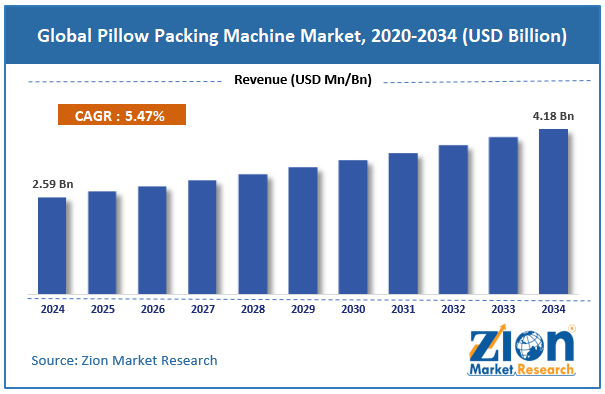
The global pillow packing machine market size was worth approximately USD 2.59 billion in 2024 and is projected to grow to around USD 4.18 billion by 2034, with a compound annual growth rate (CAGR) of roughly 5.47% between 2025 and 2034.
Key Insights
- As per the analysis shared by our research analyst, the global pillow packing machine market is estimated to grow annually at a CAGR of around 5.47% over the forecast period (2025 to 2034).
- In terms of revenue, the global pillow packing machine market size was valued at approximately USD 2.59 billion in 2024 and is projected to reach USD 4.18 billion by 2034.
- The pillow packing machine market is expected to grow due to rising demand for packaged goods, increased automation, stricter safety standards, expanding e-commerce, and wider use in the pharmaceutical and personal care industries.
- Based on machine type, the horizontal flow wrapper segment is expected to lead the pillow packing machine market, while the vertical form-fill-seal segment is anticipated to grow rapidly.
- Based on automation level, the fully automatic segment is expected to lead the pillow packing machine market. In contrast, the semi-automatic segment is anticipated to grow steadily among small and medium-sized manufacturers.
- Based on end-user industry, the food and beverage segment is the largest, while the pharmaceutical segment is growing and commercially significant.
- Based on distribution channel, the direct sales segment is expected to lead the pillow packing machine market. In contrast, the online procurement segment is anticipated to grow steadily as digital buying habits expand.
- Based on region, the Asia Pacific is projected to dominate the global pillow packing machine market during the estimated period, followed by Europe.
Pillow Packing Machine Market: Overview
A pillow packing machine is an automatic machine that packs products into sealed pouches with pillow-like ends. It uses a roll of packaging film to form a tube, places the product inside, and then seals and cuts it into individual packs. The final pack is clean, compact, and ready for sale or transport. These machines typically use materials like plastic films, laminated films, or foil-based packaging, depending on the product type. This type of packaging is commonly used for items like biscuits, chocolates, soap bars, medicines, and snacks. These machines are widely used in food factories, pharmaceutical plants, and consumer goods manufacturing units. They come in different sizes and speeds to meet a range of production needs, from small-scale operations to large industrial setups. Modern machines use advanced features such as servo motors, digital controls, and automatic film tracking to ensure smooth operation and reduce waste. The pillow packing machine industry is growing as demand for packaged products increases worldwide. Industries are moving toward automation to improve efficiency and reduce labor costs. At the same time, companies are focusing on better packaging for product safety and visual appeal. Growth is strong in food, pharmaceuticals, and consumer goods, especially in developing regions.
The growing global appetite for packaged products, the push toward factory automation, stricter food safety and hygiene packaging standards, the boom in e-commerce, and the ongoing expansion of pharmaceutical and personal care manufacturing are all driving growth in the pillow packing machine market.
Pillow Packing Machine Market: Technology Roadmap 2025 to 2034
What key trends and future developments will drive the pillow packing machine market during the forecast period?
The pillow packing machine market is shaped by digital controls, automation, connected systems, growing food and pharmaceutical production, and the need for faster, low-waste machines. The market is expected to grow at a CAGR of around 5.47% over the forecast period, supported by strong demand across the food processing, pharmaceutical production, personal care manufacturing, and industrial goods packaging sectors.
The following roadmap outlines key development phases expected during the forecast period.
2025–2027: Smart Controls and Flexible Packaging Phase
- Pillow packing machines are expected to adopt touchscreen controls, making it easier for operators to switch between products and settings quickly without technical support.
- Servo motor systems are likely to replace older mechanical systems, improving speed, reducing waste, and ensuring better packaging quality.
- Vision inspection cameras are expected to become common, helping automatically detect defects such as poor sealing or incorrect product placement.
2028–2031: Connected Production and Predictive Maintenance Phase
- Machines are expected to connect with factory software, allowing real-time tracking of production, performance, and output from remote locations.
- Predictive maintenance systems are likely to analyze machine data to detect issues early, reducing downtime and extending machine lifespan.
- Augmented reality tools are projected to support remote training and servicing, making it easier for operators to learn and fix machines.
2032–2034: Fully Automated and Sustainable Packaging Phase
- Pillow packing machines are expected to become fully integrated with other production systems, enabling smooth and automated operations.
- Machines are likely to support eco-friendly packaging materials like recycled, compostable, and paper-based films.
- Artificial intelligence is projected to adjust machine settings in real time, improving efficiency and reducing material waste.
Pillow Packing Machine Market: Dynamics
Growth Drivers
The growing global demand for packaged food and consumer goods is driving the pillow packing machine market.
The pillow packing machine market is growing strongly due to the rising global demand for packaged food and consumer goods. More people are buying ready-to-eat snacks, biscuits, chocolates, instant meals, cereals, personal care items, and basic medicines as daily consumption habits continue to change. This shift is supported by urbanization, higher incomes, and the rapid growth of supermarkets, convenience stores, and online delivery platforms. As a result, companies need efficient packaging solutions that can handle large volumes while maintaining product safety and visual appeal. Food manufacturers are expanding their production capacity and upgrading packaging systems to meet this increasing demand. They prefer machines that are fast, reliable, easy to operate, and capable of handling a variety of product types without frequent adjustments. Pillow packing machines meet these needs by offering high-speed packaging, flexibility with different materials, and consistent output with minimal errors. As global consumption of packaged goods continues to rise across both developed and developing markets, the demand for pillow packing machines is expected to grow steadily.
What role does the expansion of factory automation play in driving demand for pillow packing machines?
The pillow packing machine market is growing rapidly as the shift toward factory automation across industries such as food, pharmaceuticals, personal care, and industrial goods intensifies. Many manufacturers are replacing manual packaging with automated systems to reduce labor costs, improve consistency, lower contamination risks, and increase production speed. In many regions, rising wages, shortage of skilled labor, and strong market competition are making automation a necessity rather than a choice. Pillow packing machines are among the most practical and cost-effective automation solutions available, suitable for manufacturers of all sizes.
Even compact, semi-automatic machines can significantly improve packaging speed and quality for businesses that previously relied on manual labor. As machine costs become more affordable and financing options improve, more small and medium businesses in developing countries are adopting these systems. Governments in countries like India, Vietnam, Indonesia, and Mexico are also supporting this shift through industrial policies, incentives, and infrastructure development. These factors together are creating strong and consistent growth drivers for the pillow packing machine industry.
Restraints
The high upfront equipment costs and a shortage of skilled operators’ slow growth in the pillow packing machine market.
The pillow packing machine industry faces several restraints that slow down adoption, especially among small businesses and price-sensitive markets. The initial cost of buying and installing a high-quality machine can be high, and additional expenses such as staff training, maintenance, packaging materials, and infrastructure upgrades increase the total investment. Many small manufacturers find it difficult to manage these costs, which limits their ability to adopt automated packaging solutions. Another key challenge is the shortage of skilled workers who can operate and maintain these advanced machines.
Modern pillow packing machines use digital controls, sensors, and automated systems that require proper training to operate. In regions with limited technical education, finding qualified operators and technicians can be difficult. When machines face issues or require maintenance, delays in getting expert support can lead to longer downtime and reduced production efficiency. These factors create uneven adoption across different regions and business sizes, acting as a barrier to faster growth in the pillow packing machine market.
Opportunities
What opportunities is the growth of the pharmaceutical and personal care sectors creating for the pillow packing machine market?
The pillow packing machine market is experiencing strong growth driven by the rapid expansion of the pharmaceutical and personal care industries worldwide. These sectors are expanding due to aging populations, higher health awareness, and increasing spending on hygiene, wellness, and beauty products. Pillow packing machines are widely used to pack items such as tablets, sachets, wet wipes, soap bars, sanitary products, and small cosmetic packs that require clean and sealed packaging. These industries offer high-value opportunities because buyers focus more on quality, hygiene, and compliance over price alone. Pharmaceutical companies require machines that can operate in clean environments, create airtight seals, and support tracking systems to meet strict regulations in regions such as Europe, the United States, and Japan. This allows machine manufacturers to offer advanced solutions and earn better profit margins.
In addition, the growth of contract manufacturing companies in the pharmaceutical and cosmetics industries is driving demand for flexible packaging machines that can efficiently handle diverse products. These trends are creating strong and long-term growth opportunities for the pillow packing machine market.
Challenges
How do film compatibility issues and counterfeit spare parts affect the pillow packing machine market?
The pillow packing machine market faces several ongoing challenges that affect machine performance and long-term reliability. One major issue is the shift toward sustainable packaging materials such as thinner films, recycled laminates, biodegradable plastics, and paper-based options. Many existing machines were designed for traditional plastic films, so they often require adjustments or upgrades to handle these new materials properly, increasing costs and creating operational difficulties. Another challenge is the growing use of low-quality or counterfeit spare parts in some markets, where original components are expensive or hard to access. These parts may fail quickly, damage machines, and affect product quality, especially in food and pharmaceutical applications.
In addition, limited after-sales support in certain regions makes it harder for operators to resolve issues quickly, resulting in longer downtime and reduced productivity. To overcome these challenges, manufacturers need to invest in better service networks, a reliable spare-parts supply, and improved customer support systems in the pillow packing machine market.
Pillow Packing Machine Market: Report Scope
| Report Attributes | Report Details |
|---|---|
| Report Name | Pillow Packing Machine Market |
| Market Size in 2024 | USD 2.59 Billion |
| Market Forecast in 2034 | USD 4.18 Bllion |
| Growth Rate | CAGR of 5.47% |
| Number of Pages | 226 |
| Key Companies Covered | Bosch Packaging Technology, Coesia Group (IMA and ILAPAK), Omori Machinery, Ishida Company Limited, Hayssen Flexible Systems, Fuji Machinery, Cavanna Packaging Group, Cryovac (Sealed Air Corporation), PFM Packaging Machinery, Ola Packaging, and others. |
| Segments Covered | By Machine Type, By Automation Level, By End-User Industry, By Distribution Channel, and By Region |
| Regions Covered | North America, Europe, Asia Pacific (APAC), Latin America, Middle East, and Africa (MEA) |
| Base Year | 2024 |
| Historical Year | 2019 to 2023 |
| Forecast Year | 2025 - 2034 |
| Customization Scope | Avail customized purchase options to meet your exact research needs. Request For Customization |
Pillow Packing Machine Market: Segmentation
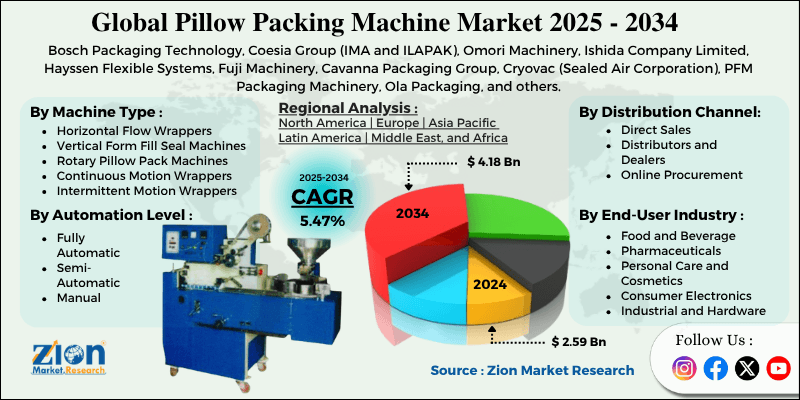
The global pillow packing machine market is segmented based on machine type, automation level, end-user industry, distribution channel, and region.
What makes horizontal flow wrappers the leading machine type in the pillow packing machine market?
Based on machine type, the global pillow packing machine industry is segregated into horizontal flow wrappers, vertical form-fill-seal machines, rotary pillow pack machines, continuous motion wrappers, and intermittent motion wrappers. The horizontal flow wrapper segment accounted for approximately 38% of the global market share and is expected to lead the market during the forecast period. Horizontal flow wrappers lead because they are the most versatile format available, able to handle virtually every type of solid food product, pharmaceutical item, and consumer good, regardless of shape or rigidity. The vertical form-fill-seal machine segment is growing rapidly. It holds approximately 24% of the market share, driven by strong demand for packaging powders, granules, and liquids across food, agricultural, and pharmaceutical applications.
Why does the fully automatic segment dominate the automation level category in the pillow packing machine market?
Based on the level of automation, the pillow packing machine industry is classified into fully automatic, semi-automatic, and manual machines. The fully automatic segment accounts for nearly 57% of the global market share. Fully automatic machines lead due to high output, low labor needs, consistent quality, and increasing affordability. The semi-automatic segment holds around 30% of the market share, valued for its lower purchase price, simpler operating requirements, and practical suitability for small- and medium-scale manufacturers automating their packaging processes for the first time.
How does the food and beverage segment lead the pillow packing machine market as the main end-user?
Based on end-user industry, the market is divided into food and beverage, pharmaceuticals, personal care and cosmetics, consumer electronics, and industrial and hardware sectors. The food and beverage segment accounts for around 43% of the total market share. It leads because the food industry produces an enormous volume and variety of products daily, all of which require fast, hygienic, and visually appealing packaging before they reach stores and consumers. The pharmaceutical segment holds around 22% of the market share, driven by the global medicines and healthcare products industry, where packaging integrity, sterility, and regulatory compliance are non-negotiable requirements.
Why does the direct sales channel lead in the distribution of pillow packing machines?
Based on distribution channel, the pillow packing machine market is categorized into direct sales, distributors, dealers, and online procurement. The direct sales segment accounts for approximately 51% of global market share, driven by buyers who prefer to deal directly with manufacturers for specifications, testing, installation, and service support. The online procurement segment holds around 19% of the market share. It is growing as familiarity with digital purchasing increases, particularly for standard machine models, replacement parts, and consumable packaging film rolls that buyers can order repeatedly without requiring hands-on evaluation.
Pillow Packing Machine Market: Regional Analysis
Why does Asia Pacific lead the global pillow packing machine market?
The pillow packing machine market is led by Asia Pacific, which is expected to account for about 39.2% of global demand and remain the top region during the forecast period. The region leads because it has the largest and fastest-growing industries in food processing, pharmaceuticals, and consumer goods manufacturing. China plays the biggest role, with very high domestic demand and a strong export-driven manufacturing sector that requires large volumes of packaging machines. Chinese companies also produce pillow packing machines and supply them to both local and international markets, especially in developing countries. India is another key market, supported by the rapid growth of its food processing and pharmaceutical sectors, as well as rising demand for packaged products driven by increasing incomes and urbanization. Countries such as Vietnam, Thailand, Indonesia, Malaysia, and the Philippines are also seeing strong growth as foreign investments increase and local consumption rises. Japan and South Korea remain important sources of advanced, high-quality packaging machines used in precision industries. The region also benefits from strong government support for industrial development, infrastructure improvements, and export growth. These combined factors make Asia Pacific the leading and most dynamic region in the global pillow packing machine market.
What supports Europe's strong position in the global pillow packing machine market?
The pillow packing machine market ranks Europe as the second-largest region, accounting for about 23.8% of global demand and showing steady growth due to its strong engineering base and advanced manufacturing capabilities. The region is known for producing high-quality packaging machines, especially in countries like Germany, Italy, the Netherlands, and Switzerland, where manufacturers focus on precision, reliability, and advanced technology. These machines meet strict food safety, pharmaceutical, and environmental standards, which support both strong domestic use and global exports. The food processing industry in Western Europe is well developed and highly automated, with companies regularly upgrading equipment to improve efficiency and comply with changing regulations. Germany and Italy lead in machine production, while countries like the United Kingdom, France, Spain, and the Scandinavian nations are major users of these machines. Europe also has a highly demanding pharmaceutical packaging sector that requires strong sealing, high hygiene standards, and full product traceability, driving demand for advanced pillow-packaging machines.
Sustainability is another key factor, as buyers prefer machines that can work with recyclable and eco-friendly packaging materials. Eastern Europe is also growing as manufacturing expands. Strong regulatory frameworks and continuous innovation further strengthen Europe’s position as the second leading region in the global pillow packing machine market.
Recent Market Developments
- In August 2025, Syntegon Technology also introduced the Pack 301 flow wrapping system, capable of handling multiple product shapes and achieving speeds of up to 250 packs per minute, targeting high-volume biscuit and confectionery production lines.
Pillow Packing Machine Market: Competitive Analysis
The leading players in the global pillow packing machine market are:
- Bosch Packaging Technology
- Coesia Group (IMA and ILAPAK)
- Omori Machinery
- Ishida Company Limited
- Hayssen Flexible Systems
- Fuji Machinery
- Cavanna Packaging Group
- Cryovac (Sealed Air Corporation)
- PFM Packaging Machinery
- Ola Packaging
The Global Pillow Packing Machine Market is Segmented as Follows:
By Machine Type
- Horizontal Flow Wrappers
- Vertical Form Fill Seal Machines
- Rotary Pillow Pack Machines
- Continuous Motion Wrappers
- Intermittent Motion Wrappers
By Automation Level
- Fully Automatic
- Semi-Automatic
- Manual
By End-User Industry
- Food and Beverage
- Pharmaceuticals
- Personal Care and Cosmetics
- Consumer Electronics
- Industrial and Hardware
By Distribution Channel
- Direct Sales
- Distributors and Dealers
- Online Procurement
By Region
- North America
- The U.S.
- Canada
- Mexico
- Europe
- France
- The UK
- Spain
- Germany
- Italy
- Rest of Europe
- Asia Pacific
- China
- Japan
- India
- Australia
- South Korea
- Rest of Asia Pacific
- The Middle East & Africa
- Saudi Arabia
- UAE
- Egypt
- Kuwait
- South Africa
- Rest of the Middle East & Africa
- Latin America
- Brazil
- Argentina
- Rest of Latin America
Table Of Content
Methodology
FrequentlyAsked Questions
A pillow packing machine is automated packaging equipment that wraps products inside a sealed, pillow-shaped pouch made from flexible packaging film. These machines are used in food, pharmaceutical, personal care, and consumer goods manufacturing to package products quickly, hygienically, and at high volumes.
The global pillow packing machine market is projected to grow due to rising global consumption of packaged food and consumer goods, rapid expansion of factory automation across developing and developed economies, increasing food safety and hygiene packaging requirements, strong growth in pharmaceutical and personal care manufacturing, and the ongoing expansion of e-commerce and organized retail networks that demand faster and better packaging solutions.
According to the study, the global pillow packing machine market size was worth around USD 2.59 billion in 2024 and is predicted to grow to around USD 4.18 billion by 2034.
The CAGR value of the pillow packing machine market is expected to be around 5.47% during 2025 to 2034.
Asia Pacific is expected to lead the global pillow packing machine market during the forecast period, supported by the massive scale of food processing, pharmaceutical, and consumer goods manufacturing activity across China, India, and Southeast Asia.
The major players profiled in the global pillow packing machine market include Bosch Packaging Technology, Coesia Group, Omori Machinery, Ishida Company Limited, Hayssen Flexible Systems, Fuji Machinery, Cavanna Packaging Group, Cryovac, PFM Packaging Machinery, and Ola Packaging.
The report examines key aspects of the pillow packing machine market, including a detailed analysis of current growth drivers and constraints, emerging opportunities, significant challenges facing manufacturers and end users, a competitive landscape overview, regional market breakdowns, and a forward-looking outlook across all major machine types, automation levels, end-user industries, and geographies.
The pillow packing machine market is influenced by strict food safety, pharmaceutical packaging regulations, and environmental policies promoting recyclable and biodegradable materials, pushing manufacturers to develop machines compatible with sustainable films and compliant with global hygiene and traceability standards.
The pillow packing machine market will be shaped by economic growth, rising labor costs, and industrial investments, with expanding manufacturing activity and increasing demand for automation supporting steady global market expansion.
The pillow packing machine market is highly competitive, with global players focusing on automation, innovation, and service support. At the same time, regional manufacturers compete on pricing, customization, and accessibility, creating a mix of high-end technology providers and cost-effective local suppliers.

HappyClients

