
Physical Identity And Access Management Market Size and Forecast 2034

Physical Identity And Access Management Market By Offering (Software and Services), By Product (Backend Database Solutions, Credential Management and Visitor Management), By Application (BFSI, Defense & Security, Airports, IT & Telecom, Government & Public Sector, Industrial and Others) and By Region - Global and Regional Industry Overview, Market Intelligence, Comprehensive Analysis, Historical Data, and Forecasts 2025 - 2034
| Market Size in 2024 | Market Forecast in 2034 | CAGR (in %) | Base Year |
|---|---|---|---|
| USD 1.4 Billion | USD 5.9 Billion | 15.5% | 2024 |
Physical Identity And Access Management Industry Perspective:
What will be the size of the global physical identity and access management market during the forecast period?
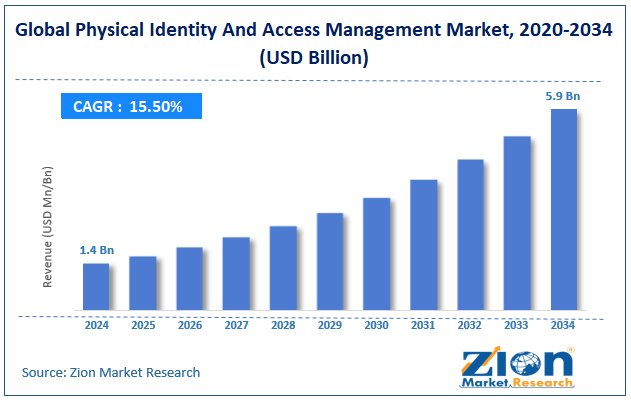
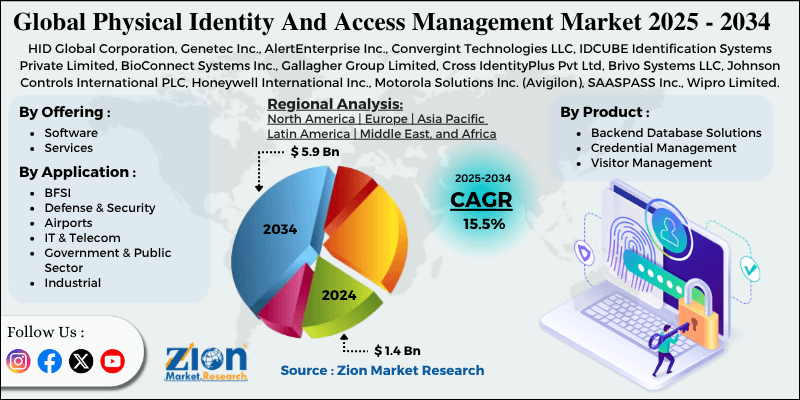
The global physical identity and access management market size was worth around USD 1.4 billion in 2024 and is predicted to grow to around USD 5.9 billion by 2034 with a compound annual growth rate (CAGR) of roughly 15.5% between 2025 and 2034.
Key Insights
- As per the analysis shared by our research analyst, the global physical identity and access management market is estimated to grow annually at a CAGR of around 15.5% over the forecast period (2025-2034).
- In terms of revenue, the global physical identity and access management market size was valued at around USD 1.4 billion in 2024 and is projected to reach USD 5.9 billion by 2034.
- Growth of smart buildings & infrastructure is expected to propel the physical identity and access management market over the projected period.
- Based on the offering, the software segment captures the largest market share in 2024 of 60%.
- Based on the product, the backend database solutions segment captures the largest revenue share in 2024.
- Based on the application, the BFSI segment captures the largest revenue share in 2024.
- Based on region, North America accounted for the largest market share of 38% in 2024.
Physical Identity And Access Management Market: Overview
Physical Identity and Access Management is an all-inclusive security strategy that facilitates and controls people’s entry to physical premises using their identified credentials. This security system integrates information related to individual identification, retrieved from HR databases or other directories, with physical security systems such as badge access, biometric verification, and surveillance to allow only authorized employees to enter particular areas at specific times. This system automates all processes involved in the identity lifecycle, which include identity verification, onboarding, provisioning of access rights, continuous monitoring, and access revocation.
Impact of the USA-Israel War on Iran on the Physical Identity And Access Management Market
The dispute between the US and Israel with Iran (2026) is related to the PIAM industry and can be viewed as a major driver of demand growth and the challenges that arise during the technological implementation process. In this case, the growing number of attacks against critical infrastructure heightens threat levels, making physical and cyber threats an inherent part of contemporary military operations. This situation requires more reliable physical access controls, identification verification systems, and enhanced management of personnel and resource movement. Moreover, damaged infrastructure and heightened geopolitical tensions in the Middle East underscore the need for improved identity governance and robust perimeter control measures, which favor the development of PIAM technologies.
On the other hand, the discussed confrontation also exerts an indirect influence on the market, as it increases complexity and costs associated with deploying new technologies. In particular, the rapid rise in cyberattacks and ongoing disruptions to the Internet infrastructure make the combination of physical and digital identities challenging.
Physical Identity And Access Management Market: Dynamics
Growth Drivers
Why does the growing security threats & insider risks drive the physical identity and access management market?
The emergence of growing security threats and insider risks is one of the most powerful catalysts pushing the market for PIAM forward. The presence of security threats and insider risks reveals the weaknesses of existing access control systems and underscores the pressing need for a more identity-focused approach to security. With modern organizations facing mounting risks such as unauthorized access, data breaches, acts of sabotage, and violence at work, whether perpetrated by outsiders or even people within the organization (e.g., employees, contractors, or vendors), traditional access control systems (e.g., single-factor access cards or manual log books) are incapable of providing the necessary data on what was accessed, how, when, and why. PIAM compensates for the deficiencies of these outdated systems by ensuring that access rights are based on the individual's identity and can be easily modified to meet organizational needs.
Another factor that plays an important role in the development of the PIAM industry is the difficulty of detecting and mitigating insider risks. As insiders are already authorized personnel, misuse of access such as unauthorized entry into restricted areas or access outside office hours is unlikely to be detected in time using traditional approaches to access management.
Restraints
Lack of skilled professionals hindering the physical identity and access management industry growth
Limited availability of professional skills is one of the major constraints on growth in the PIAM sector, as these tools involve complex implementation and integration processes that require the involvement of specialists proficient in these fields. The PIAM solutions combine physical security technologies and IAM capabilities, so companies should hire people with experience in both areas. Unfortunately, such skills are in short supply worldwide, as qualified professionals who can handle the integration of PIAM technology, identity lifecycle management, cybersecurity issues, and other tasks in this direction are quite rare. There are several reasons why this problem delays the growth of the PIAM market.
In the first place, many businesses find it difficult to implement and integrate such technology due to its complexity. Moreover, without skilled professionals involved, this process becomes lengthy, costly, and troublesome. Another reason is that managing PIAM tools after installation requires significant time and effort, which companies may not always provide.
Opportunities
How does the rising platform expansion by the key market players offer a lucrative opportunity for the physical identity and access management market?
The expanding platform presence of key market players is expected to create opportunities for the physical identity and access management market. For instance, in June 2025, Veza, the identity security company, announced a significant platform expansion focused on securing Non-Human Identities (NHIs). The new NHI Security product and capabilities deliver visibility, ownership, and governance to machine identities such as service accounts, secrets, keys, and workloads across SaaS, cloud, infrastructure, and on-premises environments.
As enterprises rush to adopt AI, they’re unleashing a flood of machine identities faster than anyone can control. Every model, training run, and inference call spins up new credentials that access sensitive data and systems. These AI workloads don’t just add scale; they introduce chaos. Machine identities now outnumber humans 17 to 1, and most are invisible, ownerless, and dangerously overprivileged. They're powering core business processes, yet flying completely under the radar. Worse, threat actors like Volt Typhoon are deliberately targeting identity as their primary attack surface.
Challenges
Why does the complexity of integration with existing systems pose a significant challenge to the physical identity and access management market?
The difficulty of applying the PIAM system with existing technologies stems from the need to integrate systems that were not originally designed for integration, since most businesses use several technology systems, none of which are designed for interoperability. This means that integrating PIAM would require working with multiple systems simultaneously, including access control equipment, an IT identity management system, HR, a visitor management system, and even surveillance solutions. Each of these systems comes from another vendor, with its own protocols and data structures, which necessitates custom coding and significantly prolongs the project's implementation.
Moreover, some legacy technologies lack APIs, making the synchronization of identity information challenging. For instance, when an employee leaves the company, it may take quite some time to make all necessary changes across systems to revoke their access to sensitive resources. Technical integration of all legacy technologies with PIAM is definitely a difficult task.
Physical Identity And Access Management Market: Report Scope
| Report Attributes | Report Details |
|---|---|
| Report Name | Physical Identity And Access Management Market |
| Market Size in 2024 | USD 1.4 Billion |
| Market Forecast in 2034 | USD 5.9 Billion |
| Growth Rate | CAGR of 15.5% |
| Number of Pages | 228 |
| Key Companies Covered | HID Global Corporation, Genetec Inc., AlertEnterprise Inc., Convergint Technologies LLC, IDCUBE Identification Systems Private Limited, BioConnect Systems Inc., Gallagher Group Limited, Cross IdentityPlus Pvt Ltd, Brivo Systems LLC, Johnson Controls International PLC, Honeywell International Inc., Motorola Solutions Inc. (Avigilon), SAASPASS Inc., Wipro Limited, IBM Corporation, and others. |
| Segments Covered | By Offering, By Product, By Application, and By Region |
| Regions Covered | North America, Europe, Asia Pacific (APAC), Latin America, Middle East, and Africa (MEA) |
| Base Year | 2024 |
| Historical Year | 2019 to 2023 |
| Forecast Year | 2025 - 2034 |
| Customization Scope | Avail customized purchase options to meet your exact research needs. Request For Customization |
Physical Identity And Access Management Market: Segmentation
Offering Insights
Why does the software dominate the physical identity and access management market?
The software segment captures the largest market share in 2024 of 60%. Organizations will always have different security requirements depending on their size and industry. Software solutions for physical identity and access management that can be custom-made to an organization's requirements and scalable as the organization grows are highly appreciated. Software solutions that can scale up and accommodate diverse demands without excessive maintenance are what organizations look for.
Product Insights
Do the backend database solutions capture the largest market share in the physical identity and access management market?
The backend database solutions segment captures the largest revenue share in 2024. By combining back-end databases with analytics and reporting capabilities, organizations can analyze usage patterns, evaluate system performance, and identify security weaknesses. Modern database technologies provide advanced query and mining capabilities, enabling the generation of analytical reports and dashboards. Using data to secure and optimize IT infrastructure drives demand for back-end databases in the physical ID and access management space.
Application Insights
Why do BFSI capture the largest market share in the physical identity and access management market?
The BFSI segment captures the largest revenue share in 2024. The growing frequency of threats such as identity theft, fraudulent transactions, and hacking into financial networks has heightened the need for robust security systems. A physical identity and access management solution offers a common framework through which an organization can control physical access to its critical sites and integrates with the cybersecurity system to form a comprehensive security system. Integration of the two security methods is necessary for the timely detection and handling of any security threats. Due to the increasing frequency of threats, the BFSI sector is increasingly adopting physical identity and access management solutions.
Regional Insights
Why does North America lead the physical identity and access management market?
North America accounted for the largest market share, 38%, in 2024. As attacks against organizations, whether physical or cyber, have increased, there is now a greater demand for highly efficient security systems. In North America, companies are concerned with safeguarding their assets and personnel against potential attacks, and thus physical identity and access control systems are vital to enhancing the physical security of these firms. On the other hand, the Asia Pacific is expected to grow at the highest CAGR during the forecast period. The emergence of telecommuting and flexible work structures has altered organizational access control processes.
Employees work from multiple locations and enter buildings only when necessary. This has made it essential to adopt physical identity and access management solutions that can respond to such shifts in organizational access control needs. Physical identity and access management have become necessary in light of evolving workplace environments.
Physical Identity And Access Management Market: Competitive Analysis
The global physical identity and access management market is dominated by players like:
- HID Global Corporation
- Genetec Inc.
- AlertEnterprise Inc.
- Convergint Technologies LLC
- IDCUBE Identification Systems Private Limited
- BioConnect Systems Inc.
- Gallagher Group Limited
- Cross IdentityPlus Pvt Ltd
- Brivo Systems LLC
- Johnson Controls International PLC
- Honeywell International Inc.
- Motorola Solutions Inc. (Avigilon)
- SAASPASS Inc.
- Wipro Limited
- IBM Corporation
The global physical identity and access management market is segmented as follows:
By Offering
- Software
- Services
By Product
- Backend Database Solutions
- Credential Management
- Visitor Management
By Application
- BFSI
- Defense & Security
- Airports
- IT & Telecom
- Government & Public Sector
- Industrial
- Others
By Region
- North America
- The U.S.
- Canada
- Mexico
- Europe
- France
- The UK
- Spain
- Germany
- Italy
- Rest of Europe
- Asia Pacific
- China
- Japan
- India
- Australia
- South Korea
- Rest of Asia Pacific
- The Middle East & Africa
- Saudi Arabia
- UAE
- Egypt
- Kuwait
- South Africa
- Rest of the Middle East & Africa
- Latin America
- Brazil
- Argentina
- Rest of Latin America
Table Of Content
Methodology
FrequentlyAsked Questions
Physical Identity and Access Management is an all-inclusive security strategy that facilitates and controls people’s entry to physical premises using their identified credentials.
Key growth drivers for the Physical Identity and Access Management (PIAM) market include rising security threats and insider risks, stringent regulatory compliance requirements, adoption of smart buildings and IoT, convergence of physical and digital identity systems, and increasing use of AI, biometrics, and cloud-based solutions.
Major challenges restraining the Physical Identity and Access Management (PIAM) market include high implementation costs, complex integration with legacy systems, shortage of skilled professionals, data privacy concerns, and interoperability issues.
Based on the application, the BFSI segment is expected to dominate the physical identity and access management market growth during the projected period.
Emerging trends and innovations in the Physical Identity and Access Management (PIAM) market include AI-driven analytics, advanced biometrics, cloud-based platforms, IoT-enabled smart infrastructure, mobile and touchless access, and the convergence of physical and digital identity systems.
According to the report, the global physical identity and access management market size was worth around USD 1.4 billion in 2024 and is predicted to grow to around USD 5.9 billion by 2034.
The global physical identity and access management market is expected to grow at a CAGR of 15.5% during the forecast period.
The global physical identity and access management industry growth is expected to be led by North America over the forecast period.
The global physical identity and access management market is dominated by players like HID Global Corporation, Genetec Inc., AlertEnterprise Inc., Convergint Technologies LLC, IDCUBE Identification Systems Private Limited, BioConnect Systems Inc., Gallagher Group Limited, Cross IdentityPlus Pvt Ltd, Brivo Systems LLC, Johnson Controls International PLC, Honeywell International Inc., Motorola Solutions Inc. (Avigilon), SAASPASS Inc., Wipro Limited and IBM Corporation among others.
The market report covers the geographical market along with a comprehensive competitive landscape analysis. It also includes cash flow analysis, profit ratio analysis, market basket analysis, market attractiveness analysis, sentiment analysis, PESTLE analysis, trend analysis, SWOT analysis, trade area analysis, demand & supply analysis, Porter’s five forces analysis, and value chain analysis.

HappyClients

