
Global Photo Editing Software Market Size, Share, Growth, Trends, and Forecasts 2034

Photo Editing Software Market By Product Type (Desktop Software, Mobile Software, and Online Software), By Application (Personal, Commercial, Educational, and Others), By End-User (Individual, Professional Photographers, Enterprises, and Others), By Distribution Channel (Online Stores and Offline Stores), and Region - Global and Regional Industry Overview, Market Intelligence, Comprehensive Analysis, Historical Data, and Forecasts 2026 - 2034
| Market Size in 2025 | Market Forecast in 2034 | CAGR (in %) | Base Year |
|---|---|---|---|
| USD 1.3 Billion | USD 3.0 Billion | 9.87% | 2025 |
Photo Editing Software Market Size and Value
What will be the size of the global photo editing software market during the forecast period?
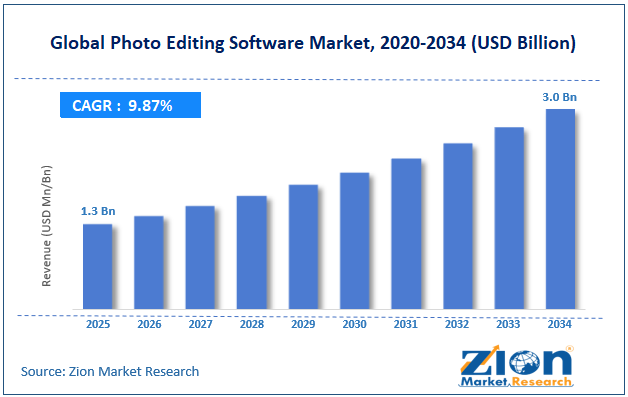
The global photo editing software market size was worth around USD 1.3 billion in 2025 and is predicted to grow to around USD 3.0 billion by 2034, with a compound annual growth rate (CAGR) of roughly 9.87% between 2026 and 2034.
Key Insights
- As per the analysis shared by our research analyst, the global photo editing software market is estimated to grow annually at a CAGR of around 9.87% over the forecast period (2026-2034).
- In terms of revenue, the global photo editing software market size was valued at around USD 1.3 billion in 2025 and is projected to reach USD 3.0 billion by 2034.
- Growth of social media and the creator economy is expected to propel the photo editing software market over the projected period.
- Based on the product type, the desktop software segment dominates the market with a revenue share of 48% in 2025.
- Based on the application, the personal segment holds a majority of market share of 38% in 2025.
- Based on the end-user, the individual segment holds a majority of market share in 2025 of 41.5%.
- Based on the distribution channel, the online stores segment holds a majority of market share in 2025 of 74.5%.
- Based on region, North America dominates the photo editing software market with a revenue share of 36.4% in 2025.
Photo Editing Software Market: Overview
Photo editing software is any computer program or digital application used to alter or manipulate images or photographs. This type of software allows people to make adjustments such as cropping, resizing, brightness and contrast adjustments, color correction, removal of unwanted objects, application of filters, photo retouching, and adding text and graphics to an image. Photo editing software is commonly used by photographers, graphic designers, digital marketers, business owners, and even individuals to enhance their photos. Examples of photo editing software include Photoshop and Lightroom.
Impact of the USA-Israel War on Iran on the Photo Editing Software Market
The US and Israel's war against Iran is expected to have a negative impact on the photo editing software market in Iran in the short run, owing to the disruptions to internet access and international digital services stemming from the ongoing war. The country suffered long periods of internet outages during the war, and internet use remained limited despite partial availability. This is likely to result in reduced usage of cloud-based editing applications and other online tools, including software and artificial intelligence-based services. Moreover, economic pressures and tightened international sanctions might prevent the Iranians from buying foreign software subscriptions. Demand for locally sourced photo-editing software, however, will increase.
Photo Editing Software Market: Dynamics
Growth Drivers
How does the rise of smartphone photography drive the photo editing software market?
The increase in smartphone use for photography is a major driver of the photo editing software market, as today's smartphones come equipped with high-resolution cameras, multiple lenses, computational photography, and artificial intelligence technologies used for enhancing photos. As people are taking more pictures for their own use, social media, digital marketing, and content creation, there is an increasing need for efficient tools that can enhance, retouch, resize, and customize photos directly on their phones. The increased use of mobile editing apps is also fueled by the growth of social media and the creator economy, where users need to edit their photos before posting them online.
Additionally, with improvements in smartphone cameras, there is an increasing number of high-quality photos that people are editing with dedicated photo-editing apps. Today's mobile editing apps come packed with features such as RAW editing, selective adjustment, masking, artificial intelligence technology for enhancing photos, and background removal, among others, enabling sophisticated editing without the need of using desktop programs.
Restraints
Why do the high cost of professional-grade software and recurring subscription fees act as a major restraint on the growth of the photo editing software industry?
The high cost of quality photo editing software, as well as the need for subscriptions to use it, poses a significant limitation to the photo editing software market, especially for hobbyists, freelancers, students, and small companies with limited capital. In most cases, advanced editing software requires a monthly, quarterly, or annual subscription to access professional features, AI, cloud services, and software upgrades. This implies that the overall costs associated with purchasing such software become very high. Therefore, users who are sensitive to costs tend to move towards cheaper, freemium, and open-source alternatives.
Additionally, the problem of subscription fatigue may lead users with other paid digital service subscriptions to shy away from paying for additional services. This implies that high costs and recurring payments may hinder adoption of premium software and prompt firms to offer cheaper plans.
Opportunities
How does the integration of AI and generative AI offer a lucrative opportunity for the photo editing software market?
Integration of AI and Generative AI offers a profitable opportunity for the photo editing software market by streamlining advanced photo editing through speed, efficiency, and accessibility. With AI-driven applications, advanced photo editing is automated, saving time on tasks such as background and object removal, image enhancement, color adjustment, and portrait retouching.
Furthermore, Generative AI allows users to manipulate image content with ease using textual commands. For instance, Adobe Photoshop currently offers AI Assistant, Generative Fill, Generative Expand, Generative Remove, and Generative Upscale, which enable sophisticated photo editing operations with minimal manual effort. This technology offers an array of ways to distinguish premium software, attract non-professionals, increase subscription value, and create additional AI-driven services. Generative AI allows creators to generate numerous image variants instantly, customize images for advertisement and e-commerce purposes, and adjust photos to different platforms and formats. Thus, advancements in AI precision, prompt-based photo editing, automation, and personalization will bring substantial revenue-generating and product development opportunities for photo editing software vendors.
Challenges
Data privacy and security concerns pose a significant challenge to the growth of the photo editing software industry
The issue of data privacy and security poses a major obstacle to the future growth of the Photo Editing Software Market. The rise of cloud-based photo editing tools and the implementation of AI-powered technology in photo editing platforms lead to privacy concerns such as the risks of data being accessed by someone who does not have permission to do so, data breaches, data being shared with third parties, and the risk that the uploaded pictures will be used to develop AI models. The issues mentioned may discourage privacy-aware customers and businesses from adopting the cloud-based solutions.
Thus, for instance, Adobe gives users the option to choose whether their pictures will be used to train or interact with the company's AI models. In addition, privacy regulations, data-handling rules, and issues of image ownership and the use of images for AI model development will add additional expenses to software companies' operations. In particular, Adobe's current generative AI guidelines explicitly warn users against entering sensitive personal data when using AI-generating tools unless the tools are designed to process such information.
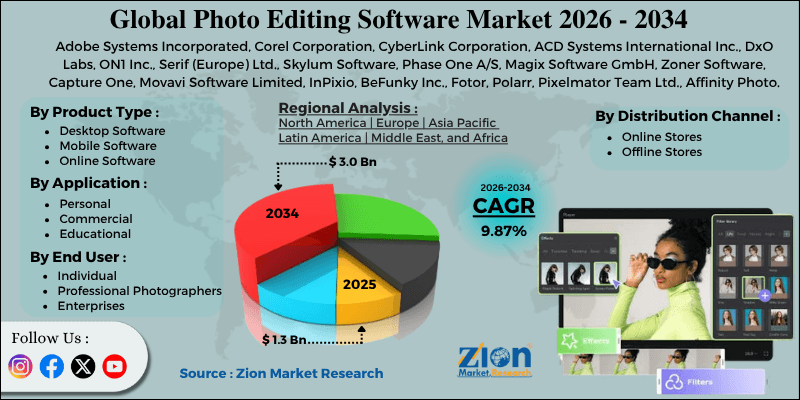
Photo Editing Software Market: Report Scope
| Report Attributes | Report Details |
|---|---|
| Report Name | Photo Editing Software Market |
| Market Size in 2025 | USD 1.3 Billion |
| Market Forecast in 2034 | USD 3.0 Billion |
| Growth Rate | CAGR of 9.87% |
| Number of Pages | 227 |
| Key Companies Covered | Adobe Systems Incorporated, Corel Corporation, CyberLink Corporation, ACD Systems International Inc., DxO Labs, ON1 Inc., Serif (Europe) Ltd., Skylum Software, Phase One A/S, Magix Software GmbH, Zoner Software, Capture One, Movavi Software Limited, InPixio, BeFunky Inc., Fotor, Polarr, Pixelmator Team Ltd., Affinity Photo, PicMonkey, and others. |
| Segments Covered | By Product Type, By Application, By End User, By Distribution Channel, and By Region |
| Regions Covered | North America, Europe, Asia Pacific (APAC), Latin America, Middle East, and Africa (MEA) |
| Base Year | 2025 |
| Historical Year | 2020 - 2024 |
| Forecast Year | 2026 - 2034 |
| Customization Scope | Avail customized purchase options to meet your exact research needs. Request For Customization |
Photo Editing Software Market: Segmentation
Product Type Insights
Why does the desktop software segment hold a prominent position in the photo editing software market?
The desktop software segment dominates the photo editing software market, accounting for 48% of revenue in 2025. Growth is fueled by the constant demand for photo-editing capabilities among professional photographers, graphic designers, advertising agencies, digital marketers, and other creative professionals who need advanced image-processing features. Desktop applications offer greater processing power, larger display sizes, all necessary editing features, RAW image processing, batch editing, and full control over complex workflows than many mobile applications. Major players such as Adobe Photoshop and Lightroom offer advanced features specific to desktop applications – professional editing, image management, AI-based editing, and AI-driven generative editing.
Further revenue growth in this category is also fueled by the use of AI and generative AI editing within professional desktop editing workflows. Automated object removal, image enlargement, background editing, noise reduction, masking, and AI-driven generative editing help professionals work faster and improve the value of premium software subscriptions. Subscription revenues from Adobe's Creative & Marketing Professionals were up 13% year over year to $4.537 billion in Q2 FY2026, indicating ongoing spending on professional creative software solutions, while the company's total subscription revenues were up 13% during the first half of FY2026.
In addition, subscription models used in desktop applications help companies earn revenue from users who pay for access to their editing tools and cloud capabilities. Therefore, the combination of professional demand, advanced desktop functionality, AI, and subscription models is expected to drive revenue growth of the desktop software category in the photo editing software market.
Application Insights
How does the personal segment capture the largest share in the photo editing software market?
The personal segment holds the largest share of the photo editing software market, at 38% in 2025. The growth of the market will be fueled by increasing adoption of smartphones, social media activity, and personal photography. Individuals have become more involved in photo editing for their social media posts, albums, personal branding, and selfies. This is creating continuous demand for simple photo-editing software.
End-User Insights
Does the individual segment capture the largest share in the photo editing software market?
The individual segment holds a 41.5% share of the photo editing software industry in 2025. Revenue growth in this market segment is driven by AI editing capabilities, intuitive interfaces, freemium models, and affordable premium subscriptions. Editing of backgrounds, objects, automation, filters, retouching, and image generation using AI enables one to produce professional-quality images without having high technical skills. The increasing trend in social media and influencer content is also prompting people to purchase premium editing software and to use its capabilities. The Individual market segment is expected to grow faster than several other traditional market segments, mainly due to smartphone adoption and social media presence.
Distribution Channel Insights
What factor drives online stores in the photo editing software market?
The online stores segment holds the largest share of the photo editing software market in 2025, at 74.5%. Revenue growth is achieved by increasing software usage through subscriptions, cloud computing, mobile applications, artificial intelligence-based editing software, and digital payments. The presence of online stores helps vendors deliver regular software updates, premium offers, free trials, upgrades, and subscriptions. The growing adoption of online content creation, e-commerce, and social media sites is motivating consumers and businesses to purchase the editing software online.
Regional Insights
What factors drive the North America region in the photo editing software market?
North America dominates the photo editing software market with a revenue share of 36.4% in 2025. The growth is fueled by high levels of digital content creation, professional photography, social media marketing, e-commerce, and the use of advanced creative software in the region. There are many professional photographers, graphic designers, advertising agencies, enterprises, and individuals in the region who need advanced image-editing solutions. Revenue growth is also boosted by the increasing integration of AI and generative AI, as it increases the value of premium editing platforms by automating complex processes and reducing editing time. Adobe, a leading company within the region, has noted high demand for Photoshop, Lightroom, and Creative Cloud Pro due to the growing integration of AI. There were innovative product launches in 2025 that contributed to the market growth.
Thus, in May 2025, Canva launched Canva AI and substantially improved its Photo Editor via AI-powered precision editing and generative background features. This allows users to make complex changes to images through simple, intuitive workflows. Also, Canva has launched Visual Suite 2.0 at Canva Create 2025 and expanded its AI-powered creative ecosystem by integrating photo editing into overall design and content-creation workflows.
Photo Editing Software Market: Competitive Analysis
The global photo editing software market is dominated by players like:
- Adobe Systems Incorporated
- Corel Corporation
- CyberLink Corporation
- ACD Systems International Inc.
- DxO Labs
- ON1 Inc.
- Serif (Europe) Ltd.
- Skylum Software
- Phase One A/S
- Magix Software GmbH
- Zoner Software
- Capture One
- Movavi Software Limited
- InPixio
- BeFunky Inc.
- Fotor
- Polarr
- Pixelmator Team Ltd.
- Affinity Photo
- PicMonkey
The global photo editing software market is segmented as follows:
By Product Type
- Desktop Software
- Mobile Software
- Online Software
By Application
- Personal
- Commercial
- Educational
- Others
By End User
- Individual
- Professional Photographers
- Enterprises
- Others
By Distribution Channel
- Online Stores
- Offline Stores
By Region
- North America
- The U.S.
- Canada
- Mexico
- Europe
- France
- The UK
- Spain
- Germany
- Italy
- Rest of Europe
- Asia Pacific
- China
- Japan
- India
- Australia
- South Korea
- Rest of Asia Pacific
- The Middle East & Africa
- Saudi Arabia
- UAE
- Egypt
- Kuwait
- South Africa
- Rest of the Middle East & Africa
- Latin America
- Brazil
- Argentina
- Rest of Latin America
Table Of Content
Methodology
FrequentlyAsked Questions
Photo editing software is any computer program or digital application used to alter or manipulate images or photographs. This type of software allows people to make adjustments such as cropping, resizing, brightness and contrast adjustments, color correction, removal of unwanted objects, application of filters, photo retouching, and adding text and graphics to an image.
The key growth drivers for the photo editing software market include the rising adoption of smartphones and digital photography, increasing social media usage, growth of the creator economy, expanding e-commerce and digital marketing, and the growing integration of AI and generative AI. These technologies enable automated background removal, object editing, image enhancement, retouching, and content generation, making advanced editing faster and accessible to non-professional users.
The major challenges restraining the growth of the photo editing software market include high subscription costs for professional-grade software, availability of free and open-source alternatives, data privacy and security concerns, software piracy, and the complexity of advanced editing tools.
Based on the application, the personal segment is expected to dominate the photo editing software market growth during the projected period.
The emerging trends and innovations impacting the photo editing software market include the rapid integration of generative AI, AI-powered automation, natural-language editing, AI upscaling, personalized editing, and agentic AI assistants. These technologies enable users to add or remove objects, enlarge images, enhance resolution, and perform complex edits with simple prompts. In 2025, Adobe introduced AI Assistant capabilities and expanded generative tools in Photoshop, while multi-model AI integration is giving users greater choice and flexibility.
According to the report, the global photo editing software market size was worth around USD 1.3 billion in 2025 and is predicted to grow to around USD 3.0 billion by 2034.
The global photo editing software market is expected to grow at a CAGR of 9.87% during the forecast period.
The global photo editing software industry growth is expected to be led by North America over the forecast period.
The global photo editing software market is dominated by players like Adobe Systems Incorporated, Corel Corporation, CyberLink Corporation, ACD Systems International Inc., DxO Labs, ON1 Inc., Serif (Europe) Ltd., Skylum Software, Phase One A/S, Magix Software GmbH, Zoner Software, Capture One, Movavi Software Limited, InPixio, BeFunky Inc., Fotor, Polarr, Pixelmator Team Ltd., Affinity Photo, and PicMonkey, among others.
The photo editing software market report covers the geographical market along with a comprehensive competitive landscape analysis. It also includes cash flow analysis, profit ratio analysis, market basket analysis, market attractiveness analysis, sentiment analysis, PESTLE analysis, trend analysis, SWOT analysis, trade area analysis, demand & supply analysis, Porter’s five forces analysis, and value chain analysis.

HappyClients

