
Phase Change Memory Market Size, Growth, Global Trends, Forecast 2034

Phase Change Memory Market By Type (PCM - Overwriteable Memory (PCM - OTM), PCM - Read Only Memory (PCM - ROM), and PCM - Random Access Memory (PCM - RAM)), By Application (Aerospace & Defense, Enterprise Storage, Automotive, Wearable, Smartphone, and Others), and By Region - Global and Regional Industry Overview, Market Intelligence, Comprehensive Analysis, Historical Data, and Forecasts 2026 - 2034
| Market Size in 2025 | Market Forecast in 2034 | CAGR (in %) | Base Year |
|---|---|---|---|
| USD 1.82 Billion | USD 10.8 Billion | 21.88% | 2025 |
Phase Change Memory Industry Perspective:
What is the anticipated size of the phase change memory market during the projection period?
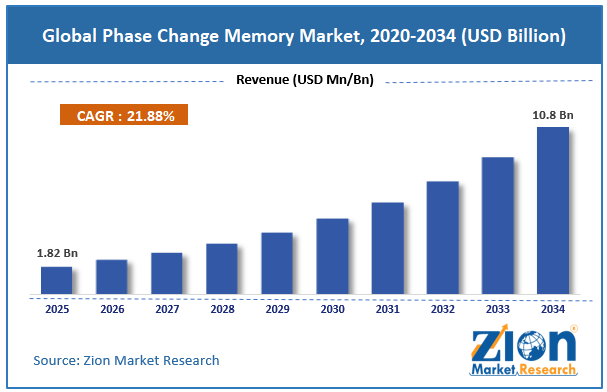
The global phase change memory market size was worth around USD 1.82 billion in 2025 and is predicted to grow to around USD 10.8 billion by 2034, with a compound annual growth rate (CAGR) of roughly 21.88% between 2026 and 2034.
Key Insights:
- As per the analysis shared by our research analyst, the global phase change memory market is estimated to grow annually at a CAGR of around 21.88% over the forecast period (2026-2034)
- In terms of revenue, the global phase change memory market size was valued at around USD 1.82 billion in 2025 and is projected to reach USD 10.8 billion, by 2034.
- The phase change memory market is projected to grow at a significant rate due to the growing investments in next-generation technologies such as Big Data Analytics, Artificial Intelligence (AI), and Machine Learning (ML), among others.
- Based on the type, the PCM - read-only memory segment will generate the highest CAGR of 27.65% due to higher demand for energy-efficient and high-performance read-only memory solutions.
- Based on the application, the automotive industry is expected to emerge as the fastest growing with a CAGR of 28.75%.
- Based on region, North America is projected to dominate the global market during the forecast period.
Phase Change Memory Market: Overview
Phase-change memory (PCM) is a non-volatile memory technology. It leverages heat from electrical pulses to transition a phase-change material, such as chalcogenide glass, between an amorphous (high-resistance) state and a crystalline (low-resistance) state. Data obtained is stored as logical ‘1’ and ‘0’, which is further read out by measuring devices. According to market analysis, phase-change memory technology has gained widespread popularity as it has superior writing speed and reading ability. This property makes PCM systems highly suitable for a wide range of applications. For instance, PCM is preferred in areas that require superior data transmission, buffering, and caching.
In addition, data stored on PCM systems remains as they are even in the absence of power. During the forecast period, the phase change memory market is expected to be driven by rising proliferation of smartphones & wearables, favorable government policies, and investments in next-generation technologies. However, high cost of PCM and thermal management challenges will affect market revenue during the forecast period.
Impact of the USA-Israel and Iran war on the Phase Change Memory Market:
The USA-Israel and Iran war has disrupted the semiconductor supply chain, subsequently impacting the phase-change memory market. PCM manufacturing and transportation have increased due to a surge in oil prices, insurance premiums, and trade wars. During the forecast period, this geopolitical conflict is expected to encourage investments in domestic production and the building of a more robust supply chain network.
Phase Change Memory Market: Dynamics
Growth Drivers
How will investments in next-generation technologies drive revenue in the phase change memory market?
The global phase change memory market is expected to be driven by the growing investments in next-generation technologies such as Big Data Analytics, Artificial Intelligence (AI), and Machine Learning (ML), among others. These technologies require low-latency, high-speed, and superior endurance memory systems that can handle large volumes of information at unprecedented speeds. In the last few years, defense and commercial investments in AI and ML have reached new heights.
As per official findings, total global AI investment in 2025 reached over USD 1.45 trillion. PCMs deliver multiple resistance rates. They have the potential to represent a wide range of neural-network weights. Other advantages, such as higher energy efficiency, faster processing rates, and support for edge-computing infrastructure, will elevate PCM applications in next-generation systems.
How are technological advancements fueling growth in the phase change memory market?
Market leaders such as Intel, IBM, Samsung, and others are investing significantly in developing improved phase-change memory technologies. These advancements are focused on embedding novel PCM solutions into 3D crossbar arrays and AI accelerators. According to research, global phase change memory market players are working to reduce production and deployment costs by developing PCMs with multi-level cell (MLC) storage, allowing the memory system to store multiple bits instead of one bit per memory cell.
Restraints
High cost of technology to disrupt market expansion during the forecast period
The global phase change memory industry is expected to be restricted as PCMs are expensive to develop. Phase-change memory systems are relatively novel in the memory technology landscape. In addition, PCM manufacturing requires expert guidance and specialized materials. PCMs are produced using complex manufacturing systems. Currently, a limited number of players are operating in the industry. These factors contribute to the high cost of PCM production, limiting its overall adoption rate.
Opportunities
Which growth opportunities will the automotive industry offer to the phase change memory market?
The global phase change memory market is anticipated to generate growth opportunities due to increased use of technology in modern automotive solutions. Vehicle manufacturers are using PCMs across electronic systems such as infotainment and navigation solutions. In addition, phase-change memories are leveraged to improve the performance of Advanced Driver Assistance Systems (ADAS), as they can store, process, and analyze information more rapidly than conventional counterparts. Commercialization of self-driving cars will deliver extensive market growth possibilities in the coming years.
How are government directives shaping the phase change memory market?
Government and regulatory pressure mandates the use of energy-efficient memory systems. These regulations and stricter implementation policies are driving demand for PCMs in power-intensive applications such as data centers. For instance, the European Union has launched the Energy Efficiency Directive. With this move, data center companies operating in the European market must monitor and report the energy performance of their facilities. PCMs are considered more energy-efficient across applications, driving their end applications.
Challenges
Scalability concerns and alternative technologies to challenge industry growth during the forecast period
The global phase change memory industry is anticipated to be challenged by scalability concerns, the presence of alternative technologies, and high write energy requirements. In addition, MLC implementation in modern PCMs can be extremely challenging due to process complexity, thus affecting industry revenue in the coming years.
Phase Change Memory Market: Report Scope
| Report Attributes | Report Details |
|---|---|
| Report Name | Phase Change Memory Market |
| Market Size in 2025 | USD 1.82 Billion |
| Market Forecast in 2034 | USD 10.8 Billion |
| Growth Rate | CAGR of 21.88% |
| Number of Pages | 229 |
| Key Companies Covered | Samsung Electronics Co. Ltd., STMicroelectronics N.V., Texas Instruments Incorporated, IBM Corporation, Fujitsu Ltd., Western Digital Corporation, Renesas Electronics Corporation, Toshiba Corporation, Intel Corporation, Infineon Technologies AG, Sony Corporation, Microchip Technology Inc., NXP Semiconductors N.V., Micron Technology Inc., SK hynix Inc., and others. |
| Segments Covered | By Type, By Application, and By Region |
| Regions Covered | North America, Europe, Asia Pacific (APAC), Latin America, Middle East, and Africa (MEA) |
| Base Year | 2025 |
| Historical Year | 2020 - 2024 |
| Forecast Year | 2026 - 2034 |
| Customization Scope | Avail customized purchase options to meet your exact research needs. Request For Customization |
Phase Change Memory Market: Segmentation
The global phase change memory market is segmented based on type, application, and region.
Why will the PCM - random access memory segment lead the phase change memory industry revenue during the forecast period?
Based on type, the global market is segmented as PCM-overwriteable memory (PCM-OTM), PCM-read-only memory (PCM-ROM), and PCM-random access memory (PCM-RAM). In 2025, the highest growth was listed in the PCM-random access memory segment. It accounted for 49.1% of the global revenue. Although it will continue leading the market during the forecast period, the PCM-read-only memory segment will generate the highest CAGR of 27.65% due to higher demand for energy-efficient and high-performance read-only memory solutions.
Which will be the fastest-growing application during the forecast period in the phase change memory market?
Based on application, the global industry is divided into aerospace & defense, enterprise storage, automotive, wearable, smartphone, and others. The enterprise storage segment was the leading revenue generator in 2025, accounting for 27.6% of the global revenue. In the coming years, the automotive industry is expected to emerge as the fastest growing with a CAGR of 28.75%. Increasing demand for ADAS in modern automotives, government safety mandates, and investments in autonomous cars will drive segmental growth.
Phase Change Memory Market: Regional Analysis
Why will North America lead the phase change memory market in the coming years?
The global phase change memory market is currently led by North America. In 2025, it accounted for 37% of the global revenue. The presence of prominent technology companies, high demand for advanced semiconductors, and growing investments in domestic PCM manufacturing facilities will drive regional growth. The region is home to some of the largest and most high-functioning data centers, driving PCM applications.
Why will Asia-Pacific generate the fastest CAGR in the phase change memory market during the forecast period?
Asia-Pacific is expected to emerge as the fastest-growing region in the phase change memory market with a CAGR of 29.45% during the forecast period. In 2025, it accounted for 24.9% of the global revenue. Growing investments in AI & ML systems, investments in research & development, and the presence of the world’s most prominent memory technology industry will fuel regional growth. Moreover, rapid industrial automation and favorable policies will aid accelerated revenue in Asia-Pacific.
Phase Change Memory Market: Competitive Analysis
The global phase change memory market is led by players like:
- Samsung Electronics Co. Ltd.
- STMicroelectronics N.V.
- Texas Instruments Incorporated
- IBM Corporation
- Fujitsu Ltd.
- Western Digital Corporation
- Renesas Electronics Corporation
- Toshiba Corporation
- Intel Corporation
- Infineon Technologies AG
- Sony Corporation
- Microchip Technology Inc.
- NXP Semiconductors N.V.
- Micron Technology Inc.
- SK hynix Inc.
What are the latest key trends in the phase change memory market?
Applications in 3D crossbar arrays
Market players are investigating the use of PCMs in 3D crossbar arrays. The in-memory computing features offered by phase-change memory systems may prove beneficial for large-scale, cost-effective deployment of high-density 3D crossbar arrays.
Work on system-level optimization
The ongoing development of software, controllers, and other systems to research and operate PCMs is a prominent market trend. System-level optimization processes will open new growth avenues for the industry players.
The global phase change memory market is segmented as follows:
By Type
- PCM - Overwriteable Memory (PCM - OTM)
- PCM - Read Only Memory (PCM - ROM)
- PCM - Random Access Memory (PCM - RAM)
By Application
- Aerospace & Defense
- Enterprise Storage
- Automotive
- Wearable
- Smartphone
- Others
By Region
- North America
- The U.S.
- Canada
- Mexico
- Europe
- France
- The UK
- Spain
- Germany
- Italy
- Rest of Europe
- Asia Pacific
- China
- Japan
- India
- Australia
- South Korea
- Rest of Asia Pacific
- The Middle East & Africa
- Saudi Arabia
- UAE
- Egypt
- Kuwait
- South Africa
- Rest of the Middle East & Africa
- Latin America
- Brazil
- Argentina
- Rest of Latin America
Table Of Content
Methodology
FrequentlyAsked Questions
Phase-change memory (PCM) is a non-volatile memory technology. It leverages heat from electrical pulses to transition a phase-change material, such as chalcogenide glass, between an amorphous (high-resistance) state and a crystalline (low-resistance) state.
The global phase change memory market is expected to be driven by the growing investments in next-generation technologies such as Big Data Analytics, Artificial Intelligence (AI), and Machine Learning (ML), among others.
According to study, the global phase change memory market size was worth around USD 1.82 billion in 2025 and is predicted to grow to around USD 10.8 billion by 2034.
The CAGR value of the phase change memory market is expected to be around 21.88% during 2026-2034.
The global phase change memory industry is anticipated to be challenged by scalability concerns, the presence of alternative technologies, and high write energy requirements.
Applications in 3D crossbar arrays and work on system-level optimization are the emerging trends and innovations impacting the phase change memory market.
The global phase change memory market has performed well so far and will offer similar trends in the coming years.
North America will contribute notably towards the phase change memory market value.
The global phase change memory market is led by players like Samsung Electronics Co., Ltd., STMicroelectronics N.V., Texas Instruments Incorporated, IBM Corporation, Fujitsu Ltd., Western Digital Corporation, Renesas Electronics Corporation, Toshiba Corporation, Intel Corporation, Infineon Technologies AG, Sony Corporation, Microchip Technology Inc., NXP Semiconductors N.V., Micron Technology, Inc., and SK hynix Inc.
The report explores crucial aspects of the phase change memory market, including a detailed discussion of existing growth factors and restraints, while also browsing future growth opportunities and challenges that impact the market.

HappyClients

