
Pharmaceutical Metal Detector Market Size, Share, Value and Forecast 2034

Pharmaceutical Metal Detector Market By Product Type (Tablet Metal Detectors, Capsule Metal Detectors, Liquid Metal Detectors, Powder Metal Detectors, and Pipeline Metal Detectors), By Technology (Magnetic Field Detectors, Multi Frequency Detectors, X-ray Inspection with Metal Detectors, and Others), By Application (Quality Control, Contaminant Detection, Packaging, and Compliance), By End-User (Pharmaceutical Companies, Biopharmaceutical Companies, CDMO, and Others), and By Region - Global and Regional Industry Overview, Market Intelligence, Comprehensive Analysis, Historical Data, and Forecasts 2026 - 2034
| Market Size in 2025 | Market Forecast in 2034 | CAGR (in %) | Base Year |
|---|---|---|---|
| USD 158 Million | USD 241 Million | 9.68% | 2025 |
Pharmaceutical Metal Detector Industry Perspective:
What will be the size of the global pharmaceutical metal detector market during the forecast period?
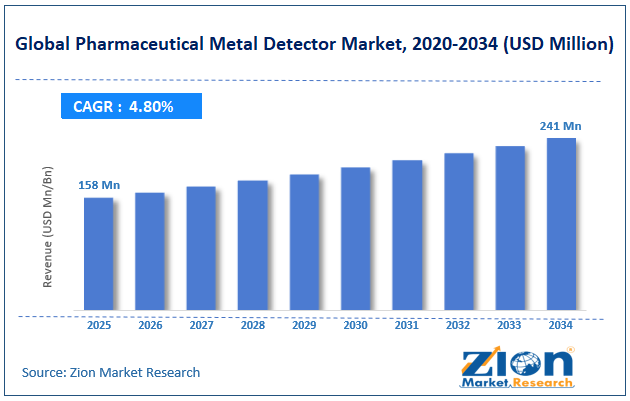
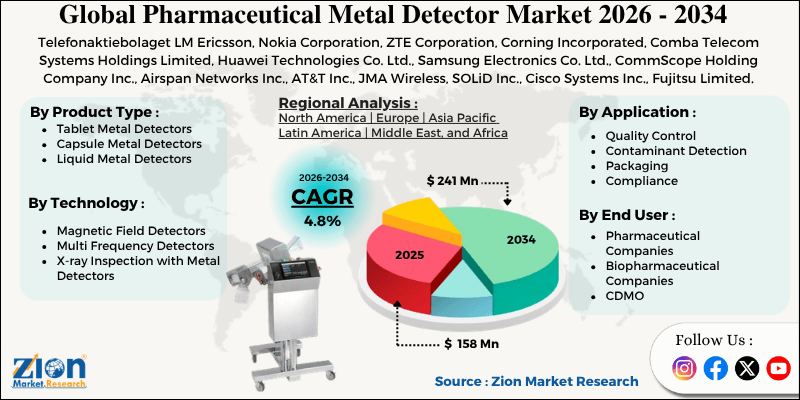
The global pharmaceutical metal detector market size was worth around USD 158 million in 2025 and is predicted to grow to around USD 241 million by 2034, with a compound annual growth rate (CAGR) of roughly 4.8% between 2026 and 2034.
Key Insights
- As per the analysis shared by our research analyst, the global pharmaceutical metal detector market is estimated to grow annually at a CAGR of around 4.8% over the forecast period (2026-2034).
- In terms of revenue, the global pharmaceutical metal detector market size was valued at around USD 158 million in 2025 and is projected to reach USD 241 million by 2034.
- Rising investments in pharmaceutical manufacturing facilities are expected to propel the pharmaceutical metal detector market over the projected period.
- Based on the product type, the tablet metal detectors segment dominates the pharmaceutical metal detector market.
- Based on the technology, the magnetic field detectors segment held the largest revenue share in 2025.
- Based on the application, the quality control segment held a prominent share in 2025.
- Based on the end user, the pharmaceutical company segment is growing at a significant rate over the projected period.
- Based on region, North America dominates the pharmaceutical metal detector market with a revenue share of 37% in 2025.
Pharmaceutical Metal Detector Market: Overview
A pharmaceutical metal detector is a specific inspection system used in the pharmaceutical industry to ensure that metal parts or foreign matter do not end up in the produced medicinal products. Metal detection systems separate metal-contaminated products from acceptable ones, preventing the circulation of low-quality and potentially dangerous drugs. Such detectors are essential in the pharmaceutical industry due to the frequent occurrence of heavy metals in the production environment and the high risks they pose to consumers’ health. Most metal detection systems used in the pharmaceutical industry can detect both ferrous and non-ferrous metals, as well as stainless-steel parts. They can be used for continuous inspection of tablets, capsules, powders, granules, and many other drug forms during production, thus contributing to the production chain’s efficiency.
In addition, pharmaceutical metal detectors contribute to adherence to GMP guidelines and other regulations and standards concerning the production of medicines and healthcare products. Generally, metal detecting systems in the pharmaceutical industry are used to ensure the quality of medicinal products, protect brand reputation, and guarantee consumer safety.
Impact of the USA-Israel War on Iran on the Pharmaceutical Metal Detector Market
The USA-Israel dispute over Iran has led to a short-term deterioration in the pharmaceutical metal detector market due to geopolitical instability and disruptions to global supply chains for electronic components, semiconductors, sensors, and stainless steel used in pharmaceutical metal detector construction. The surge in freight rates, extended delivery periods, and higher raw material prices have put additional pressure on manufacturers and suppliers, resulting in higher production costs and reduced profit margins.
However, strong demand from the pharmaceutical industry for metal detectors in general, and those compliant with FDA regulations in particular, has been resilient to supply chain disruption. The market is projected to grow steadily in the medium term as a result of rising investments in domestic pharmaceutical production and the need for more safety checks during the manufacturing process.
Pharmaceutical Metal Detector Market: Dynamics
Growth Drivers
How does rising global pharmaceutical production drive the pharmaceutical metal detector market?
The burgeoning growth of the global pharmaceutical industry is propelling the demand for pharmaceutical metal detectors. An increase in large-scale production requires strict measures and control over contamination during the manufacturing and packaging process. Besides, governments worldwide are promoting pharmaceutical production to ensure the security of their population and support domestic production. According to the Government of India (Ministry of Chemicals and Fertilizers), the Indian pharma market size was valued at USD 50 billion for FY 2023-24. It is estimated to be around USD 23.5 billion for domestic sales and USD 26.5 billion for exports. Moreover, the government reports that the pharma sector’s turnover reached ₹4.56 lakh crore (approximately) in FY 2022-23, employing more than 9.25 lakh people. Thus, we may conclude that the pharmaceutical sector has witnessed remarkable growth in recent years.
In addition, according to the U.S. Census Bureau, there were around 2,905 pharmaceutical and medicine manufacturing companies in the United States in 2023. Moreover, the FRED database indicates that the U.S. pharmaceutical manufacturing value was USD 217.2 billion in 2023, USD 226.1 billion in 2024, and USD 234.2 billion in 2025. In other words, pharmaceutical manufacturing companies worldwide are witnessing consistent growth. Consequently, growing pharmaceutical production is expected to drive increased investment in pharmaceutical metal detectors to ensure compliance, prevent product contamination, support Good Manufacturing Practices (GMP), and help manufacturers avoid recalls and stringent regulations.
Restraints
High initial investment and maintenance costs hamper the growth of the pharmaceutical metal detector industry
High initial investment and operational expenditures constitute a significant restraint in the pharmaceutical metal detector market. Advanced metal detection systems equipped with multi-frequency, high-sensitivity, automated reject systems, validation software, and GMP-compliant data management systems involve a huge capital outlay. Moreover, the additional costs incurred during installation, commissioning, validation (IQ/OQ/PQ), maintenance, upgrades, repairs, and training for proper use make these systems unviable for small and medium-sized manufacturers with limited budgets. As a result, in emerging economies, manufacturers often choose to invest in other critical production equipment over pharmaceutical metal detectors, thereby impeding the growth of the pharmaceutical metal detector market.
Opportunities
How do increasing product launches offer a lucrative opportunity for the pharmaceutical metal detector market?
Increasing product launch is expected to offer a potential opportunity to the pharmaceutical metal detector market over the projected period. For instance, in April 2025, Loma Systems announced the North American launch of its latest innovation, the IQ4M Metal Detector. This state-of-the-art food safety technology is set to take contaminant detection to a whole new level, offering increased detection capability while reducing costly false rejections. Loma’s IQ4M Metal Detector utilizes the company’s patented Variable Frequency technology combined with multi-spectrum detection in an enhanced, innovative way to provide unprecedented levels of contaminant detection performance.
The IQ4M Metal Detector offers improved inspection performance for packaged meats and poultry, bakery, and convenience food and metalized film products in the snack and confectionery markets. It has been engineered to maximize productivity through Dynamic Data Screen+ technology for optimum signal analysis and Quick Recovery technology that greatly reduces changeover time and eliminates false rejections. Enhanced security is also built into IQ4M with RFID security tags for complete access control, and Industry 4.0-ready OPC-UA connectivity for total integration and data exchange capabilities. IQ4M heads are certified to UL standards for the U.S. and Canada, and the detector has an IP69 rating, meaning it is suitable for even the most rigorous washdown environments.
Challenges
How does the competition from alternative inspection technologies pose a significant challenge to the growth of the pharmaceutical metal detector industry?
Competition from alternative inspection technologies, such as X-ray inspection machines and advanced vision inspection systems, constitutes a major threat to the pharmaceutical metal detector market. Because it can penetrate product packaging, X-ray technology can detect not only metal contaminants but also glass, stone, ceramic, dense plastics, and bone. Moreover, this technology is used to inspect products for defects and check fill and packaging.
Therefore, the pharmaceutical market could shift toward X-ray inspection machines due to their ability to perform a variety of functions and address several issues at once. Upgrading production facilities creates an impediment to the use of metal detectors for pharmaceutical producers who opt for more advanced inspection technologies.
Pharmaceutical Metal Detector Market: Report Scope
| Report Attributes | Report Details |
|---|---|
| Report Name | Pharmaceutical Metal Detector Market |
| Market Size in 2025 | USD 158 Million |
| Market Forecast in 2034 | USD 241 Million |
| Growth Rate | CAGR of 4.8% |
| Number of Pages | 229 |
| Key Companies Covered | Telefonaktiebolaget LM Ericsson, Nokia Corporation, ZTE Corporation, Corning Incorporated, Comba Telecom Systems Holdings Limited, Huawei Technologies Co. Ltd., Samsung Electronics Co. Ltd., CommScope Holding Company Inc., Airspan Networks Inc., AT&T Inc., JMA Wireless, SOLiD Inc., Cisco Systems Inc., Fujitsu Limited, PCTEL Inc., Huber+Suhner AG, Nextivity Inc., Proptivity AB, LiteOn Technology Corporation, Boingo Wireless Inc., and others. |
| Segments Covered | By Product Type, By Technology, By Application, By End User, and By Region |
| Regions Covered | North America, Europe, Asia Pacific (APAC), Latin America, Middle East, and Africa (MEA) |
| Base Year | 2025 |
| Historical Year | 2020 - 2024 |
| Forecast Year | 2026 - 2034 |
| Customization Scope | Avail customized purchase options to meet your exact research needs. Request For Customization |
Pharmaceutical Metal Detector Market: Segmentation
Product Type Insights
Why does the tablet metal detectors segment hold a prominent position in the pharmaceutical metal detector market?
The tablet metal detectors segment dominates the pharmaceutical metal detector market. The growth of this market is mainly attributed to the high production of tablets worldwide, which is currently the leading dosage form in terms of prescriptions and production volume. Tablet metal Detectors are used at the end of a tablet manufacturing line, after compression and dedusting, to ensure that no ferrous, non-ferrous, and stainless-steel contaminants go through the process and end up in the final packaged products. This helps to meet the GMP requirements and other regulatory guidelines, including those of the United States Food and Drug Administration (USFDA) and the European Medicines Agency (EMA). The growing demand for generic drugs, over-the-counter drugs, nutraceuticals, and investment in high-speed automatic tablet manufacturing lines are some of the other factors influencing the market for high-sensitivity metal detectors in tablet manufacturing.
Technology Insights
Does the magnetic field detectors segment capture the largest share in the pharmaceutical metal detector market?
The magnetic field detectors segment held the largest revenue share of the pharmaceutical metal detector market in 2025. The growth is attributed to its ability to reliably detect ferrous metal contaminants in pharmaceutical products during production and packaging. The detectors are widely used across all phases of manufacturing and processing tablets, capsules, powders, granules, and other pharmaceutical products due to their fast inspection speed, ease of use, and cost-effective ferrous metal detection and rejection in applications where this contaminant must be identified. Rising pharmaceutical production, enhanced implementation of Good Manufacturing Practices (GMP), and improved quality assurance regulations are factors expected to drive magnetic field market growth. This is because manufacturers are often required to adopt magnetic field detection systems to avoid producing inferior-quality products and subsequent product recalls.
Application Insights
How does the quality control segment capture the largest market share in the pharmaceutical metal detector market?
The quality control segment held a prominent share of the pharmaceutical metal detector industry in 2025. The market's growth is attributed to the rising emphasis on product safety and regulatory compliance and the growing need to prevent contamination in the pharmaceutical industry. Pharmaceutical metal detectors are primarily used to ensure the quality of the final drug products by separating any foreign matter such as ferrous, non-ferrous, and stainless-steel metals. These detectors are used to meet the quality standards and regulations such as Good Manufacturing Practices, U.S. FDA regulations, and other international standards.
Moreover, the increasing demand for tablets, capsules, powders, and biologics, along with frequent regulatory inspections and product recalls in the pharmaceutical industry, will propel demand for metal detectors during the forecast period.
End-User Insights
Why does the pharmaceutical companies segment capture the largest share in the pharmaceutical metal detector market?
The pharmaceutical company segment is growing at a significant rate over the projected period. The growth of the market is primarily driven by the rise in pharmaceutical production, stringent regulatory guidelines, and the need to ensure product quality and patient safety. Metal detection systems are used by manufacturers in the production of tablets, capsules, powders, and granules to separate and remove foreign matter such as ferrous, non-ferrous, and stainless-steel contaminants. These systems help meet Good Manufacturing Practices (GMP), the US FDA regulations, and other international standards. The growth of the generic drugs market, rising investment in biologics and specialty pharmaceuticals, and the adoption of continuous and automated manufacturing lines are some of the factors expected to drive demand for metal detectors in the pharmaceutical industry.
Regional Insights
What factors drive the North America region in the pharmaceutical metal detector market?
North America dominates the pharmaceutical metal detector market with a revenue share of 37% in 2025. The growth is attributed to the region's developed pharmaceutical manufacturing industry, stringent FDA regulations, and the adoption of advanced inspection technologies. The industry has witnessed the proliferation of automated production lines and contamination control systems in pharmaceutical production, together with Industry 4.0 quality control solutions. Additionally, product innovation is expected to drive market growth.
For instance, CEIA launched the THS/PH210® Series Pharmaceutical Metal Detectors in 2025 that offer 50% higher sensitivity, FDA 21 CFR Part 11 capabilities, advanced traceability features, and compatibility with automated lines that enable pharmaceutical manufacturers to detect, record, and report contamination accurately. The company also launched the THS/PH210-FFV Valve System for Pharmaceutical Powder Inspection, ideal for optimizing hygiene performance and inspection processes in modern pharmaceutical production. Therefore, the aforementioned technologies are projected to motivate pharmaceutical companies in North America to adopt metal detection solutions to replace the conventional technologies in their manufacturing processes.
Pharmaceutical Metal Detector Market: Competitive Analysis
The global pharmaceutical metal detector market is dominated by players like:
- Telefonaktiebolaget LM Ericsson
- Nokia Corporation
- ZTE Corporation
- Corning Incorporated
- Comba Telecom Systems Holdings Limited
- Huawei Technologies Co. Ltd.
- Samsung Electronics Co. Ltd.
- CommScope Holding Company Inc.
- Airspan Networks Inc.
- AT&T Inc.
- JMA Wireless
- SOLiD Inc.
- Cisco Systems Inc.
- Fujitsu Limited
- PCTEL Inc.
- Huber+Suhner AG
- Nextivity Inc.
- Proptivity AB
- LiteOn Technology Corporation
- Boingo Wireless Inc.
The global pharmaceutical metal detector market is segmented as follows:
By Product Type
- Tablet Metal Detectors
- Capsule Metal Detectors
- Liquid Metal Detectors
- Powder Metal Detectors
- Pipeline Metal Detectors
By Technology
- Magnetic Field Detectors
- Multi Frequency Detectors
- X-ray Inspection with Metal Detectors
- Others
By Application
- Quality Control
- Contaminant Detection
- Packaging
- Compliance
By End User
- Pharmaceutical Companies
- Biopharmaceutical Companies
- CDMO
- Others
By Region
- North America
- The U.S.
- Canada
- Mexico
- Europe
- France
- The UK
- Spain
- Germany
- Italy
- Rest of Europe
- Asia Pacific
- China
- Japan
- India
- Australia
- South Korea
- Rest of Asia Pacific
- The Middle East & Africa
- Saudi Arabia
- UAE
- Egypt
- Kuwait
- South Africa
- Rest of the Middle East & Africa
- Latin America
- Brazil
- Argentina
- Rest of Latin America
Table Of Content
Methodology
FrequentlyAsked Questions
A pharmaceutical metal detector is a specific inspection system used in the pharmaceutical industry to ensure that metal parts or foreign matter do not end up in the produced medicinal products. Metal detection systems separate metal-contaminated products from acceptable ones, preventing the circulation of low-quality and potentially dangerous drugs.
The pharmaceutical metal detector market is primarily driven by the increasing global production of pharmaceutical products, stringent regulatory requirements for contamination control, and growing emphasis on product quality and patient safety. Rising adoption of automated and continuous manufacturing processes, along with advancements in high-sensitivity, multi-frequency metal detection technologies, is further accelerating market growth.
The pharmaceutical metal detector market faces several challenges, including the high initial investment and ongoing maintenance costs associated with advanced inspection systems, which can limit adoption among small and medium-sized manufacturers. Competition from alternative inspection technologies, such as X-ray systems that can detect both metallic and non-metallic contaminants, also restrains market growth.
Based on the application, the magnetic field detectors segment is expected to dominate the pharmaceutical metal detector market growth during the projected period.
The pharmaceutical metal detector market is being shaped by several emerging trends and innovations, including the adoption of multi-frequency and digital signal processing (DSP) technologies that improve the detection of ferrous, non-ferrous, and stainless-steel contaminants while minimizing false rejects. Manufacturers are increasingly integrating Industry 4.0, Industrial Internet of Things (IIoT), and AI-enabled diagnostics for real-time equipment monitoring, predictive maintenance, and remote performance management.
According to the report, the global pharmaceutical metal detector market size was worth around USD 158 million in 2025 and is predicted to grow to around USD 241 million by 2034.
The global pharmaceutical metal detector market is expected to grow at a CAGR of 4.8% during the forecast period.
The global pharmaceutical metal detector industry growth is expected to be led by North America over the forecast period.
The global pharmaceutical metal detector market is dominated by players like Mettler-Toledo International Inc., Fortress Technology Ltd., Thermo Fisher Scientific Inc., CEIA S.p.A., Minebea Intec GmbH, Bizerba SE & Co. KG, Anritsu Infivis Co. Ltd., Ishida Co. Ltd., Sesotec GmbH, A&D Company Ltd., DMT GmbH & Co. KG, Detectamet Ltd., Nishizaki Co. Ltd., Automation Components Inc., Globus (Italy), Control Dynamics Ltd., Loma Systems Ltd., Key Technology Inc., and Goring Kerr Ltd, among others.
The pharmaceutical metal detector market report covers the geographical market along with a comprehensive competitive landscape analysis. It also includes cash flow analysis, profit ratio analysis, market basket analysis, market attractiveness analysis, sentiment analysis, PESTLE analysis, trend analysis, SWOT analysis, trade area analysis, demand & supply analysis, Porter’s five forces analysis, and value chain analysis.

HappyClients

