
Global Personalized Cancer Medicine Market Size, Share, Trends, Growth, and Forecasts 2034

Personalized Cancer Medicine Market By Type (Personalized Medicine Diagnostics and Personalized Medicine Therapeutics), By End-User (Clinics, Hospitals, and Others), and By Region - Global and Regional Industry Overview, Market Intelligence, Comprehensive Analysis, Historical Data, and Forecasts 2025 - 2034
| Market Size in 2024 | Market Forecast in 2034 | CAGR (in %) | Base Year |
|---|---|---|---|
| USD 95.23 Billion | USD 279.87 Billion | 12.51% | 2024 |
Personalized Cancer Medicine Market Size & Value
What is the anticipated size of the personalized cancer medicine market during the projection period?
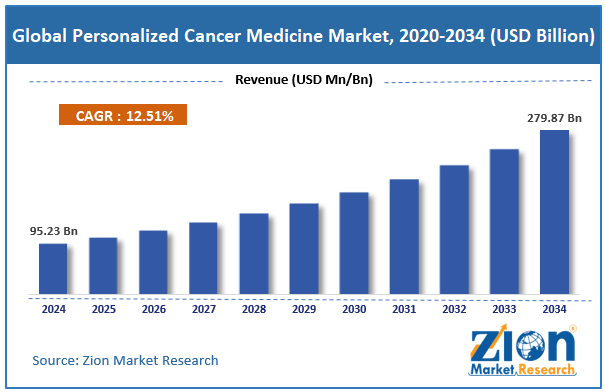
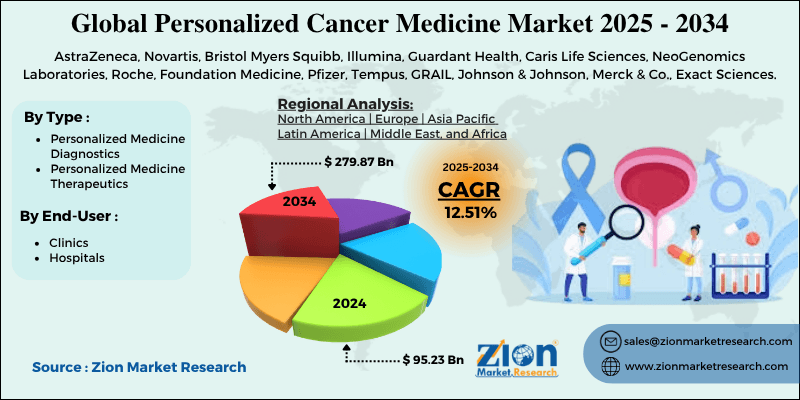
The global personalized cancer medicine market size was worth around USD 95.23 billion in 2024 and is predicted to grow to around USD 279.87 billion by 2034 with a compound annual growth rate (CAGR) of roughly 12.51% between 2025 and 2034.
Key Insights:
- As per the analysis shared by our research analyst, the global personalized cancer medicine market is estimated to grow annually at a CAGR of around 12.51% over the forecast period (2025-2034)
- In terms of revenue, the global personalized cancer medicine market size was valued at around USD 95.23 billion in 2024 and is projected to reach USD 279.87 billion by 2034.
- The market is projected to grow at a significant rate due to the growing prevalence of cancer worldwide.
- Based on the type, the personalized medicine therapeutics segment is growing at a high rate and will continue to dominate the global market, as per industry projections
- Based on the end-user, the hospitals segment is anticipated to command the largest market share.
- Based on region, the Asia-Pacific is projected to dominate the global market during the forecast period.
Personalized Cancer Medicine Market: Overview
Personalized cancer medicine is a customized approach toward detecting, treating, and managing cancer. It deals with developing diagnostic tools and medical therapies that are unique to a cancer patient’s medical needs. Precision medicine has emerged as a popular form of healthcare since it offers a higher success rate compared to conventional medical procedures. The complexity of cancer disease has further encouraged advancements in personalized cancer medicine. In oncology, personalized care focuses on targeting specific molecular alterations that drive cancer progression. During the forecast period, demand for personalized cancer medicine is projected to grow due to the rising prevalence of cancer. Increased research-based investments and expansion of the healthcare sector will further influence market growth. However, the high cost of treatment, lack of skilled workforce, and absence of supportive infrastructure may limit market growth trends in the coming years.
Impact of the USA-Israel and Iran War on the Personalized Cancer Medicine Market:
The ongoing war between the USA, Israel, and Iran is expected to impact global supply chains. Furthermore, the war has disrupted international travel and impacted medical tourism. In the coming years, the war is projected to influence greater domestic dependence on medical equipment and the workforce to prevent unwanted circumstances due to geopolitical conflicts.
Personalized Cancer Medicine Market: Dynamics
Growth Drivers
How will the rising prevalence of cancer drive demand in the personalized cancer medicine market?
The global personalized cancer medicine market is expected to be driven by the growing prevalence of cancer worldwide. According to the National Cancer Institute, around 38.9% of the female and male population will be diagnosed with cancer once in their lifetime. It is the leading cause of medical deaths across the globe, resulting in 9.7 million fatalities in 2022. The most common types include colorectal, breast, and lung cancer. Lifestyle, environmental, and genetic factors are the prominent reasons for cancer. For instance, excessive consumption of alcohol is linked to cancers of the liver, throat, and mouth. In some cases, cancer mutations are passed down from the parents. Other factors include exposure to harmful chemicals, poor diet, sedentary lifestyle, and age. Personalized cancer medicine has shown better results in treating and managing cancer as compared to conventional treatments, subsequently driving market demand.
Shift toward targeted approach and immunotherapy to work in favor of the industry players
Chemotherapy, the traditionally used technique for cancer treatment, has several side effects and shows limited success for certain types of cancer. This has resulted in greater demand for a targeted approach and immunotherapy. Personalized medicare deals with tumor-agnostic treatments and mutation-specific drugs since they cause reduced side effects and an elevated response rate. The global personalized cancer medicine market will benefit from the ongoing research & development (R&D) in targeted therapies for improved results.
Restraints
Why will cost barriers limit the expansion of the personalized cancer medicine market?
The global personalized cancer medicine industry is expected to be restricted due to cost barriers. Personalized therapies are expensive medical procedures since they deal with developing patient-centric medical care programs. The average cost of personalized cancer medicine can range between USD 250,000 and $300,000 per patient, depending on the cancer stage and the patient's overall health, along with other factors. Economic uncertainty worldwide is projected to affect market adoption trends in the coming years.
Opportunities
Use of Artificial Intelligence (AI) in personalized cancer medicine to offer new growth opportunities
The global personalized cancer medicine market is anticipated to generate growth opportunities due to the rising use of Artificial Intelligence. In April 2026, SOPHiA GENETICS, a leading provider of AI-driven precision medicine, launched a partnership with the Mount Sinai Health System. The latter is the leading academic health system in the US and will use AI-powered SOPHiA DDM™ Platform to enhance genomic testing capabilities and advance cancer research. In April 2026, AWS, a leading technology company, introduced Amazon Bio Discovery. This AI platform is projected to help researchers and scientists test novel drugs using Artificial Intelligence. Rising advancements in AI and Machine Learning (ML) will prove beneficial in the long run.
Which emerging fields will present expansion possibilities to the personalized cancer medicine market players?
Emerging fields such as spatial omics and companion diagnostics (CDx) testing are expected to open new doors for market growth. Spatial omics utilizes next-generation technologies to map molecular information on tissue samples, thus revealing the place of interaction of cancer cells and immune cells. These systems are designed to provide information about cancer on a deeper level, thus facilitating improvements in medical treatments.
Challenges
Lack of infrastructure and a skilled workforce to challenge market growth over the forecast period
The global personalized cancer medicine industry is expected to be challenged by the lack of supportive infrastructure and a skilled workforce. Personalized cancer treatment is facilitated by advanced oncology centers and diagnostic labs. It also requires the input of skilled experts. In addition, the absence of standard reimbursement policies concerning personalized cancer care may further affect business revenue in the coming years.
Personalized Cancer Medicine Market: Report Scope
| Report Attributes | Report Details |
|---|---|
| Report Name | Personalized Cancer Medicine Market |
| Market Size in 2024 | USD 95.23 Billion |
| Market Forecast in 2034 | USD 279.87 Billion |
| Growth Rate | CAGR of 12.51% |
| Number of Pages | 227 |
| Key Companies Covered | AstraZeneca, Novartis, Bristol Myers Squibb, Illumina, Guardant Health, Caris Life Sciences, NeoGenomics Laboratories, Roche, Foundation Medicine, Pfizer, Tempus, GRAIL, Johnson & Johnson, Merck & Co., Exact Sciences, and others. |
| Segments Covered | By Type, By End-User, and By Region |
| Regions Covered | North America, Europe, Asia Pacific (APAC), Latin America, Middle East, and Africa (MEA) |
| Base Year | 2024 |
| Historical Year | 2019 to 2023 |
| Forecast Year | 2025 - 2034 |
| Customization Scope | Avail customized purchase options to meet your exact research needs. Request For Customization |
Personalized Cancer Medicine Market: Segmentation
The global personalized cancer medicine market is segmented based on type, end-user, and region.
Why will the personalized medicine therapeutics segment lead the personalized cancer medicine industry revenue during the forecast period?
Based on type, the global market is divided into personalized medicine diagnostics and personalized medicine therapeutics. In 2024, more than 75% of the global revenue was listed in the personalized medicine therapeutics segment. During the forecast period, it is expected to grow at a CAGR of 15%, driven by higher prevalence of cancer, increased demand for value-based healthcare, and technological advancements.
Which will be the fastest-growing application during the forecast period in the personalized cancer medicine market?
Based on end-users, the global market is fragmented into clinics, hospitals, and others. The highest growth rate in 2024 was reported in the hospitals segment. It accounted for 66% of the global revenue in 2024 and is projected to grow at a CAGR of 14.9% during the forecast period. Expansion of healthcare infrastructure, improved reimbursement policies, and rising consumer awareness will promote segmental expansion.
Personalized Cancer Medicine Market: Regional Analysis
Which factors will influence growth in the North American personalized cancer medicine market?
The global personalized cancer medicine market is expected to be led by North America during the forecast period. In 2024, it accounted for 45% of the global revenue and will grow at a CAGR of 8.7% during the forecast period. North America is dominated by a robust healthcare infrastructure. In addition, the presence of several healthtech companies investing heavily in cancer research will further help the region thrive. Other factors, such as growing medical tourism and AI integration in cancer care, may drive improved CAGR in North America.
Why will Asia-Pacific emerge as the fastest-growing region in the personalized cancer medicine market?
Asia-Pacific is set to emerge as the fastest-growing region in the personalized cancer medicine market, growing at a CAGR of 11% during the forecast period. In 2024, the Asia-Pacific region dominated 21% of the global revenue. Rising prevalence of cancer, infrastructure development, and regulatory support will aid regional growth. Moreover, the introduction of domestically developed personalized cancer medicines and devices will allow accelerated growth across the Asia-Pacific.
Personalized Cancer Medicine Market: Competitive Analysis
The global personalized cancer medicine market is led by players like:
- AstraZeneca
- Novartis
- Bristol Myers Squibb
- Illumina
- Guardant Health
- Caris Life Sciences
- NeoGenomics Laboratories
- Roche
- Foundation Medicine
- Pfizer
- Tempus
- GRAIL
- Johnson & Johnson
- Merck & Co.
- Exact Sciences
What are the latest key trends in the personalized cancer medicine market?
Advancements in cell and gene therapies
Ongoing developments in cell and gene therapies are expected to encourage the adoption of personalized cancer medicine in mainstream oncology. These advancements will promote the development of cutting-edge targeted therapies for cancer.
Focus on early detection
A prominent trend in the personalized cancer treatment industry is the use of technology to detect cancer in early stages. Liquid biopsies have emerged as an effective tool promoting early detection, subsequently improving the success rate for cancer treatment.
The global personalized cancer medicine market is segmented as follows:
By Type
- Personalized Medicine Diagnostics
- Personalized Medicine Therapeutics
By End-User
- Clinics
- Hospitals
- Others
By Region
- North America
- The U.S.
- Canada
- Mexico
- Europe
- France
- The UK
- Spain
- Germany
- Italy
- Rest of Europe
- Asia Pacific
- China
- Japan
- India
- Australia
- South Korea
- Rest of Asia Pacific
- The Middle East & Africa
- Saudi Arabia
- UAE
- Egypt
- Kuwait
- South Africa
- Rest of the Middle East & Africa
- Latin America
- Brazil
- Argentina
- Rest of Latin America
Table Of Content
Methodology
FrequentlyAsked Questions
Personalized cancer medicine is a customized approach toward detecting, treating, and managing cancer.
The global personalized cancer medicine market is expected to be driven by the growing prevalence of cancer worldwide.
According to study, the global personalized cancer medicine market size was worth around USD 95.23 billion in 2024 and is predicted to grow to around USD 279.87 billion by 2034.
The CAGR value of the personalized cancer medicine market is expected to be around 12.51% during 2025-2034.
The global personalized cancer medicine industry is expected to be challenged by the lack of supportive infrastructure and skilled workforce.
Advancements in cell and gene therapies and focus on early detection are the emerging trends and innovations impacting the personalized cancer medicine market.
The global personalized cancer medicine market has performed well so far and will offer similar trends in the coming years.
Asia-Pacific will contribute notably towards the personalized cancer medicine market value.
The global personalized cancer medicine market is led by players like AstraZeneca, Novartis, Bristol Myers Squibb, Illumina, Guardant Health, Caris Life Sciences, NeoGenomics Laboratories, Roche, Foundation Medicine, Pfizer, Tempus, GRAIL, Johnson & Johnson, Merck & Co., and Exact Sciences.
The report explores crucial aspects of the personalized cancer medicine market including detailed discussion of existing growth factors and restraints while also browsing future growth opportunities and challenges that impact the market.

HappyClients

