
Global Orthopedic Implants Market Size, Share, Trends & Forecast 2032

Orthopedic Implants Market - By Product Type (Reconstructive Joint Replacements, Spinal Implants, Dental Implants, Trauma, Orthobiologics, And Others), By Biomaterial (Metallic, Polymeric, Ceramic, And Others), By Type (Knee, Hip, Wrist & Shoulder, Dental, Spine, Ankle, And Others), And By Region - Global Industry Perspective, Comprehensive Analysis, And Forecast, 2024 - 2032
| Market Size in 2023 | Market Forecast in 2032 | CAGR (in %) | Base Year |
|---|---|---|---|
| USD 45.67 Billion | USD 71.94 Billion | 5.30% | 2023 |
Orthopedic Implants Market: Industry Perspective
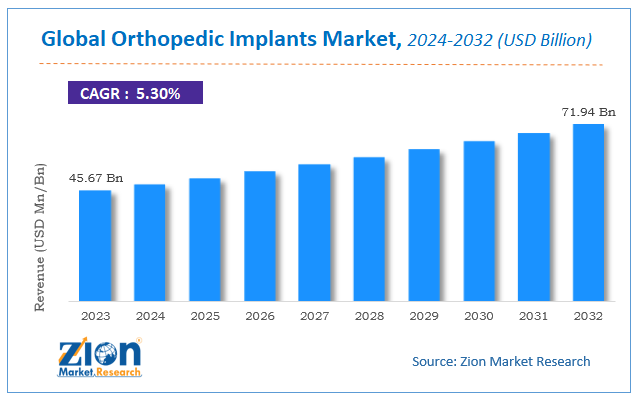
The global orthopedic implants market size was worth around USD 45.67 billion in 2023 and is predicted to grow to around USD 71.94 billion by 2032 with a compound annual growth rate (CAGR) of roughly 5.30% between 2024 and 2032. The report offers an assessment and analysis of the Orthopedic Implants market on a global and regional level. The study offers a comprehensive assessment of the market competition, constraints, sales estimates, opportunities, evolving trends, and industry-validated data.
Orthopedic Implants Market Overview
Orthopedic implants are medical instruments that are utilized for replacing a damaged bone. Moreover, these medical devices are surgically inserted into the human body system to either treat or support a joint or damaged part of the bone. Furthermore, inflation in healthcare spending along with the rise in the number of product innovations is likely to increase the use of orthopedic implants over the forthcoming years.
Orthopedic Implants Market: Growth Drivers
There is a prominent surge in the proportion of geriatric persons prone to osteoporosis-related fractures, thereby requiring surgeries with orthopedic implantations. This is expected to steer the market growth in the coming years. The rapid increase in orthopedic damages and musculoskeletal disorders will result in restraint mobility as well as tremendous pain in the patient. Hence, the need for raising the quality of life of patients along with reducing the incurrence of medical treatment costs for patients has generated a huge demand for orthopedic implants in recent years.
As per the NCBI report published in 2023, nearly 210 million persons are affected from osteoporosis each year and the number can surge in the coming years. This aspect is expected to steer the growth of the orthopedic implant industry in the foreseeable future. Furthermore, a large proportion of the aging population requires hip & knee replacements and this is going to result in humungous demand for orthopedic implants over the coming years.
Apart from this, an increase in obesity and sedentary life patterns will uplift the business growth over the forecast timespan. An increase in funding for research activities for developing minimally invasive orthopedic implants at affordable prices will provide impetus to industry growth within the next few years.
Orthopedic Implants Market: Report Scope
| Report Attributes | Report Details |
|---|---|
| Report Name | Orthopedic Implants Market |
| Market Size in 2023 | USD 45.67 Billion |
| Market Forecast in 2032 | USD 71.94 Billion |
| Growth Rate | CAGR of 5.30% |
| Number of Pages | 245 |
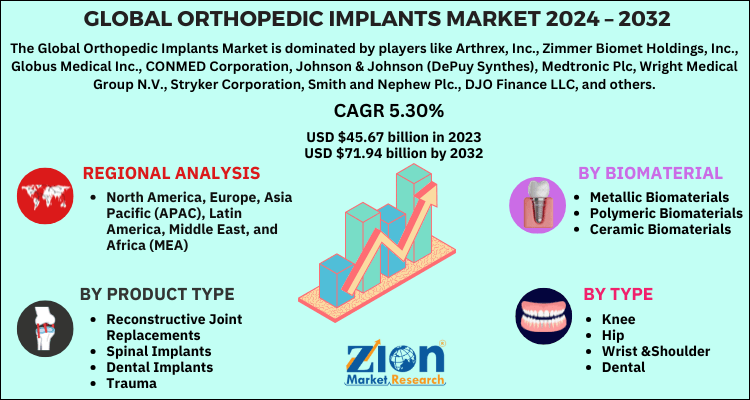
| Key Companies Covered | Arthrex, Inc., Zimmer Biomet Holdings, Inc., Globus Medical Inc., CONMED Corporation, Johnson & Johnson (DePuy Synthes), Medtronic Plc, Wright Medical Group N.V., Stryker Corporation, Smith and Nephew Plc., DJO Finance LLC, and others. |
| Segments Covered | By Product Type, By Biomaterial, By Type, and By Region |
| Regions Covered | North America, Europe, Asia Pacific (APAC), Latin America, The Middle East and Africa (MEA) |
| Base Year | 2023 |
| Historical Year | 2018 - 2022 |
| Forecast Year | 2024 - 2032 |
| Customization Scope | Avail customized purchase options to meet your exact research needs. Request For Customization |
Orthopedic Implants Market: Segmentation
The Orthopedic Implants market is segmented by product type, biomaterial, type, and region.
Based on Product Type Segment, The Orthopedic Implants market is divided into Reconstructive Joint Replacements, Spinal Implants, Dental Implants, Trauma, Orthobiologics, and others. Reconstructive Joint Replacements represent the most dominant sub-segment, driven by the rising prevalence of osteoarthritis and osteoporosis, continuous technological advancements in knee and hip replacement systems, and elevated research and development investments by leading manufacturers. These implants restore mobility and significantly improve patient quality of life, generating high procedural volumes that propel overall market growth. Spinal Implants rank as the second most significant category, supported by increasing incidence of degenerative disc disease and trauma-related spinal injuries, with fusion devices and motion-preservation technologies contributing substantially to revenue and clinical innovation.
Based on Biomaterial Segment, The Orthopedic Implants market is divided into Metallic Biomaterials, Polymeric Biomaterials, Ceramic Biomaterials, and others. Metallic Biomaterials hold the leading position due to their superior mechanical strength, fatigue resistance, corrosion resistance, and long-established clinical track record in load-bearing applications such as joint replacements and trauma fixation devices. Titanium alloys, stainless steel, and cobalt alloys provide reliable performance under high stress, supporting widespread adoption and driving market volume. Ceramic Biomaterials form the second major category, valued for excellent biocompatibility, wear resistance, and aesthetic properties that make them suitable for certain joint articulating surfaces and dental applications, thereby expanding material options and supporting specialized growth.
Based on Type Segment, The Orthopedic Implants market is divided into Knee, Hip, Wrist & Shoulder, Dental, Spine, Ankle, and others. Knee implants dominate the segment because of the high incidence of knee osteoarthritis among the aging population and the proven success of total and partial knee replacement procedures in restoring function and reducing pain. These procedures account for a large share of reconstructive surgeries and continue to drive market expansion through technological refinements. Hip implants constitute the second most dominant type, benefiting from similar demographic trends and strong clinical outcomes in total hip arthroplasty, which further reinforces overall demand for reconstructive orthopedic solutions.
Orthopedic Implants Market: Regional Analysis
-
North America To Account For Major Portion Of Overall Market Size By 2032
The growth of the orthopedic implants market in the North American sub-continent during the forecasting years is due to a rise in the number of aging populations that are affected due to osteoarthritis. Apart from this, a rise in the number of sports injuries is likely to generate large-scale product demand in the region over the next decade. This, in turn, will propel the growth of the regional market over the assessment period.
Orthopedic Implants Market: Competitive Analysis
The global orthopedic implants market is dominated by players like:
- Arthrex, Inc.
- Zimmer Biomet Holdings, Inc.
- Globus Medical Inc.
- CONMED Corporation
- Johnson & Johnson (DePuy Synthes)
- Medtronic Plc
- Wright Medical Group N.V.
- Stryker Corporation
- Smith and Nephew Plc.
- DJO Finance LLC
By Product Type
-
Reconstructive Joint Replacements
- Knee Replacement Implants
- Hip Replacement Implants
- Extremities
- Upper Extremity
- Shoulder
- Elbow
- Wrist
- Lower Extremity
- Upper
- Lower
- Upper Extremity
- Spinal Implants
- Spinal Fusion Devices
- Thoracolumbar Devices
- Cervical Fixation Devices
- Interbody Fusion Devices
- Vertebral Compression Fracture (VCF) Devices
- Balloon Kyphoplasty Devices
- Vertebroplasty Devices
- Motion Preservation Devices/Non-Fusion Devices
- Dynamic Stabilization Devices
- Artificial Disc Replacement Devices
- Annulus Repair Devices
- Nuclear Disc Prostheses
- Invasive Spinal Bone Stimulators
- Spinal Fusion Devices
- Dental Implants
- Root Form Dental Implants
- Plate Form Dental Implants
- Trauma
- Orthobiologics
- Demineralized Bone Matrix (DBM)
- Allograft
- Bone Morphogenetic Protein (BMP)
- Viscosupplementation Products
- Synthetic Bone Substitutes
- Others
- Others
By Biomaterial
- Metallic Biomaterials
- Stainless steel
- Titanium Alloy
- Cobalt Alloy
- Others
- Polymeric Biomaterials
- Ceramic Biomaterials
- Others
By Type
- Knee
- Hip
- Wrist & Shoulder
- Dental
- Spine
- Ankle
- Others
By Region
- North America
- The U.S.
- Canada
- Mexico
- Europe
- France
- The UK
- Spain
- Germany
- Italy
- Rest of Europe
- Asia Pacific
- China
- Japan
- India
- Australia
- South Korea
- Rest of Asia Pacific
- The Middle East & Africa
- Saudi Arabia
- UAE
- Egypt
- Kuwait
- South Africa
- Rest of the Middle East & Africa
- Latin America
- Brazil
- Argentina
- Rest of Latin America
Table Of Content
Methodology
FrequentlyAsked Questions
Orthopedic implants are medical devices used to replace, repair, or stabilize bones, joints, and other structures in the musculoskeletal system. They are often made from biocompatible materials like metals or plastics and can range from simple screws and plates to complex artificial joints.
According to a study, the global orthopedic implants market size was worth around USD 45.67 billion in 2023 and is expected to reach USD 71.94 billion by 2032.
The global orthopedic implants market is expected to grow at a CAGR of 5.30% during the forecast period.
North America is expected to dominate the orthopedic implants market over the forecast period.
Leading players in the global orthopedic implants market include Arthrex, Inc., Zimmer Biomet Holdings, Inc., Globus Medical Inc., CONMED Corporation, Johnson & Johnson (DePuy Synthes), Medtronic Plc, Wright Medical Group N.V., Stryker Corporation, Smith and Nephew Plc., and DJO Finance LLC, among others.
The orthopedic implants market report covers the geographical market along with a comprehensive competitive landscape analysis. It also includes cash flow analysis, profit ratio analysis, market basket analysis, market attractiveness analysis, sentiment analysis, PESTLE analysis, trend analysis, SWOT analysis, trade area analysis, demand & supply analysis, Porter’s five forces analysis, and value chain analysis.

HappyClients

